The Galbaio dynasty ruled the Duchy of the Venetians from 764 until 804, through three generations and with two dukes on the traditional list of doges of Venice.
Mauricius was the seventh doge, rising to power after the deposition of Domenicus Monegarius in 764, and ruling until 787.
During his reign, his son Giovanni became co-ruler with Mauricius. Consequently, when Mauricius died of old age in 787 — the first Venetian doge not to be blinded and deposed violently — Giovanni succeeded him uncontested on the throne, in what was essentially a dynastic succession.
Giovanni likewise made his son Mauricius co-ruler.
Frankish pressure on the duchy was increasing during the period, and the Venetian elite was divided between pro-Byzantine and pro-Frankish factions. As part of this internal struggle, which included the premeditated murder of a patriarch of Grado, Giovanni and his son were deposed and exiled in 804 by the pro-Frankish side.
The surname Galbaio was assigned to the family later. It does not appear in any of the early sources.
The sources
Duke Mauricius is mentioned in a letter from Giovanni, Patriarch of Grado, to pope Stephen III, regarding the treatment of the dioceses of Istria by the Lombard conquerors, dating to between 768 and 772.
Mauricius is also the first Venetian doge to be reliably mentioned by a non-Venetian source, as he appeared in a short remark in the Liber Pontificalis for pope Adrian I, referring to events of 772, probably written shortly after the death of the pontiff in 795.
As usual, the earliest Venetian source for the dukes Mauricius and Giovanni — and the basis for most later Venetian chronicles — is the Istoria Veneticorum by John the Deacon, written around the year 1000.
The Chronicon Altinate is as terse as for the previous doges, but the Chronica per extensum descripta by Andrea Dandolo added some information about how duke Mauricius intervened in an ecclesiastical dispute between the patriarchs of Aquileia and Grado, based on the letter mentioned above, which John the Deacon ignored (likely) or didn’t know (less likely).
The Narrative
Mauricius was a nobleman from Heraclia, but was elected doge in 764 by an assembly in Metamauco, where he also held court.
He was politically very astute, which explains the longevity and success of his rule, compared to his predecessors.
He managed to contain the tensions between the factions in Venetian society, and unlike all his predecessors, he wasn’t blinded and deposed. His reign lasted over two decades, until his natural death, without any accounts of major cases of internal strife and violence.
In a letter by the patriarch Giovanni, from the early years of the reign of Mauricius, he is styled as consul and imperial duke of this province of the Venetians. This indicates that Mauricius held the Byzantine title of hypatos, that his election was recognised by the emperor in Constantinople, and that the Duchy of the Venetians was still considered a Byzantine province, at least formally.
The dioceses of Istria
That letter by the patriarch wasn’t dated, but it must be from the period between 768 and 772.
It was related to grievances the Patriarchate of Grado had with the Lombard treatment of the dioceses in Istria. These bishoprics had been under the jurisdiction of Grado since the early 600s, when both Venetia Maritima and Histria were provinces of the Byzantine Empire, but after the demise of the Exarchate of Ravenna, the province of Istria was under the Lombards, who wanted the dioceses there to depend on the Patriarchate of Aquileia.
From the point of view of the Patriarchate of Grado, the Aquileia was usurping territories which justly belonged to Grado.
Duke Mauricius was mentioned in the letter to emphasise to the pope that the secular government of Venetia supported the ecclesiastical cause of Grado. Pope Stephen III responded to both patriarchs, but died soon after, in 772, to be succeeded by Adrian I.
This is as much as we can deduce from the letter itself.
Captivity of his son
Apparently unrelated, the Liber Pontificalis for pope Adrian I mentioned duke Mauricius and a son of his in events which happened in 772 between the Papacy, the Lombards and the Archbishopric of Ravenna.
According to this account, a son of duke Mauricius was held captive by king Desiderius of the Lombards. The son in question wasn’t named, so we don’t know whether it was Giovanni or another unknown son of Mauricius. We also don’t know why he was a prisoner or hostage of the Lombards, what kind of situation had led to his capture, or if he was ever freed.
Quite a few scholars and writers have tied these two sources together in a narrative of a Lombard military campaign in Istria around 770, in which Venetia participated in defence of the Patriarchate of Grado. Giovanni, the son of Mauricius was captured during the fighting, and held for several years, until ransom was paid.
This story is essentially conjecture based on connecting the letter of the patriarch and the Liber Pontificalis, and filling in the blanks.
The letter of the patriarch does contain the word ‘son,’ but as ‘the son of God, Mauricius,’ in the sense of one of God’s children, a good Christian, not as ‘the son of Mauricius.’
All the later Venetian chronicles ignored the story of the captivity of the son of the duke, and left it out of their narratives, which might indicate that it wasn’t a glorious moment for Venice. It is highly unlikely that John the Deacon and the later chroniclers hadn’t read the Liber Pontificalis.
End of the Kingdom of the Lombards
The Kingdom of the Franks had been a player in Italy since the time of king Aistulf and the end of the Exarchate. The conflicts between the Lombards and the Papacy over the lands of the former Exarchate continued, leading to a Frankish invasion of the Kingdom of the Lombards. In 774 Charlemagne defeated, deposed and captured king Desiderius, and made himself King of the Lombards.
Duke Mauricius successfully stewarded the duchy through this turbulent period around 774 during the Frankish conquest of the Kingdom of the Lombards. The last stand of the Lombards happened in Friuli, near the dogado.
The end of the Kingdom of the Lombards changed the international situation of the Duchy of the Venetians dramatically.
Before 774, the duchy was surrounded by was a regional power, but after 774, its closest neighbour was a superpower, the rapidly expanding empire of Charlemagne, which soon rivalled the Byzantine Empire.
The diocese of Olivolo
In 774, or short thereafter, duke Mauricius instituted, with permission of the pope, a diocese on the island of Olivolo.
The island of Olivolo is now situated in the easternmost part of Venice, but in the 700s it was a separate and distinct lagoon islands. Furthermore, it was the first settlement the route from the sea to Rivoalto (modern-day Rialto).
The settlement was therefore fortified already in the 700s or 800s, to guard the approaches towards Rivoalto. Early sources referred to it as a castrum — a fortification — which is the origin of the name of the Sestiere Castello.
According to tradition, the other dioceses in the lagoons (Bibione, Caorle, Equilo/Jesolo, Heraclia, Torcello and Metamauco) were mainland bishoprics, which had moved into the lagoons following the Lombard conquest of the mainland of Venetia.
The diocese of Olivolo was the first to be created after the migration from the mainland to the lagoons, and the first to be created on Venetian initiative.
The territory of the new diocese came from the bishopric of Metamauco, and was specified as Olivolo, Gemini, Rivoalto, Luprio and Dorsoduro, which are all situated within the boundaries of modern-day Venice.
Our sources don’t tell us why this decision was taken, but it was probably a combination of several factors.
Firstly, duke Mauricius was a native of Heraclia, but ruled from Metamauco. He likely wanted to curb the influence of the aristocracy of Metamauco, and reducing the territory of the diocese was one way of diminishing the relative weight of Metamauco within the duchy.
Secondly, the marketplace of Rivoalto was growing in importance, and the new diocese could be a recognition of that.
Thirdly, other sources, such as the Chronicon Altinate, listed families which moved from Heraclia and Equilo to Rivoalto. This could be a consequence of the constant in-fighting between the two settlements, or due to changes in the flow of the river Piave.
Both Heraclia and Equilo were located along the Piave, but it changed its course at some point. The Pactum Lotharii, from 840, but referring to older charters, mentioned lands between the Piave and the Dry Piave. Such changed might have made Heraclia and Equilo economically less viable, and cause the leading merchant families to relocate to a better place, which turned out to be Rivoalto.
If the elite of Heraclia, where Mauricius originated, had mostly moved to the Rivoalto area, the new diocese could be a means for Mauricius to favour his own group within the duchy.
The Diocese of Olivolo was later renamed the Diocese of Venice, and in 1451 it was joined with the Patriarchate of Grado to become the Patriarchate of Venice, which still exists.
Giovanni — co-ruler and successor
Shortly after the creation of the diocese of Olivolo — if we disregard the notoriously unreliable chronology of John the Deacon — Giovanni (Iohannes or John), son of Mauricius, was appointed co-ruler along with his father.
This was a turn in a dynastic direction, making Giovanni the designated heir to the throne.
The duchy had already seen the son of a doge become doge. However, the appointment of Deusdedit had happened several years after the end of the reign of his father Ursus, not during his reign.
Giovanni was co-ruler from 778, according to the chronology of Andrea Dandolo, and governed in his own right from 787, after the death of his father.
For all the praise John the Deacon and Andrea Dandolo had for Mauricius, they had none for Giovanni.
John the Deacon simply stated that he had seen nothing in the archives which indicated that Giovanni had ruled well, and Andrea Dandolo plainly wrote that he ruled poorly.
Shortly after the death of his father, Giovanni appointed his own son, named Mauricius after the grandfather, as co-ruler, continuing the dynastic tendency.
While John the Deacon and Andrea Dandolo both wrote that Giovanni was made co-ruler with the consent of the Venetian elite, thanks to the respect his father commanded. They make no such remarks regarding the appointment of Mauricius II, making it appear a more autocratic decision.
Byzantium or Aachen
Following the Frankish conquest of the Kingdom of the Lombards, the Duchy of the Venetians soon felt the pressure of the imperial ambitions of Charlemagne.
The duchy found itself in a tight spot, on the border between two empires.
The Venetian elite was split on which side to lean towards, and tensions between the internal factions rose. Parts of the Venetian elite wanted to remain within the Byzantine orbit as protection against the Franks, while another part wanted to prioritise good relations to the Franks, which were a lot closer to the duchy.
We don’t know the details of how this divide manifested itself within Venetian society, but a good guess is that it followed the primary economic interests of the various lagoon settlements and their dominant families.
Venetian trade was — just as before the arrival of the Lombards — predominantly across the lagoons, between the sea and the mainland cities, functioning as an intermediary between the Byzantine realm and the wider north Italian hinterland, which was now Frankish. Trade within the duchy, along the long axis of the lagoons, was fare less important.
Some Venetian settlements and families were primarily engaged in overseas trade towards the east, in the Byzantine world, while others traded up the inland rivers. Each side prioritised peaceful coexistence on their direction, to keep business going.
Whatever the reasons, the divide within the Venetian elite was evident, and would lead to violence, murder and, ultimately, war.
The Galbaio dynasty, all three generations, were firmly in the pro-Byzantine side.
The attack on Grado
In 766, in the early years of the reign of Mauricius, another Giovanni was made patriarch of Grado.
He was, in opposition to the dukes Mauricius and Giovanni, on the pro-Frankish side, and openly maintained close relationships within the Carolingian empire.
In 802, this internal conflict came to a head, and duke Giovanni sent his son to Grado, with a navy. The troops of the young Mauricius entered the city, wounded and captured the elderly patriarch, and finally killed him by throwing him off a tall tower.
Deposition of Giovanni
The slain patriarch was succeeded by a relative, Fortunatus II, also on the pro-Frankish side of Venetian politics.
He therefore fled to Treviso, on the Frankish controlled mainland. Here, he became a leader of the internal opposition to the dukes Giovanni and Mauricius, and numerous leading Venetians from the pro-Frankish side gathered there.
Fortunatus travelled on to France, probably to seek the support of Charlemagne, while the others remained to organise a rebellion against Giovanni and Mauricius.
Once the dukes got wind of these developments on the Frankish mainland, fearing for their eyes and lives, they fled Venetia. The younger, Mauricius, went to France, while Giovanni fled to Mantua. None of them ever returned to Venice, but we do not know when and how they ended their days.
The leader of the opposing faction, Obelerius, returned to Venetia and was appointed duke in 804.
Sources
Below are translations of the main primary sources we have for the duke Mauricius and Giovanni.
Liber Pontificalis for Adrian I
The Liber Pontificalis for Adrian I (772–795) has at the beginning, dated to 772, a long narrative of the misdeeds of the pro-Lombard cleric Paul Afiarta, who was accused of having had some supporters of the pro-Frankish pontiff murdered.
Paul was sent on a mission to the Lombard court in Pavia, but the mission failed, and on his return he was captured by the probably pro-Byzantine, and definitely very anti-Lombard, archbishop Leo I of Ravenna.
The pope ordered Leo I to exile Paul to Constantinople, with the help of the Venetians, but he refused, and instead had Paul executed.
The excuse of Leo I for not obeying the pontiff was this:
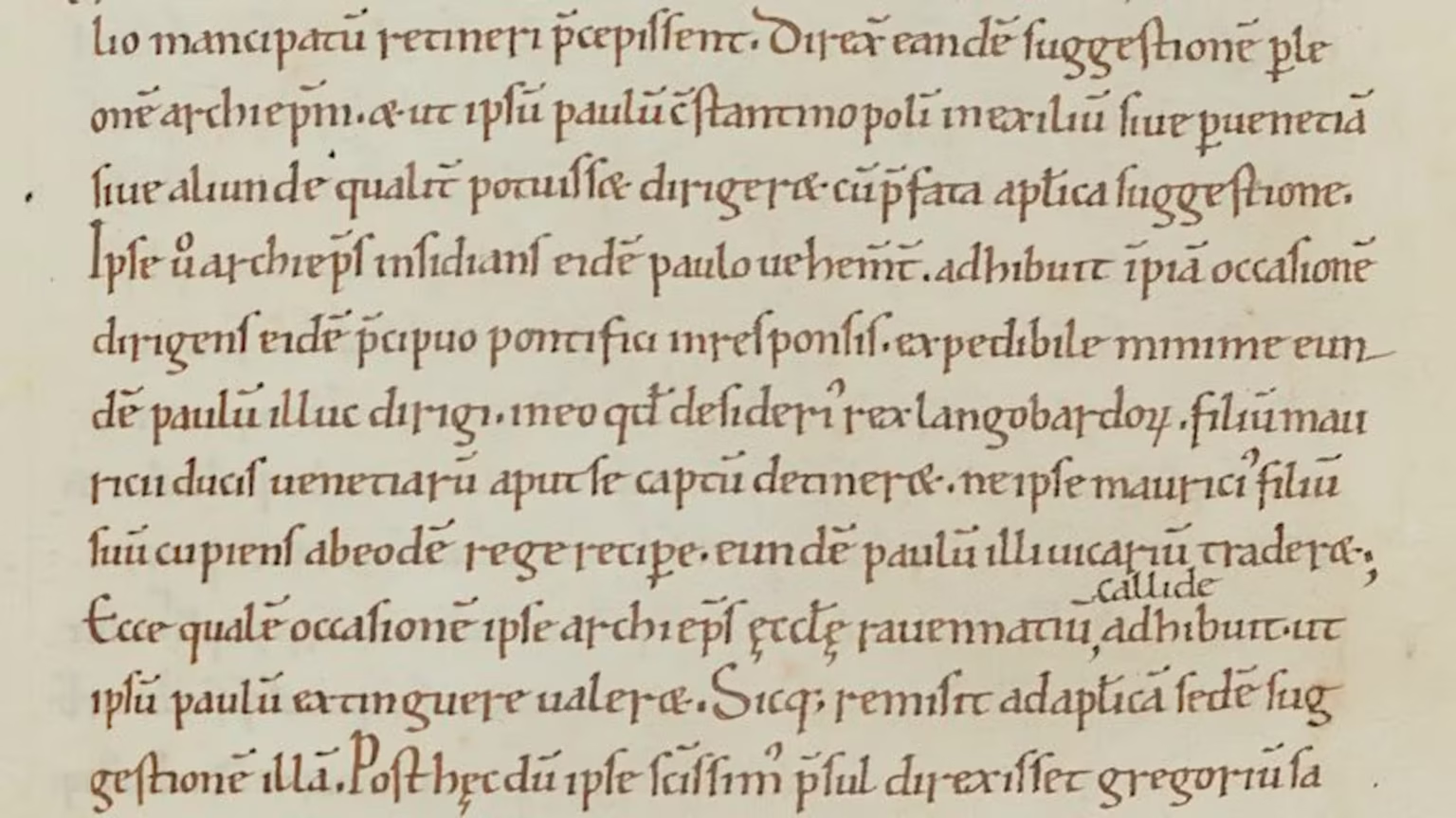
But the archbishop himself, vehemently plotting against the same Paul, took advantage of the impious opportunity, directing in his replies to the same supreme pontiff that it was not at all expedient to send Paul there; in that Desiderius, king of the Lombards, was keeping the son of Mauricius, duke of the Venetians, captured, lest Mauricius himself, desiring to free his son from the king, should hand over Paul to him as ransom.
Duchesne (1886), vol. 1, p. 490–491.
Patriarchal letter
The letter from patriarch Giovanni to pope Stephen III, dated to 768–772 based on the reigns of the two, is a long list of grievances of how the Lombard rulers of Istria taxed and mistreated the dioceses of the province, which remained loyal to the Patriarchate of Grado, to which they formally belonged.
Towards the end of the long letter, the patriarch specified that he was writing with the consent of duke Mauricius.
Mauricius was given the title of consul — corresponding to the Byzantine title of hypatos — and imperial duke, which indicated at the very least a Byzantine recognition of this role as duke of the Venetians. The Duchy of the Venetians was named as a province, so it was still considered a part of the Byzantine Empire.
On account of all these matters set forth in the above chapters, we hastened to grant relief from all our unbearable tribulation and excessive oppression, with the consent of the holy Son of God, Mauricius, consul and imperial duke of this province of the Venetians.
Cessi (1940), n. 30 (excerpt), p. 49.
John the Deacon
The Istoria Veneticorum by John the Deacon, written around the year 1000, has several chapters for the Galbaio dynasty. Continuing from the blinding and deposition of Domenicus Monegarius, he wrote:
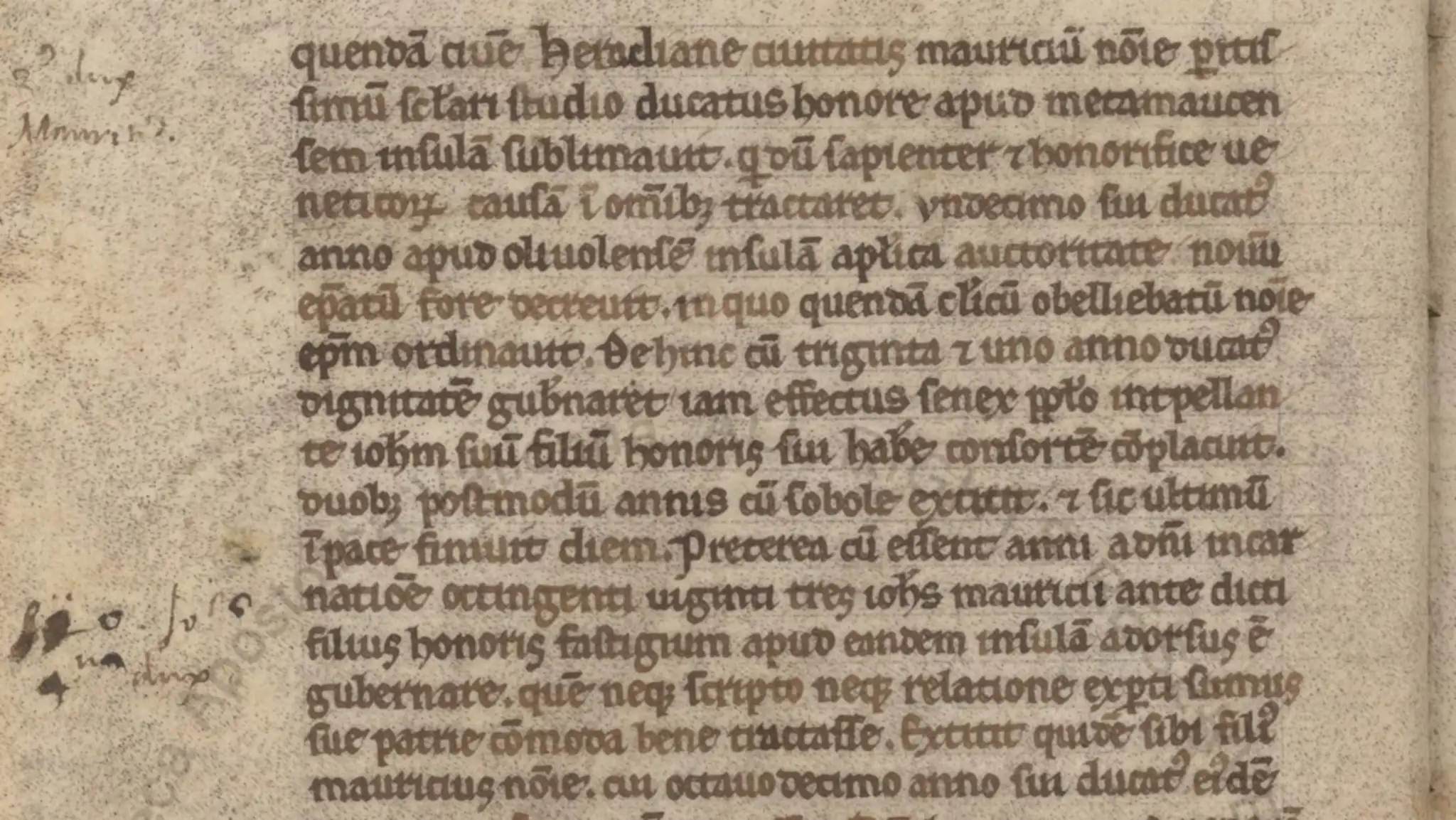
After the aforementioned, during which the entire attendance of the Venetians was gathered, a certain citizen of the city of Heraclia, named Mauricius, very skilled in secular matters, was elevated to the honour of the duchy on the island of Metamauco.
While he wisely and honourably managed the affairs of the Venetians in all matters, in the eleventh year of his duchy he decreed, by apostolic authority, that a new bishopric should be established on the island of Olivolo, in which he ordained a certain cleric, named Obelliebatus, as bishop.
Then, when he had held the ducal dignity for thirty-one years, already advanced in age, at the people’s urging, he was pleased to have his son Giovanni share in his honour; two years later, with his son, he thus ended his final day in peace.
Moreover, in the year of our Lord 823, Giovanni, the aforementioned son of Mauricius, assumed the peak of honour in governing the same island; we have discovered neither in writing nor in report that he managed the affairs of his country well.
Indeed, he had a son, named Mauricius, to whom in the eighteenth year of his duchy he granted the partnership of the same dignity.
Istoria Veneticorum, II.19.
As always, the chronology of John the Deacons is not very reliable.
On the murder of the patriarch:
In the twenty-third year of the rule of the aforementioned Giovanni, seizing an opportunity, he sent his son Mauricius with a naval force to the city of Grado to kill Lord Giovanni, the most holy patriarch.
When he arrived there, eager to obey his father’s orders, he cruelly killed the same most holy man. His death caused the greatest sorrow to his fellow citizens, since he had been slain unjustly.
The aforementioned man of God governed the church of Grado for … years, and was buried in the chapel of Saint Mark behind the mausoleums of the holy martyrs; he was succeeded by Fortunatus in leading the church.
Istoria Veneticorum, II.22.
On the deposition of the Giovanni e Mauricius:
Indeed, Fortunatus the patriarch, bitterly grieving the murder of his predecessor and parent, arranged plots against Mauricius and Giovanni the leaders and, having left his seat and city, went to Italy.
Then a certain tribune, named Obelerius, from Metamauco, followed, and Felix the tribune, Dimitrius, Marianus, Fuscarus Gregorio, and some other elders of the Venetians, of whom only the patriarch went to Francia.
The others remained in a city not far from Venice, called Treviso, and there, not staying for long, having been advised by those who were living in Venetia, they elected the tribune Obelerius as their duke.
When Giovanni and Mauricius, the dukes, realised this, worn down by fear, they fled. One of them went to Francia, that is Mauricius, the other indeed went to Mantua, where they sojourned so long that neither of them returned to Venetia, but there they ended their last day.
Istoria Veneticorum, II.24.
Chronicon Altinate
The anonymous Chronicon Altinate, of uncertain date, only has one line for each of the two doges.
Duke Mauricius ruled for 23 years.
Chronicon Altinate, Liber I, Cessi (1933), p. 29 and p. 116.
Duke Giovanni ruled for 25 years.
Andrea Dandolo
Doge Andrea Dandolo, writing his Chronica per extensum descripta in the 1340s, has little more than John the Deacon, if not for literary flourishes.
These are the relevant parts of book VII.
From the chapter on duke Mauricius:
Mauricius was proclaimed duke in the year of our Lord Jesus Christ 764. He, born in Heraclea, noble by birth, and more noble for his illustrious deeds, was now made duke at Metamauco: who, exercising just rule, reconciled discordant citizens, and from the Italian disturbances imminent in his time, preserved the Venetian homeland unharmed.
… omissis …
These days, Mauricius, Duke of Venice and now appointed imperial consul, sympathizing with the people of Istria and grieving over the diminishment of the church of Grado, deplored the intolerable cruelty of the Lombards through his envoys: Magnus, priest and secretary, and the tribune Constantius, together with the patriarch, informed pope Stephen, but the pope, with his death approaching, could not provide the full remedy he wished.
… omissis …
Until now, all the islands where the citizens of Padua first settled had been under a single bishop, namely the bishop of Metamauco; but now, with a part removed, a cathedral seat has been established in the oldest island at the fortress of Olibola, with equally commendable clergy, and the neighbouring islands of Gemini, Rivoalto, Luprio, and Dorsoduro have been placed under its jurisdiction; these have been confirmed by the privilege of Pope Adrian.
After this, a synod of the clergy and people of the Venetians was gathered, with the duke and the patriarch appointed Obeliebatus, a cleric, son of En’eaglius, tribune of Metamauco, bishop of the aforementioned see, and praised, invested and enthroned by the duke, who was consecrated by the patriarch, eleventh year of the duke, however, the title to him, according to the Greek pronunciation, was decreed bishop of Olivolo, in Latin however Olibolo; he also held the bishopric for 23 years.
… omissis …
In the same year, the Venetians, eager to please Doge Mauricius, who had conducted himself laudably in public affairs in his time, appointed his son Giovanni as a partner in dignity and later as his successor: and thus they began to have two dukes at the same time, leaving to the successors a disastrous outcome of affairs.
… omissis …
Mauricius, also Duke of Venice, full of days, in the twenty-third year of his duchy, happily ended his days.
Chronica per extensum descripta, VII.12
From the chapter on duke Giovanni:
Duke Giovanni, held the duchy alone in the year of our Lord Jesus Christ 787. After the death of his father, he held the sceptre alone at Metamauco, but, unlike his father in word and deed, did not manage the affairs of the country well and undertook ruinous endeavours.
… omissis …
During these days, duke Giovanni, seizing the opportunity, sent his son Mauricius, with a naval force, to Grado to kill Patriarch Giovanni. However, Mauricius, in a fury, invaded the city; in this invasion, the patriarch was captured, severely wounded by the Venetians, and thrown from the highest tower of his palace where he died; his blood, as a testament to his death, still appears on the stones; and he was buried in the chapel of Saint Mark, behind the mausoleums of the holy martyrs.
… omissis …
… Giovanni also ruled with his father for nine years, and after his father’s death, he ruled alone for nine years, and with his son Mauricius for seven years; and thus, counting all the years, he held the dukedom for twenty-five years.
Chronica per extensum descripta, VII.13
Bibliography
- Cessi, Roberto. Origo civitatum Italie seu Venetiarum : (Chronicon Altinate et Chronicon Gradense) in Fonti per la storia d'Italia / pubblicate dall'Istituto storico italiano ; 73. Roma : Tipografia del Senato, 1933. [more]
- Cessi, Roberto. Documenti relativi alla storia di Venezia anteriori al Mille. Padova : Gregoriana, 1940-1942. [more] 🔗
- Dandolo, Andrea and Ester Pastorello. Chronica per extensum descripta in Rerum Italicarum scriptores : raccolta degli storici italiani dal Cinquecento al Millecinquecento / ordinata da L. A. Muratori , 12.1. Bologna : N. Zanichelli, 1938-1958. [more] 🔗
- Duchesne, Louis. Le liber pontificalis / texte, introduction et commentaire, 2 voll. Paris : Thorin, 1886-1892. [more] 🔗
- Iohannes : Diaconus Venetus. Chronicon Venetum omnium quae circumferuntur vetustissimum et Johanni Sagornino vulgo tributum e mss. codice Apostoli Zeno V. Cl. nunc primum cum mss. codicibus Vaticanis collatum, notisque illustratum in lucem profert H. Fr. Zanetti Al. F. Venetiis, 1765. [more] 🔗
- Iohannes : Diaconus Venetus and Luigi Andrea Berto. Istoria Veneticorum. Bologna Zanichelli, 1999. [more] 🔗
- Monticolo, Giovanni. Cronache veneziane antichissime. Roma, Forzani e C. tipografi del Senato, 1890. [more] 🔗
- Rossi, Antonio, Giovanni Galvani, Martino : da Canale and Emmanuele Antonio Cicogna. La Cronaca veneta detta Altinate di autore anonimo, in latino, preceduta da un commentario del prof. Antonio Rossi e La cronaca dei Veneziani del maestro Martino da Canale, nell'antico francese, colla corrispondente versione italiana del conte Giovanni Galvani e con annotazioni di Emmanuele Cicogna … [et al.]. Firenze : Gio. Pietro Vieusseux, 1845. [more] 🔗
Leave a Reply