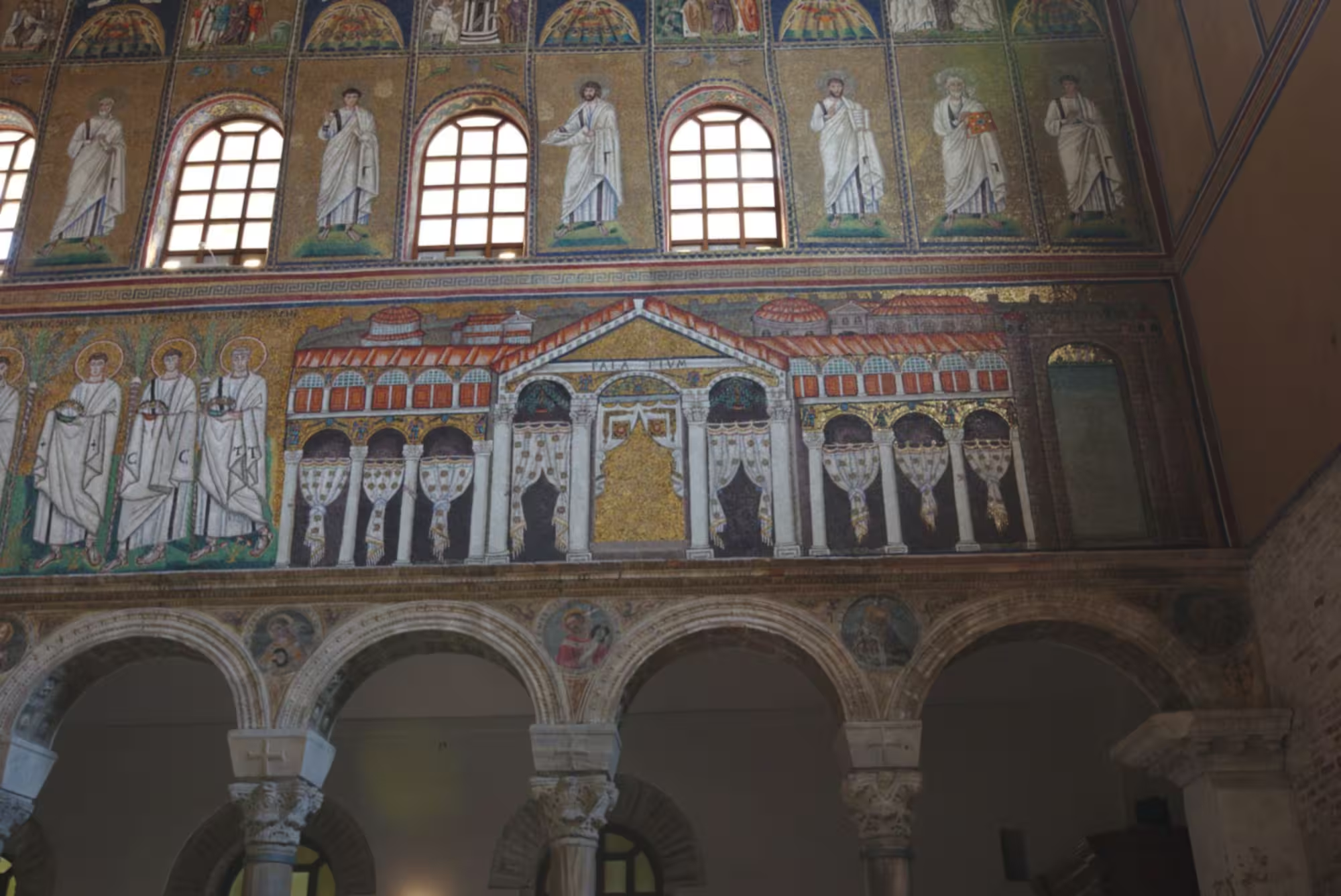
Sergius was archbishop of Ravenna from 744 to 769, at the time when the Exarchate ceased to exist, and the territory of Ravenna and the Pentapolis was contested between the papacy and the Lombards.
The Venetians are mentioned twice in the entry for Sergius in the Liber pontificalis ecclesiae Ravennatis — the Book of the Pontiffs of Ravenna — written around 840 by a local cleric, Agnello.
The Lombard conquest of Ravenna in 751 happened during the tenure of Sergius. The repercussions of this event would dominate much of the reign of Sergius, but it is mentioned with only a few words.
The reference is rather enigmatic, and the text doesn’t link it directly to the Lombard conquest, but it seems to implicate that the Venetians were allies of the Lombards against the Exarchate.
This city was harassed by the Lombards and the Venetians.
We have no other sources for any Venetian involvement in the conquest of Ravenna, or for any kind of Venetian military activity there at the time. These events would have been during the reign of duke Deusdedit (742-755).
An alternative explanation is that Agnello got the chronology wrong, and reference is to the episode of Hildeprand taking Ravenna and the Venetians helping the exarch return there, as recounted by Paul the Deacon, John the Deacon and in the Chronica extensa. That event is, however, usually placed before the reign of Sergius.
The other mention of the Venetians follows events, which, if true, must have happened in 753–754. Agnello recounts the passage of pope Stephen II in Ravenna on his way to Francia, during which the pope stole part of the treasure of the archdiocese of Ravenna and the clerics therefore plotted to kill the pontiff. This story is not corroborated by any other source. Other sources mention the journey from Rome to Francia, but not the passage in Ravenna.
After this, according to Agnello, the pontiff, not trusting the Lombards, entered into an alliance with the Venetians and paid them a large amount in gold. The narrative is contradictory to the first mention of the Venetians, which had them helping the Lombards. This event, too, would have been during the reign of Deusdedit, or possibly Galla (755–756) or Domenicus Monegarius (756–764). We have no other sources for any such alliance.
Source: Liber pontificalis ecclesiae Ravennatis (c.840), by Agnello Ravennate, from Waitz, Georg (ed.). Scriptores rerum Langobardicarum et Italicarum saec. 6.-9 in Monumenta Germaniae historica. Hannoverae : impensis Bibliopolii Hahniani, 1878. Translation by René Seindal.
Paragraph 154
Sergius XL1 was a young man in age, short in body, with a laughing face, handsome in appearance, with blue eyes, of most noble birth. He was a layman and had a wife.
Then, after he assumed the governance of the church, he consecrated Euphemia, his wife, as a deaconess, and she remained in the same state.
Because at this zealous time there were priests having quarrels and disputes, not united in mind, the multitude was divided; and after he was consecrated in Rome,2 the priests despised him, and the ministers separated themselves from him, and there was no one who would approach the holy altar with him.
Also, this city was harassed by the Lombards and the Venetians.
We cannot discuss so much because it grows long; nevertheless, let us bring forward a summary.
The pope,3 however, sent to the deacons and to the other ministers of the church, so that they all might gather into the bosom of the church.
But they, enduring the very stimulus of pain, refused.
Then, having devised a plan, he consecrated priests and deacons.
But they, indeed hard of heart, hearing this, came and on Sunday went with him to the solemnities of the masses.
However, the new sheep, who thought they stood on high, were chased away by the ancient priests, and covered their mouths in shame.
Then the pontiff, gently and softly comforting the previous priests, pouring out gentle words around them, until he turned them from anger to gentleness.
Then, turning over many things among themselves, after they had made peace, they decided on a new consecration, so that the deacons, leaving the dalmatic, would place the humeral veil in the manner of the Greeks and stand around the altar.
And from that day the Levites began to multiply, even though the canons forbid it, based on apostolic authority.
Click to reveal the Latin text
Sergius XL iuvenis aetate, brevis corpore, ridens facie, decorus forma, glaucis oculis, nobilissimis ortus natalibus.Iste laicus fuit et sponsam habuit.
Quam, post regimen ecclesiae suscepit, eam Eufimiam sponsam suam diaconissam cunsecravit, et in eodem habitu permansit.
Quia in tempore istius zelum sacerdotibus et iurgium habentibus, non unitis animo, scissa est multitudo; et postquam Romae cunsecratus est, spreverunt eum sacerdotes, et separaverunt se ab eo ministri, et nullus erat, qui cum eo ad sanctam accederet aram.
Haec autem civitas vexabatur a Langobardis et Veneticis.
Non possumus per tanta discurrere, quia olescit; tamen cunpendii proferamus causam.
Pontifex vero misit ad diaconos et ad reliquos ministros ecclesiae, ut se omnes in gremium cunglobarent ecclesiae.
At illi in ipso perdurantes doloris stimulo, renuerunt.
Tunc excogitato consilio, cunsecravit presbiteros et diaconos.
Illi vero duri corde haec audientes, venerunt et die dominico cum eo ad solempnia missarum processerunt.
Novellae vero oves, qui se putaverunt sublimiter stare, a veteribus sacerdotibus repulsi sunt, et verecundati oppilaverunt ora.
Tunc pontifex blande et leniter priores refovens sacerdotes, blanda circa eos eloquia fundens, quousque ab ira eos in mansuetudinem revocaret.
Tunc inter se multa volventes, post foedus pacis statuerunt de novella consecratione, ut diacones relicta dalmatica superhumeralem inponerent more Grecorum et circa altare resisterent.
Et ex illo die coeperunt levitae multiplicare, nam canones proibent, apostolica auctoritate muniente.
Paragraph 158
And indeed at that time, Pope Stephen,4 setting out from Rome, took the road to Francia, hastening here to Ravenna, he was accommodated within the bishopric.
But the priests, knowing and seeing that he rummaged through the treasures and wanted to swallow all the riches of the church, exchanged harsh words among themselves.
Some said: “Let us suffocate him”; others: “No, let the fortune of the church be preserved”.
There were differing opinions among the people.
Then Leo the deacon, the vicar of his house, said to the priests: “When he begins to remove everything, let us call him secretly as if to show him something, and let us throw him, so that having been sent into the depths of the water he may never appear again.”
This was a plan among them, and both severe and less severe words were discussed and concluded.
Others, when the deed had seemingly been done, were contemplating the prevention of the crime.
He knew this, Uviliaris, archdeacon of this see of Ravenna, of the monastery of Saint Bartholomew, where at that time the abbot was stationed, and where, God willing, I am now the fourth after him; he rushed to the bishopric of the church with utmost speed and saw all the priests engaged in such schemes of conversations and turning various counsels among themselves; recognizing that their plan was contrary to his ideas, he clasped his hands and spoke up against them: “O’ what great madness, brothers! If you have thought to kill the pontiff, you are not carrying fair counsel in your hearts. Listen to me so that the pope may leave here honourably, and keep your hands untarnished, and let us preserve the oath of our prelate intact. When night has begun to fall and the bodies of the Romans have been filled with feasts and the clearest wine, during the first sleep, as if they were lying buried: all the lamps of the atrium shall be extinguished, so that the flames of the candles may not provide comfort at night, and whatever we can secretly set aside, all shall be hidden in the crypts, without our bishop knowing, and let the Roman pope take away from the places of wealth that which he may find.”
And this plan pleased everyone, and they decided that this advice of Uviliaris is better than the opinion expressed by the others in mind.
And the priests entered into each place of the treasures, and hid as much as they could.
Truly untimely at night came the aforementioned Pope Stephen.
All the keys of the church treasurers were brought before him, and all the doors were opened to him.
He stole the relics, which they could not hide so quickly, nine containers full of gold, many silver vessels and silver spoons, one set of four and various other types of gold and silver, and thus he went to France, indeed sending one of the spoons to Rome.
Then the despoliation of the church became known to the citizens of Ravenna, after the pope had departed, they wanted to pursue the wagon, which was carrying the silver, but the fearful drivers went to Rimini, and the people of Ravenna returned to their own city.
Click to reveal the Latin text
Eo namque tempore exiens Stephanus papa Romanus Roma, Franciae arripuit iter, properans huc Ravennam, infra episcopiumeius applicitus est.
Scientes autem et videntes sacerdotes, quod ipse scrutaretur gazas atque omnes opes ecclesiae deglotire deberet, erant inter eos incommoda verba.
Alii dicebant: ‘Suffocemus eum’; alii: ‘Non, serventur ecclesia fortunae’.
Erant dispares voces in vulgo.
Tunc Leo diaconus et ipsius domui vicedominus sacerdotibus dixit: ‘Cum coeperit depopulare omnia, vocemus eum occulte quasi aliquid ad ostendendum ei, et praecipitemus eum, ut dimersus in profundum aquae nunquam cunpareat’.
Hoc erat inter eos cunsilum, et verba incommoda et commoda agebantur et cunclusa.
Alii, cum quasi facta fuisset, remotionem criminis meditabantur.
Audiens haec Uviliaris archidiacono istius sedis Ravennae de monasterio sancti Bartolomei, qui illo tempore ibidem sistebat abba, ubi Deo favente post ipsum quartus ego sum modo, ad episcopium ecclesiae cum summa velocitate occurrit et vidit omnes sacerdotes in talibus machinamentis sermocinationum sistere et diversa inter se cunsilia volvere; agnoscens suum in contraria coeptum, complosis manibus cuntra eos vocem misit: ‘O quanta insania, fratres! Si ista meditati estis perimere pontifice, non aequa cunsilia in pectoribus vestris gestatis. Adquiescite mihi, ut papa honorifice hinc abscedat, manusque vestrae servate innoxiis, et sacramentum praesulis nostri servemus illaesum.
Cum incubare coeperitatra nox et Romanorum cum fuerit corpora ex dapibus et lucidissimo lyeo opleta, prima quies, quasi sepulti iacent: cuncta atrii lichna extinguantur, ne illi flammae candelarum nocte solatia praestent, et quid possimus occulte abdicare, omnia in criptis celentur, ignorante pontifice nostro, et apertis locis divitiarum quas papa Romanus invenerit tollat’.
Placuitque omnibus hoc cunsilium, et decreverunt, quia haec Uviliaris melior est quam ceterorum sententia prolata mente.
Et ingressi sacerdotes infra singula loca gazarum, abscunderunt quantum valuerunt.
Intempestivum vero noctis venit praedictus papa Stephanus.
Allatae sunt ante eum omnes claves a vesterariis ecclesiae, et reserata sunt ei omnia ostia.
Abstulit reliquias, quas non potuerunt sic citius occultare, ex auro plenas balantias novem, vascula argentea plurima et coclearia argentea tractoria, quaternaria una et diversas alias aureas et argenteas species, et sic in Franciam perrexit, unam vero [ex] cuclearibus Romam transmisit.
Tunc cognitum Ravennensibus civibus, postquam papa egressus est, depopulationem ecclesiae, voluerunt prosequi plaustrum, quod argentum vegebat, sed timidi vehiculatores in Ariminum delati sunt, et Ravennenses ad suam reversi sunt civitatem.
Paragraph 159
Therefore, this bishop had jurisdiction from the boundaries of Persiceto for the whole of Pentapolis and up to Tuscany and up to the river Volani, just like an exarch, thus arranging everything, as the Romans are accustomed to doing now.
Indeed, Pope Stephen returned from France to Rome, having previously held a council with the archbishop, and sent very persuasive flattery and peaceful letters to some noble judges of Ravenna, urging them to send to Rome those who had conspired in the murder of the pope.
Among whom was also my father’s grandfather, and they were confined in Rome for so long, until they all died there.
And after these things, the pontiff joined a treaty with the Venetians, so that nothing worse should happen to him afterwards because the king of the Lombards had deceived him, and he was no longer trusting of him; distributing money among the Venetians, he spent seven scales of gold through the most noble men.
He built the convent of Saint Apollinaris on the side of the men, where he also stationed monks, and left there many possessions.
Click to reveal the Latin text
Igitur iudicavit iste a finibus Persiceti totum Pentapolim et usque ad Tusciam et usque ad mensam Walani, veluti exarchus, sic omnia disponebat, ut soliti sunt modo Romani facere.
Reversus vero papa Stephanus ex Francia Romam, inito antea cum archiepiscopo cunsilio, pernimia blandimenta et pacificas epistolas ad aliquantos nobiles Ravennenses iudices misit, ortantes, ut Romam pergerent illi, qui in necem pontificis cunsenserunt.
Inter quos etiam avus patris mei fuit, et tandiu Romae sunt coartati, quousque omnes ibi mortui sunt.
Et post haec cuniunxit foedus pontifex cum Veneticis, ut ne deterius quod ei contingerat postmodum veniret, quia fefellit eiLangobardorum rex, et ultra non fuit credulus illi; et destributa pecunia in Veneticis, 7 balancias per nobilissimos viros aurum expendit.
Aedificavit iste cellam beati Apolenaris de parte virorum, ubi et monachos statuit, et reliquid ibidem multas possessiones.
Notes
- Sergius was the 60th archbishop ofRavenna. ↩︎
- During the reign of pope Zachary. ↩︎
- Zachary (679–752) (also Zacharias and Zaccaria) was the 91st bishop of Rome from 741 to 752. ↩︎
- [Pope Stephen II] (714–757) was bishop of Rome from 752 until his death in 757, during the transition from the Byzantine Papacy to the Frankish Papacy. ↩︎
Bibliography
- Holder-Egger, O. (ed). Agnelli qui et Andreas liber pontificalis ecclesiae Ravennatis in Waitz, Scriptores, p. 265–391. Hannover, 1878. [more]
- Pierpaoli, M. Il libro di Agnello Istorico. Le vicende di Ravenna antica fra storia e realtà. Ravenna, 1988. [more]
- Waitz, Georg (ed.). Scriptores rerum Langobardicarum et Italicarum saec. 6.-9 in Monumenta Germaniae historica. Hannoverae : impensis Bibliopolii Hahniani, 1878. [more] 🔗
Leave a Reply