In the early-700s, a series of events around Ravenna involved, to varying degrees, the Exarchate of Ravenna, the Papacy of Rome, the Lombards and the Venetians.
In the early 720s, the Lombard king Liutprand besieged Ravenna, and sacked the harbour city of Classe.
Around 726–727, an iconoclast edict from emperor Leo III caused widespread rioting in the Exarchate, and the Venetians participated in the fighting, against the Byzantine reinforcements sent to Ravenna.
In the early 730s, Hildeprand, nephew of king Liutprand, captured Ravenna, but was defeated and captured by a Venetian force, this time on the side of Byzantium.
Ten years later, king Liutprand besieged Ravenna again, and pillaged much of the Pentapolis.
The various chronicles, even those close to the events, often contradicted each other on the details, such as dates and the order of events. The confusion and uncertainties therefore go far back, practically the earliest sources.
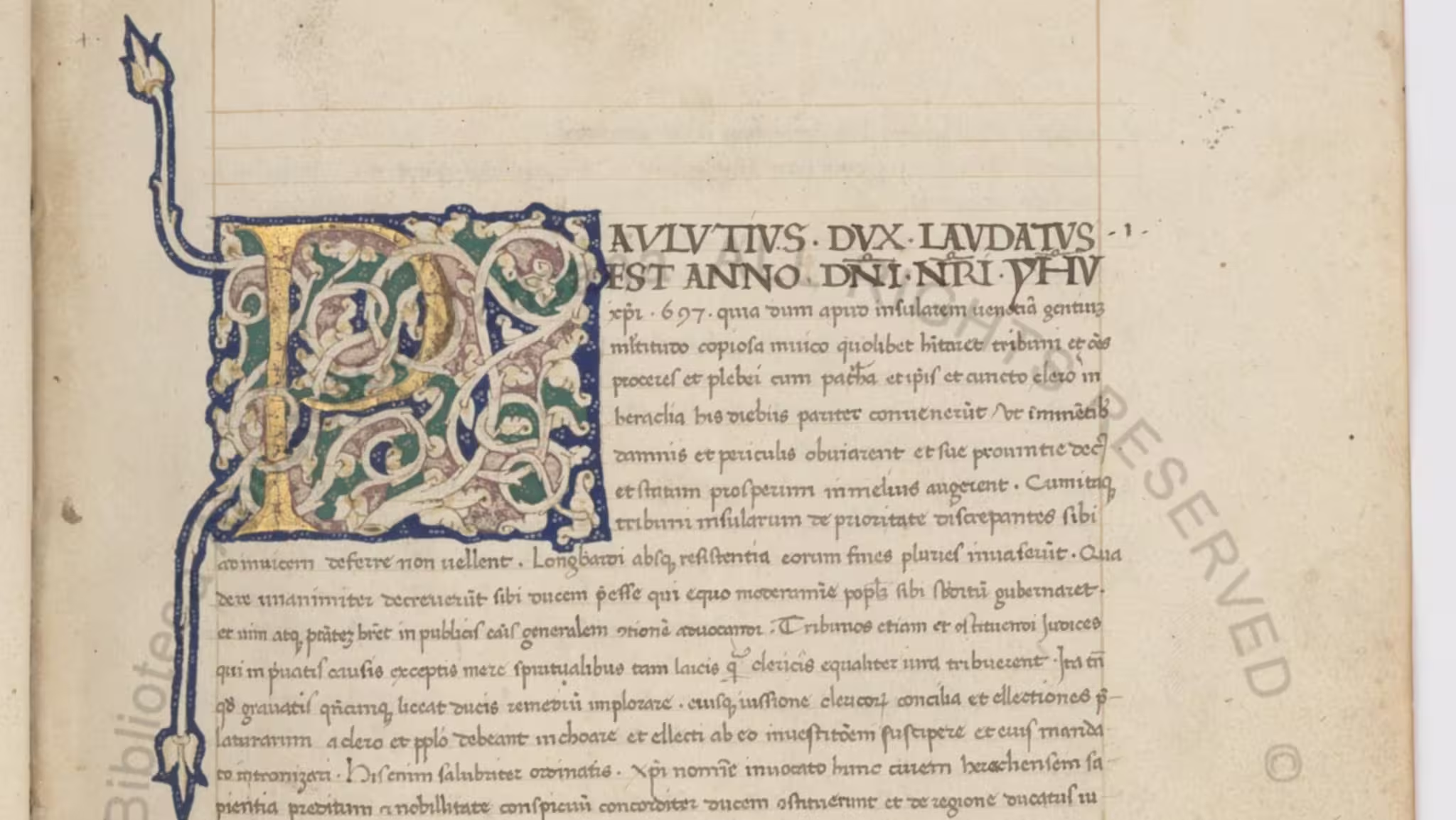
In this excerpt of the Chronica per extensum descripta, the author, doge Andrea Dandolo, manages to merge them all into one single narrative.
Andrea Dandolo used as sources the Historia Langobardorum by Paul the Deacon, the Istoria Veneticorum by John the Deacon, the Liber Pontificalis, the Liber pontificalis ecclesiae Ravennatis, and several others.
Source: Chronica per extensum descripta (1340s), also called the Chronicon Venetum, by Andrea Dandolo, translated by René Seindal.
Available translations from the Chronica Extensa:
- The first doges — VII.1–8 (excerpts)
- Hildeprand in Ravenna — VII.3, paragraphs 2–5.
- Doges of the 700s — VII.9–13.
Excerpts from the Chronica per extensum descripta, book VII, chapter 3, paragraphs 2–5.
VII–3–2
At that time, Liutprand1 besieged Ravenna,2 attacked and destroyed Classe,3 and after a long siege, Hildeprand,4 the king’s nephew, and Peredeo,5 the duke of Vicenza, took possession of Ravenna; however, the exarch,6 escaping the fury of the Lombards, took refuge safely in Venice.7 And therefore, Pope Gregory,8 agreeing with him, wrote two letters of the following tenor for the patriarch and the duke.9
Click to reveal the Latin text
Eo tempore, Liuthprandus Ravenam obsedit, Classem invasit atque destruxit, et post diutinam obsidionem, Ildeprandus regis nepos et Peredeo vincentinus dux Ravenam optinuerunt; exarchus autem ravenas furorem Longobardorum evadens in Venecia tutatus est. Et propterea Gregorius’ papa, sibi conpaciens, patriarche et duci duas divisim infrascripti tenoris scripsit epistolas.
VII–3–3
“Bishop Gregory, servant of the servants of God, to the beloved son Ursus, Duke of Venice, etcetera.
Because, through sin, the city of Ravenna, which was the foremost of all, was captured by the unspeakable people of the Lombards, and our distinguished son, the lord exarch, as we have learned, is staying in Venice, your nobility ought to adhere to him, and with him, in our stead, contend together, so that the city of Ravenna may be restored to its former state in the holy service of the republic and imperial service of our lords and sons, Leo10 and Constantine,11 the great emperors, so that, with zeal and love for our holy faith, we may remain steadfast in the state of service to the republic and the empire, with the Lord assisting us.
May God keep you safe, my dear son.”
Click to reveal the Latin text
Gregorius episcopus servus servorum Dei, dilecto filio Urso duci Venecie etcetera.
Quia, pecato faciente, Ravenancium civitas, que capud erat omnium a(d) necdicenda(m) gente Longobardorum capta est, et filius noster eximius dominus exarcha apud Venecias, ut cognovimus, moratur, debeat nobilitas tua ei adherere, et cum eo, nostra vice, pariter decertare, ut ad pristinum statum sancte reipublice et imperiali servicie dominorum filiorumque nostrorum, Leonis et Constantini, magnorum imperatorum, ipsa revocetur Ravenancium civitas, ut, zelo et amore sancte fidei nostre, in statu reipublice et imperiali servicio firmi persistere, Domino cohoperante, valeamus.
Deus te incolumen custodiat dilectissime filli.
VII–3–4
But the Duke, with the Venetians, inflamed with zeal for the faith, hastening to Ravenna with a naval army, attacked the city, and captured Hildeprand, the king’s nephew, and killed Peredeo, the duke of Vicenza, fighting valiantly: and, once the city had been obtained, restored the exarch to his seat. Indeed, the honesty and loyalty of the Venetians are commendable, attested by the testimony of Paul, historian of the deeds of the Lombards.12
Click to reveal the Latin text
Dux autem, cum Venetis, zelo fidei accensi, cum navali exercitu, Ravenam properantes, urbem impugnant, et Yldeprandum nepotem regis capiunt, et Peredeo ducem vicentinum viriliter pugna[n]tem occidunt: et, optenta urbe, exarchum in sede restituunt. Que quidem Venetorum probitas et fides laudabilis, testimonio Pauli gestorum Longobardorum ystoriographi, conprobantur.
VII–3–5
Meanwhile, Emperor Leo, seduced by a certain Beser,13 a deserter of the faith, wages war against the images of Christ and his saints, and orders them to be removed and burned everywhere; and he commanded Pope Gregory14 to do the same in Rome. But the pope disregarded this, excommunicated the emperor, and, as Paul and Bishop Sicardus15 testify, the armies of Ravenna and Venice also, with fervour of faith, unanimously resisted, and would have chosen another emperor if not for the pope, having it forbidden. Therefore, since many inhabitants of Constantinople resisted the emperor, some were martyred, and then Saint Theodosia16 suffered.
Click to reveal the Latin text
Interea, Leo imperator, a quodam Beser refuga fidei seductus, contra ymagines Christi et sanctorum eius bellum inducit, easque ubique deponi et incendi edicit; mandavitque Gregorio pape, ut idem Rome faceret. Sed pontifex hoc contempsit, et imperatorem excomuuicavit, et, ut Paulus et Sicardus episcopus testificantur, exercitus quoque Ravene et Veneciarum, fervore fidei, unanimiter resisterunt, elegissentque alium imperatorem nisi pontifex prohibuisset. Cum igitur plerique Constantinopolitani imperatori resisterent, aliqui martiricantur, et tunc passa est sancta Theodosia.
Notes
- Liutprand (c.680–744) was king of the Lombards from 712 to 744. During his reign, he fought wars with Byzantine over Ravenna, and donated lands at Sutri to the Pope, leading to the creation of the Papal State. ↩︎
- Ravenna was the capital of the Western Roman Empire in the 400s, of the Ostrogoth Kingdom in the early 500s, and seat of the Exarchate of Ravenna until 751. ↩︎
- Classe (Latin: Classis) was a harbour city near Ravenna, and an important naval base in Antiquity. ↩︎
- Hildeprand (†744) was the king of the Lombards with Luitprand from 737, but was deposed by Ratchis immediately after the death of Luitprand in 744. ↩︎
- Peredeo was a Lombard duke of Vicenza, who was killed by the Venetians in Ravenna, which the Lombards had shortly taken, sometimes between 726 and 741. ↩︎
- Eutychius (†751) was the last Byzantine exarch of Ravenna from 726 or 727 until his death. He was killed during the Lombard conquest of Ravenna in 751, which ended the Exarchate of Ravenna. ↩︎
- Here, Venice meant the Byzantine province of Venetia, not the current city of Venice, which didn’t exist yet. The important cities at this time were Heraclea and Grado. ↩︎
- Either Gregory II (715–731) or Gregory III (731–741), depending on when the letter was written. ↩︎
- Andrea Dandolo is the earliest source for the quoted letter from the pontiff to duke Ursus, as John the Deacon only quoted the letter to Antoninus, the patriarch of Grado. ↩︎
- Leo III the Isaurian (c. 685–741) was Byzantine emperor from 717. He is associated with the start of iconoclasm in 726. ↩︎
- Constantine V (718–775) was Byzantine emperor from 741 to his death in 775. ↩︎
- Paul the Deacon (c.720–c.799) was a Lombard scholar, writer, historian, teacher and monk, best known for his history of the Lombard people. ↩︎
- Beser, an Syrian Christian, who had converted to Islam in captivity, and returned to Christianity once freed, was in Constantinople a promoter of iconoclasm and close to emperor Leo III. ↩︎
- Pope Gregory II (669–731) was bishop of Rome from 715 to his death in 731. He took a firm stance against iconoclasm as imposed by emperor Leo III. ↩︎
- [Sicardus of Cremona] (1155–1215) (also: Sicard or Sicardo) was an Italian prelate and chronicler, and bishop of Cremona from 1185. ↩︎
- Saint Theodosia (†729) (also: Santa Teodosia) was a Byzantine nun, who was executed during an iconoclast conflict in Constantinople, and therefore a martyr of the heresy of iconoclasm. ↩︎
Bibliography
- Dandolo, Andrea and Ester Pastorello. Chronica per extensum descripta in Rerum Italicarum scriptores : raccolta degli storici italiani dal Cinquecento al Millecinquecento / ordinata da L. A. Muratori , 12.1. Bologna : N. Zanichelli, 1938-1958. [more] 🔗
- Muratori, Lodovico Antonio. Rerum Italicarum scriptores, 28 vols. Mediolani : ex Typographia Societatis Palatinae in Regia Curia, 1723-1751. [more]

Leave a Reply