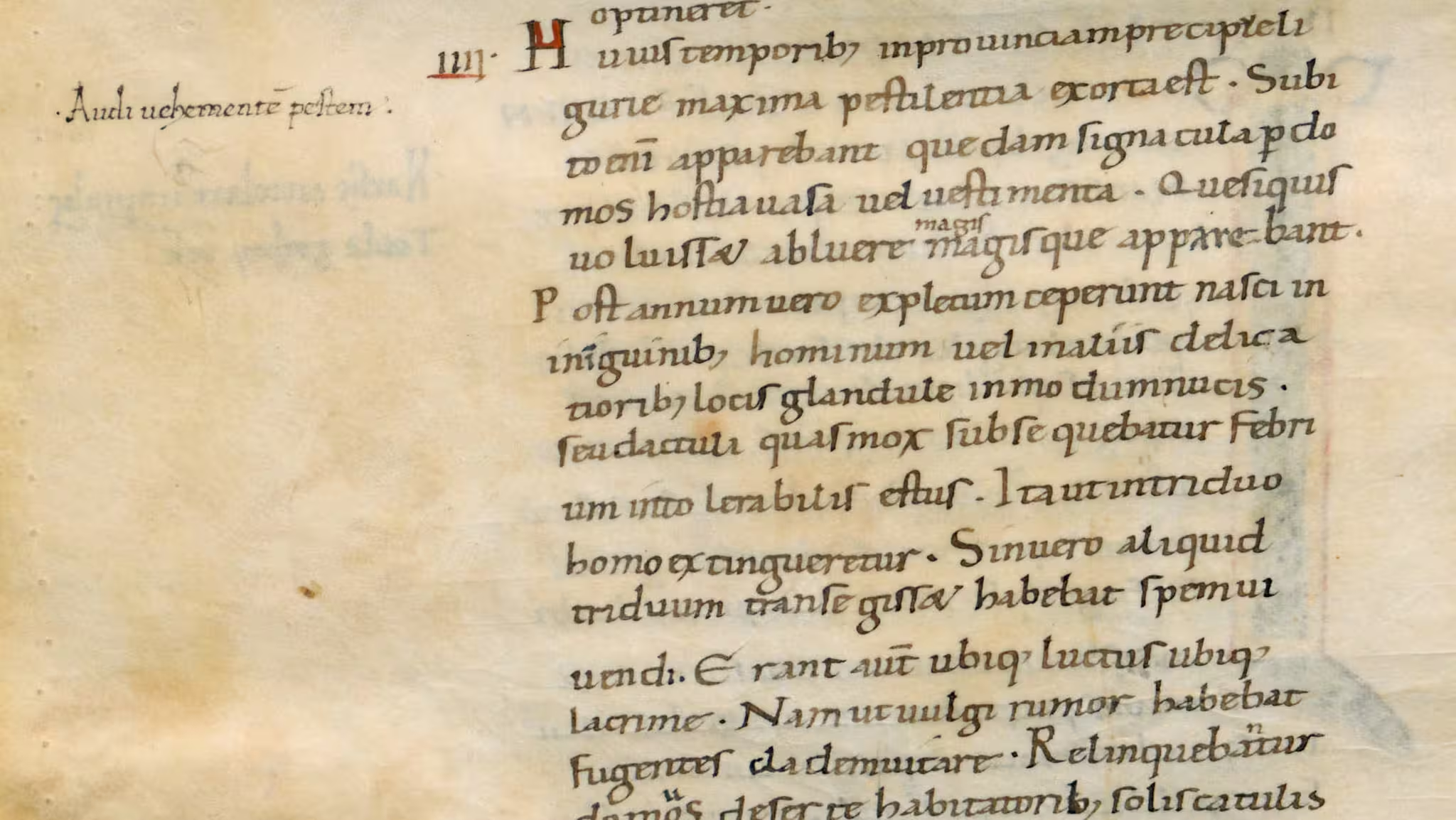
This excerpt from book II of the Historia Langobardorum by Paul the Deacon describes the effect of the Justinian plague in Italy.
Based on archaeological DNA samples, the epidemic has recently been verified as yersinia pestia — bubonic or black plague. As such, it was the first of three pandemics of bubonic plague in known history.
The plague arrived in Italy in 541, and the first wave lasted a few years, but just as in the Middle Ages, successive waves came and went over at least two centuries.
The final paragraph doesn’t mention the plague, but it gives some clues to the dating of the passage. Based on that, the date must be shortly after 565 when Justinian I died, and no later than 573, when the patrician Narses died. Most scholars date the narrative to 566 or 567.
Other outbreaks of the plague happened later in the 590s, as apparent from another two short excerpts from book IV of the Historia Langobardorum.
Source: Historia Langobardorum (780s–790s) by Paul the Deacon, here in the translation by William Dudley Foulke from 1906.
Available translations from the Historia Langobardorum:
- The Justinian plague — II.4, IV.4 and IV.14.
- The invasion of Venetia — II.5–12 and II.14.
- The conquest of Venetia — IV.20, IV.23, IV.25, IV.28, IV.38, IV.45 and V.28
- Alboin and Rosamund — I.29, II.28 and II.29.
- Iconoclasm — VI.49.
- Hildeprand in Ravenna — VI.54.
The text leading up to this excerpt discuss the actions of the Byzantine general Narses, so the initial “this man” refers to him.
Chapter II.4
In the times of this man a very great pestilence broke out, particularly in the province of Liguria.
For suddenly there appeared certain marks among the dwellings, doors, utensils, and clothes, which, if any one wished to wash away, became more and more apparent.
After the lapse of a year indeed there began to appear in the groins of men and in other rather delicate places, a swelling of the glands, after the manner of a nut or a date, presently followed by an unbearable fever, so that upon the third day the man died. But if any one should pass over the third day he had a hope of living.
Everywhere there was grief and everywhere tears.
For as common report had it that those who fled would avoid the plague, the dwellings were left deserted by their inhabitants, and the dogs only kept house. The flocks remained alone in the pastures with no shepherd at hand. You might see villas or fortified places lately filled with crowds of men, and on the next day, all had departed and everything was in utter silence.
Sons fled, leaving the corpses of their parents unburied; parents forgetful of their duty abandoned their children in raging fever. If by chance long-standing affection constrained any one to bury his near relative, he remained himself unburied, and while he was performing the funeral rites he perished; while he offered obsequies to the dead, his own corpse remained without obsequies.
You might see the world brought back to its ancient silence : no voice in the field ; no whistling of shepherds ; no lying in wait of wild beasts among the cattle; no harm to domestic fowls.
The crops, outliving the time of the harvest, awaited the reaper untouched; the vineyard with its fallen leaves and its shining grapes remained undisturbed while winter came on ; a trumpet as of warriors resounded through the hours of the night and day ; something like the murmur of an army was heard by many ; there were no footsteps of passers by, no murderer was seen, yet the corpses of the dead were more than the eyes could discern ; pastoral places had been turned into a sepulchre for men, and human habitations had become places of refuge for wild beasts.
And these evils happened to the Romans only and within Italy alone, up to the boundaries of the nations of the Alamanni and the Bavarians.
Meanwhile, the emperor Justinian1 departed from life and Justin the younger2 undertook the rule of the state at Constantinople. In these times also Narses the patrician,3 whose care was watching everything, at length seized Vitalis, bishop of the city of Altinum (Altino),4 who had fled many years before to the kingdom of the Franks — that is, to the city of Aguntum (Innichen)5 — and condemned him to exile in Sicily.
Chapter II.26 (excerpt)
… The Romans had then no courage to resist because the pestilence which occurred at the time of Narses had destroyed very many in Liguria and Venetia, and after the year of plenty of which we spoke, a great famine attacked and devastated all Italy. …
Chapter IV.4
In this year6 the inguinal plague was again at Ravenna, Gradus (Grado) and Istria, and was very grievous as it had also been thirty years before.
At this time too king Agilulf made peace with the Avars. Childepert7 also waged with his cousin the son of Hilperic, a war in which as many as thirty thousand men fell in battle.
The winter was then very cold, so that hardly anyone recalled its like before.8
Also in the region of the Briones (Brenner) blood flowed from the clouds, and among the waters of the river Renus (Reno) a rivulet of blood arose.
Chapter IV.14
At a subsequent time9 a very severe plague again devastated Ravenna and those places which were around the shores of the sea. Also in the following year a great mortality wasted the people of Verona.
Notes
- The Byzantine emperor Justinian I (482–565) initiated the reconquest of Italy to the empire, which made Venetia a Byzantine province under the Exarchate of Ravenna. ↩︎
- Justin II was Eastern Roman Emperor 565–578, during whose reign the Lombards invaded Italy. ↩︎
- Narses (c. 478–573) was a Byzantine general, who led the imperial forces in parts of the Gothic Wars in Italy in the 500s. ↩︎
- This is the only existing reference to a bishop Vitalis (or Vitale) of Altino. The bishopric of Altino was suppressed in 639, when the seat of the bishop moved to Torcello in the lagoon. ↩︎
- This is the town of San Candido in the upper Puster valley, in the province of Bolzano in Tyrol, on the modern border with Austria. ↩︎
- From the context, probably 591 or 592. ↩︎
- Childebert II (c. 570–596) was Merovingian king of Austrasia (575–596) and king of Burgundy (592–596). ↩︎
- Agilulf (c.555–616) was a Lombard Duke of Turin and king of the Lombards from 591 until 616. ↩︎
- From the context, this must have been in 590 or 591. ↩︎
Original text
Liber II – iv
Huius temporibus in provincia praecipue Liguriae maxima pestilentia exorta est.
Subito enim apparebant quaedam signacula per domos, ostia, vasa vel vestimenta, quae si quis voluisset abluere, magis magisque apparebant.
Post annum vero expletum coeperunt nasci in inguinibus hominum vel in aliis delicatioribus locis glandulae in modum nucis seu dactuli, quas mox subsequebatur febrium intolerabilis aestus, ita ut in triduo homo extingueretur. Sin vero aliquis triduum transegisset, habebat spem vivendi.
Erant autem ubique luctus, ubique lacrimae.
Nam, ut vulgi rumor habebat, fugientes cladem vitare, relinquebantur domus desertae habitatoribus, solis catulis domum servantibus. Peculia sola remanebant in pascuis, nullo adstante pastore. Cerneres pridem villas seu castra repleta agminibus hominum, postero vero die universis fugientibus cuncta esse in summo silentio.
Fugiebant filii, cadavera insepulta parentum relinquentes, parentes obliti pietatis viscera natos relinquebant aestuantes. Si quem forte antiqua pietas perstringebat, ut vellet sepelire proximum, restabat ipse insepultus; et dum obsequebatur, peri mebatur, dum funeri obsequium praebebat, ipsius funus sine obsequio manebat.
Videres seculum in antiquum redactum silentium: nulla vox in rure, nullus pastorum sibilus, nullae insidiae bestiarum in pecudibus, nulla damna in domesticis volucribus.
Sata transgressa metendi tempus intacta expectabant messorem; vinea amissis foliis radiantibus uvis inlaesa manebat hieme propinquante. Nocturnis seu diurnis horis personabat tuba bellantium, audiebatur a pluribus quasi murmur exercitus. Nulla erant vestigia commeantium, nullus cernebatur percussor, et tamen visus oculorum superabant cadavera mortuorum. Pastoralia loca versa fuerant in sepulturam hominum, et habitacula humana facta fuerant confugia bestiarum.
Et haec quidem mala intra Italiam tantum usque ad fines gentium Alamannorum et Baioariorum solis Romanis acciderunt.
Inter haec Iustiniano principe vita decedente, Iustinus minor rem publicam apud Constantinopolim regendam suscepit. His quoque temporibus Narsis patricius, cuius ad omnia studium vigilabat, Vitalem episcopum Altinae civitatis, qui ante annos plurimos ad Francorum regnum confugerat, hoc est ad Agonthiensem civitatem, tandem conprehensum apud Siciliam exilio damnavit.
Liber IV – iv
Hoc anno fuit pestis inguinaria iterum aput Ravennam, Gradus et [in] Histria nimium gravis, sicut et prius ante triginta annos extiterat.
Hoc etiam tempore Agilulfus rex cum Avaris pacem fecit. Childepertus quoque bellum gessit cum consobrino suo, Hilperici filio; in quo proelio usque ad triginta milia hominum caesa sunt.
Fuit autem tunc hiems frigida nimis, qualem vix aliquis prius recolebat fuisse.
In regione quoque Brionum sanguis de nubibus fluxit; et inter Reni fluvii aquas rivulus cruoris emanavit.
Liber IV – xiv
Subsequenti tempore rursum Ravennam et eos qui circa ora maris erant pestis gravissima vastavit. Sequenti quoque anno mortalitas valida populos Veronensium attrivit.
Leave a Reply