The first book of the Chronicon Altinate — which is by an unknown author, of an unknown date — contains a list of the early doges of Venice.
The oldest part of the list is no doubt taken from the Istoria Veneticorum by John the Deacon, in particular from the initial chapters of book II, with some changes to the length of the reign of Marcello, to somehow get the chronology to work better.
The list is in the typical medieval form, giving just the order and the length of each reign. The actual years only appear in the Chronica per extensum descripta by Andrea Dandolo, written in the 1340s, which is the origin of the traditional list of doges.
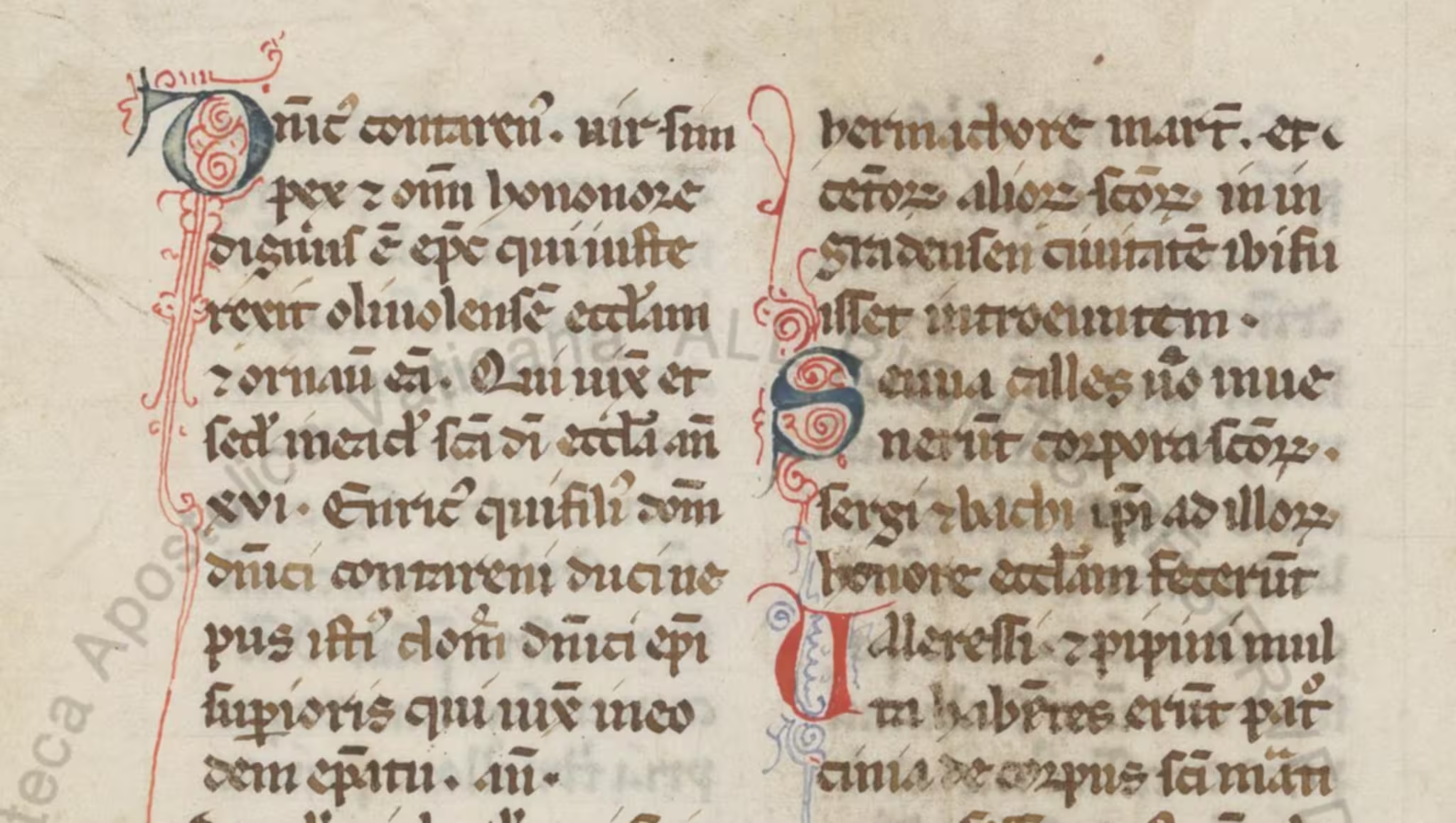
The Chronicon Altinate has several editions, with slight differences between them, and the excerpt below comes to us in two versions, which are both reproduced.
Source: Chronicon Altinate, also called the Origo civitatum Italie seu Venetiarum, translated by René Seindal. The original is from Cessi (1933).
Available translations from the Chronicon Altinate:
- The first doges — liber I (excerpts).
- The death of Paulicius — liber III (excerpt).
Liber I — editio prima (excerpt)
Duke Paulicius1 ruled for 20 years, 6 months, and 9 days.
Duke Marcellus2 ruled for 9 years and 21 days.
Duke Ursus ruled for 11 years and 5 months.
After the death of Duke Ursus,3 there were no dukes in Venice for 6 years, but the Master of Soldiers4 judged matters, that is, Lord Leo,5 Master of Soldiers served for 1 year; Felix,6 Master of Soldiers served for 1 year; Deusdedit,7 Master of Soldiers served for 2 years; Julian,8 Hypatus,9 Master of Soldiers served for 1 year; Johannes Fabriacus,10 Master of Soldiers served for 1 year.
[Duke and] hypatos Deusdedit11 ruled for 13 years.
Duke Galla12 ruled for 1 year and 2 months.
Duke Domenicus13 ruled for 8 years.
Duke Mauricius14 ruled for 23 years.
Duke Giovanni15 ruled for 25 years.
Duke Obelerio16 and Beatus17 sat for 5 years.
Click to reveal the Latin text
Paulicius dux ducavit annos .XX. et menses .VI. et dies .VIIII.
Cessi (1933), p. 28–29.
Marcellus dux ducavit annos .VIIII. dies .XXI.
Ursus dux ducavit annos .XI. et menses .V.
Post interfectionem Ursi duci in annos .VI. non fuerunt duces in Venecia, sed magister militum earn iudicabat, id est domnus Leo magister militum sedit anno .I. ; Felix magister militum sedit ann. .I. ; Deusdedi [magister militum sedit] ann. .II. ; Iulianus ypatus [magister militum sedit] ann. .I.; Iohannes Fabriacus [magister militum sedit] ann. .I.
Deusdedi ypatus [et dux] ducavit ann. .XIII.
Galla dux ducavit annum .I. et menses .II.
Dominicus dux ducavit annos .VIII.
Mauricius dux ducavit annos .XXIII.
Iohannes dux ducavit ann. .XXV.
Obilierius dux et Beatus sederunt ann. .V.
Liber I — editio terzo (excerpt)
Duke Paulicius ruled for 20 years, 6 months, 9 days.
Duke Marcellus ruled for 9 years, 16 days.
Duke Ursus ruled for 11 years, 5 months.
After his death, there were no dukes in Venice for 6 years, but the master of the soldiers was already judging, so the first Dominic Leo, master of the soldiers, sat for one year. Felix, master of the soldiers, sat for 1 year. Deusdedit, master of the soldiers, sat for 2 years. Hypatus Iubianus, master of the soldiers, sat for 1 year. Johannes Fabriacus, master of the soldiers, sat for 1 year.
Duke and hypatos Deusdedit ruled for 13 years.
Duke Galla ruled for 1 year and 2 months.
Duke Domenicus ruled for 8 years.
Duke Mauricius ruled for 23 years.
Duke Giovanni ruled for 25 years.
Duke Obelerio and Beatus, his brother, sat for 5 years.
Click to reveal the Latin text
Paulicius dux ducavit annos .xx., mens. .VI., dies .VIIII.
Cessi (1933), p. 115–116.
Marcellus dux ducavit annos .VIIII., dies .XVI.
Ursus dux ducavit annos .XI., mens. .V.
Post huius interfectionem per annos .vi. non fuerunt duces in Venecia, sed magister militum iam iudicabat, et ideo primus
Dominicus Leo magister militum sedit annum unum.
Felix magister militum sedit ann. .I.
Deusdedit magister militum sedit ann. .II.
Iubianus ypatus magister militum sedit ann. .I.
Iohannes Fabriacus magister militum sedit ann. .I.
Deusdedit ypatus et dux ducavit ann. .XIII.
Galla dux ducavit ann. .I. et menses .II.
Dominicus dux ducavit ann. .VIII.
Mauricius dux ducavit ann. .XXIII.
Iohannes dux ducavit ann. .XXV.
Obelerius dux et Beatus, frater eius, sederunt ann. .V.
Notes
- Paulicius (also Paoluccio Anafesto or Paulicio) was the first doge of Venice, nominally from 697 to 717, but the years are uncertain, as is his real identity. See also: Paulicius — the first doge of Venice?. ↩︎
- Marcellus (†726), also Marcello Tegalliano, was, according to tradition, the 2nd doge of Venice from 717 to his death in 726, but very little is known about him. ↩︎
- Ursus Hypatos (†737) (also Orso Ipato) was the 3rd doge of Venice, and probably the first to be chosen by the Venetians. He was killed in an internal struggle in 737. ↩︎
- Magister militum (master of soldiers) was a Roman and Byzantine title for a provincial or local military commander, who often had civil duties too. ↩︎
- Leone (or Leo) was the first magister militum (master of the soldiers), serving one year in 737. Otherwise, nothing is known about him. ↩︎
- Felice Carnicola (or Felix) was the second magister militum (master of the soldiers), serving one year in 738. Otherwise, nothing is known about him. ↩︎
- Deusdedit Hypatos (†755) (also Deusdatus, Diodato, or Teodato Ipato) was the 4th doge of Venice, from 742 to 755, and son of Ursus Hypatos. He also served at the third magister militum in 739. ↩︎
- Giuliano (or Iubianus) was the fourth magister militum (master of the soldiers), serving one year in 740. Otherwise, nothing is known about him. ↩︎
- Hypatos (also: Latinised as hypatus or ypatus, or Italian ipato) was a Byzantine court title, meaning consul, derived from the late Roman honorary consulship. ↩︎
- Giovanni Fabriciaco (or Iohannes Fabriacusx) was the fifth and last magister militum (master of the soldiers), serving one year in 741. He was deposed, blinded and exiled during a riot. ↩︎
- Deusdedit Hypatos (†755) (also Deusdatus, Diodato, or Teodato Ipato) was the 4th doge of Venice, from 742 to 755, and son of Ursus Hypatos. He also served at the third magister militum in 739. ↩︎
- Galla, later attributed the surname Gaulo, was the 5th doge of Venice. Having deposed and blinded Deusdedit, he was in turn deposed and blinded the following year. ↩︎
- Domenico Monegario was the 6th doge of Venice, from 756 until he was deposed and blinded in 764. ↩︎
- Maurizio Galbaio (†787), also Mauricius Galba, was the 7th doge of Venice from 764 to his death. He was succeeded by his son Giovanni. ↩︎
- Giovanni Galbaio (†804), was the 8th doge of Venice, from 778 as co-ruler of his father Maurizio, from 787 alone, until his death, ↩︎
- Obelerio was doge of Venice from 804, after the fall of the Galbaio, until 811, following the war with the Franks in 809. ↩︎
- Beatus, also Beato, later given the surname Antenoreo, was the brother of Obelerio, and co-ruler for most of his reign. ↩︎
Bibliography
- Cessi, Roberto. Origo civitatum Italie seu Venetiarum : (Chronicon Altinate et Chronicon Gradense) in Fonti per la storia d'Italia / pubblicate dall'Istituto storico italiano ; 73. Roma : Tipografia del Senato, 1933. [more]
- Rossi, Antonio, Giovanni Galvani, Martino : da Canale and Emmanuele Antonio Cicogna. La Cronaca veneta detta Altinate di autore anonimo, in latino, preceduta da un commentario del prof. Antonio Rossi e La cronaca dei Veneziani del maestro Martino da Canale, nell'antico francese, colla corrispondente versione italiana del conte Giovanni Galvani e con annotazioni di Emmanuele Cicogna … [et al.]. Firenze : Gio. Pietro Vieusseux, 1845. [more] 🔗
Leave a Reply