Deusdedit was the fourth doge of Venice on the traditional list, ruling from 742 to 755 in the chronology established in the 1340s by Andrea Dandolo.
Our sources for his life and reign are just as scarce as for the previous doges and the magistri militum.
Our knowledge of Deusdedit is based almost entirely on the Istoria Veneticorum by John the Deacon, written around the year 1000. The Chronicon Altinate and the Chronica per extensum descripta by Andrea Dandolo added a few more details.
There are no non-Venetian primary sources for Deusdedit.
The narrative
Deusdedit was the son of duke Ursus, and was forced into exile after the assassination of his father in 737.
The second magister militum, Felix Cornicula, allowed him back to Heraclia, and Deusdedit then succeeded Felix as magister militum, for either one or two years.
When the fifth magister militum was deposed and blinded a two years later, Deusdedit was chosen as duke of the Venetian. For the first time ever, the election or appointment happened in Metamauco, rather than in Heraclia, which had been the capital of the duchy since the 640s.
Like his father, he had the Byzantine title of hypatos (honorary consul).
He ruled for thirteen years, until 755, which meant that he steered the duchy through the turmoil of the Lombard conquest of the Exarchate in 750–752.
Towards the end of his rule, he was engaged in building a fortification in the estuary of the Brenta river, at the southern border of the dogado. This could be to protect the duchy from the Lombards, or to control trade on the river, which passed near Padua, or both.
He was deposed and blinded in the usual fashion by a usurper named Galla.
We do not know when and how he died, or where he was buried.
Sources
Below are translations of the main primary sources we have for the life of duke Deusdedit Hypatos.
John the Deacon
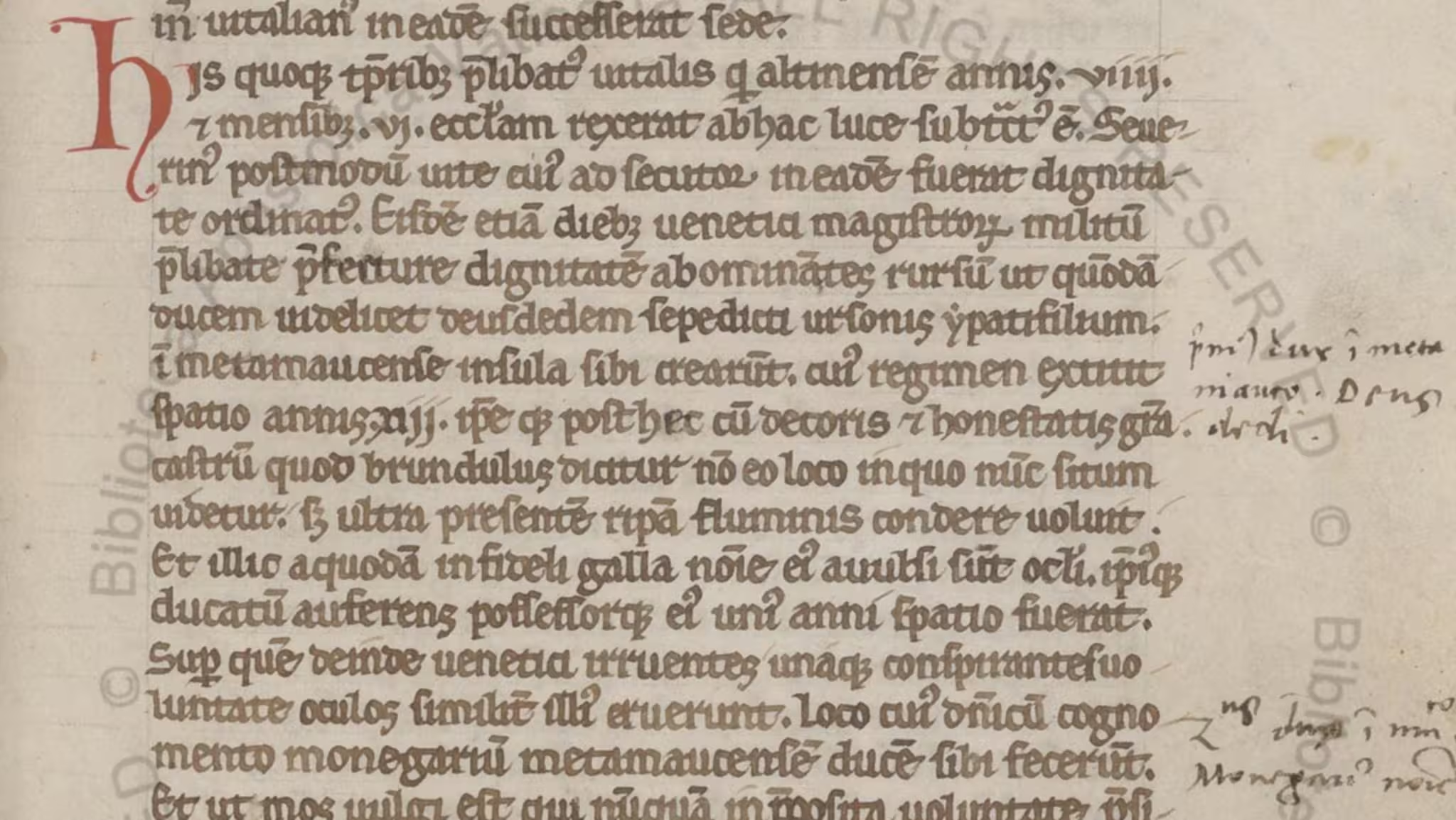
The oldest extant source is the Istoria Veneticorum by John the Deacon, written around the year 1000. He wrote of Deusdedit as magister militum:
Then a third master of the soldiers was called Deusdedit, the son of the aforementioned Ursus, the slain duke, who also held that power for the space of one year.
Istoria Veneticorum, II.11.
And as doge:
At the same time, the Venetians, abhorring the esteemed dignity of the prefects, again, as before, chose a duke for themselves, namely Deusdedit, the son of Ursus the hypatos, on the island of Metamauco; his rule lasted for a period of 13 years.
He himself, after this, for the sake of honour and reputation, wished to build a fortress called Brondolo, not in its current location, but beyond the present bank of the river, and there, by a certain unfaithful man named Galla, his eyes were put out and his duchy was taken, …
Istoria Veneticorum, II.17.
Chronicon Altinate
The anonymous Chronicon Altinate, of uncertain date, only has two lines.
Deusdedit as magister militum:
Deusdedit, Master of Soldiers, served for 2 years.
Chronicon Altinate, Liber I, Cessi (1933), p. 28 and p. 115.
And Deusdedit as doge:
Duke and hypatos Deusdedit ruled for 13 years.
Chronicon Altinate, Liber I, Cessi (1933), p. 29 and p. 116.
This mention is the earliest source for the title of hypatos.
Andrea Dandolo
Doge Andrea Dandolo, writing his Chronica per extensum descripta in the 1340s, associated the reign of Deusdedit with the Largitio Astolfina, probably based on his more explicit chronology.
We have no sources indicating duke Deusdedit had any role whatsoever in the Lombard concession.
These are the relevant chapters of book VII.
Deusdedit, master of the soldiers, began to rule in the year of our Lord Jesus Christ, 739. Here, the son of the slain leader, recalled from exile, was honoured with the military command by the Venetians, to somewhat exact satisfaction for his injustices.
Certainly, Deusdedit held the throne for one year; and in some records, it is found that he held the throne for two years; namely, that after completing the first year, he was again approved for the second.
Chronica per extensum descripta, VII.6
Deusdedit as doge:
Duke Deusdedit was appointed in the year of our Lord Jesus Christ seven hundred and forty-two.
Because the Venetians had proven through experience that the annual rulers were useless to them, they unanimously chose this leader, the son of Duke Ursus, who had been killed, at the gathering held in Metamauco, and established the duke’s seat in the same place.
Here, because he was noble and an imperial hypatos, that is, a consul, he served honourably.
… omissis …
Aistulf, who was the duke of Forum Iulii, at this time succeeded his brother Ratchis, who had become a monk, in the kingdom of the Lombards.
This king definitively confirmed the boundaries of the city of Heraclia, delineated at the time by duke Paulicius and Master of the Soldiers Marcellus, namely, from the greater Piave up to the dry Piave.
… omissis …
Here, duke Deusdedit, in the thirteenth year of his rule, while attending to the fortification of the strongest castle on the other bank of the estuary of the Brenta river for its protection, was, by Galla, a most wicked man, deprived of his rule and sight.
Chronica per extensum descripta, VII.9
Bibliography
- Dandolo, Andrea and Ester Pastorello. Chronica per extensum descripta in Rerum Italicarum scriptores : raccolta degli storici italiani dal Cinquecento al Millecinquecento / ordinata da L. A. Muratori , 12.1. Bologna : N. Zanichelli, 1938-1958. [more] 🔗
- Iohannes : Diaconus Venetus. Chronicon Venetum omnium quae circumferuntur vetustissimum et Johanni Sagornino vulgo tributum e mss. codice Apostoli Zeno V. Cl. nunc primum cum mss. codicibus Vaticanis collatum, notisque illustratum in lucem profert H. Fr. Zanetti Al. F. Venetiis, 1765. [more] 🔗
- Iohannes : Diaconus Venetus and Luigi Andrea Berto. Istoria Veneticorum. Bologna Zanichelli, 1999. [more] 🔗
- Monticolo, Giovanni. Cronache veneziane antichissime. Roma, Forzani e C. tipografi del Senato, 1890. [more] 🔗
- Rossi, Antonio, Giovanni Galvani, Martino : da Canale and Emmanuele Antonio Cicogna. La Cronaca veneta detta Altinate di autore anonimo, in latino, preceduta da un commentario del prof. Antonio Rossi e La cronaca dei Veneziani del maestro Martino da Canale, nell'antico francese, colla corrispondente versione italiana del conte Giovanni Galvani e con annotazioni di Emmanuele Cicogna … [et al.]. Firenze : Gio. Pietro Vieusseux, 1845. [more] 🔗
Leave a Reply