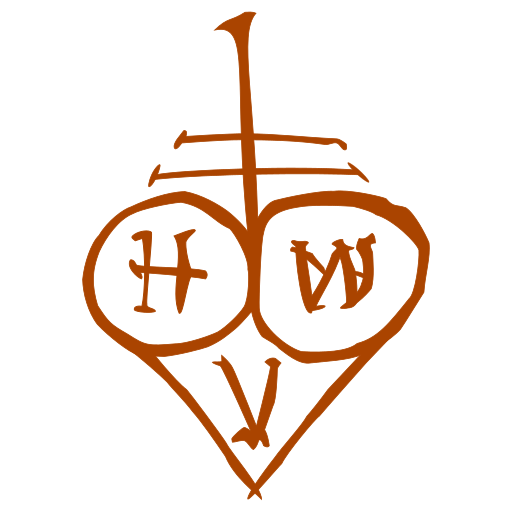
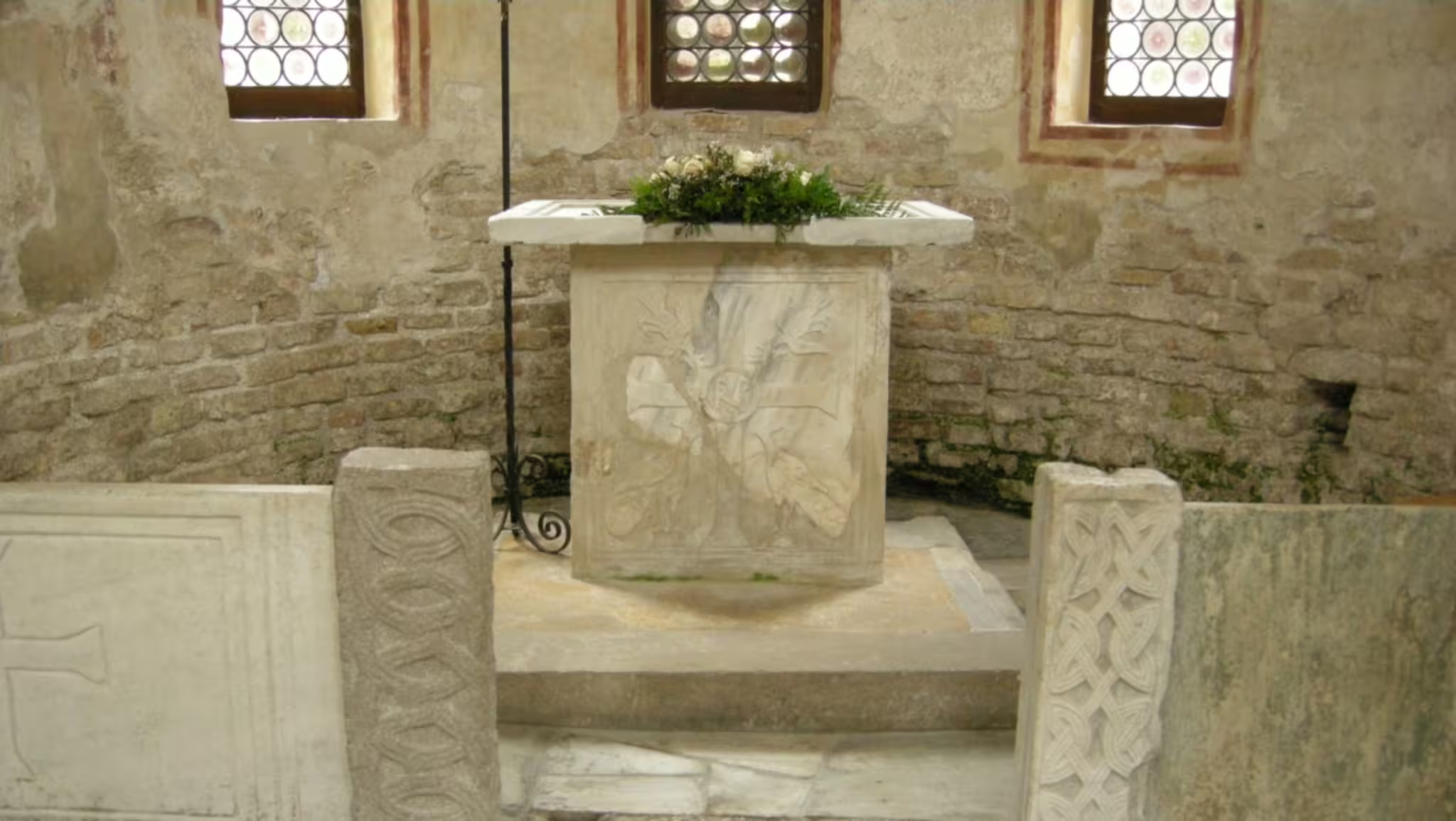
According to ancient legend, the Patriarchate of Aquileia was established in the 1st century by St Mark and St Peter.
St Mark had come to Aquileia — the capital of north-east Italy in Roman times — and chose Hermagoras to lead the local church. Together, they travelled to Rome, where Hermagoras was invested as bishop of Aquileia by St Peter himself.
This would make the Church of Aquileia one of the most ancient Christian communities.
Such an origin story of the church of Aquileia was highly useful — both for the local church and for the Venetians — as it placed the church of Aquileia on an almost equal footing with the Patriarchate of Alexandria, founded by St Mark, and the Papacy in Rome, founded by St Peter.
In fact, it is much more likely that the church of Aquileia was established in the early 300s, and that Hermagoras — later sanctified — lived then.
Aquileia was, nevertheless, one of the first areas of Italy where Christians could worship freely, and the archbishop of Aquileia was — at least locally — considered second only to the pope, thanks to that legend of the apostolic succession from both St Mark and St Peter.
Much later, the Byzantine emperor Heraclius gifted the chair of St Mark — a throne carved in marble — to the cathedral of St Euphemia at Grado, probably due to this perceived bond between St Mark and the archdiocese of Aquileia.
The later translation of the bones of St Mark from Alexandria in Egypt to Venice, in 828, was based on this ancient bond between St Mark and Aquileia. If his remains couldn’t rest in his native Alexandria — where he had founded the Orthodox Church of Africa of which he was the first patriarch — Aquileia would be the next-best place. Or Grado, as things developed.
In fact, he ended in Rivoalto because politics.
The Schism of the Three Chapters
The Schism of the Three Chapters is a complicated story, and most of the main events unfolded in the east, between the church of Constantinople and the oriental churches of Asia and Africa, in primis, the church of Alexandria.
It was, nevertheless, a pivotal event on the road towards a Venetian church.
The early Christian church had several disputes over the nature of Christ. Was he human, divine, a human who became divine, or human and divine at the same time, and in that case, which was the dominant nature of Christ, how did the two natures interact, and so on? Furthermore, how was the divinity of Christ related to the divinity of God?
It is tempting to think that such disputes wouldn’t make one iota of difference, but they did.
The debate over the nature of Christ and the nature of his divinity went on for centuries, and was central for several church councils through the 300s, 400s and 500s.
The idiom itself — one iota of difference — come from those disputes.
One of the points of view in this debate, established by the Council of Nicaea in 325, was that the divinity of God and Christ was of the same essence — in Greek, homoousios.
The Arians — who were condemned as heretics at the council of Nicaea — believed that the divinities of God and Christ were of different, but of similar essence — in Greek, homoiousios.
This was a major split within early Christianity, with ramifications for centuries afterwards, but the Greek words for the two lines of thought only differ by one letter “ι”, a Greek iota. An “ι” is tiny, but in this case, it made a huge difference.
The Lombards, at the time of their migration into Italy in 568, were largely Arian, so those ideas were around for several centuries. The Lombards converted to orthodoxy later, once they were established in Italy.
Likewise, the Orthodox African Church, founded by St Mark in the first century, had a different view on this question than the Orthodox Church of Constantinople. The main division happened at the Council of Chalcedon in 451, where the churches of Constantinople and Alexandria parted ways.
Almost a century later, in 543, emperor Justinian tried to reconcile these differences between the church of Constantinople, and the oriental churches of Africa and Asia, with a political move.
In an edict, he condemned certain writings of three long dead bishops of Antioch, which together were known as the Three Chapters.
These chapters had been accepted at the Council of Chalcedon, but were now condemned within the Byzantine Empire.
The schism in Italy
The western Churches, which had supported the canons of Chalcedon, refused to accept the Byzantine condemnation of the Three Chapters.
This only really mattered in the parts of Italy, which were under Byzantine control.
The pope quickly acquiesced to pressure from Constantinople, but the bishops of Milan, Aquileia and from Istria didn’t, and were consequently excommunicated.
The archbishop of Aquileia, Paulinus, held a synod around 560, where he excommunicated pope Pelagius, emperor Justinian and the praetorian prefect of Italy, Narses.
At the time of the Lombard invasion in 568, the church of Venetia was therefore not in communion with the papacy and Constantinople.
When the Lombards arrived at Aquileia, Paulinus fled to Grado, which was in Byzantine controlled territory, but didn’t change his stance on the Three Chapters.
The main church in Grado — a metropolitan church after the arrival of Paulinus — was therefore dedicated to St Euphemia, just as the church in which the Council of Chalcedon had been held.
For those who knew their church history, that was a clear statement against the imperial condemnation of the Three Chapters.
The Archdiocese of Aquileia — now called Patriarchate to emphasise its independence of Rome — was subsequently based in Grado. The city of Grado is therefore often referred to as New Aquileia to underline the continuity.
However, the archdiocese, or patriarchate, was still undivided through the reigns of the patriarchs Probinus, Elias and Severus.
When Severus died in 606, the rebellious spirit in Grado was wearing thin, while the pressure from Constantinople to conform to imperial orthodoxy hadn’t diminished.
Consequently, the canons in Grado chose Candidianus as the new patriarch, who promptly returned the Patriarchate of Aquileia in communion with Rome and Constantinople.
The schism was over, but would immediately lead to another.
Two Patriarchs
Those of the chapter of Grado who didn’t agree with the line of Candidianus, left Grado. They returned to old Aquileia, in Lombard territory, where they chose Giovanni as Patriarch of Aquileia.
Consequently, from 606, there were two patriarchs of Aquileia — one in Old Aquileia, which was now in the Kingdom of the Lombards, and one of New Aquileia, which was in the Byzantine Venetia Maritima.
The schismatic line of patriarchs in old Aquileia continued until 698, when internal Lombard politics made it opportune to return to orthodoxy and communion with Rome.
In principle, the two patriarchates should then be reunited, but that didn’t happen.
It had at this time become customary within the Christian churches for the borders of ecclesiastical jurisdictions to follow the main political divides.
Old Aquileia was in the Kingdom of the Lombards, and New Aquileia — Grado — was in Venetia Maritima within the Exarchate of Ravenna, in the Byzantine sphere.
The two patriarchates therefore continued to exist side by side, each with jurisdiction over the dioceses within the same political entity.
The Patriarchate of Grado consequently oversaw the dioceses of Venetia Maritima from Grado in the north to Cavarzere in the south, near the Po estuary, and of the Istrian peninsula in modern-day Croatia, east of Grado.
The rest of ancient Venetia et Histria was in Lombard lands, and under the patriarchate of Aquileia.
Despite this political divide, both patriarchates continued to claim formal jurisdiction over the dioceses in the other polity, making sure the conflict wouldn’t end soon.
In fact, this conflict would continue for centuries, and even deteriorate into armed clashes and raids, until the Venetian conquest of the feudal Patriarchal State of Aquileia in 1420.
Bibliography
- Gasparri, Stefano and Sauro Gelichi. Le isole del rifugio : Venezia prima di Venezia. Bari, Laterza, 2024. [more]
- Paulus : Diaconus and William Dudley Foulke (translator). History of the Langobards. New York Longmans, Green & Co., 1907. [more] 🔗
- Rando, Daniela. Una Chiesa di frontiera: le istituzioni ecclesiastiche veneziane nei secoli 6.-12.. Bologna Il mulino, 1994.
Leave a Reply