Early Venice, as a political entity, started as a duchy — what the Venetians later called the dogado.
There was nothing odd in that. This was the normal form of territorial organisation both in the Exarchate of Ravenna, and in the Kingdom of the Lombards.
A duchy must be in want of a duke, but the situation around the first dukes — or doges — of a more or less independent Duchy of the Venetians is very murky indeed.
We don’t even know who the first doge of Venice was, or when he was elected.
Byzantine dukes and duchies
The Exarchate of Ravenna was subdivided into duchies. They were territories, each governed by a military leader called a dux, and they were therefore called ducati (in the singular, ducatus).
The English words ‘duke’ and ‘duchy’ come from there, and so do the Venetian doge and dogado.
Rome and Naples were such Byzantine duchies, as was Perugia, the Pentapolis south of Ravenna, and, indeed, Venetia.
There might have been other Byzantine duchies.
We often have very scarce information about the exarchate and the Byzantine duchies, as the system was created on an ad hoc basis, as a military emergency response to the Lombard invasion. We can’t even draw up a reliable list of the Exarchs of Ravenna, and much less of their subordinate territorial commanders.
Lombard dukes and duchies
Before the invasion of Italy in 568, the Lombards had lived in close contact with Byzantium for half a century. That is at least two generations, so many Lombards only knew the Byzantine world — or rather, they knew the periphery of it.
They had lived on Byzantine lands, and they had sent troops as auxiliaries for Byzantine wars, including the Gothic Wars in Italy in the 550s.
When the Lombards migrated to Italy and established themselves there, they created a somewhat similar organisation, and often used elements of the Byzantine terminology.
We therefore see — practically immediately — the creation of Lombard duchies, governed by Lombard dukes.
As they took over one Roman city after another, Alboin — the Lombard leader of the invasion, and later king of the Lombards — put his trusted brothers-in-arms in charge of them, as dukes.
Within the first few years, they created duchies of Forum Iulii (Friuli), Treviso, Vicenza, Verona, and Ceneda (modern Vittorio Veneto), and as the conquest progressed, many more were added. Several of these duchies would exist for centuries, and some well into the modern period.
The Venetian Dogado
When the Byzantine Venetians migrated to the many lagoon settlements, there was an existing system of government, which moved along.
The Exarchate of Ravenna already had a Ducatus Venetiarum — a duchy of the Venetians — with an appointed dux.
As that Byzantine duchy was reduced to the Venetia Maritima, the appointed dux moved from Oderzo (ancient Opitergium) on the mainland to Civitas Nova Heracliana in the lagoons in the estuary of the river Piave.
This happened around 640when Lombard attacks made Opitergium too insecure.
The polity, however, remained the Byzantine Ducatus Venetiarum. The dukes were Byzantine officials, not the heads of an independent nation.
Consequently, Venice was — at the start of its history — a Byzantine duchy governed by a Byzantine appointed dux.
At some point, the power of appointment shifted from the Exarchate of Ravenna to the local communities, ultimately leading to Venetian statehood and independence.
When did that happen?
Initially, we can limit the period to between the 640s and 751.
In the 640s, the dux, along with the bishop, moved from Oderzo to the New City (Civitas Nova or Cittanova) of Heraclea. We have no sources whatsoever indicating that this was anything but the head of the Byzantine military and civil administration, and of the local Orthodox church, moving to a nearby, but safer city.
A century later, in 751, the Lombard king Aistulf attacked and took Ravenna. The last exarch was killed, and no successor was ever appointed. This ended the Exarchate of Ravenna, and eliminated any Byzantine presence in north-eastern Italy, except for the now detached Duchy of the Venetians.
The birth of Venice as a political entity, with some degree of independence, must therefore be found in this period.
The first doges
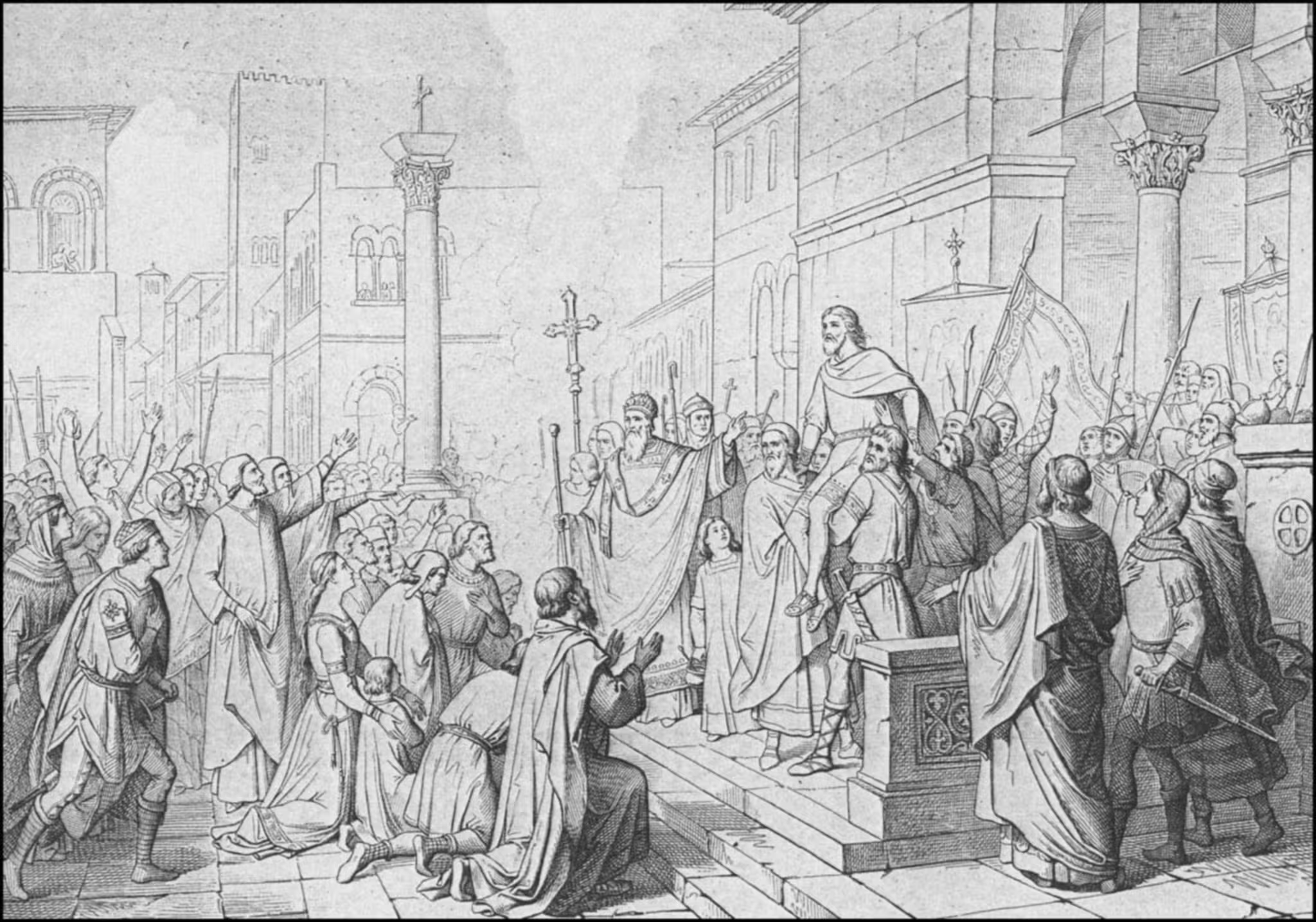
According to tradition, the transition happened in 697, with the appointment of duke Paulicius by a local assembly of citizens and clergy in Heraclea.
The official list of the first doges are:
- Paulicius 697–717
- Marcellus 717–726
- Ursus 726–737
Our source for this line of succession is the Chronica per extensum descripta by Andrea Dandolo, which is from the 1340s, that is, six centuries after the events.
The earliest source, and the one Dandolo used, is the Istoria Veneticorum by John the Deacon, written around the year 1000, by a clergyman who was very close to doge Pietro II Orseolo, and therefore with access to the ducal chancery and archives.
His list is less clear:
- Paulicius, from around 713–715 to 727, but reigned 20 years
- Marcellus, from 727 to ?, reigned 18 years
- Ursus, from ? to ?, reigned 11 years.
This is the oldest source we have for the first doges, and it is still from three centuries after the events.
So when did Venice become independent, in the sense of choosing its own ruler?
Looking into the nitty-gritty details of the possible sources of John the Deacon’s information, it appears that he ‘misread’ a document called the Pactum Lotharii, probably on purpose, to bring the line of doges further back in time.
The Pactum Lotharii mentioned a Paulicius dux, who, with an opposing Marcellus magister militum, agreed on the border between the lagoon city of Heraclea and the Lombard territory on the mainland.
Since the agreement is clearly between the two, Paulicius and Marcellus, and the latter has a title, which was only used in Byzantine territories, the Paulicius mentioned had to be a Lombard duke.
The Pactum Lotharii is the only known document where John the Deacon could have picked up the two names, and there is no doubt that he knew the treaty.
Consequently, there was no Venetian doge Paulicius.
He was not a Venetian, he was not Byzantine, he was a Lombard.
John the Deacon then picked Marcellus as the second doge, and placed the start of his reign in 727.
The year is significant. In 726–727, most of Byzantine Italy was in rebellion against an iconoclast edict issued by emperor Leo III. The exarch was killed, and it took quite a while for the empire to regain control.
The Liber Pontificalis — the Book of the Popes — recounted these events during the reign of Gregory II, including the participation of the Venetians in the rebellion, and noted how they chose all leaders for themselves throughout Italy.
Venice therefore had to have a new ruler in that period.
John the Deacon always tried to write all Byzantine influence out of his narrative, and he couldn’t entirely ignore something everybody knew, so he made Marcellus the second doge of Venice, from 727.
He made Marcellus a Venetian doge, as he had to, but, given the title of magister militum, Marcellus was almost certainly a Byzantine official.
Andrea Dandolo, in his much later chronicle, tried to correct these inconsistencies.
Counting backwards, he made the reign of Paulicius start much earlier, and had Marcellus die in 726, so the third doge Ursus could be elected to coincide with the account of the Liber Pontificalis.
When was it? And who?
So, trying to answer the question of when did the Venetians choose their own leader for the first time, we don’t really have an answer.
It all boils down to how much we’re willing to trust John the Deacon, and he is not a very reliable source for the early period. All the other sources either derive from John the Deacon, or they are much later and possibly falsified.
Paulicius was almost certainly fictitious.
Marcellus might have existed, but in that case, as a Byzantine official in charge of the Venetia Maritima or a part thereof.
We don’t really have much more or better information about the third doge Ursus, but the consensus today is, that he was the first Venetian doge, chosen following the rebellion after the iconoclast edict.
To summarise, the two first doges of Venice weren’t doges of Venice, and the third might not have been, but we have nobody else to put there.
Bibliography
- Dandolo, Andrea and Ester Pastorello. Chronica per extensum descripta in Rerum Italicarum scriptores : raccolta degli storici italiani dal Cinquecento al Millecinquecento / ordinata da L. A. Muratori , 12.1. Bologna : N. Zanichelli, 1938-1958. [more] 🔗
- Duchesne, Louis. Le liber pontificalis / texte, introduction et commentaire, 2 voll. Paris : Thorin, 1886-1892. [more] 🔗
- Iohannes : Diaconus Venetus. Chronicon Venetum omnium quae circumferuntur vetustissimum et Johanni Sagornino vulgo tributum e mss. codice Apostoli Zeno V. Cl. nunc primum cum mss. codicibus Vaticanis collatum, notisque illustratum in lucem profert H. Fr. Zanetti Al. F. Venetiis, 1765. [more] 🔗
- Iohannes : Diaconus Venetus and Luigi Andrea Berto. Istoria Veneticorum. Bologna Zanichelli, 1999. [more] 🔗
Localities
Illustration by Giuseppe Lorenzo Gatteri (1829-1884), from La storia veneta espressa in centocinquanta tavole inventate e disegnate da Giuseppe Gatteri, incise da Antonio Viviani e dai migliori artisti veneziani ed illustrate da Francesco Zanotto. Venezia: Giuseppe Grimaldo, 1860.
Leave a Reply