
The Chronica per extensum descripta by Andrea Dandolo — doge of Venice 1343-1354 — was an influential early chronicle of the history of Venice, from the mythical foundations to the early 1300s.
It is also called Andreae Danduli ducis venetiarum Chronica per extensum descripta, which is shorted to Chronica per extensum descripta, or just the Chronica extensa. It is also called the Chronicon Venetum.
Andrea Dandolo also wrote a short chronicle, the Chronica brevis, during his tenure as Procuratore di San Marco, before being created doge.
Andrea Dandolo
Andrea Dandolo was a Venetian aristocrat and politician, an esteemed scholar, and a friend of Petrarch, who wrote:
… the most marvellous city of Venice, and its illustrious duke, to be named also for the sake of honour, Andreas, a man famous no less for his devotion to the good arts than for the insignia of such a great magistracy.
Petrarch, Familiari, VIII, 5.
Andrea Dandolo was born in 1306, on May 3rd, into one of the most ancient Venetian noble families, one of the so-called case vecchie (old houses), which were considers as old as the Republic of Venice.
It is fairly well established that he studied Law at the University of Padua, as it is attested by numerous contemporary sources, but there is some doubt about whether he obtained a degree. None of the most important extant documents related to him — such as the promissione ducale, his last will and testament, and the inscription on his tomb — attribute the title of doctor to him.
Another testament to the high esteem in which Andrea Dandolo was held by his contemporaries and peers, was that he was shortlisted for the dogado in 1339, at the young age of thirty. However, he lost the election to Bartolomeo Gradenigo.
After the death of Gradenigo in December 1342, he was shortlisted again, and this time he was elected.
He was created1 doge in January 1343 — which according to the Venetian calendar was 1342 — at the age of 36. Even in a world where many didn’t live much longer than that, it was considered a very young age for such an august position. Most doges were created at a much later age, and it attests to a very swift rise in Venetian politics.
In fact, the other contestant of 1339, Marin Falier, who succeed Dandolo in 1354, was created doge at the age of eighty.
Andrea Dandolo was a man of law, of books, and of faith, and that was how he started his reign. He initiated a reordering of the statute books of the Republic, and he funded important works on the Pala d’Oro on the altar in the Basilica di San Marco.
Foreign affairs, however, intervened, and pushed his reign in a direction, which he was much less suited for: war and conflict.
The Smyrniote Crusades (1343–1351), a rebellion of the city of Zara in Dalmatia in 1345, which soon involved the Kingdom of Hungary, and the War of the Straits (1350–1355) against Genoa, all drained the resources of Venice, and took up the time of its governors, in primis the doge Andrea Dandolo.
In particular, the war with Genoa ruined his friendship with Petrarch, who was vociferously against the war as fratricidal.
Finally, in 1348, bubonic plague arrived in Venice, killing probably around one third of the entire population. This was the first wave of the black plague, which would haunt Venice, Italy and Europe for several centuries to come.
Yet, during the 1340s, he also managed to write the Chronicon Venetum.
Dandolo died in 1354, aged 48, of unknown causes. He was the last doge to be buried inside the Basilica of St Mark, where his tomb still stands today.
The judgement of his contemporaries was generally positive, but also ambiguous. This is from the anonymous Venetiarum Historia, dating to around the 1360s:
A young man in age, but oldest in wisdom, noble, courteous, generous, wise, lovable and very eloquent, whose fame spread throughout the world, but full of vanity, lies, weakness, and cowardice.
Cessi et.al. (1964).
The Chronica per extensum descripta
We have surviving manuscripts, originating in the ducal chancery, from the reign of Andrea Dandolo.
The oldest, mostly written between 1344 and 1347, was in eight notebooks, which were bound into a single volume in the late 1400s, with some additions by the then owner, the Venetian nobleman Ambrogio Contarini.
The chronicle is traditionally divided into seven books, numbered from four to ten.2
Paraphrased from the index added by Ambrogio Contarini:
- Book four begins with the pontificate of Saint Mark the Evangelist in Aquileia, year of Our Lord, 48.
- Book five begins with the new construction of the Venetian province under Augustine, bishop of Aquileia, year of Our Lord, 407.
- Book six begins with the translation of the new metropolitan seat from Aquileia to Grado, year of Our Lord 531 under Bishop Helias of Aquileia.
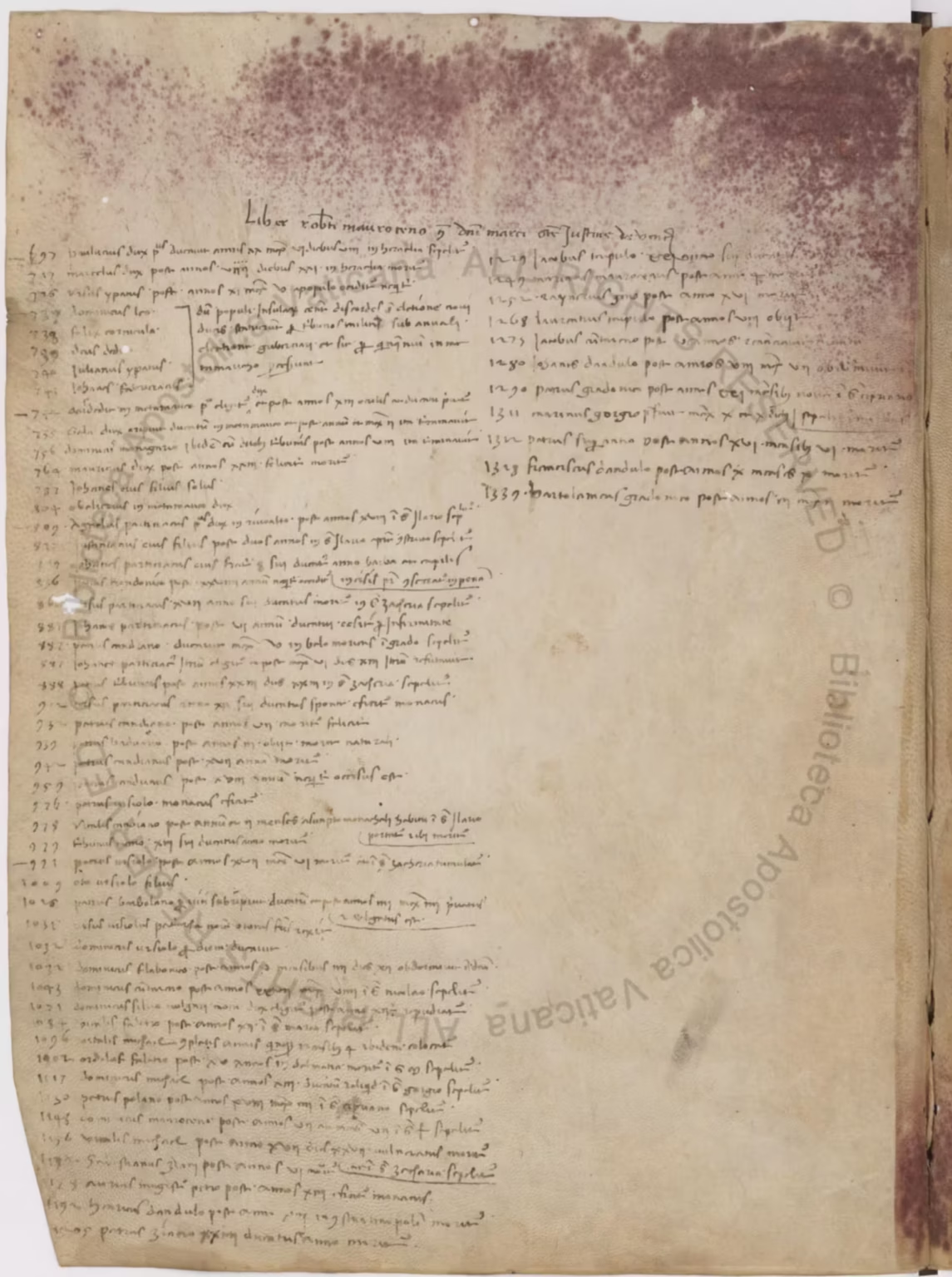
- Book seven begins with the enthronement of the Dukes of Venice in the city of Heraclia, year of Our Lord 697, starting with Paulucio as first duke. It also lists the important families which moved to Rivoalto from other lagoon settlements.
- Book eight begins with the new restoration of the ducal seat of Metamauco transferred to Rivoalto, year of Our Lord 809 under Angelo Partecipazio.
- Book nine begins with the acquisition of the new Duchy of Dalmatia, year of Our Lord 991 under Pietro Orseolo as Duke.
- Book ten begins with Sebastiano Ziani, the first duke elected, year of Our Lord 1172.
The first three books are more legend than fact, and in particular the first, but there is a reason for the legends.
By making St Mark the founder of the Patriarchate of Aquileia, and therefore of the Patriarchate of Grado and the later Venetian church, Dandolo placed the Venetian church on an almost equal footing with the Roman church.
The Patriarchate of Antioch and the Papacy of Rome were both founded by St Peter, and with the two patriarchates of Alexandria and Aquileia founded by St Mark, a disciple and companion of St Peter, Venice would be in excellent company indeed. Even more so, as the Venetian church would predate the Patriarchate of Constantinople.
Likewise, the reconstruction of the province of Venetia by the Patriarch of Aquileia, rather than by the Byzantines, served to underline that Venice had always been independent, and never subservient to Constantinople.
The Chronicon Venetum gave Venice an authoritative origin narrative — also thanks to the supreme position of the author — which emphasised the political, religious and historical independence of Venice at all times. In this narrative, Venice had never been under Ostrogoth, Byzantine or Lombard rule, but was born free and independent.
This is well in line with the political line of Istoria Veneticorum by John the Deacon, written three centuries earlier, but such a narrative was even more important at the time of Andrea Dandolo, with Venice in a much more powerful position internationally.
The generally accepted list of doges also originates in the Chronicon Venetum, including placing the start of the list in the year 697, which doesn’t agree with our earliest source, John the Deacon.
Dandolo’s sources
Needless to say, Dandolo and his chancery had full access to all the documents in the Venetian archives.
He had read Cassiodorus, Paul the Deacon, both Historia Langobardorum and Storia Romana, Istoria Veneticorum by John the Deacon, the anonymous Chronicon Altinate, the chronicles of the patriarchs of Grado, Martin da Canal, and many more.
Much of the non-Venetian and early church related material in the Chronica per extensum descripta is copied, more or less verbatim, from the Historica Satyrica (or Satirica ystoria) by Paolino Veneto.
As the name implies, Paolino had roots in or around Venice, but nothing is known of his family background. He was likely born in the early 1270s, and in 1324, he was appointed bishop of Pozzuoli near Naples. There, he wrote several books, including the Satirica ystoria. He died in 1344, during the reign of Dandolo in Venice.
Dandolo must therefore have had access to a contemporary copy of Paolino’s work, so it is not unlikely that they knew each other. However, the copy used by Dandolo hasn’t survived, even if other copies have.
The importance for Venice
It is difficult to overstate the importance of the Chronica per extensum descripta by Andrea Dandolo for the earlier historiography of Venice.
Marco Foscarini — a scholar and writer who, like Dandolo, became doge —expressed it this way:
The Annals of Doge Andrea Dandolo are generally regarded as the oldest and most reliable record of the City; whether this is due to the merit of the work, the nobility of the author, or finally the fact that they came to light when customs were beginning to be purified and the writers’ craft was gaining prestige, these Annals achieved such fame that the memory of those who had worked on the same subject earlier was almost entirely erased; and it would have been completely lost, if, some years ago, the scholarly curiosity of a few had not intervened, who managed to recover the names of more than one chronicler preceding the aforementioned Doge, and also to reclaim some precious remnants of such works.
Foscarini (1752), p. 105.
In short, until then, the Chronica extensa was what every other chronicle was measured against, or tried to improve upon. It was the authoritative reference for the early history of Venice.
Foscarini, writing in the mid-1700s, saw it as his task to find and make known again the writers on Venetian history from before Dandolo, such as Istoria Veneticorum by John the Deacon, and the anonymous Chronicon Altinate.
Manuscripts and versions
The autograph of the Chronica per extensum descripta doesn’t exist, and maybe never did, as Dandolo had all the scribes, amanuenses, and notaries he could ever need at his disposal.
The oldest extant manuscript is in the Marciana Library in Venice, shelf-mark Lat. Fondo Antico 400, which was likely produced in the ducal chancery, under the direct supervision of Andrea Dandolo himself.
This manuscript contains corrections and annotations in the margins, which appear to by the hand of Beneintendi de’ Ravagnani, who served in the palace at the time of Andrea Dandolo, and as Cancellier grando from 1352.
The manuscript was originally kept in the ducal archives in the form of eight separate notebooks, as the first page of each show notable signs of wear and tear.
A century later, in the 1460s or 1470s, it was the property of Ambrogio Contarini (†1491) of San Silvestro, q.m. Federico (†1448). Contarini added an index, wrote various annotations, completed the list of doges until 1486, and had the eight notebooks bound in a single codex.
It is unclear how the manuscript became the property of Contarini. He was a Savio di Terra ferma, so he had access to the palace, and his father was a Procuratore di San Marco, a rank second only to the doge.
The codex remained the property of various branches of the Contarini until 1713, when it passed to the national library of the Serenissima, the Marciana Library.
Half a dozen other manuscripts are copies from up through the 1400s. The earliest of these in the National Archives of Turin, and dates from before 1370, attested by a notary of the ducal chancery. Today, only parts of it survive, due to a fire in 1904.
Such copies, often beautifully written with initials in coloured ink, were gifted to important figures, as the piece of political propaganda it was.
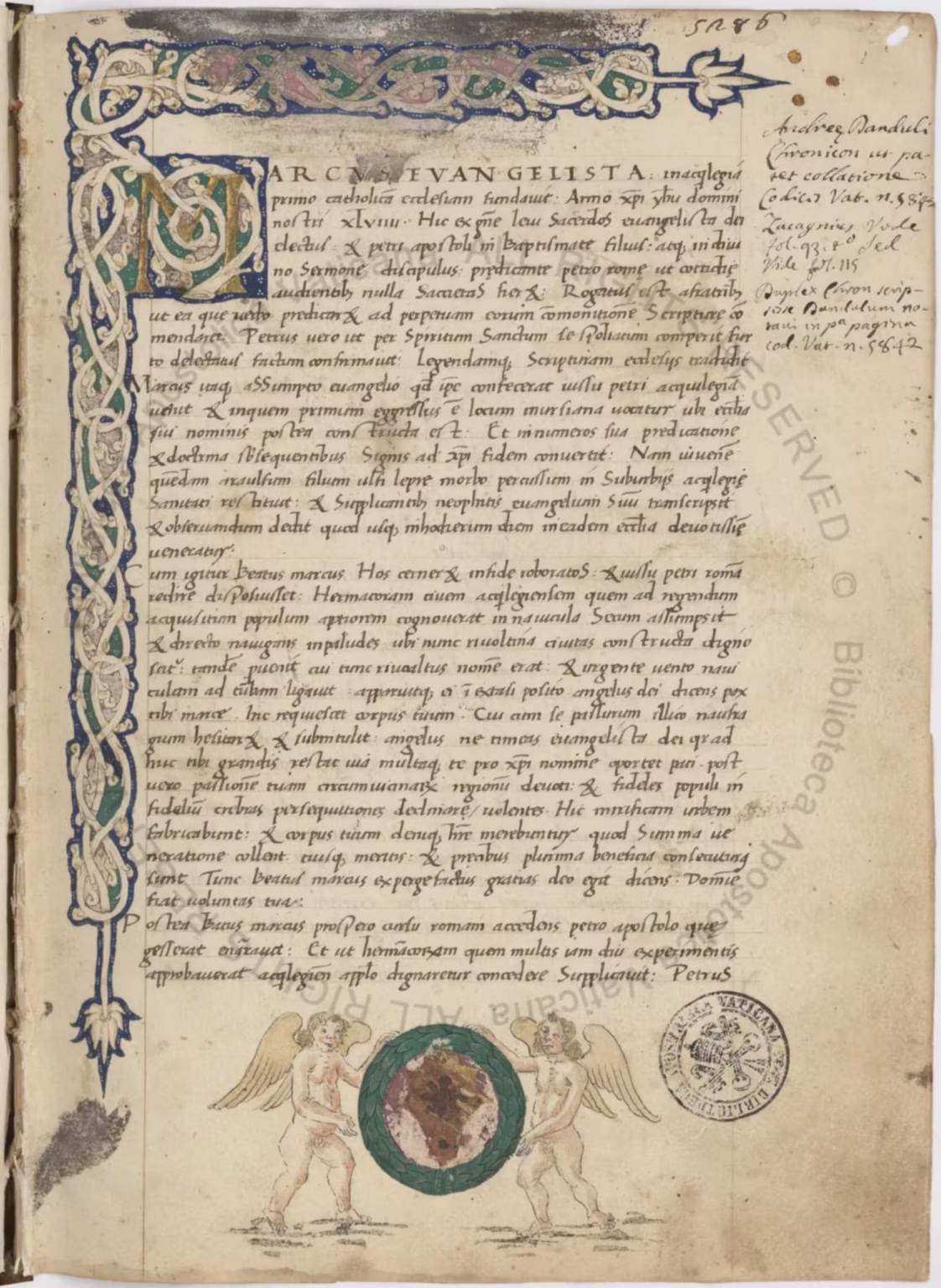
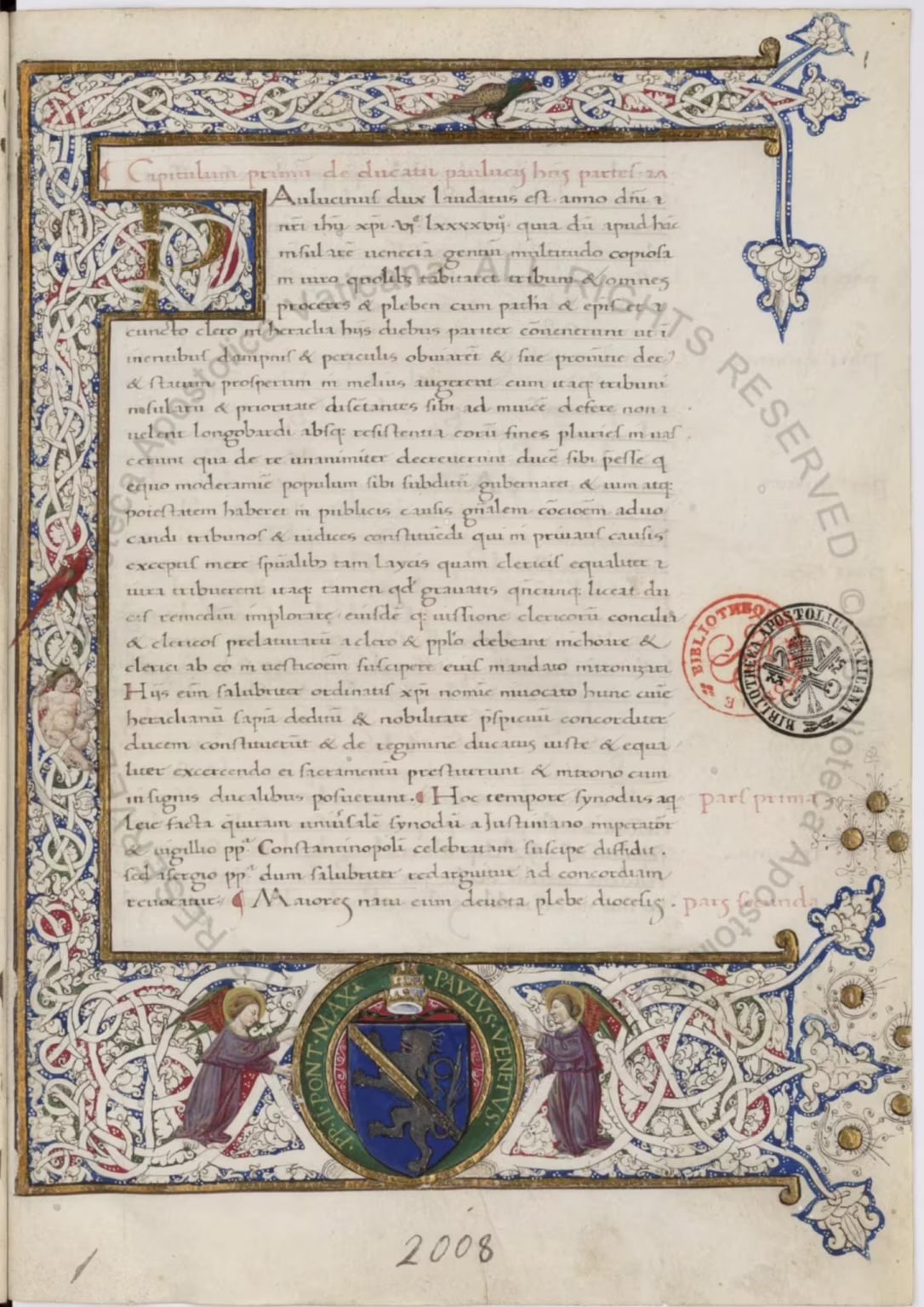
Of the earlier manuscripts, the Vatican Libraries have several available online: Vat. lat. 5282 and Vat. lat.5286 from the late 1300s, and Vat. Lat. 2008 (early 1400s) and Vat. lat.5842 (late 1400s). The French National Library has Lat. 5874 from the late 1400s, also as PDF.
The only print version of the Chronicon Venetum is Muratori (1723), volume 12, part 1 published in 1728, which has been re-published with an introduction and critical commentary by Ester Pastorello as Dandolo et.al. (1938), available from archive.org. Please see the bibliography below for the full references.
There are no translations from the original Latin, except early modern Venetian translations.
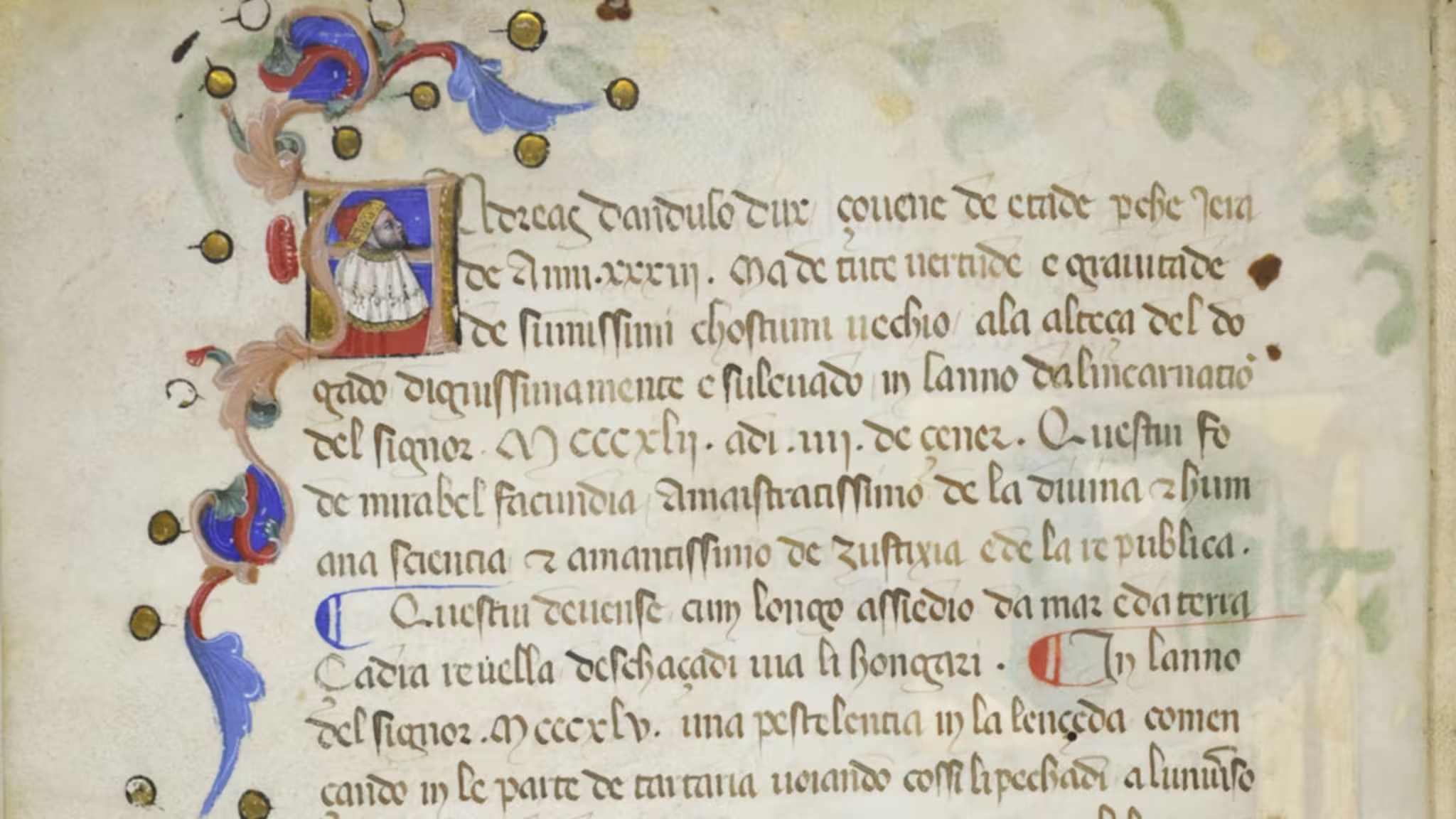
The illustration
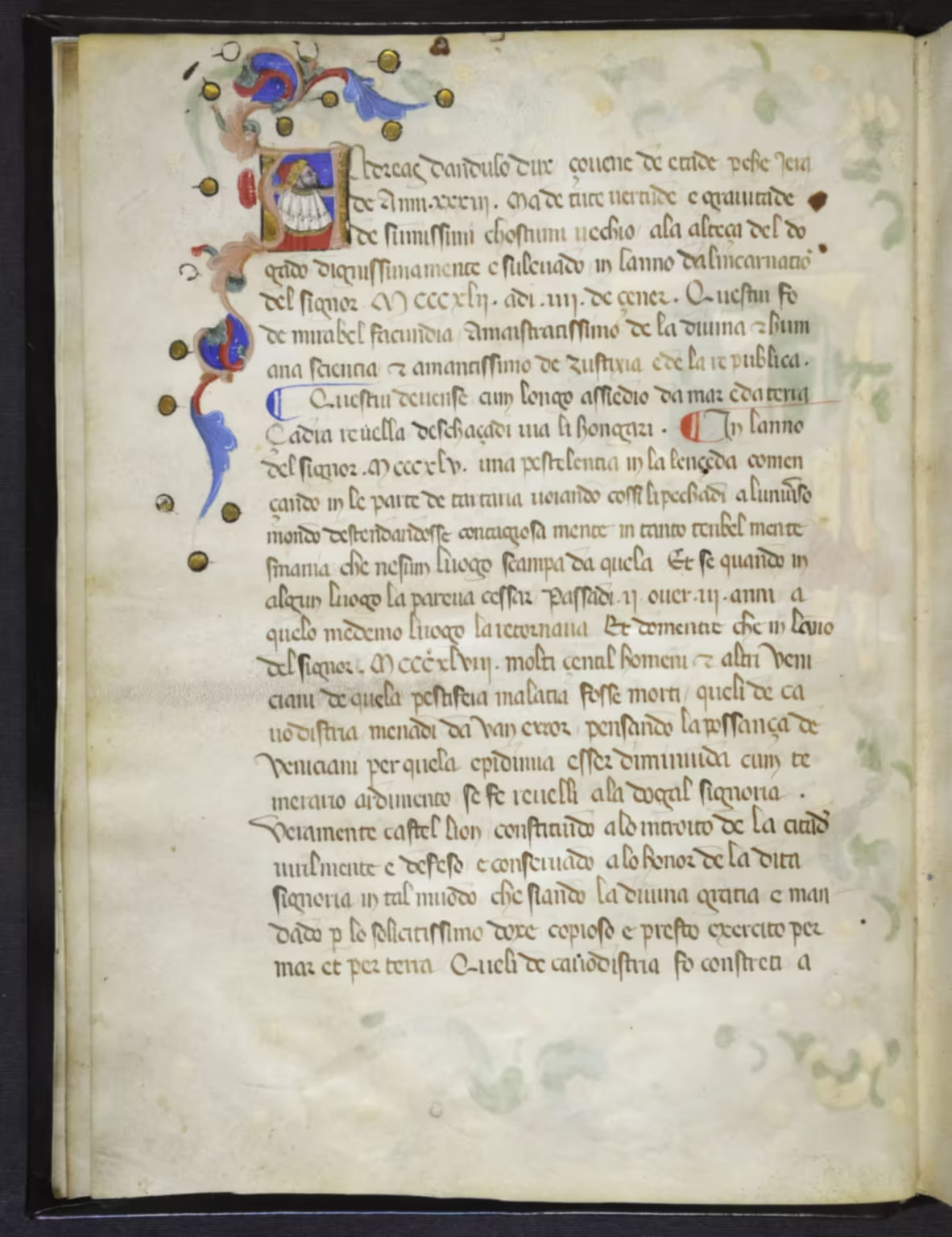
The illustration at the top of this page is from a manuscript with a continuation of Dandolo’s Chronica brevis, written between 1383 and 1386 by Raffaino de’ Caresini, then Cancelier Grando of the Republic of Venice.
The full title of this work is Chronica edita per me Raphainum de Caresinis Cancellarium Venetiarum continaundo historiam post Chronicam compilatam per illustrissimae memoriae memoriae meum Dominum Andream Dandulo ducem.
Translated: “Chronicle published by me, Raffaino de’ Caresini, Chancellor of Venice, continuing the history after the Chronicle compiled by my lord Andrea Dandolo, Duke, of the most illustrious memory.”
The manuscript is in the Marciana Library in Venice, codex it. VII, 770, image on foglio 1v.
Excerpts
- The first doges — VII.1–8 (excerpts)
- Hildeprand in Ravenna — VII.3, paragraphs 2–5.
- Doges of the 700s — VII.9–13.
Notes
- In the Republic of Venice, doges and other magistrates were created, rather than being elected, chosen or appointed. ↩︎
- The reason for this odd numbering is not entirely clear, but it seems to be partly from the original division into separate, unbound, notebooks, and partly from later, incomplete, copies of the text. ↩︎
Bibliography
- Cessi, Roberto and Fanny Bennato (eds). Venetiarum historia vulgo Petro Iustiniano Iustiniani filio adiudicata. Venezia : Deputazione di storia patria per le Venezie, 1964.
- Dandolo, Andrea and Ester Pastorello. Chronica per extensum descripta in Rerum Italicarum scriptores : raccolta degli storici italiani dal Cinquecento al Millecinquecento / ordinata da L. A. Muratori , 12.1. Bologna : N. Zanichelli, 1938-1958. [more] 🔗
- Foscarini, Marco. Della letteratura veneziana libri otto di Marco Foscarini cavaliere e procuratore. Volume primo. In Padova : nella Stamperia del seminario : appresso Gio. Manfrè, 1752. 🔗
- Muratori, Lodovico Antonio. Rerum Italicarum scriptores, 28 vols. Mediolani : ex Typographia Societatis Palatinae in Regia Curia, 1723-1751. [more]
Leave a Reply