Domenicus Monegarius was the sixth doge of Venice, following the deposition and blinding of duke Galla, who in turn had blinded and deposed duke Deusdedit.
He, too, was deposed and blinded after eight years on the ducal throne.
He ruled from 756 to 764, according to the chronology established in the 1340s by Andrea Dandolo.
The only original source for duke Domenicus is the Istoria Veneticorum by John the Deacon, written around the year 1000. The Chronicon Altinate, the Chronica per extensum descripta by Andrea Dandolo and other later chronicles mostly just repeated what John the Deacon wrote, without adding anything new.
There are no non-Venetian primary sources for duke Domenicus.
Factionalism and internal strife
The information about the person Domenicus Monegarius is very scarce.
He was from Metamauco, which is relevant due to the constant factional in-fighting in early Venetian society.
The doges Ursus and Deusdedit were natives of Heraclia, which Galla probably wasn’t, considering the way he took power.
Domenicus was most likely chosen in opposition to Galla, who had just been deposed. However, neither he was a representative of the aristocracy of Heraclia, which Galla had opposed.
This hints at a more complex system of interests and alliances within the early Venetian elite, than just a pro-Byzantine faction in Heraclia, and a pro-Lombard faction in Equilo and Metamauco.
Check and balances
The previous doges had ruled as autocrats with a power base in a subset of the internal factions. With Domenicus Monegarius we see, for the first time, an attempt at curbing or controlling the power of the duke
The ‘common people’ — which John the Deacon clearly disdained — not only chose the duke, but also two tribunes. They would serve under the doge, but for one-year terms, according to the ancient tradition of local tribunes in the lagoon settlements.
This was clearly an attempt at instituting checks and balances on the exercise of ducal power, to avoid the recurring outbreaks of factional violence which had ended the reigns of the previous three Venetian dukes.
There’s a slight hint in the account of John the Deacon that Domenicus Monegarius didn’t appreciate having the tribunes assigned.
In any case, it didn’t work — at least non sufficiently — because after eight years of rule, in yet another conspiracy, Domenicus Monegarius was deposed and blinded like his predecessors.
We do not know how and when he died, but it was likely shortly after his blinding.
Domenicus Monegarius is the first doge, who has a surname in the most ancient chronicles. In all the earlier cases, the surnames were either titles like hypatos, or they were surnames assigned to them centuries later.
Sources
Below are translations of the main primary sources we have for the life of duke Domenicus Monegarius.
John the Deacon
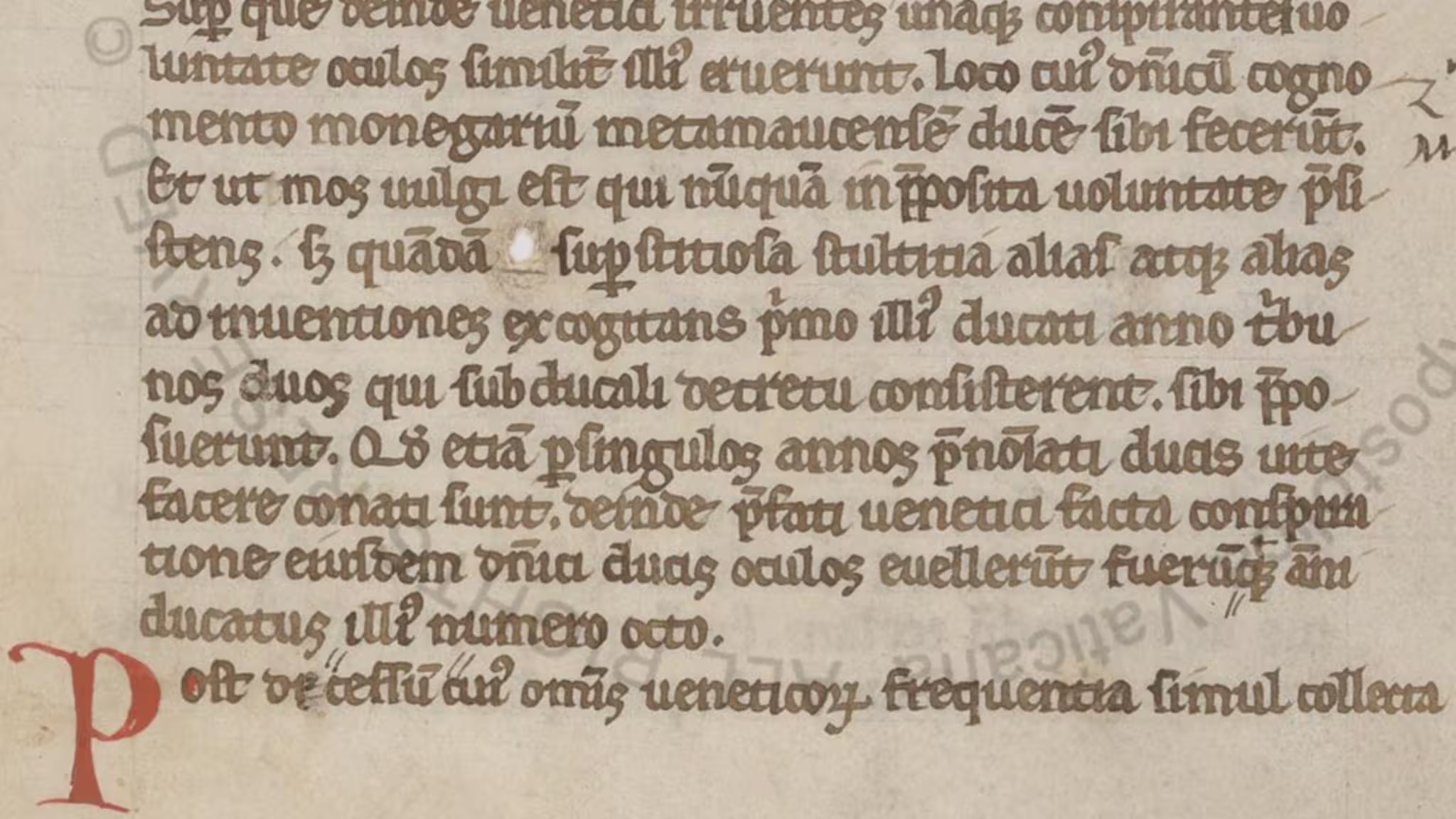
The oldest extant source is the Istoria Veneticorum by John the Deacon, written around the year 1000. He dedicated one paragraph to Domenicus:
In his place, Dominicus, surnamed Monegarius of Metamauco, was made their duke, and, as is the custom of the common people, who never persist in any given intention, but, driven by a certain superstitious folly, invent one idea after another, in the first year of his duchy they appointed for themselves two tribunes, who would serve under the ducal decree. This they also tried to carry out every year of the aforementioned duke’s life. Then the aforementioned Venetians, having made a conspiracy, plucked out the eyes of the same duke Dominicus, and the years of his duchy amounted to eight.
Istoria Veneticorum, II.18.
Chronicon Altinate
The anonymous Chronicon Altinate, of uncertain date, only has one line.
Duke Domenicus ruled for 8 years.
Chronicon Altinate, Liber I, Cessi (1933), p. 29 and p. 116.
Andrea Dandolo
Doge Andrea Dandolo, writing his Chronica per extensum descripta in the 1340s, has little more than John the Deacon, if not for literary flourishes.
These are the relevant parts of book VII:
Domenicus Monegarius was appointed duke in the year of our Lord Jesus Christ 756. He, originally from Metamauco, was made duke in Metamauco in person.
Indeed, as is the custom of the common people, who never persist in a determination, they, with a certain superstitious folly, devising various inventions, created for themselves two annual tribunes for this duke, who would serve under him.
… omissis …
The following year, the Venetians, having conspired, put out the eyes and deposed this duke, after he had ruled for eight years.
Chronica per extensum descripta, VII.11
Bibliography
- Cessi, Roberto. Origo civitatum Italie seu Venetiarum : (Chronicon Altinate et Chronicon Gradense) in Fonti per la storia d'Italia / pubblicate dall'Istituto storico italiano ; 73. Roma : Tipografia del Senato, 1933. [more]
- Dandolo, Andrea and Ester Pastorello. Chronica per extensum descripta in Rerum Italicarum scriptores : raccolta degli storici italiani dal Cinquecento al Millecinquecento / ordinata da L. A. Muratori , 12.1. Bologna : N. Zanichelli, 1938-1958. [more] 🔗
- Iohannes : Diaconus Venetus. Chronicon Venetum omnium quae circumferuntur vetustissimum et Johanni Sagornino vulgo tributum e mss. codice Apostoli Zeno V. Cl. nunc primum cum mss. codicibus Vaticanis collatum, notisque illustratum in lucem profert H. Fr. Zanetti Al. F. Venetiis, 1765. [more] 🔗
- Iohannes : Diaconus Venetus and Luigi Andrea Berto. Istoria Veneticorum. Bologna Zanichelli, 1999. [more] 🔗
- Monticolo, Giovanni. Cronache veneziane antichissime. Roma, Forzani e C. tipografi del Senato, 1890. [more] 🔗
- Rossi, Antonio, Giovanni Galvani, Martino : da Canale and Emmanuele Antonio Cicogna. La Cronaca veneta detta Altinate di autore anonimo, in latino, preceduta da un commentario del prof. Antonio Rossi e La cronaca dei Veneziani del maestro Martino da Canale, nell'antico francese, colla corrispondente versione italiana del conte Giovanni Galvani e con annotazioni di Emmanuele Cicogna … [et al.]. Firenze : Gio. Pietro Vieusseux, 1845. [more] 🔗
Leave a Reply