About half of book II of the Historia Langobardorum by Paul the Deacon is an account of the initial Lombard invasion of the Roman province of Venetia et Histria, under the leadership of Alboin.1
The salient parts are reproduced below, excluding the many asides, geographical descriptions of other parts of Italy and what happened after Alboin moved on from Venetia.
The importance of the mainland of Venetia is evident from the facts that Alboin established the first Lombard duchy in Friuli — which controlled the entry route the Lombards themselves had used — and later chose Verona as his capital. Here he met a sticky, if suitable, end for such an abusive husband.
Almost all later Venetian chronicles and manuscripts base their account of the arrival of the Lombards on this text.
In particular, the story of how the Byzantine general Narses2 fell out of favour with emperor Justin,3 and in particular with empress Sophie,4 and how he responded to an insult by inviting the Lombards to Italy, was popular.5
The story is dubious, and Paul probably recounts it to justify the invasion, and make it appear as of less than an opportunistic land grab.
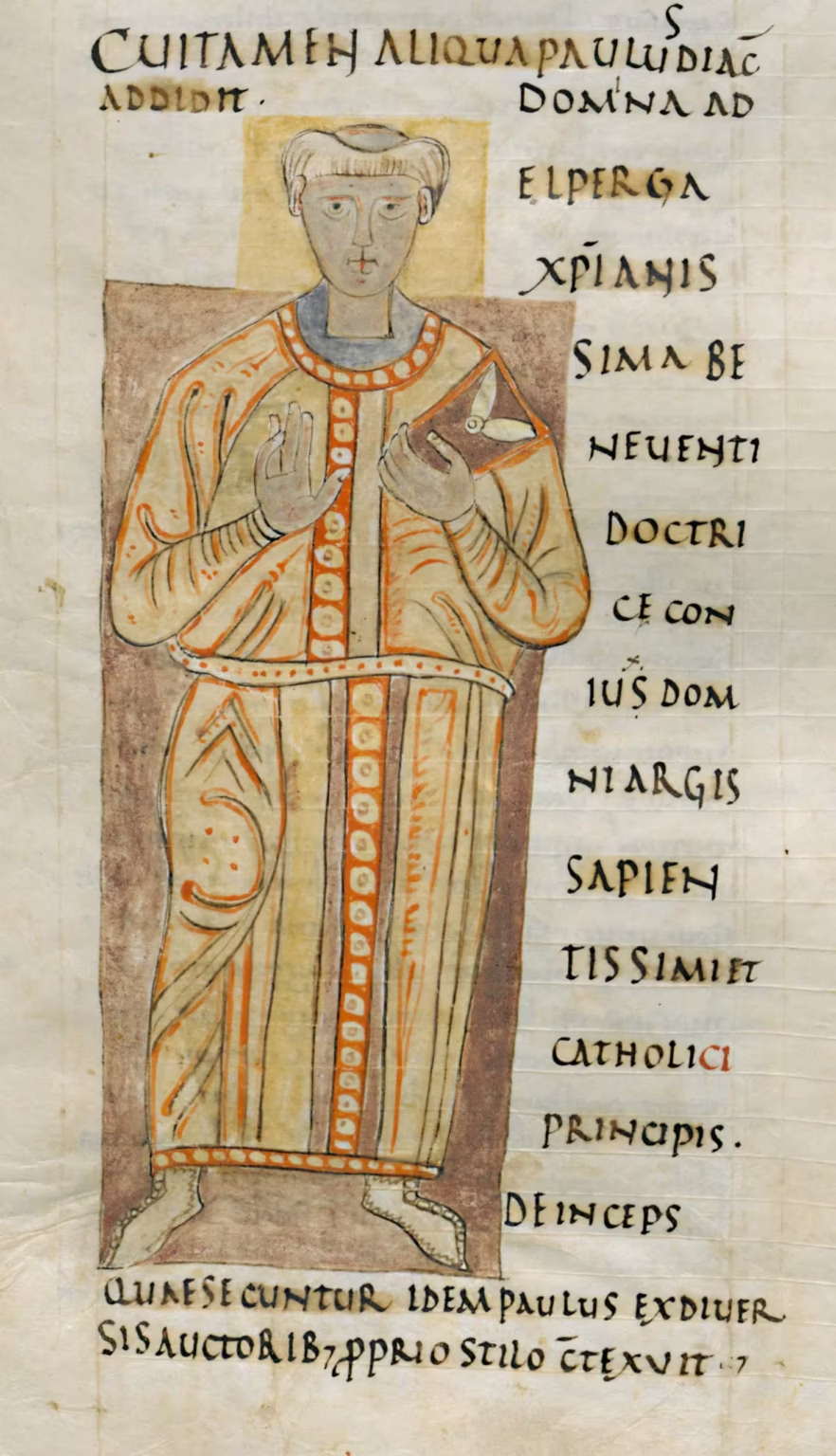
Paul was a Lombard, and proud of it, but he was also a scholar, steeped in classical culture, and writing an impeccable Latin.
He wanted to reconcile this double heritage of his.
Coming to both Pannonia and Italy because the empire had politely asked for help, was a far nicer story than being the uncultured barbarians on unprovoked campaigns of pillaging and rape.
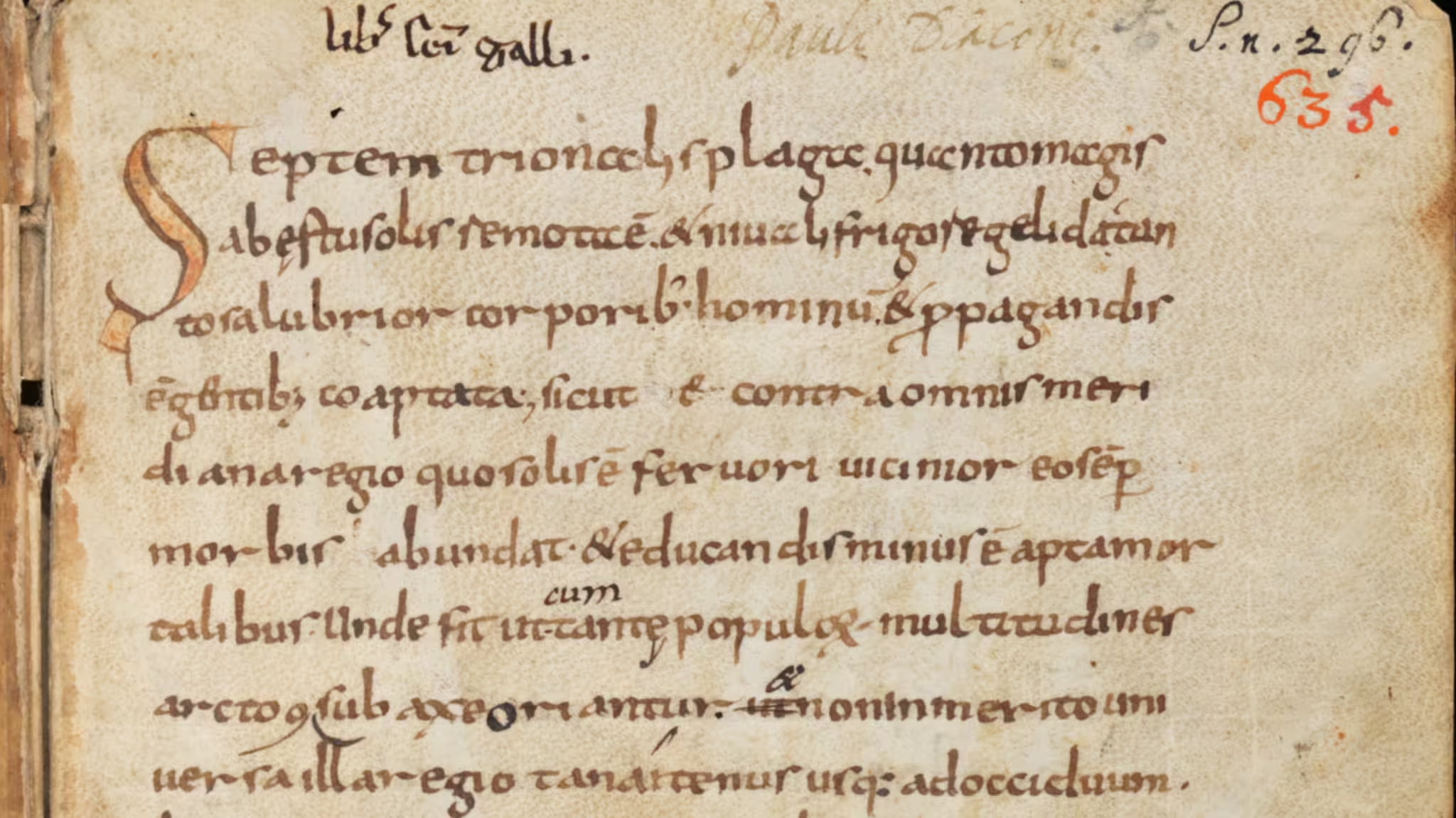
Source: Historia Langobardorum (780s–790s) by Paul the Deacon, here in the translation by William Dudley Foulke from 1906.
Available translations from the Historia Langobardorum:
- The Justinian plague — II.4, IV.4 and IV.14.
- The invasion of Venetia — II.5–12 and II.14.
- The conquest of Venetia — IV.20, IV.23, IV.25, IV.28, IV.38, IV.45 and V.28
- Alboin and Rosamund — I.29, II.28 and II.29.
- Iconoclasm — VI.49.
- Hildeprand in Ravenna — VI.54.
The first chapters of book II is the lead up to the Lombard invasion of Italy.
Chapter II.1 describe how a band of Lombards went to Italy as auxiliaries for the Byzantine general Narses during the last phase of the Gothic Wars between the Roman Empire and the Ostrogoths.
In chapter II.2, the Franks intervened in Italy, and Narses fought them off.
Finally, chapter II.3 recounts how Narses defeats the last Ostrogoth warlords, and finally finished the Gothic Wars, a feat which made him immensely rich and powerful.
Chapter II.4 is about the effects of an outbreak of the plague in 567.
Chapter II.5
Now the whole nation of the Goths having been destroyed or overthrown, as has been said, and those also of whom we have spoken having been in like manner conquered, Narses, after he had acquired much gold and silver and riches of other kinds, incurred the great envy of the Romans although he had labored much for them against their enemies, and they made insinuations against him to the emperor Justin and his wife Sophia, in these words, saying, “It would be advantageous for the Romans to serve the Goths rather than the Greeks wherever the eunuch Narses rules and oppresses us with bondage, and of these things our most devout emperor is ignorant : Either free us from his hand or surely we will betray the city of Rome and ourselves to the heathens.” When Narses heard this he answered briefly these words: “If I have acted badly with the Romans it will go hard with me.” Then the emperor was so greatly moved with anger against Narses that he straightway sent the prefect Longinus into Italy to take Narses’ place.
But Narses, when he knew these things, feared greatly, and so much was he alarmed, especially by the same empress Sophia, that he did not dare to return again to Constantinople.
Among other things, because he was a eunuch, she is said to have sent him this message, that she would make him portion out to the girls in the women’s chamber the daily tasks of wool.
To these words Narses is said to have given this answer, that he would begin to weave her such a web as she could not lay down as long as she lived.
Therefore, greatly racked by hate and fear, he withdrew to Neapolis (Naples), a city of Campania, and soon sent messengers to the nation of the Langobards, urging them to abandon the barren fields of Pannonia and come and take possession of Italy, teeming with every sort of riches. At the same time he sends many kinds of fruits and samples of other things with which Italy is well supplied, whereby to attract their minds to come.
The Langobards receive joyfully the glad tidings which they themselves had also been desiring, and they form high expectations of future advantages.
In Italy terrible signs were continually seen at night, that is, fiery swords appeared in heaven gleaming with that blood which was afterwards shed.
Chapter II.6
But Alboin, being about to set out for Italy with the Langobards, asked aid from his old friends, the Saxons, that he might enter and take possession of so spacious a land with a larger number of followers. The Saxons came to him, more than 20,000 men, together with their wives and children, to proceed with him to Italy according to his desire. Hearing these things, Chlothar and Sigisbert, kings of the Franks, put the Suavi and other nations into the places from which these Saxons had come.
Chapter II.7
Then Alboin bestowed his own abode, that is, Pannonia, upon his friends the Huns on this condition: that if at any time it should be necessary for the Langobards to return they should take back their own fields.
Then the Langobards, having left Pannonia, hastened to take possession of Italy with their wives and children and all their goods. They dwelt in Pannonia forty-two years.
They came out of it in the month of April in the first indiction on the day after holy Easter, whose festival that year, according to the method of calculation, fell upon the calends (the first) of April, when five hundred and sixty-eight years had already elapsed from the incarnation of our Lord.
Chapter II.8
Therefore, when king Alboin with his whole army and a multitude of people of all kinds had come to the limits of Italy, he ascended a mountain which stands forth in those places, and from there as far as he could see, he gazed upon a portion of Italy.
Therefore this mountain it is said, was called from that time on “King’s Mountain.”
They say wild oxen graze upon it, and no wonder, since at this point it touches Pannonia, which is productive of these animals. In fine, a certain very truthful old man related to me that he had seen the hide of a wild ox killed on this mountain of such size that in it fifteen men, as he said, could lie one against the other.
Chapter II.9
When Alboin without any hindrance had thence entered the territories of Venetia, which is the first province of Italy — that is, the limits of the city or rather of the fortress of Forum Julii (Cividale) — he began to consider to whom he should especially commit the first of the provinces that he had taken.
For indeed all Italy (which extends toward the south, or rather toward the southeast), is encompassed by the waves of the Tyrrhenian and Adriatic seas, yet from the west and north it is so shut in by the range of Alps that there is no entrance to it except through narrow passes and over the lofty summits of the mountains. Yet from the eastern side by which it is joined to Pannonia it has an approach which lies open more broadly and is quite level.
When Albion therefore, as we have said, reflected whom he ought to make duke in these places, he determined, as is related, to put over the city of Forum Julii and over its whole district, his nephew Gisulf, who was his master of horse — whom they call in their own language “marpahis” — a man suitable in every way. This Gisulf announced that he would not first undertake the government of this city and people unless Alboin would give him the “faras,” that is, the families or stocks of the Langobards that he himself wished to choose.
And this was done, and with the approval of the king he took to dwell with him the chief families of the Langobards he had desired.
And thus finally, he acquired the honor of a leader. He asked also from the king for herds of high-bred mares, and in this also he was heeded by the liberality of his chief.
Chapter II.10
In these days in which the Langobards invaded Italy, the kingdom of the Franks, divided into four parts upon the death of their king Chlotar, was ruled by his four sons.
The first among these, Aripert (Charibert) had the seat of his kingdom at Paris; the second indeed, Gunthram held sway at the city of Aureliani (Orleans); the third, Hilperic (Chilperic) had his throne at Sessionae (Soissons), in the place of Chlotar, his father; the fourth, Sigisbert, ruled at the city of Mettis (Metz).
At this time, too, the most holy Benedict as pope governed the Roman Church.
Also the blessed patriarch Paul presided over the city of Aquileia and its people and, fearing the barbarity of the Langobards, fled from Aquileia to the island of Grado; and he carried away with him all the treasure of his church.
In this year in the early winter as much snow fell in the plain as is wont to fall upon the summits of the Alps, and in the following summer there was such great fertility as no other age claims to remember.
At this time too when they had learned of the death of king Chlotar, the Huns, who are also called Avars, attacked his son Sigisbert and the latter, coming up to meet them in Turingia, overcame them with great force near the river Albis (Elbe) and gave peace to them when they sought it.
Brunicheldis, coming from Spain, is joined in marriage to this Sigisbert, and from her he had a son by name Childepert.
The Avars, fighting again with Sigisbert in the same places as before, crushed the army of the Franks and obtained the victory.
Chapter II.11
Narses indeed returned from Campania to Rome and there not long afterwards, departed from this life, and his body, placed in a leaden casket, was carried with all his riches to Constantinople.
Chapter II.12
When Alboin then came to the river Plavis (Piave), Felix the bishop of the church of Tarvisium (Treviso) came forth there to meet him, and the king, since he was very generous, granted to him at his request all the property of his church and confirmed the things asked for by a solemn document.
Chapter II.14
Then Alboin took Vincentia (Vicenza) and Verona and the remaining cities of Venetia, except Patavium (Padua), Mons Silicis (Monselice) and Mantua.
For Venetia is composed not only of the few islands which we now call Venice, but its boundary stretches from the borders of Pannonia to the river Addua (Adda).
This is proved in the books of annals in which Pergamus (Bergamo) is said to be a city of Venetia and in histories we thus read of lake Benacus (Lago di Garda) : “Benacus, a lake of Venetia from which the river Mincius (Mincio) flows.”
The Eneti,6 indeed (though a letter is added among the Latins), are called in Greek the “praiseworthy.”
Histria is also joined to Venetia and both are considered one province. Histria is named from the river Hister which, according to Roman history, is said to have been broader than it is now.
The city of Aquileia was the capital of this Venetia, in place of which is now Forum Julii (Cividale) so called because Julius Caesar had established there a market for business.
Original text
Click to reveal the Latin text
Liber II – v
Igitur deleta, ut dictum est, vel superata Narsis omni Gothorum gente, his quoque de quibus diximus pari modo devictis, dum multum auri sive argenti seu ceterarum specierum divitias adquisisset, magnam a Romanis, pro quibus multa contra eorum hostes laboraverat, invidiam pertulit. Qui contra eum Iustiniano Augusto et eius coniugi Sophiae in haec verba suggesserunt, dicentes quia expedierat Romanis Gothis potius servire quam Grecis, «ubi Narsis eunuchus imperat et nos servitio premit; et haec noster piissimus princeps ignorat. Aut libera nos de manu eius, aut certe et civitatem Romanam et nosmetipsos gentibus tradimus».
Cumque hoc Narsis audisset, haec breviter retulit verba: «Si male feci Romanis, male inveniam».
Tunc Augustus in tantum adversus Narsetem commotus est, ut statim in Italiam Longinum praefectum mitteret, qui Narsetis locum obtineret.
Narsis vero, his cognitis, valde pertimuit; et in tantum maxime ab eadem Sophia Augusta territus est, ut regredi ultra Constantinopolim non auderet.
Cui illa inter cetera, quia eunuchus erat, haec fertur mandasse, ut eum puellis in genicio lanarum faceret pensa dividere.
Ad quae verba Narsis dicitur haec responsa dedisse: talem se eidem telam orditurum, qualem ipsa, dum viveret, deponere non possit.
Itaque odio metuque exagitatus in Neapolim Campaniae civitatem secedens, legatos mox ad Langobardorum gentem dirigit, mandans, ut paupertina Pannoniae rura desererent et ad Italiam cunctis refertam divitiis possidendam venirent. Simulque multimoda pomorum genera aliarumque rerum species, quarum Italia ferax est, mittit, quatenus eorum ad veniendum animos possit inlicere.
Langobardi laeta nuntia et quae ipsi praeoptabant gratanter suscipiunt de que futuris commodis animos adtollunt.
Continuo apud Italiam terribilia noctu signa visa sunt, hoc est igneae acies in caelo apparuerunt, eum scilicet qui postea effusus est sanguinem coruscantes.
Liber II – vi
Alboin vero ad Italiam cum Langobardis profecturus ab amicis suis vetulis Saxonibus auxilium petit, quatenus spatiosam Italiam cum pluribus possessurus intraret. Ad quem Saxones plus quam viginti milia virorum cum uxoribus simul et parvulis, ut cum eo ad Italiam pergerent, iuxta eius voluntatem venerunt. Hoc audientes Chlotharius et Sigibertus, reges Francorum, Suavos aliasque gentes in locis de quibus idem Saxones exierant posuerunt.
Liber II – vii
Tunc Alboin sedes proprias, hoc est Pannoniam, amicis suis Hunnis contribuit, eo scilicet ordine, ut, si quo tempore Langobardis necesse esset reverti, sua rursus arva repeterent.
Igitur Langobardi, relicta Pannonia, cum uxoribus et natis omnique supellectili Italiam properant possessuri. Habitaverunt autem in Pannonia annis quadraginta duobus.
De qua egressi sunt mense aprili, per indictionem primam, alio die post sanctum Pascha, cuius festivitas eo anno iuxta calculi rationem ipsis kalendis aprilis fuit, cum iam a Domini incarnatione anni quingenti sexaginta octo essent evoluti.
Liber II – viii
Igitur cum rex Alboin cum omni suo exercitu vulgique promiscui multitudine ad extremos Italiae fines pervenisset, montem qui in eisdem locis prominet ascendit, indeque, prout conspicere potuit, partem Italiae contemplatus est.
Qui mons propter hanc, ut fertur, causam ex eo tempore mons Regis appellatus est.
Ferunt, in hoc monte bisontes feras enutriri. Nec mirum, cum usque huc Pannonia pertingat, quae horum animantium ferax est. Denique retulit mihi quidam veracissimus senex, tale se corium in hoc monte occisi bisontis vidisse, in quo quindecim, ut aiebat, homines, unus iuxta alium potuissent cubare.
Liber II – ix
Indeque Alboin cum Venetiae fines, quae prima est Italiae provincia, hoc est civitatis vel potius castri Foroiulani terminos sine aliquo obstaculo introisset, perpendere coepit, cui potissimum primam provinciarum quam ceperat committere deberet.
Siquidem omnis Italia, quae versus meridiem vel potius in eurum extenditur, Tyrreni sive Adriatici maris fluctibus ambitur, ab occiduo vero et aquilone iugis Alpium ita circumcluditur, ut nisi per angustos meatus et per summa iuga montium non possit habere introitum; ab orientali vero parte, qua Pannoniae coniungitur, et largius patentem et planissimum habet ingressum.
Igitur, ut diximus, dum Alboin animum intenderet, quem in his locis ducem constituere deberet, Gisulfum, ut fertur, suum nepotem, virum per omnia idoneum, qui eidem strator erat, quem lingua propria «marpahis» appellant, Foroiulanae civitati et totae illius regioni praeficere statuit. Qui Gisulfus non prius se regimen eiusdem civitatis et populi suscepturum edixit, nisi ei quas ipse eligere voluisset Langobardorum faras, hoc est generationes vel lineas, tribueret.
Factumque est, et annuente sibi rege quas optaverat Langobardorum praecipuas prosapias, ut cum eo habitarent, accepit.
Et ita demum ductoris honorem adeptus est. Poposcit quoque a rege generosarum equarum greges, et in hoc quoque liberalitate principis exauditus est.
Liber II – x
His diebus, quibus Langobardi Italiam invaserunt, Francorum regnum, mortuo iam eorum rege Clothario, eius filii quadrifarie regebant divisum.
Primusque ex his Aripertus sedem habebat apud Parisios. Secundus vero Gunthramnus civitati praesidebat Aurelianensi. Tertius quoque Hilpericus cathedram habebat apud Sessionas in loco Chlotharii patris sui. Quartus nihilominus Sigibertus apud urbem regnabat Metensem.
Hoc etiam tempore Romanam Ecclesiam vir sanctissimus Benedictus papa regebat.
Aquileiensi quoque civitati eiusque populis beatus Paulus patriarcha praeerat. Qui Langobardorum barbariem metuens, ex Aquileia ad Gradus insulam confugit secumque omnem suae thesaurum ecclesiae deportavit.
Hoc anno superiori hieme tanta nix in planitie cecidit, quanta in summis Alpibus cadere solet; sequenti vero aestate tanta fertilitas extitit, quanta nulla aetas adseveratur meminisse.
Eo quoque tempore comperta Hunni, qui et Avares, morte Clotharii regis, super Sigibertum eius filium inruunt. Quibus ille in Turingia occurrens, eos iuxta Albem fluvium potentissime superavit, eisdemque petentibus pacem dedit.
Huic Sigiberto de Hispaniis adveniens Brunichildis matrimonio iuncta est, de qua ille filium Childebertum nomine suscepit.
Rursumque Avares cum Sigiberto in locis ubi et prius pugnantes, Francorum proterentes exercitum, victoriam sunt adepti.
Liber II – xi
Narsis vero de Campania Romam regressus, ibidem non post multum tempus ex hac luce subtractus est. Cuius corpus positum in locello plumbeo, cum omnibus eius divitiis Constantinopolim est perlatum.
Liber II – xii
Igitur Alboin cum ad fluvium Plabem venisset, ibi ei Felix episcopus Tarvisianae ecclesiae occurrit. Cui rex, ut erat largissimus, omnes suae ecclesiae facultates postulanti concessit et per suum pracmaticum postulata firmavit.
Liber II – xiv
Igitur Alboin Vicentiam Veronamque et reliquas Venetiae civitates, exceptis Patavio et Monte Silicis et Mantua, cepit.
Venetia enim non solum in paucis insulis, quas nunc Venetias dicimus, constat, sed eius terminus a Pannoniae finibus usque ad Adduam fluvium protelatur.
Probatur hoc annalibus libris, in quibus Bergamus civitas esse legitur Venetiarum. Nam et de lacu Benaco in historiis ita legimus: «Benacus lacus Venetiarum, de quo Mincius fluvius egreditur».
Eneti enim, licet apud Latinos una littera addatur, grece laudabiles dicuntur.
Venetiae etiam Histria conectitur, et utraeque pro una provincia habentur. Histria autem ab Histro flumine cognominatur. Quae secundum Romanam historiam amplior, quam nunc est, fuisse perhibetur.
Huius Venetiae Aquileia civitatis extitit caput; pro qua nunc Forum Iulii, ita dictum quod Iulius Caesar negotiationis forum ibi statuerat, habetur.
Notes
- Alboin (530s–572) was king of the Lombards from about 560 until 572, and led the first Lombard invasion of Italy in 568. ↩︎
- Narses (c. 478–573) was a Byzantine general, who led the imperial forces in parts of the Gothic Wars in Italy in the 500s. ↩︎
- Justin II was Eastern Roman Emperor 565–578, during whose reign the Lombards invaded Italy. ↩︎
- Sophia (c. 530–c. 601) was wife of emperor Justin II, and regent during his period of incapacity. ↩︎
- It is, for example, repeated in the Translatio Marci Evangelistae Venetias (Latin original). ↩︎
- The Greek word Αινετοι, which means laudable or the praiseworthy, was in Antiquity thought to be the origin of the name of the Veneti people and Venetia itself, which is why the words laudable or praiseworthy are often associated with Venice. ↩︎
Leave a Reply