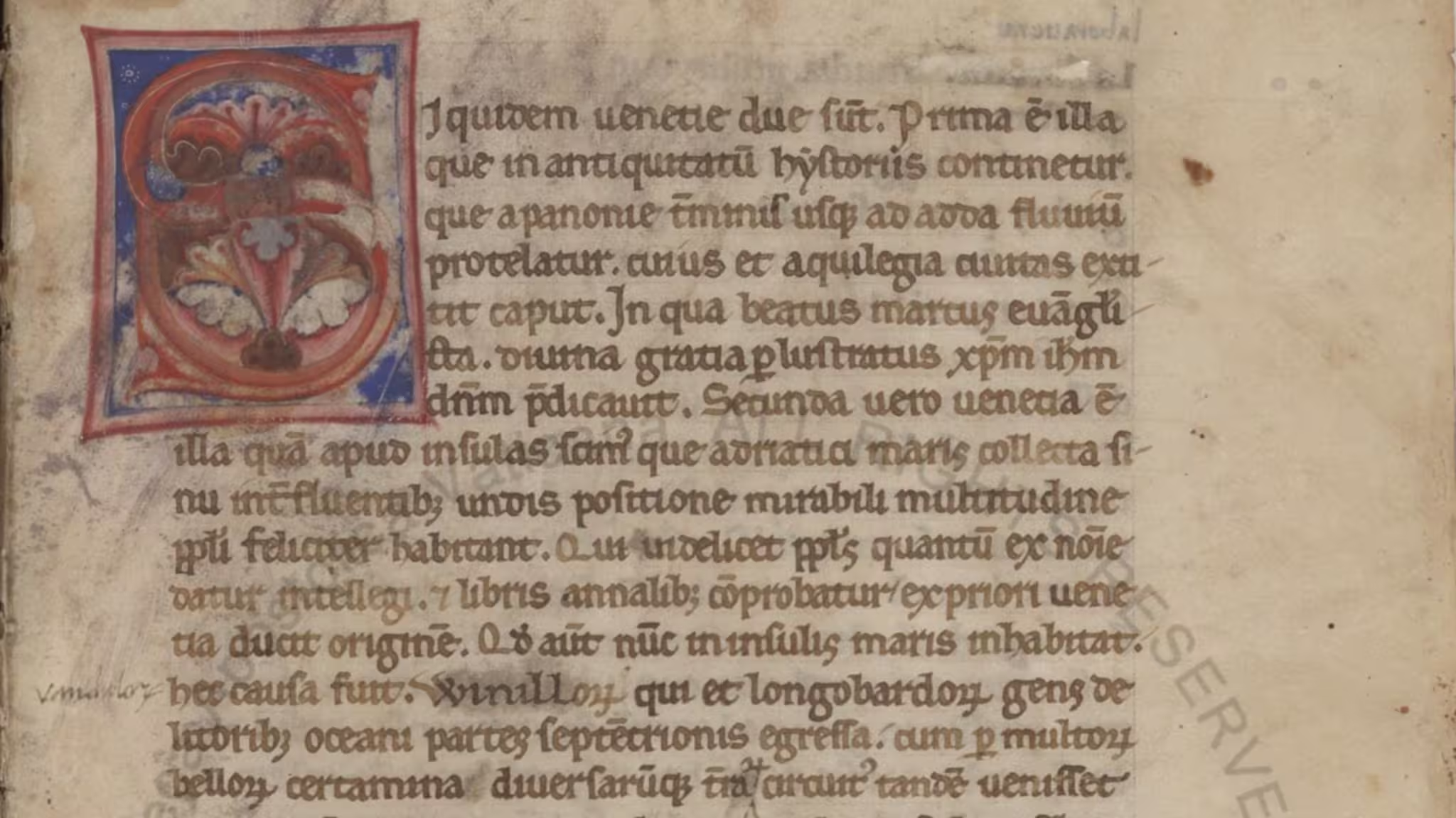
Most of the little we know about the doges of Venice in the 700s, we have from the Istoria Veneticorum by John the Deacon, which was written around the year 1000.
The relevant paragraphs for the doges between 742 and 804 are translated below.
They are Deusdedit Hypatos (742-755), Galla (755–756), Domenico Monegario (756–764), Maurizio Galbaio (764–787) with his son Giovanni Galbaio (787–804), in turn with his son Maurizio II.
The years of their reigns are as established by Andrea Dandolo in his Chronica per extensum descripta, which is from the 1340s.
Dandolo wrote about the same doges in the Chronica Extensa. His version was the authoritative Venetian narrative until the end of the Serenissima.
John the Deacon also wrote about the first three doges and five magistri militum, which preceded these.
Source: Istoria Veneticorum (c.1008) by John the Deacon, translated by René Seindal, and controlled with the Italian translation in Iohannes : Diaconus Venetus et.al. (1999).
Available translations from the Istoria Veneticorum:
- The settlements of the lagoons — chapter I.7
- The first doges — chapters II.1–2, II.10–11 and II.14.
- Hildeprand in Ravenna — chapters II.12–13.
- Doges of the 700s — chapters II.17–19, 22 and 24.
Chapter II.17
At the same time,1 the Venetians, abhorring the esteemed dignity of the prefects,2 again, as before, chose a duke for themselves, namely Deusdedit,3 the son of Ursus the hypatos,4 on the island of Metamauco;5 his rule lasted for a period of 13 years.
He himself, after this, for the sake of honour and reputation, wished to build a fortress called Brondolo,6 not in its current location, but beyond the present bank of the river, and there, by a certain unfaithful man named Galla,7 his eyes were put out and his duchy was taken, and he was the possessor of the position for one year.
Over him then, the Venetians, attacking and conspiring together with one mind, likewise plucked out his eyes.
Click to reveal the Latin text
Eisdem etiam diebus Venetici, magistrorum militum prelibate prefecture dignitatem abominantes, rursum, ut quondam, ducem, videlicet Deusdedem, sepedicti Ursonis ypati filium, in Metamaucense insula sibi crearunt; cuius regimen extitit spatio annis XIII.
Ipse quoque post hec, cum decoris et honestatis gratia castrum, quod Brundulus dicitur, non eo loco in quo nunc situm videtur, sed ultra presentem ripam fluminis condere voluit et illic a quodam infideli, Galla nomine, eius avulsi sunt oculi ipsiusque ducatum auferens possessorque eius unius anni spatio fuerat.
Super quem deinde Venetici irruentes unaque conspirantes voluntate, oculos similiter illius eruerunt.
Chapter II.18
In his place, Dominicus,8 surnamed Monegarius of Metamauco, was made their duke, and, as is the custom of the common people, who never persist in any given intention, but, driven by a certain superstitious folly, invent one idea after another, in the first year of his duchy they appointed for themselves two tribunes, who would serve under the ducal decree. This they also tried to carry out every year of the aforementioned duke’s life. Then the aforementioned Venetians, having made a conspiracy, plucked out the eyes of the same duke Dominicus, and the years of his duchy amounted to eight.
Click to reveal the Latin text
Loco cuius Dominicum, cognomento Monegarium Metamaucensem, ducem sibi fecerunt et, ut mos vulgi est, qui nunquam in preposita voluntate persistens, sed quandam superstitiosa stultitia alias atque alias adinventiones excogitans, primo illius ducati anno tribunos duos, qui sub ducali decretu consisterent, sibi preposuerunt. Quod etiam per singulos annos prenominati ducis vite facere conati sunt. Deinde prefati Venetici, facta conspiratione, eiusdem Dominici ducis oculos evellerunt, fueruntque anni ducatus illius numero octo.
Chapter II.19
After the aforementioned, during which the entire attendance of the Venetians was gathered, a certain citizen of the city of Heraclia,9 named Mauricius,10 very skilled in secular matters, was elevated to the honour of the duchy on the island of Metamauco.
While he wisely and honourably managed the affairs of the Venetians in all matters, in the eleventh year of his duchy he decreed, by apostolic authority, that a new bishopric should be established on the island of Olivolo,11 in which he ordained a certain cleric, named Obelliebatus,12 as bishop.
Then, when he had held the ducal dignity for thirty-one years, already advanced in age, at the people’s urging, he was pleased to have his son Giovanni13 share in his honour; two years later, with his son, he thus ended his final day in peace.
Moreover, in the year of our Lord 823, Giovanni, the aforementioned son of Mauricius, assumed the peak of honour in governing the same island; we have discovered neither in writing nor in report that he managed the affairs of his country well.
Indeed, he had a son, named Mauricius, to whom in the eighteenth year of his duchy he granted the partnership of the same dignity.
At times when the sea near Venice rose so much that it covered all the islands excessively.
Click to reveal the Latin text
Post dicessum cuius omnis Veneticorum frequentia simul collecta quendam civem Heraclianae civitatis, Mauricium nomine, peritissimum seculari studio, ducatus honore apud Metamaucensem insulam sublimavit.
Qui dum sapienter et honorifice Veneticorum causam in omnibus tractaret, undecimo sui ducatus anno apud Olivolensem insulam apostolica auctoritate novum episcopatum fore decrevit, in quo quendam clericum, Obelliebatum nomine, episcopum ordinavit.
Dehinc, cum triginta et uno anno ducatus dignitatem gubernaret, iam effectus senex, populo interpellante, Iohannem suum filium honoris sui habere consortem complacuit; duobus postmodum annis cum sobole extitit et sic ultimum in pace finivit diem.
Praeterea cum essent anni a Domini incarnacione octigenti viginti tres, Iohannes, Mauricii antedicti filius, honoris fastigium apud eandem insulam adorsus est gubernare; quem neque scripto neque relatione experti sumus suae patriae commoda bene tractasse.
Extitit quidem sibi filius, Mauricius nomine, cui octavo decimo anno sui ducatus eiusdem dignitatis societatem concessit.
Temporibus quorum apud Veneciam adeo excrevit mare, ut omnes insulas ultra modum cooperiret.
Chapter II.22
In the twenty-third year of the rule of the aforementioned Giovanni, seizing an opportunity, he sent his son Mauricius with a naval force to the city of Grado to kill Lord Giovanni,14 the most holy patriarch.
When he arrived there, eager to obey his father’s orders, he cruelly killed the same most holy man. His death caused the greatest sorrow to his fellow citizens, since he had been slain unjustly.
The aforementioned man of God governed the church of Grado for … years,15 and was buried in the chapel of Saint Mark behind the mausoleums of the holy martyrs; he was succeeded by Fortunatus16 in leading the church.
Click to reveal the Latin text
Anno vero vigesimo tercio ducatus predicti Iohannis, comperta occasione, suum filium Mauricium navali exercitu ad Gradensem urbem, ut domnum Iohannem, sanctissimum patriarcham, interficeret, destinavit.
Ubi illuc pervenit, paternis iussionibus optemperare studens, eundem sanctissimum virum crudeliter interfecit. Cuius mors maximum dolorem suis reliquit civibus, quoniam insons fuerat interemptus.
Gubernavit autem predictus Dei vir Gradensem ecclesiam annis […], sepultusque fuit in sancti Marci capella post sanctorum martyrum mausolea; quem successit Fortunatus ad regendam ecclesiam.
Chapter II.24
Indeed, Fortunatus the patriarch, bitterly grieving the murder of his predecessor and parent, arranged plots against Mauricius and Giovanni the leaders and, having left his seat and city, went to Italy.
Then a certain tribune, named Obelerius,17 from Metamauco, followed, and Felix the tribune, Dimitrius, Marianus, Fuscarus Gregorio, and some other elders of the Venetians, of whom only the patriarch went to France.
The others remained in a city not far from Venice, called Treviso, and there, not staying for long, having been advised by those who were living in Venetia, they elected the tribune Obelerius as their duke.
When Giovanni and Mauricius, the dukes, realized this, worn down by fear, they fled. One of them went to France, that is Mauricius, the other indeed went to Mantua, where they sojourned so long that neither of them returned to Venice, but there they ended their last day.
Christoforus,18 also bishop of Olivolo, while he did not dare to await the arrival of Duke Obelerius, fled with the aforementioned dukes.
Then the same Obelerius boldly entered Venice. Here, when he had been received by the people with devotion and honour, he made his brother, namely Beatus by name,19 his partner in dignity.
At this time also, the New City, which is called Heraclia, was destroyed by the Venetians. Then the aforementioned leaders sent a fleet to plunder the province of Dalmatia.
Click to reveal the Latin text
Prelibatus siquidem Fortunatus patriarcha acriter dolens interfectionem sui decessoris et parentis, insidias adversus Mauricium et Iohannem duces composuit et, relicta sede et urbe, ad Italiam perexit.
Quem etiam secutus est quidam tribunus, Obellierius nomine, Metamaucensis, Felix tribunus, Dimitrius, Marianus seu Fuscarus Gregorii et nonnulli alii Veneticorum maiores, ex quibus solus patriarcha in Franciam ivit.
Ceteri vero remanserunt in quadam civitate non procul a Venecia, nomine Tarvisio, ibique non diutius degentes, consilio illorum ammoniti qui in Venetia morabantur, Obellierium tribunum ducem elegerunt.
Quo Iohannes et Mauricius duces comperto, adtriti timoratione, fuga lapsi sunt. Alter illorum Franciam, id est Mauricius, alter vero Mantuam adivit, ubi adeo commorati sunt, ut neuter illorum Veneciam rediret, sed illic diem clauserunt extremum.
Christoforus etiam Olivolensis episcopus, dum Obelierii ducis adventum non auderet prestolari, cum predictis ducibus fuga lapsus est.
Tunc hisdem Obelierius audacter Veneciam intravit. Qui cum devote et honorifice a populo susceptus esset, suum fratrem, videlicet Beatum nomine, dignitate fecit sibi socium.
Hac etiam tempestate Civitas nova, que vocatur Eracliana, a Veneticis destructa est. Deinde predicti duces navalem exercitum ad Dalmaciarum provinciam depopulandam destinaverunt.
Notes
- In 742, according to the chronology of the doges established by Andrea Dandolo. ↩︎
- This is a reference to the magistri militum, who had governed Venice for the preceeding five years. ↩︎
- Deusdedit Hypatos (†755) (also Deusdatus, Diodato, or Teodato Ipato) was the 4th doge of Venice, from 742 to 755, and son of Ursus Hypatos. He also served at the third magister militum in 739. ↩︎
- Ursus Hypatos (†737) (also Orso Ipato) was the 3rd doge of Venice, and probably the first to be chosen by the Venetians. He was killed in an internal struggle in 737. ↩︎
- Malamocco (or Metamauco) was capital of the Venetian proto-state for parts of the 700s, possibly located on the Lido di Venezia. ↩︎
- Brondolo was an ancient settlement in the lagoon, at the estuary of the Adige river. It is now a suburb of Chioggia. ↩︎
- Galla, later attributed the surname Gaulo, was the 5th doge of Venice. Having deposed and blinded Deusdedit, he was in turn deposed and blinded the following year. ↩︎
- Domenico Monegario was the 6th doge of Venice, from 756 until he was deposed and blinded in 764. ↩︎
- Eraclea (orig. Civitas Nova Heracliana, also Civitanova), founded in 640, was originally situated on a lagoon island. It was the first seat of the doges of Venice, before it moved to Metamauco. ↩︎
- Maurizio Galbaio (†787), also Mauricius Galba, was the 7th doge of Venice from 764 to his death. He was succeeded by his son Giovanni. ↩︎
- The Olivolo island was one of the most ancient settlements, which became Venice, and the seat of the Bishops of Venice since 774. ↩︎
- Obelaio (†798), or Obeliebatus, was the first bishop of Olivolo. ↩︎
- Giovanni Galbaio (†804), was the 8th doge of Venice, from 778 as co-ruler of his father Maurizio, from 787 alone, until his death. ↩︎
- Giovanni I (†802) was Patriarch of Grado from 766 until he was murdered in 802 by the son of doge Giovanni Galbaio. ↩︎
- The period is left blank in the original manuscripts. ↩︎
- Fortunatus II was patriarch of Grado 802–820. Of the pro-Frankish faction in Venetian politics, he spent much of his reign in exile. ↩︎
- Obelerio was doge of Venice from 804, after the fall of the Galbaio, until 811, following the war with the Franks in 809. ↩︎
- Cristoforo I Damiata, of Byzantine origin, born in Damietta in Egypt, was bishop of Olivolo 797–810 and 813–827. ↩︎
- Beatus, also Beato, later given the surname Antenoreo, was the brother of Obelerio, and co-ruler for most of his reign. ↩︎
Bibliography
- Iohannes : Diaconus Venetus. Chronicon Venetum omnium quae circumferuntur vetustissimum et Johanni Sagornino vulgo tributum e mss. codice Apostoli Zeno V. Cl. nunc primum cum mss. codicibus Vaticanis collatum, notisque illustratum in lucem profert H. Fr. Zanetti Al. F. Venetiis, 1765. [more] 🔗
- Iohannes : Diaconus Venetus and Luigi Andrea Berto. Istoria Veneticorum. Bologna Zanichelli, 1999. [more] 🔗
- Monticolo, Giovanni. Cronache veneziane antichissime. Roma, Forzani e C. tipografi del Senato, 1890. [more] 🔗
Leave a Reply