The Historia Langobardorum — The History of the Lombards — by Paul the Deacon is the oldest chronicle relevant to the history of Venice. It probably dates to the 780s or 790s.
As the name implies, it is a chronicle of the Lombards — or Langobards — but as the Lombard invasion was a pivotal event in the history of early Venice, there are several chapters relevant to Venice.
The Historia Langobardorum was also an important source for many of the later Venetian chronicles and writings. It is, and it always was, an essential source for the study of early Venice.
Paulus Diaconus
Paul the Deacon was, as the name implies, a cleric, at least later in his life. It is not known, however, when he made that choice.
He was also one of the great minds of his time, and he was recognised as such during his lifetime. Consequently, he wrote a lot, both religious and historical writings, poetry and letters. Likewise, much was written about him, and much of it has survived.
He was probably born around 720 in Duchy of Friuli, in the Kingdom of the Lombards in northern Italy.
In the Historia Langobardorum, Paul touches on his own ancestry.
At the time when the nation of the Langobards came from Pannonia to Italy, my great-great-grandfather Leupchis of the same nation of Langobards came with them in like manner. When he ended his last day after he had lived some years in Italy, he left five sons begotten by him who were still little boys.
Paulus : Diaconus et.al. (1907), p. 184.
The estate of Leupchis was near Cividale,1 the first Lombard capital in Italy, which is quite close to Pannonia2 in the Balkans.
Raiding Avars crossed the border, captured the five children, and sold them into slavery in Pannonia. One of them managed to escape much later, and returned to Lombard lands in Italy.
But he could obtain nothing of the property his father had had, being now excluded by those who had appropriated it through long and continuous possession. This man, as I already said before, was my great-grandfather, and he begot my grandfather Arichis, and Arichis, my father Warnefrit, and Warnefrit, from Theudelinda his wife, begot me, Paul, and my brother Arichis who was named after my grandfather.
Paulus : Diaconus et.al. (1907), p. 186.
In any case, his family background — or patronage — earned him the best education available at the time, in the Lombard capital of Pavia in … Lombardy.
He was in Pavia during the reign of King Ratchis3 (744–749). Since Ratchis had been Duke of Friuli before his election, Paul may have arrived with him to Pavia.
Ratchis was deposed, and replaced with his brother Aistulf,4 who was warring, and attacked both the Byzantine dominions around Ravenna, and Rome. During his reign Pepin the Short5 invaded Italy twice, on request of the pope, and once put the Lombard capital at Pavia to siege.
When Aistulf died, supposedly in a hunting accident, he was succeeded by Desiderius6 (756–774).
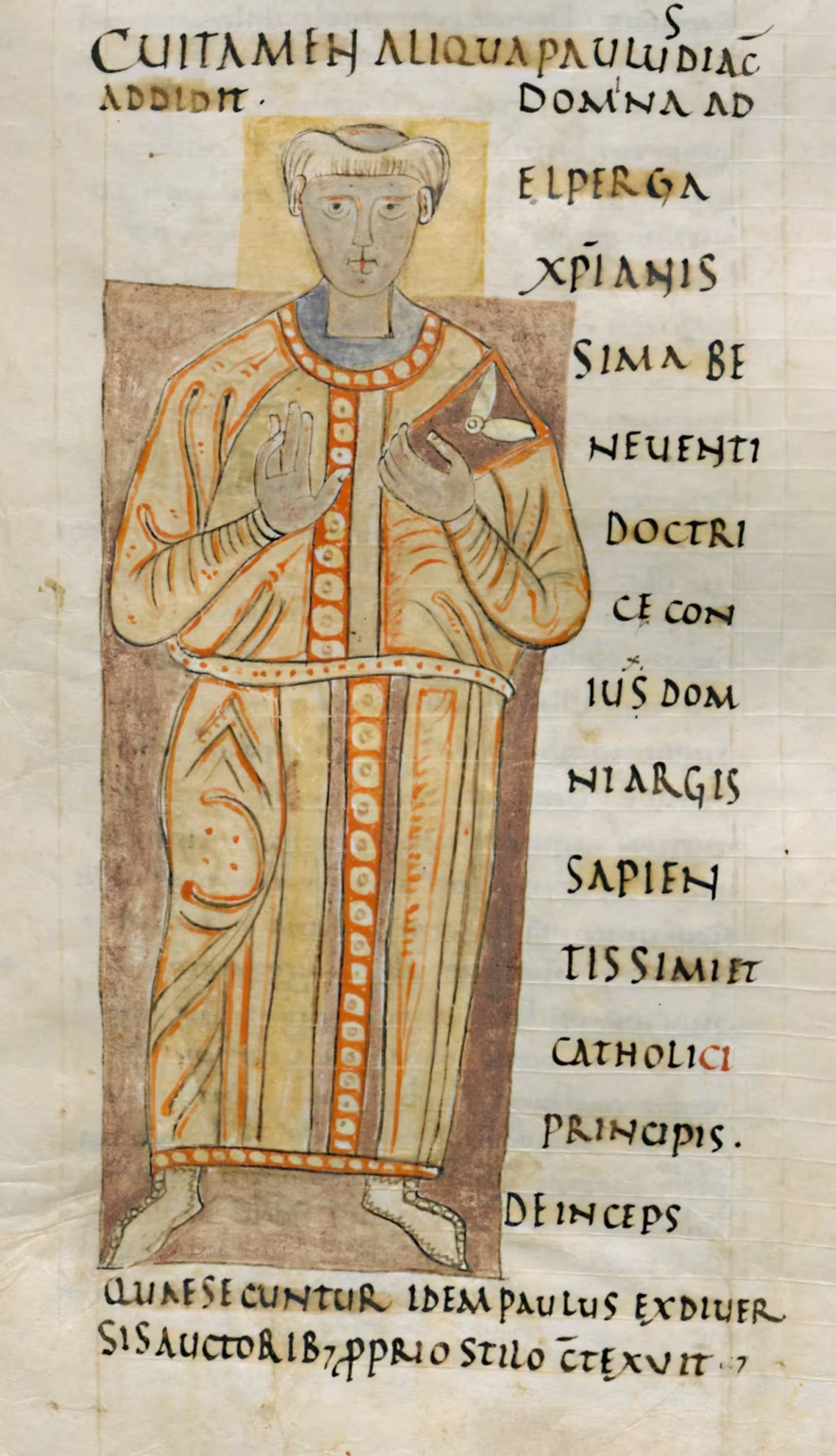
Paul the Deacon was assigned as tutor and teacher to Adelperga, daughter of Desiderius. This appointment is the basis for the estimate of his time of birth. He must have been, at that time, an esteemed scholar at court, and also sufficiently older than her.
In this role, and maybe also in others, Paul gained the trust of the king.
Desiderius married one daughter to Charlemagne of Francia, and Adelperga to the duke of the southern Lombard duchy of Benevento. When she moved there, Paul was sent there with her, and they remained in contact for much of their lives. One of his other works, a History of the Romans, was written on her request.
Charlemagne, however, repudiated and sent back the daughter of Desiderius, and invaded Italy in 773. He conquered Pavia and the northern duchies of the Kingdom of the Lombards, and in 774 he deposed his former father-in-law, and made himself King of the Lombards.
Paul the Deacon, however, was already in Benevento in the south at that time.
He later retired to the monastery of Montecassino,7 which is probably where the Historia Langobardorum was written.
Paul was a scholar steeped in classic and Christian culture, but he was also a Lombard through and through, and he grieved the loss of the Lombard kingdom.
His brother, participating in a failed Lombard uprising against the Franks in Friuli, was taken prisoner and brought to Francia.
Paul the Deacon wrote to Charlemagne to plead for the liberation of his brother, and travelled to Francia, where he stayed for several years, writing several works on commission, including a book of liturgy which was the official such book in Francia for several centuries.
When he was allowed to leave, he returned to Montecassino, making a detour to Friuli on the way. It is not known if he succeeded in obtaining the freedom for his brother.
He died at Montecassino in 799.
The Historia Langobardorum
The unfinished Historia Langobardorum is an account of the history of the Lombard people from their legendary origins in Scandinavia, to the end of the reign of King Liutprand8 in 744.
It is divided into six books. The first tells the story of the origins of the Lombards in the far north, and their arrival in Pannonia within the Byzantine Empire.
In the second book, King Alboin of the Lombards,9 on invitation of the Byzantine general Narses,10 migrated to Italy and started the conquest. This is an often repeated story, which also appears in the later Translatio Marci Evangelistae Venetias.11
This book also contains a description of Italy, as it appeared around 750, province by province.
Next, in the third book the Byzantine Empire, in the later 500s, conspired with the Franks to get them to invade Italy to eliminate the Lombards, a project which ultimately failed.
The fourth book covers the next eighty years of Lombard history, from Agilulf12 (591–616) to Grimoald13 (662–671).
In the fifth book, Paul recounts the remainder of the 600s, until the death of Cunipert14 (688–700).
Finally, the sixth book brings the story up to the death of Liutprand (712–744).
Paul the Deacon didn’t bring the narrative all the way up to his own time. Why that is, we do not know. Perhaps he preferred not to write about the last years, exactly because they were the last, and a time of internal strife and defeat, which wasn’t the light he wanted to put his people in? Maybe he died before he could finish it? We don’t know.
Many of the sources, which Paul the Deacon used for the earlier periods, have since been lost, such as the Annals of Beneventum and the history of the Lombards by Secundus of Trent.
The work was considered important already at the time, it was copied widely, and extant copies exist from shortly after Paul’s death. Well over a hundred copies still exist in various medieval manuscripts.
Of course, if he wanted the text disseminated widely, writing it a Montecassino wasn’t a bad choice. The monastery was one of the main European centres of learning in the early Middle Ages.
The relations with the powers surrounding the Lombards are especially well covered, maybe thanks to Paul’s high status at the late Lombard court. The chronicle therefore provides much information about the Popes, the Byzantine Empire, the Franks, and to a lesser extent, the Duchy of the Venetians under Byzantine rule.
The importance for Venice
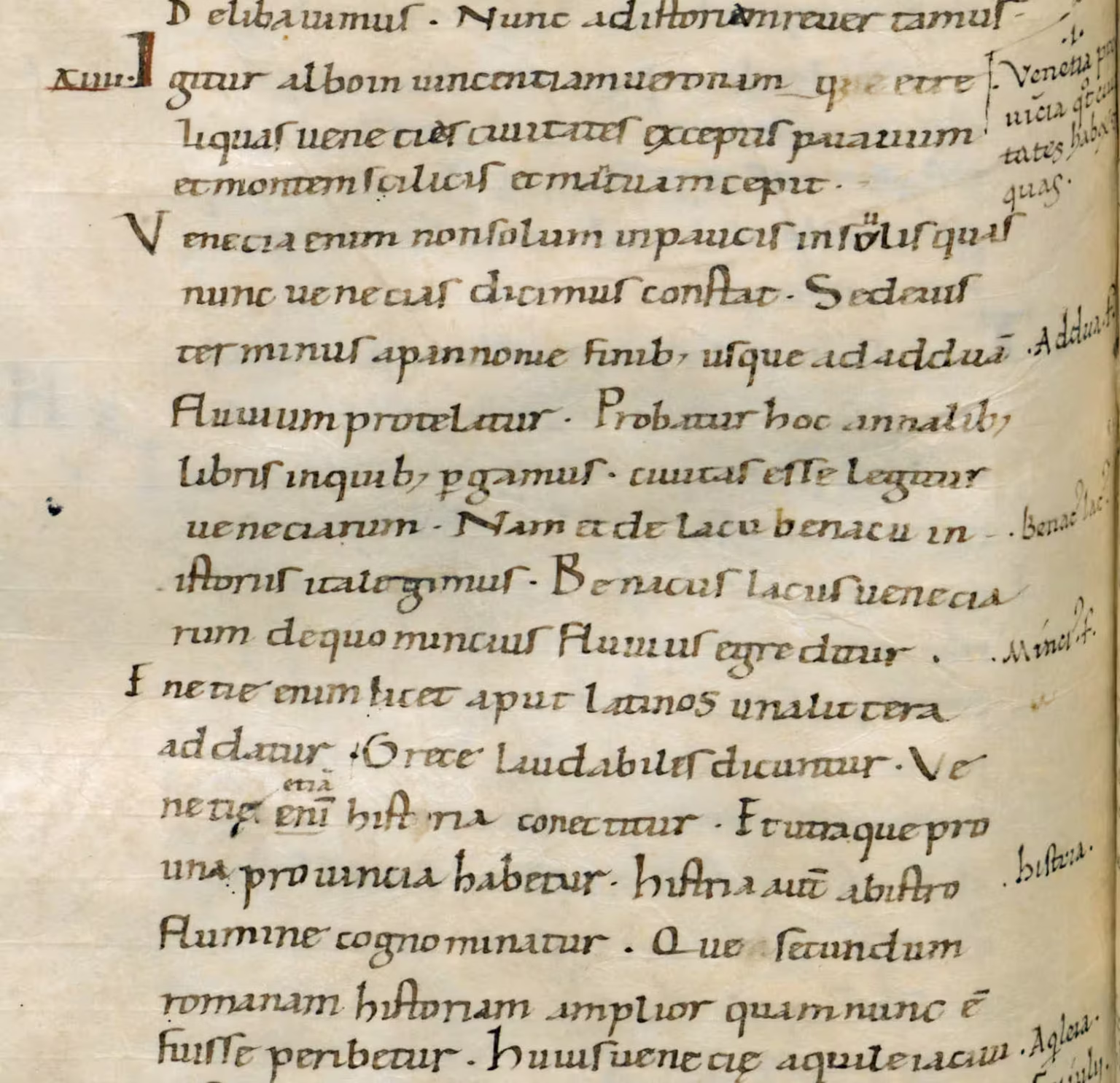
Regarding Venice, the Historia Langobardorum is the main source for the Lombard invasion, the sacking and later conquest of the mainland cities of Venetia, finally leaving only the Venetia Marittima under Byzantine influence.
However, the account of Paul the Deacon ends shortly before the final Lombard conquest of Ravenna and the definitive end of the Exarchate.
Almost all later Venetian chronicles got this information, one way or the other, from the Historia Langobardorum.
One of the often quoted sections is where Paul the Deacon distinguishes between the Venetia of the late 500s, which was still the ancient Regio X Venetia et Histria, while at his time, Venetia meant only “a few islands” in the lagoons.
Then Alboin took Vincentia (Vicenza) and Verona and the remaining cities of Venetia, except Patavium (Padua), Mons Silicis (Monselice) and Mantua.
For Venetia is composed not only of the few islands which we now call Venice, but its boundary stretches from the borders of Pannonia to the river Addua (Adda). This is proved in the books of annals in which Pergamus (Bergamo) is said to be a city of Venetia and in histories we thus read of lake Benacus (Lago di Garda) : “Benacus, a lake of Venetia from which the river Mincius (Mincio) flows.”
The Eneti, indeed (though a letter is added among the Latins), are called in Greek the “praiseworthy.” Histria is also joined to Venetia and both are considered one province. Histria is named from the river Hister which, according to Roman history, is said to have been broader than it is now. The city of Aquileia was the capital of this Venetia, in place of which is now Forum Julii (Cividale)j so called because Julius Caesar had established there a market for business.
Paulus : Diaconus et.al. (1907), p. 71 (book II, chapter XIV).
The last paragraph is a reference to an ancient belief about the etymology of the name Venetia.15
Available versions
The Latin original is readily available online, for example on WikiSource. Some of the medieval manuscripts are available digitised online (see below).
The text is widely used in Italian high schools, and some of the textbooks contain the original as well as translations to Italian.
Finally, there is an English translation by William Dudley Foulke from 1906, also available online. This is the translation used for the quotations here.
The illustration
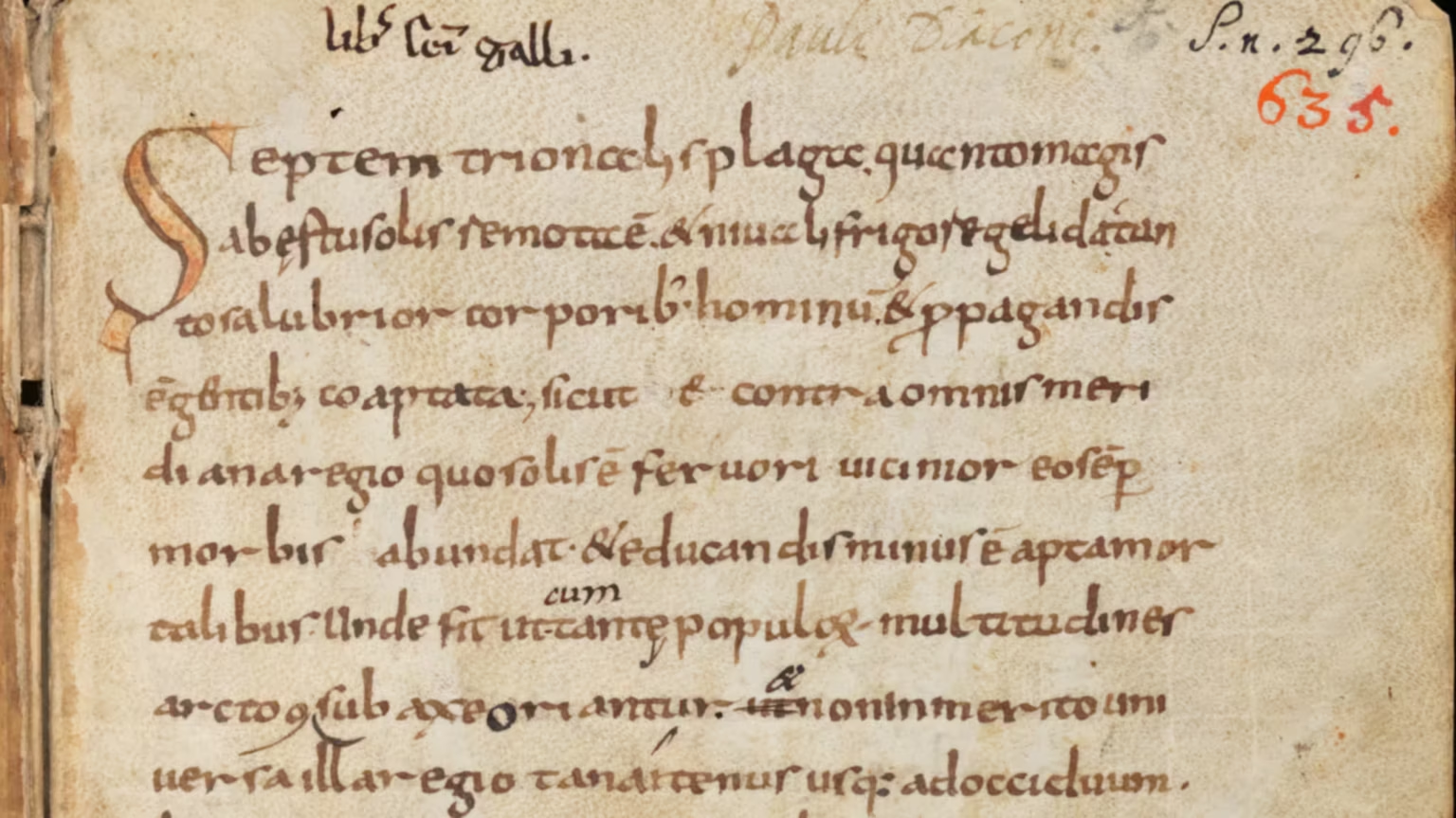
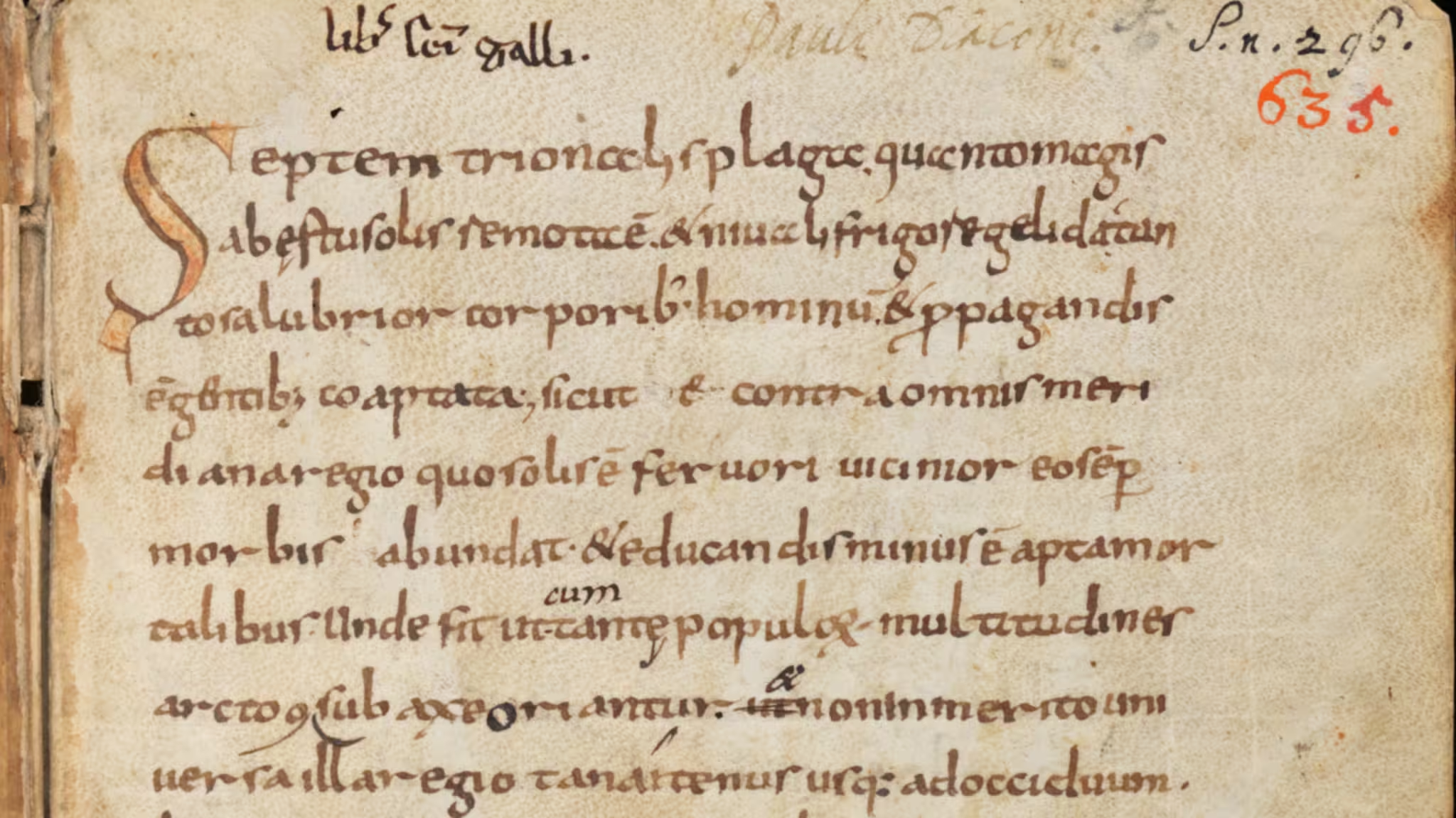
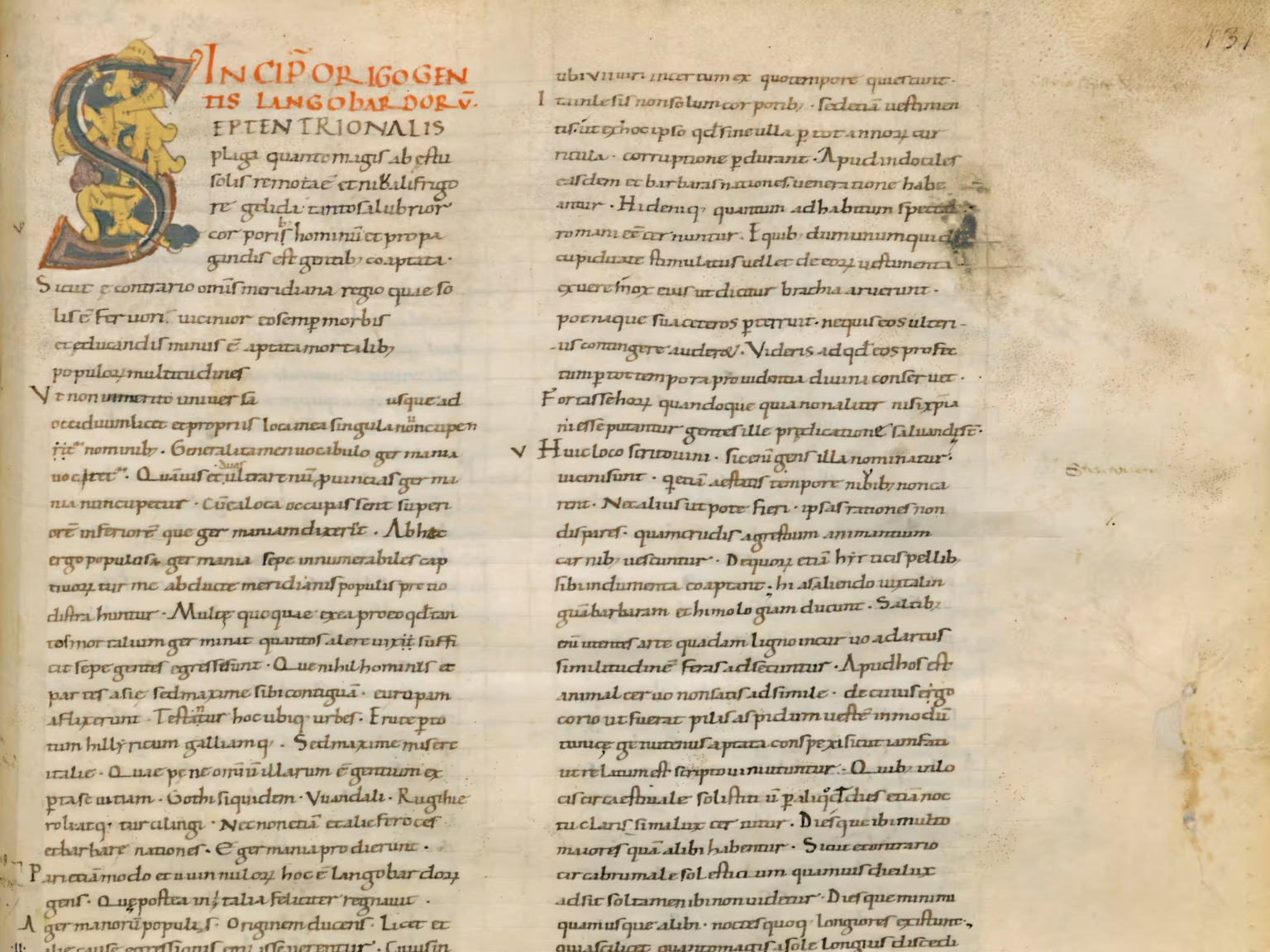
The illustration at the top of the page is from the manuscript Cod. Sang. 635 in the library of the St. Gallen abbey. It is one of the earlier copies, made in Verona around the year 800, so shortly after the death of Paul the Deacon.
The incipit shown is:
Septemtrionalis plaga quanto magis ab aestu solis remota est et nivali frigore gelida, tanto salubrior corporibus hominum et propagandis est gentibus coaptata; sicut econtra omnis meridiana regio, quo solis est fervori vicinior, eo semper morbis habundat et educandis minus est apta mortalibus.
In the translation of Dudley Foulke:
The region of the north, in proportion as it is removed from the heat of the sun and is chilled with snow and frost, is so much the more healthful to the bodies of men and fitted for the propagation of nations, just as, on the other hand, every southern region, the nearer it is to the heat of the sun, the more it abounds in diseases and is less fitted for the bringing up of the human race.
Paulus : Diaconus et.al. (1907), p. 1.
Another digitised manuscript is Biblioteca Medicea Laurenziana, Plut.65.35.
A full list of manuscripts on Mirabile.
Excerpts
- The Justinian plague — II.4, IV.4 and IV.14.
- The invasion of Venetia — II.5–12 and II.14.
- The conquest of Venetia — IV.20, IV.23, IV.25, IV.28, IV.38, IV.45 and V.28
- Alboin and Rosamund — I.29, II.28 and II.29.
- Iconoclasm — VI.49.
- Hildeprand in Ravenna — VI.54.
Notes
- Cividale del Friuli (orig: Forum Iulii) was the first Lombard capital in Italy, and the main city of the Lombard Duchy of Friuli. ↩︎
- Pannonia was a Roman province, which included parts of modern Hungary, Slovakia, Austria, Croatia, Serbia, Slovenia, and Bosnia and Herzegovina, bordering on the Italian region of Friuli. ↩︎
- Ratchis († after 757) was the Duke of Friuli (739–744) and King of the Lombards (744–749). ↩︎
- Aistulf (†756) was Duke of Friuli from 744, and King of the Lombards from 749 until his death in 756. He attacked the Byzantine dominions repeatedly, including Ravenna and Rome. ↩︎
- Pepin the Short (c. 714–768) was King of the Franks from 751 until his death in 768. He was the father and predecessor of Charlemagne. ↩︎
- Desiderius (c. 720–786) was the last king of the Lombards, from 756 until the Frankish conquest of Pavia in 774. ↩︎
- The Monastery of Montecassino is one of the oldest monasteries in Italy. ↩︎
- Liutprand (c.680–744) was king of the Lombards from 712 to 744. During his reign, he fought wars with Byzantine over Ravenna, and donated lands at Sutri to the Pope, leading to the creation of the Papal State. ↩︎
- Alboin (530s–572) was king of the Lombards from about 560 until 572, and led the first Lombard invasion of Italy in 568. ↩︎
- Narses (c. 478–573) was a Byzantine general, who led the imperial forces in parts of the Gothic Wars in Italy in the 500s. ↩︎
- The Translatio Marci Evangelistae Venetias, from the 900s, describes how the relics of St Mark came to Venice in 828. ↩︎
- Agilulf (c.555–616) was a Lombard Duke of Turin and king of the Lombards from 591 until 616. ↩︎
- Grimoald (also Grimwald; †671) was Lombard Duke of Benevento from 647 to 662, and King of the Lombards from 662 to 671. ↩︎
- Cunipert (also Cunibert or Cunincpert) was king of the Lombards from 688 to 700. ↩︎
- The Greek word Αινετοι, which means laudable or the praiseworthy, was in Antiquity thought to be the origin of the name of the Veneti people and Venetia itself, which is why the words laudable or praiseworthy are often associated with Venice. ↩︎
Leave a Reply