The elections of the first doges of Venice are shrouded in mystery, both as to who they were, and why, how and by whom they were chosen.
The Istoria Veneticorum by John the Deacon is our earliest source for this, but his account is problematic because his chronology doesn’t add up.
John the Deacon wrote that the first doge, Paulicius (or Paoluccio), was chosen during the reigns of Emperor Anastasius II and King Liutprand of the Lombards.
Anastasius II ruled 713–715, and Liutprand 712–744, so Paoluccio must have been appointed in the period 713–715. Yet, when he died in 727, John the Deacon claimed he had served more than twenty years.
The next doge, Marcellus, supposedly ruled for eighteen years, but died in 726 or 727, following the riots caused by the iconoclast edict of emperor Leo III in 726.
Ursus Hypatos (or Orso Ipato), was created doge shortly after.
None of these numbers add up, and the reigns don’t match the traditional list of the 120 doges of Venice.
That list originates mostly from the Chronica per extensum descripta from the 1340s. The rank and authority of its author made this chronicle very influential in Venetian historiography. Doge Andrea Dandolo (1343–1354) was also a renowned scholar who studied law at the University of Padua, and a close friend of Petrarch.
To arrive at a plausible chronology of events, Andrea Dandolo made the reign of Paulicius end in 717, and halved the reign of Marcellus, so Orso could start, as he should, in 727.
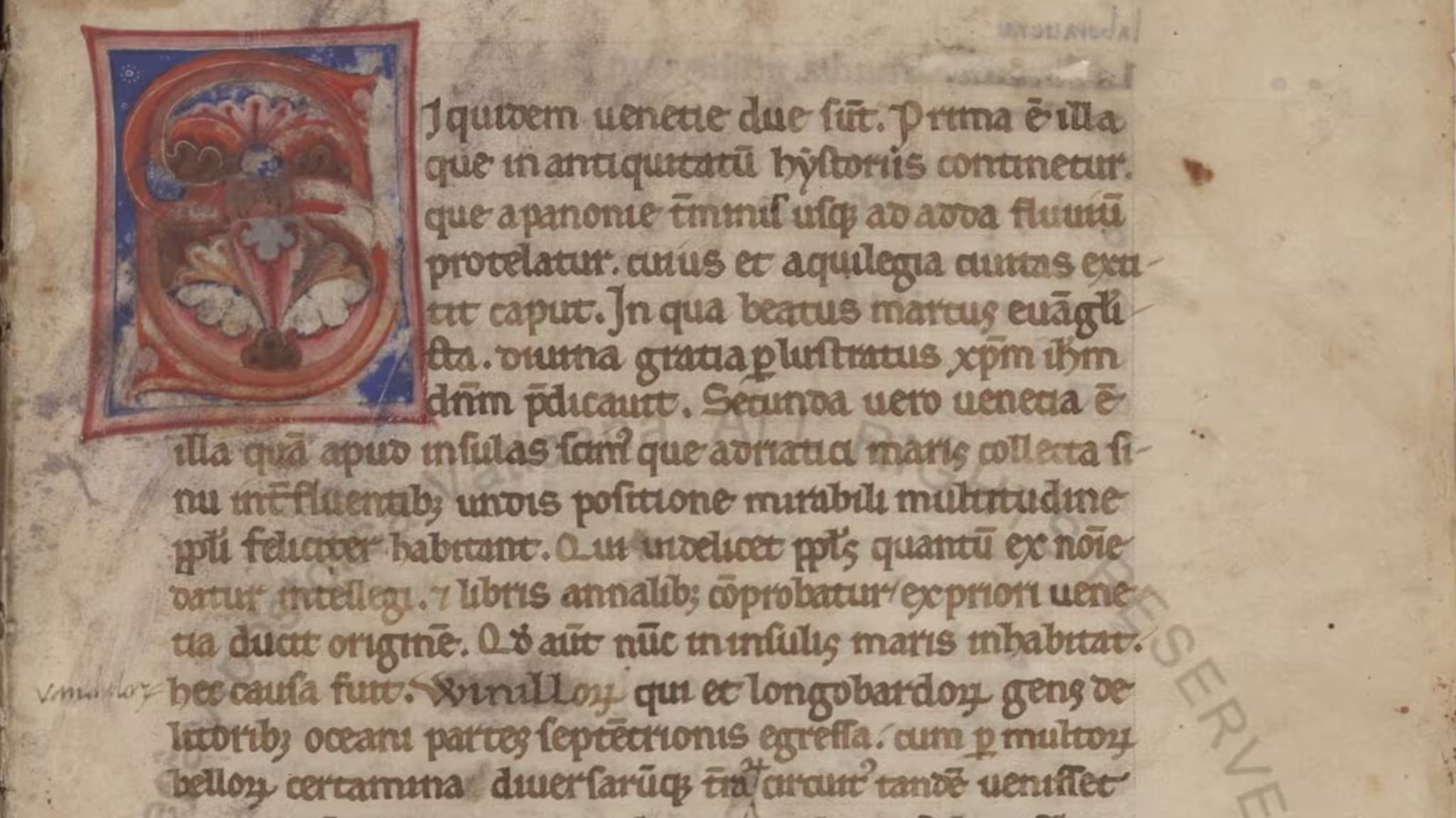
Source: Istoria Veneticorum (c.1008) by John the Deacon, translated by René Seindal, and controlled with the Italian translation in Iohannes : Diaconus Venetus et.al. (1999).
Available translations from the Istoria Veneticorum:
- The settlements of the lagoons — chapter I.7
- The first doges — chapters II.1–2, II.10–11 and II.14.
- Hildeprand in Ravenna — chapters II.12–13.
- Doges of the 700s — chapters II.17–19, 22 and 24.
Chapter II.1
So while they stayed in that same province1 with a large number of people, they preferred to be subject only to the tribunes.
As a result, over a span of one hundred and fifty years, every year they elevated to the high offices those who tried to examine their causes.
And since they were deeply grieved that their homelands were being taken by barbarians, there were constant disputes between the two sides so that they would compete with each other by causing harm and plundering.
Click to reveal the Latin text
Igitur dum apud eandem provintiam populorum multitudine permanerent, tribunis tantummodo maluerunt subesse.
Unde factum est quo spatio centum quinquaginta annorum unoquoque anno* ad huius officii fastigium sublimabant qui illorum causas examinis censura experiri satagerent.
Et quoniam omnino patrios fines dolebant a barbaris possidere, maxima inter utrasque partes iurgia versabatur ita ut inter se vicissim molestias et depopulationes conferre decertarent.
Chapter II.2
During the times of Emperor Anastasius2 and King Liutprand of the Lombards,3 all the Venetians, together with the patriarch and bishops, met and decided that it would be more honourable from then on to remain under dukes rather than tribunes.
After long discussions about who should be given this dignity, they finally found a very able and renowned man, named Paulicius,4 to whom they swore loyalty and appointed him as duke in the city of Eracliana.5 He was very disciplined, and he controlled his men with equity.6
With King Liutprand, he also secured a lasting peace, establishing agreements that still exist between the Venetians and Lombards.
He also set the boundaries of the New City,7 which until now were controlled by the Venetians, together with the same king, from Piave Majore8 to Piavisella according to the designated locations.
Click to reveal the Latin text
Temporibus nempe imperatoris Anastasii et Liuprandi Langobardorum regis, omnes Venetici, una cum patriarcha et episcopis convenientes, communi consilio determinaverunt quod dehinc honorabilius esse sub ducibus quam sub tribunis manere.
Cumque diu pertractarent quem illorum ad hanc dignitatem proveherent, tandem invenerunt peritissimum et illustrem virum, Paulitionem nomine, cui iusiurandi fidem dantes, eum apud Eraclianam civitatem ducem constituerunt. Qui tante fuerat temperantie ut equo moderamine suos diiudicaret.
Cum Liuprando vero rege inconvulse pacis vinculum confirmavit; apud quem pacti statuta, que nunc inter Veneticorum et Longobardorum populum manent, impetravit.
Fines etiam Civitatis nove, que actenus a Veneticis possidentur, iste cum eodem rege instituit, id est a Plave maiore, secundum quod designata loca discernuntur, usque in Plavisellam.
Chapter II.10
In the year of the Lord 727, with the death of Duke Paulicius at the New City, who had led for 20 years and 6 months, Marcellus9 succeeded him as duke.
At the same time, Emperor Leo10 passed away; he was succeeded by Constantine.11
Around this time, Patriarch Donatus departed from this life, who had governed the Church of Grado for 7 years. He was succeeded by Patriarch Antoninus.
Click to reveal the Latin text
Anno ab incarnatione Domini DCCXXVII, mortuo Paulitione duce apud Civitatem novam, qui ducavit annis XX, mensibus VI, cui successit Marcellus dux.
Eo quoque tempore Leo imperator migravit a seculo; cui successerat Constantinus.
Circa hec tempora Donatus patriarcha ex hac luce migravit, qui ecclesiam Gradensem rexit annis VII. Huic successit Antoninus patriarcha.
Chapter II.11
At the same time, the mentioned duke Marcellus died, who had governed the duchy at the New City of Venice12 for eighteen years and twenty days, succeeded by duke Ursus,13 who had also ruled the aforementioned duchy in the same city for eleven years and five months. Whereupon later the Venetians, killing him with bitter jealousy, wished that for a period of five years they should remain subject only to the military commanders.
The first, whose name was said to be Leo,14 whose power over them was for one year.
Then the second of them was called Felix,15 with the surname Cornicula, who similarly had ruled them for the space of one year.
Then a third master of the soldiers was called Deusdedit,16 the son of the aforementioned Ursus, the slain duke, who also held that power for the space of one year.
Afterwards the fourth among them was Iubianus17 by name, hypatus;18 he had likewise been the holder of the same honour for one year.
Click to reveal the Latin text
Eodem quoque tempore prelibato Marcello duce mortuo, qui apud Civitatem novam Venecie ducatum annis decem et octo et diebus viginti gubernaverat, cui successit Ursus dux, qui etiam in eadem civitate sepedictum ducatum rexerat annis XI et mensibus V. Unde postmodum Venetici illum acri livore interimentes, quinque annorum spatio magistris militum tantummodo subditi manere voluerunt.
Primus quorum nomine Leo dicebatur, cuius potestas super eosdem fuit anno I.
Deinde secundus illorum nominabatur Felix, cognomento Cornicula, qui similiter illos unius anni spatio rexerat.
Exinde tercius magister militum vocitabatur Deusdedi, filius sepedicti Ursonis interfecti ducis, qui etiam unius anni spatio illius potestatis fuerat.
Postmodum quartus ex is habebatur Iubianus nomine, ypatus; eiusdem honoris unius anni similiter possessor fuerat.
… omissis …
Chapter II.14
After the deaths of the aforementioned four masters of the soldiers, the fifth of the same prefecture was appointed, who was called Giovanni Fabriacus;19 in a similar way to the others, he held the command for the space of one year, and his eyes were also gouged out by the Venetians.
Click to reveal the Latin text
His prelibatis post decessum predictorum quatuor militum magistrorum, quintus eiusdem prefecture ordinatur, qui Iohannes Fabriacus vocabatur; cuius simili modo, ut alii, principatus unius anni spatio manserat, ipsiusque etiam a Veneticis oculi avulsi sunt.
Notes
- Venetia was a Byzantine ducatus, and part of the Exarchate of Ravenna, until it was conquered by the Lombards. The coastal parts of Venetia remained Byzantine, and was the origin of later Republic of Venice. ↩︎
- Anastasius II (†719) was Byzantine emperor from 713 to 715 when he was deposed. Later, he tried to stage a revolt, but failed and was executed. ↩︎
- Liutprand (c.680–744) was king of the Lombards from 712 to 744. During his reign, he fought wars with Byzantine over Ravenna, and donated lands at Sutri to the Pope, leading to the creation of the Papal State. ↩︎
- Paulicius (also Paoluccio Anafesto or Paulicio) was the first doge of Venice, nominally from 697 to 717, but the years are uncertain, as is his real identity. See also: Paulicius — the first doge of Venice?. ↩︎
- Eraclea (orig. Civitas Nova Heracliana, also Civitanova), founded in 640, was originally situated on a lagoon island. It was the first seat of the doges of Venice, before it moved to Metamauco. ↩︎
- The agreement between King Liutprand and Venice has not survived, but large parts of is reiterated in the Pactum Lotharii. ↩︎
- Another reference to Eraclea, whose full name was Civitas Nova Heracliana, the New City of Heraclius. ↩︎
- The Piave and the Piavesella were two rivers near Eraclea. ↩︎
- Marcellus (†726), also Marcello Tegalliano, was, according to tradition, the 2nd doge of Venice from 717 to his death in 726, but very little is known about him. ↩︎
- Leo III the Isaurian (c. 685–741) was Byzantine emperor from 717. He is associated with the start of iconoclasm in 726. ↩︎
- Constantine V (718–775) was Byzantine emperor from 741 to his death in 775. ↩︎
- Here Venice means the dogado, that is, the state, while the ‘New City’ is Heraclia. ↩︎
- Ursus Hypatos (†737) (also Orso Ipato) was the 3rd doge of Venice, and probably the first to be chosen by the Venetians. He was killed in an internal struggle in 737. ↩︎
- Leone (or Leo) was the first magister militum (master of the soldiers), serving one year in 737. Otherwise, nothing is known about him. ↩︎
- Felice Carnicola (or Felix) was the second magister militum (master of the soldiers), serving one year in 738. Otherwise, nothing is known about him. ↩︎
- Deusdedit Hypatos (†755) (also Deusdatus, Diodato, or Teodato Ipato) was the 4th doge of Venice, from 742 to 755, and son of Ursus Hypatos. He also served at the third magister militum in 739. ↩︎
- Giuliano (or Iubianus) was the fourth magister militum (master of the soldiers), serving one year in 740. Otherwise, nothing is known about him. ↩︎
- Hypatos (also: Latinised as hypatus or ypatus, or Italian ipato) was a Byzantine court title, meaning consul, derived from the late Roman honorary consulship. ↩︎
- Giovanni Fabriciaco (or Iohannes Fabriacusx) was the fifth and last magister militum (master of the soldiers), serving one year in 741. He was deposed, blinded and exiled during a riot. ↩︎
Bibliography
- Dandolo, Andrea and Ester Pastorello. Chronica per extensum descripta in Rerum Italicarum scriptores : raccolta degli storici italiani dal Cinquecento al Millecinquecento / ordinata da L. A. Muratori , 12.1. Bologna : N. Zanichelli, 1938-1958. [more] 🔗
- Iohannes : Diaconus Venetus and Luigi Andrea Berto. Istoria Veneticorum. Bologna Zanichelli, 1999. [more] 🔗
- Monticolo, Giovanni. Cronache veneziane antichissime. Roma, Forzani e C. tipografi del Senato, 1890. [more] 🔗
- Muratori, Lodovico Antonio. Rerum Italicarum scriptores, 28 vols. Mediolani : ex Typographia Societatis Palatinae in Regia Curia, 1723-1751. [more]
Leave a Reply