
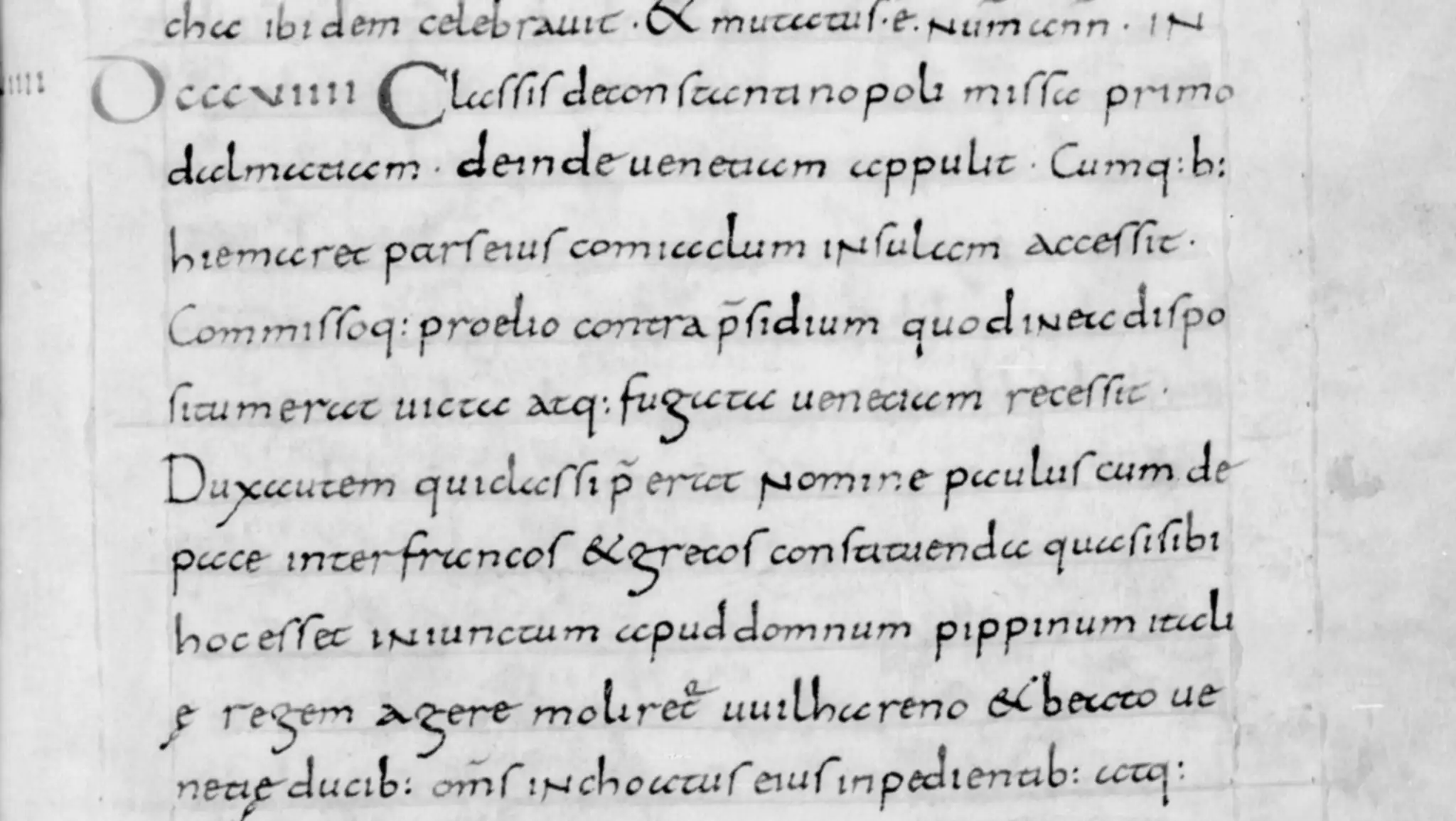
The Annales Regni Francorum is a Frankish chronicle written at the court of Charlemagne and Louis the Pius, covering the period from 741 to 829.
The authors are unknown, and they were probably several, as the chronicle was compiled bit by bit.
For each year, it briefly summarised the main events within the Carolingian Empire and in the neighbouring countries.
The point of view is naturally that of the Carolingian court, with the purpose of aggrandising the image and deeds of the emperors.
The Duchy of the Venetians — with the dukes Obelerio and Beatus (804–811) —appeared in the chronicle for the years 806, 807 and 809–811, which coincided with the Frankish-Venetian conflict in 809–810, and the Treaty of Aachen (also called the Peace of Nicepheros) of 810–812.
After the resolution of the conflict, the Frankish court lost interest in Venetia, and it is only mentioned in the passing a few times for the 820s, discussing the fate of the patriarch Fortunatus of Grado, who appeared to have been close to Charlemagne, but not to his successor.
For these specific events, this is the most contemporary source we have.
The paragraphs relevant for Venice, for the period 806–811, are reproduced and translated below.
Another source for this conflict is the De Administrando Imperio, from c. 950, by the Byzantine emperor Constantine VII Porphyrogenitus.
The usual Venetian sources all mention the events, i.e., Istoria Veneticorum by John the Deacon, the anonymous Chronicon Altinate, and the Chronica per extensum descripta by Andrea Dandolo.
Source: Pertz, Georg Heinrich, Friedrich Kurze and Einhardus. Annales regni Francorum inde ab A. 741. usque ad A. 829 ; qui dicuntur Annales Laurissenses Maiores et Einhardi in Monumenta Germaniae historica. Hannoverae : impensis Bibliopolii Hahniani, 1895, p. 120–134 (excerpts).
Excerpts from the Annales Regni Francorum.
806
Shortly after the Lord’s birth,1 came Willerius2 and Beatus,3 dukes of Venice, as well as Paulus, duke of Zara, and Donatus, bishop of the same city, ambassadors of the Dalmatians, came before the emperor4 with large gifts. And there was a settlement by the emperor concerning the dukes and peoples of both Venice and Dalmatia.
Click to reveal the Latin text
Statim post natalem Domini venerunt Willeri et Beatus duces Venetiae necnon et Paulus dux Iaderae atque Donatus eiusdem civitatis episcopus legati Dalmatarum ad praesentiam imperatoris cum magnis donis. Et facta est ibi ordinatio ab imperatore de ducibus et populis tam Venetiae quam Dalmatiae.
807
The patrician Nicetas,5 who was in Venice with the fleet from Constantinople, made peace with King Pepin6 and established a truce until the month of August, and after having completed his duty, he returned to Constantinople.
Click to reveal the Latin text
Niceta patricius, qui cum classe Constantinopolitana sedebat in Venetia, pace facta cum Pippino rege et indutiis usque ad mensem Augustum constitutis statione soluta Constantinopolim regressus est.
809
A fleet sent from Constantinople first reached Dalmatia, then landed in Venice; and while it was wintering there, part of it approached the island of Comacchio,7 and having engaged in battle against the garrison stationed there, having been defeated by them and forced them to flee, it returned to Venice.
However, the commander of the fleet, named Paulus, as if it was his duty to arrange peace between the Franks and the Greeks, tried to negotiate with King Pepin of Italy, but with Wilharenus8 and Beatus, the dukes of Venice, obstructing all his attempts and even plotting against him, he left when he discovered their treachery.
Click to reveal the Latin text
Classis de Constantinopoli missa primo Dalmatiam, deinde Venetiam appulit; cumque ibi hiemaret, pars eius Comiaclum insulam accessit commissoque proelio contra praesidium, quod in ea dispositum erat, victa atque fugata Venetiam recessit.
Dux autem, qui classi praeerat, nomine Paulus, cum de pace inter Francos et Grecos constituenda, quasi sibi hoc esset iniunctum, apud domnum Pippinum Italiae regem agere moliretur, Wilhareno et Beato Venetiae ducibus omnes inchoatus eius impedientibus atque ipsi etiam insidias parantibus, cognita illorum fraude discessit.
810
Meanwhile, King Pepin, angered by the treachery of the Venetian dukes, ordered Venice to be attacked by land and sea; having subdued Venice and received the submission of its dukes, he sent the same fleet to devastate the coasts of Dalmatia. But when Paulus, the prefect of Cephalonia, arrived with the eastern fleet to bring help to the Dalmatians, the royal fleet returned to its own ports.
…omissis…
Coming from Aachen in the month of October, the emperor heard the mentioned embassies and made peace with Emperor Nicephorus9 and with King Abdul Aziz of Spain. For he returned Venice to Nicephorus and received back Count Haimric, who had formerly been captured by the Saracens, with Abdul Aziz releasing him.
Click to reveal the Latin text
Interea Pippinus rex perfidia ducum Veneticorum incitatus Venetiam bello terraque marique iussit appetere; subiectaque Venetia ac ducibus eius in deditionem acceptis eandem classem ad Dalmatiae litora vastanda misit. Sed cum Paulus Cefalaniae praefectus cum orientali classe ad auxilium Dalmatis ferendum adventaret, regia classis ad propria regreditur.
…omissis…
Imperator Aquasgrani veniens mense Octimbrio memoratas legationes audivit pacemque cum Niciforo imperatore et cum Abulaz rege Hispaniae fecit. Nam Niciforo Venetiam reddidit et Haimricum comitem olim a Sarracenis captum Abulaz remittente recepit.
811
After Arsafius, spatharios10 — this was the name of the envoy of Emperor Nicephorus — was dismissed, envoys were sent to Constantinople by the emperor to confirm the peace. Bishop Haido of Basel, Count Hugo of Thuringia, and Aio the Lombard from Forum Julii, along with a certain Leo spatharios, a Sicilian by birth, and Willeri,11 duke of the Venetians. One of them had fled from Sicily the emperor ten years earlier while in Rome, and was sent back when he wanted to return home; the other was stripped of his honour12 because of treachery, and ordered to return to his lord in Constantinople.
Click to reveal the Latin text
Absoluto atque dimisso Arsafio spathario – hoc erat nomen legato Nicifori imperatoris – eiusdem pacis confirmandae gratia legati Constantinopolim ab imperatore mittuntur, Haido episcopus Baslensis et Hug comes Toronicus et Aio Langobardus de Foro Iuli et cum eis Leo quidam spatharius, natione Siculus, et Willeri dux Veneticorum, quorum alter ante annos X Romae ad imperatorem, cum ibi esset, de Sicilia profugit et redire volens patriam remittitur, alter propter perfidiam honore spoliatus Constantinopolim ad dominum suum duci iubetur.
Notes
- Christmas day. ↩︎
- Obelerio was doge of Venice from 804, after the fall of the Galbaio, until 811, following the war with the Franks in 809. ↩︎
- Beatus, also Beato, later given the surname Antenoreo, was the brother of Obelerio, and co-ruler for most of his reign. ↩︎
- Charlemagne (748–814) was King of the Franks from 768, King of the Lombards from 774, and Roman Emperor (de facto, of the Carolingian Empire) from 800. ↩︎
- A Byzantine patrician was a high-ranking nobleman, at the level of governor of a province. ↩︎
- Pepin (c.773-8 10) was the second son of Charlemagne, and King of the Lombards, later King of Italy, from 781. ↩︎
- Comacchio is a town south of the estuary of the river Po, which in the early Middle Ages was a competitor of Venice. ↩︎
- Another misspelling of the name of Obelerio. ↩︎
- Nicepheros I (750–811) was Byzantine emperor from 802 to his death in 811. ↩︎
- Spatharios (also spatharius) was originally a member of the imperial bodyguard in Constantinople, but in the 700s and 800s it was mostly an honorary title, ranking above hypatos. ↩︎
- Still Obelerio. ↩︎
- Here “honour” refers to the dignity of ruling the Duchy of the Venetians, so he was deposed. ↩︎
Bibliography
- Pertz, Georg Heinrich, Friedrich Kurze and Einhardus. Annales regni Francorum inde ab A. 741. usque ad A. 829 ; qui dicuntur Annales Laurissenses Maiores et Einhardi in Monumenta Germaniae historica. Hannoverae : impensis Bibliopolii Hahniani, 1895.
- Scholz, Bernhard Walter and Barbara Rogers (eds.). Carolingian Chronicles: Royal Frankish Annals and Nithard's Histories. Ann Arbor: University of Michigan, 1970.
Leave a Reply