The Lombard king Liutprand invaded the territory of the Exarchate of Ravenna in the “tenth indiction” during the reign of Pope Zachary, that is, between September 741 and August 742.
The Byzantine exarch Eutychius, unable to hold up against the Lombards on his own, together with John VI, archbishop of Ravenna, asked the Pope for help.
Pope Zachary left Rome, travelled to the Pentapolis, where he met the exarch. He then continued up the river Po to the Lombard capital of Pavia to meet the ageing king Liutprand.
The meetings happened on the 28th and 29th of June 743. Liutprand agreed to stop the hostilities, and hand back the captured territories and the fortress of Cesena, two thirds immediately, and the last third one year later.
Liutprand died in January 744, before the last part of the agreement was implemented.
This Lombard attack on Ravenna is distinct from the raids in 725–726, when Liutprand besieged Ravenna and sacked Classe, and from the attack by Hildeprand and Peredeo in the 730s, which was thwarted by the Venetians.
Paul the Deacon, torn between his two identities, unable to reconcile his loyalty to the Papacy, and his immense admiration for Liutprand, simply omitted these events from his Historia Langobardorum.
John the Deacon, in the Istoria Veneticorum, appears to have confused these events with the earlier Lombard attack on Ravenna, in the 730s, when the Venetians captured Hildeprand, the nephew and successor of Liutprand.
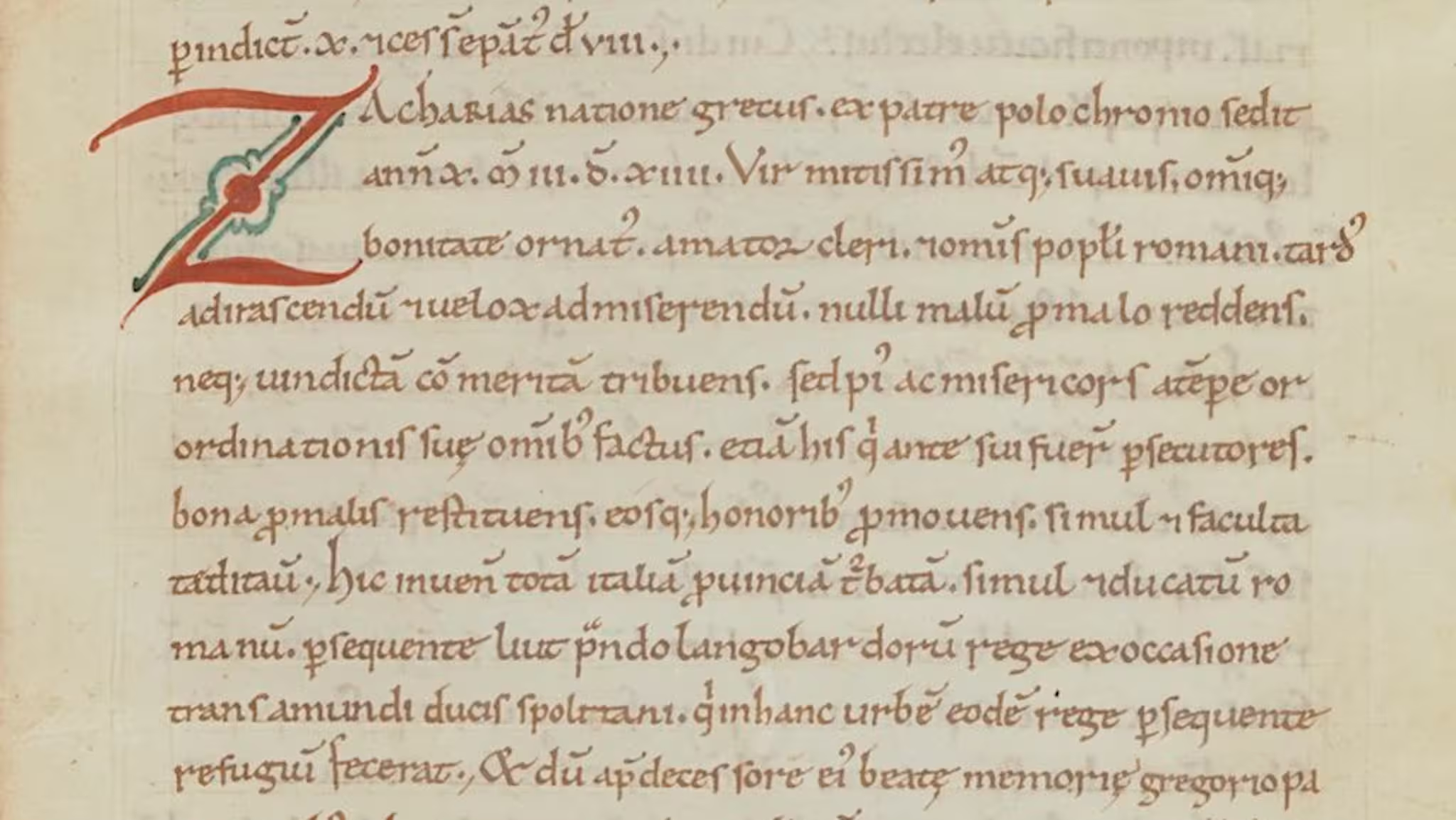
Below is an excerpt of the entry of Pope Zachary in the Liber Pontificalis, from Duchesne (1886), p. 426–439, with the parts related to the Lombard attacks on Ravenna.
The Lombard raids on the Exarchate
ZACHARIAS, Greek by birth, son of Polychronicus, reigned for 10 years, 3 months, and 15 days. A very gentle and pleasant man, adorned with every kind of goodness, a lover of the clergy and all the people of Rome, slow to anger and quick to pity, repaying evil to no one with evil, nor giving punishment according to merit, but pious and merciful; from the time of his ordination he treated everyone in this way, giving good in return for wrong even to those who had been his persecutors before, and promoting them with honours while also enriching them with wealth.
Click to reveal the Latin text
ZACHARIAS, natione Grecus, ex patre Polichronio, sedit. ann. X mens. III dies XV. Vir mitissimus atque suavis, omnique bonitate ornatus, amatori cleri et omni populi Romanorum, tardus ad irascendum et velox ad miserendum, nulli malum pro malo reddens, neque vindicta secundum meritum tribuens, sed pius ac misericors, a tempore ordinationis suae omnibus factus, etiam et his qui ante sui fuerunt persecutores bona pro malis reddidit, eosque honoribus promovens simul et facultate ditavit.
…
But he, having completed the tenth indiction, in the following eleventh indiction,1 while the aforementioned king2 was oppressing the province of the people of Ravenna excessively, and had been prepared to make a movement for capturing and besieging the city of Ravenna, having learned of the movement of the same king, Eutychius,3 most excellent patrician and exarch,4 together with John, archbishop of the church of Ravenna,5 and all the people of the aforesaid city and of both the Pentapolis6 and Emilia, made a written supplication, sent to the aforesaid holy man,7 asking that he intercede for their liberation. The holy man, having received the legation and gifts to beseech the same king through Bishop Benedict and the vicar and Ambrosius, primicerius of the notaries, asked that he cease from the threat and return the castle of Cesina8 to the people of Ravenna. But he did not consent.
Click to reveal the Latin text
His autem expletis X indictione, in subsequenti XI indictione, dum nimio opprimeret praedictus rex provinciam Ravennantium, fuissetque praeparatus ad motionem faciendi et obsedendi Ravennantium urbem, cognita motionem eiusdem regis, Eutychius excellentissimus patricius et exarchus una cum Iohanne archiepiscopo ecclesiae Ravennatis atque universum populum praedicte civitatis et utrarumque Pentapolim et Emilie, facta in scriptis obsecrationem, praedicto sancto miserunt viro, petentes ut pro eorum curreret liberatione. Qui sanctus vir missa legatione et munera ad obsecrandum eundem regem per Benedictum episcopum et vicedominum atque Ambrosium primicerium notariorum, petiit ut a monitione cessaret et Cesinatem Ravinianis redderet castrum. Sed passus non est.
While the already mentioned most holy man observed his steadfast endurance, warned by the trophy of faith, having left the city of Rome to the aforementioned Stephen,9 patrician and duke, to govern not as a mercenary, but as a true shepherd, he left the sheep and ran to redeem those things that were about to perish. To meet him came the aforementioned most excellent exarch as far as the basilica of Saint Christopher, located in the place called Aquila, almost fifty miles from the city of Ravenna. And when the men and women of different sexes and ages had left the city of Ravenna, giving thanks to Almighty God, they received the same holy pontiff with flowing tears, shouting and saying: “Welcome our shepherd, who left his sheep and comes to meet us, delivering us from what is about to perish.”
Click to reveal the Latin text
Cuius dum duram perseverantiam conspiceret iam nominatus sanctissimus vir, tropeo fidei monitus, relicta Romana urbe iamdicto Stephano patricio et duci ad gubernandum, non sicut mercennarius, sed sicut vere pastor, relictis ovibus, ad ea quae periturae erant redimendas cucurrit.* Ad cuius obviam occurrit denominatus excellentissimus exarchus usque ad basilicam beati Christofori, positam in loco qui vocatur ad Aquila, quinquagesimo fere miliario a Ravennantium urbe. Egressis autem de civitate Raviniani, viri atque mulieres diversi sexus, aetatis, agentes gratias omnipotenti Deo, profusis lacrimis eundem sanctum susceperunt pontificem, clamantes atque dicentes: «Bene venit pastor noster qui suas reliquid oves et ad nos quae periture sumus liberando occurrit».
From the same city of Ravenna, indeed, he sent to the aforementioned King, Stephen the priest and Ambrose the primicerius, announcing to him his arrival. These men, having entered the territory of the Lombards, in the city called Imola,10 learning that an ambush was being planned for the said holy man to prevent him from going there, sent notice by letter in the silence of the night. When this was learned, the already mentioned pontiff, with Saturday daybreak, not terrified by the fear of death, but relying on the help of Christ, boldly set out from the city of Ravenna, having entered the territory of the Lombards, and was followed by his messengers.
Indeed, the aforementioned king, previously overcome with grief, did not wish to receive them. The high priest himself joined the Po on the 28th day of the month of June; there the king sent his nobles to receive him. Joining them at Ticino where the king himself resided,11 going outside the walls of the same city, he proceeded to the basilica called the Golden Sky12 at the ninth hour of prayer to celebrate the solemn masses for the vigil of prince Peter of the blessed apostles.13 And after the libation was completed, he entered and stayed in the same city.
Click to reveal the Latin text
Ex eadem namque Ravennantium urbem** misit ad praenominatum regem Stephanum presbiterum et Ambrosium primicerium, adnuntians ei suum adventum. Qui viri ingressi in finibus Langobardorum, in civitate qui vocatur Imulas, cognuscentes quod praepeditio meditabatur ad fiendum praedicto sancto viro, ne illuc ambularet, per epistula scripta per noctis silentio nuntiaverunt. Quo cognito, iam nominatus pontifex, lucescente die sabbato, non mortis timore perteiritus sed Christi fretus auxilio, audacter egressus a Ravennantium urbe, in finibus Langobardorum ingressus, sequipes factus est suis missis.
Quos quidem praecedentes ante eum iamdictus rex dolore perpulsus suscipere noluit. Ipse vero summus pontifex XXVIII die mensis iunii ad Padum coniunxit; ubi ad suscipiendum eum ipse rex suos misit optimates. Cum quibus Ticino coniungens ubi ipse residebat rex, foris muros eiusdem civitatis pertransiens, ad horam orationis nonam pro vigiliarum beati apostolorum principis Petri celebranda solemnia missarum, in basilica eius qui vocatur ad Caelum aureum perrexit. Et post suppleta libatione in eadem urbe ingressus moratus est.
On the next day, to celebrate the birthday of that prince of the apostles, he celebrated the solemn mass in the aforementioned church at the invitation of the aforesaid king. There, mutually greeting each other, the citizens also welcomed him, and thus they returned to the aforementioned city. On the following day, the same king invited that holy man, through his nobles, to proceed to his palace. And having been received very honourably by the same king, he addressed him with salutary advice, beseeching him not to oppress the province of Ravenna any longer through violent action, but rather to restore it to its boundaries, which had been taken from the city of Ravenna, and at the same time, the fortress of Cesina.
Here the aforesaid king, after much hardship, was inclined to expand the boundaries of the city of Ravenna, as they initially held, and returned two parts of the territory of the castle of Cesina to the republic, but he retained the third part of the same castle under a certain agreement, so that until the kalends of June14 those sent by the royal authority would return from the city, he would restore the same castle and the third part, which he held for the sake of pledge, to the republic. After this, however, the king himself, going from place to place up to the Po, led the said holy man with courtesy; in that place, taking leave and with due ceremony, he dismissed him, giving in his service his dukes and leaders, and also other men who would return the aforementioned territories of Ravenna and Cesina. And thus it was done. Moreover, God worked marvellously, and the people of Ravenna and the Pentapolis were freed from the oppression and calamity by which they had been held, and they were sated with wheat and wine.
Click to reveal the Latin text
Alio quoque die, pro natale celebrandum ipsius principis apostolorum, in praedicta ecclesia a praenominato rege invitatus missarum solemnia celebravit. Ibique mutuo invicem salutantes pariter susciperunt cives et sic in praenominata civitate regressi sunt. Quem sanctum virum alio die isdem rex per optimates suos ad suum palatium procedere invitavit. Et ab eodem rege nimis honorifice susceptus, salutaribus monitis eum adlocutus est, obsecrans ne amplius Ravennantium provinciam opprimeret per facta motione, sed magis et abstultis Ravennantium urbis redonaret finibus, simul et castrum Cesinate.
Qui praedictus rex post multa duritia inclinatus est fines Ravennantium urbis dilatare, sicut primitus detinebant, et duas partes territorii castri Cesinae ad partem reipublice restituit; tertiam vero partem de eundem castrum sub optentu retenuit per inito constituto, ut usque ad kal. iun. eius missi a regia reverterentur urbe, eundem castrum et tertiam partem, quem pro pignoris causam detinebat, parti reipublicae restitueret. Post hec autem his ipse rex egressus de loco in locum usque ad Padum eidem sancto viro conviatus deduxit; in quo loco valefaciens cum digna ordinatione eum reppedandum absolvit, dans in obsequium eius duces et primatos suos, sed et alios viros qui sepedicta Ravennantium territoria et Cesinate redderet. Et ita factum est. Operatus est autem Deus mirabiliter et Ravennantium atque Pentapolensium populus ab oppressione et calamitate qua detinebantur liberavit; et saturati sunt in frumento et vino.
Returning, however, to the city of Rome with all who were with him, giving thanks to God, he once again celebrated the feast of the birth of the blessed princes, the apostles Peter and Paul, with the entire people, and devoted himself to prayers, asking Almighty God to grant mercy and consolation to the people of Ravenna and Rome from that plotter and persecutor, King Liutprand. Whose prayers, not displeasing to divine clemency, delivered that same king from this mortal life before the appointed time.15 And all persecution ceased, and joy was made not only for the Romans and the people of Ravenna but also for the Lombard people; for they also, rejecting Hildeprand,16 his own nephew whom he had left behind, an evil-willed king, chose Ratchis,17 who had been duke of the Lombards, as king. Upon being informed of this, the most blessed pope immediately, out of reverence for the prince of the apostles and moved by his prayers, in a period of twenty years of peace, brought rest to all the people of Italy.
Click to reveal the Latin text
Regressus autem in urbe Romana cum omnibus qui secum erant, gratias agentes Deo, denuo natale beatorum principum apostolorum Petri ac Pauli cum omni populo celebravit, et sese in orationibus dedit, petens ab omnipotenti Deo misericordiam et consolationem fieri populo Ravennantium et Romano ab insidiatore et persecutore illo Liutprando rege. Cuius preces non dispiciens divina clementia eundem regem ante constitutum de hac subtraxit luce. Et quievit omnis persecutio, factumque est gaudium non solum Romanis et Ravennianis, sed etiam et genti Langobardorum; quoniam et Hilprandum nepotem suum quem ipse reliquerat, regem malivolum, proiecto de regno, Ratchisum qui fuerat dux sibi Langobardi elegerunt in regem. Ad quem missa relatione ipse beatissimus pontifex continuo ob reverentiam principis apostolorum et ejus precibus inclinatus, in XX annorum spatium inita pace, universus Italiae quievit populus.
…
Notes
- The 11th indiction during the reign of Zachary started on September 1st, 742. ↩︎
- Liutprand (c.680–744) was king of the Lombards from 712 to 744. During his reign, he fought wars with Byzantine over Ravenna, and donated lands at Sutri to the Pope, leading to the creation of the Papal State. ↩︎
- Eutychius (†751) was the last Byzantine exarch of Ravenna from 726 or 727 until his death. He was killed during the Lombard conquest of Ravenna in 751, which ended the Exarchate of Ravenna. ↩︎
- The Exarchate of Ravenna was an ad hoc organisation of the Byzantine dominions in Italy, established c.584, in the face of the Lombard invasion and gradual conquest of much of the Italian peninsula. ↩︎
- Iohannes VI (also Giovanni or John) was archbishop of Ravenna from 726 until his death in 744, and therefore during the iconoclast riots of 726–727 and the raids of king Liutprand in the early 740s. ↩︎
- The Duchy of the Pentapolis was a Byzantine province, under the Exarchate of Ravenna, located south of Ravenna. The five cities were Rimini, Pesaro, Fano, Senigaglia and Ancona. ↩︎
- Zachary (679–752) (also Zacharias and Zaccaria) was the 91st bishop of Rome from 741 to 752. ↩︎
- Cesena is a city in Emilia-Romagna, once part of the Byzantine duchy of the Pentapolis, then of the Papal State. ↩︎
- Stephen the Patrician was the duke of the Byzantine duchy of Rome. ↩︎
- Imola is a city in Emilia-Romagna, on the Via Emilia, between Bologna and Cesena, not far from Ravenna. ↩︎
- Pavia was the capital of the Kingdom of the Lombards in the 600s and 700s, and the Frankish Kingdom of Italy in the 800s ↩︎
- The Basilica of St. Peter in the Golden Sky (Basilica di San Pietro in Ciel d’Oro) in Pavia, the final resting place of Augustine of Hippo, and of king Liutprand. ↩︎
- The main feast of Saints Peter and Paul is on June 29th, and this is the evening before, in 743. ↩︎
- The following June 1st, so in 744. ↩︎
- Liutprand died in January 744, probably in his mid-sixties. ↩︎
- Hildeprand (†744) was the king of the Lombards with Luitprand from 737, but was deposed by Ratchis immediately after the death of Luitprand in 744. ↩︎
- Ratchis († after 757) was the Duke of Friuli (739–744) and King of the Lombards (744–749). ↩︎
Leave a Reply