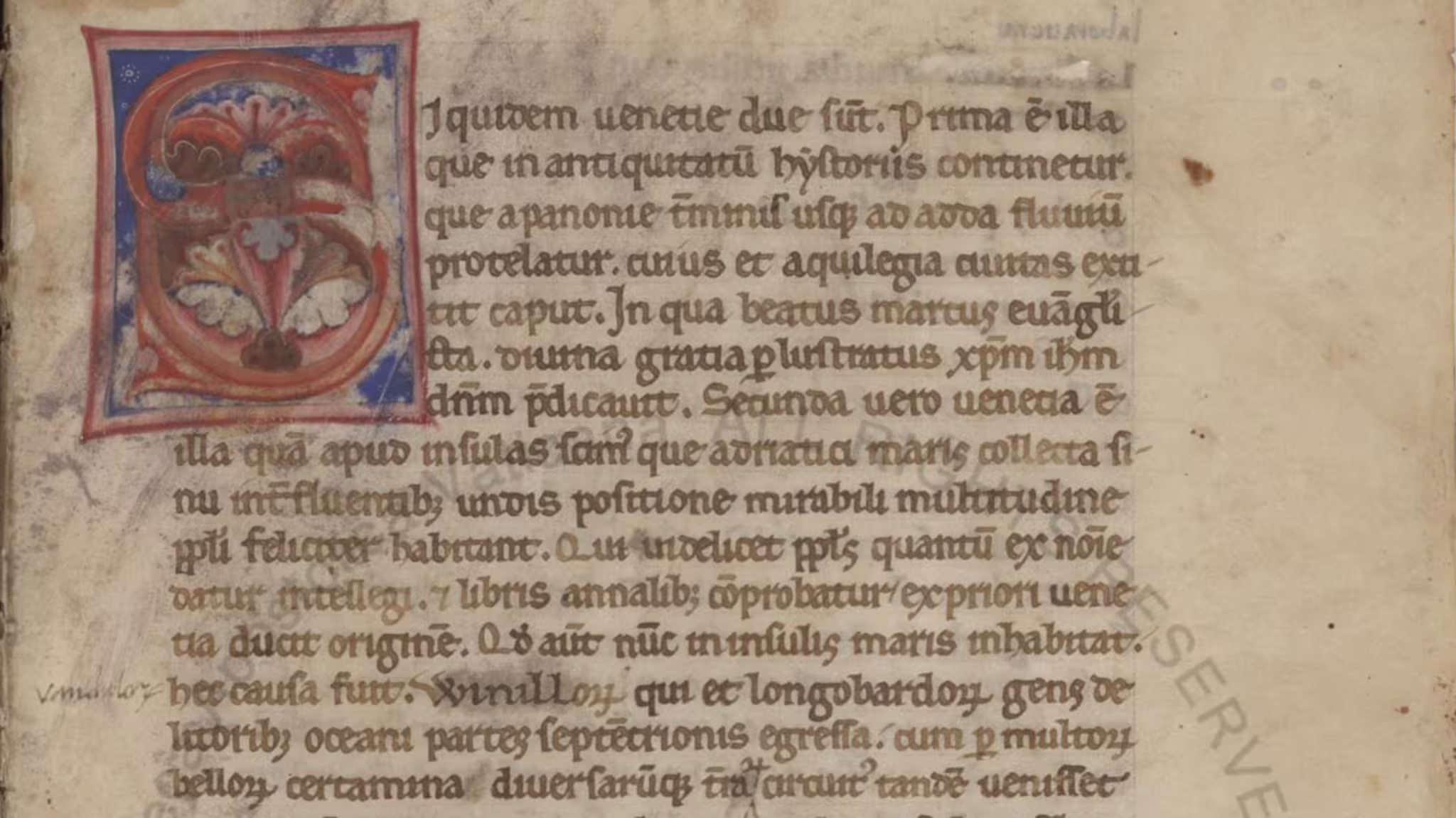
The Chronicon Altinate contains an account of how duke Paulicius was killed in a factional fight between people from Equilo and Metamauco on one side, and the inhabitants of the Civitas Nova of Heraclia on the other.
It is a very problematic story, which is not corroborated by any other source, but directly contradicted by several. For one, John the Deacon clearly stated that duke Paulicius died peacefully after a long reign.
We do not know who the authors of the Chronicon Altinate were, and we do not know when it was written.
The narrative is not structured well, with many jumps and repetitions, making reading, interpreting and translating the text difficult. There is also a fair amount of name-dropping, which served to connect the noble families of Venice at the time of writing, with their mythical forefathers based on similarities in their names.
The storyline
This excerpt starts with the town of Metamauco being settled by people from Padua, led by an Egilius and his sons. They had a fight with the people of Heraclia, led by duke Paulicius, and many were killed.
Some of the survivors of Metamauco found refuge in Equilo, further north, where they built a stronghold, diverting a canal around the settlement.
They called it Exilo, which resembled the name of the founder Egilius, and the later Jesolo, while also connecting to the myth of Equilo/Jesolo being founded by people from the fortress Asolo in the foothills of the Dolomites.
They were god-loving people, who built churches and founded monasteries.
Together with the people of Metamauco, they decided to chose their own tribunes, in opposition to duke Paulicius and his son.
They then organised a navy, and attacked Heraclia fiercely. Duke Paulicius and his sons were killed, but one who was a clergyman.
Supposedly, the city of Heraclia was destroyed, as the inhabitants resettled in Rivoalto (modern-day Venice), where they built churches and palaces.
The story as a historical source
There are some major issues with this narrative, but some parts are fairly credible.
We have no other sources for duke Paulicius meeting a violent end. On the contrary, the earlier source for Paulicius, the Istoria Veneticorum by John the Deacon, stated the opposite.
No other source mentions any offspring of Paulicius.
No other sources mention any of the other persons.
Add to this that we don’t know who wrote it, and that it was written 3–5 centuries after the events.
Consequently, there is little reason to give any credibility to the specific events narrated.
What is believable, is the general image of a society with deep fault lines, internal strife, and rampant factionalism, which often descended into physical violence and even warfare. In this period, more Venetian doges were mutilated or assassinated than died of natural causes.
Venice was, at the beginning, a divided and violent society.
The city of Heraclia was destroyed twice by its enemies from within the duchy, and when abandoned in the early 800s, many of the inhabitants settled at Rivoalto.
Since the narrative of the Chronicon Altinate doesn’t work with Paulicius as the slain ruler, it has at times been adapted to explain the killing of duke Ursus Hypatos in 737, or the last of the five magistri militum, in 742.
In fact, with the acclamation of Deusdedit, son of Ursus Hypatos, to the ducal throne in 742, the capital of the Duchy of the Venetians moved from Heraclia to Metamauco, which is not in contrast to this story. Deusdedit, however, was a native of Heraclia.
Source: Chronicon Altinate, also called the Origo civitatum Italie seu Venetiarum, translated by René Seindal. The original is from Cessi (1933).
Available translations from the Chronicon Altinate:
- The first doges — liber I (excerpts).
- The death of Paulicius — liber III (excerpt).
Chronicon Altinate, liber III (excerpt)
The people of Metamauco came from Padua and built Brendola, which was called Brondolo. The people of Equilo came from the castle of Asolo. The people of Caorle came from Concordia.
Egilius with his eight sons and three others moved to Metamauco, but they resisted Duke Paulicius and his sons.
Egilius, and Gallus and Maurus Jacobus, both brothers; Marturius, the master painter, and Georgio Ioannaceni the warrior, who was very strong; and Catarenus, who was from Cataro; Abri from Zara, who were called Liadi; Kalebrisini, who are called Calbani Caranni; Blancanisi, who are called Flabianici.
For all these, as well as others whom we must name, lived on the lido of Pineti.
A conflict arose among the inhabitants of this place, and they killed many of each other.
Those who stayed behind removed themselves from the same place and turned the channel around, placing their wise, elders and nobles in a safe place, and the channel itself was called Archimicidium because all those who should have been killed by the cruel pagans killed themselves in their sins, with God present, and they decided that no one should bury them, but birds and beasts would eat them.
In fact, the forefathers all built a castle with their tithes, but the one who was above them, a tribune and the foremost, was named Egilius, and from his name it was called Exulo, and the whole coast of Pineti was theirs.
And they built a convent for girls in honour of the holy martyrs Vitus and Modestus.
Indeed, Blancanici, who are called Flabianici, namely Exilius Gaulus, Theodosius Catarenus, and Maurus Jacobus, brothers, built these two churches, one in honour of Saint Maurus the martyr and the other in honour of Saint Thomas the Apostle.
The others, however, established the remaining churches which had previously been mentioned, and they agreed among themselves that all who wished to reside in that castle from foreign regions should be received with the greatest willingness and be obliged to pay only the ancient tribute.
Meanwhile, all the people of Metamauco praised this, along with some former Tribunes of the new city of Heraclia, and, without the consent of Duke Paulicius and his son, established a judicial tribunate in Equilo because that Duke was hated by everyone.
The names of the Tribunes were previously mentioned, but it is too long to recount them all in order. Let us find out how the New City of Heraclia was captured following the death of Duke Paulicius.
An expedition was organised among the Venetians, and they set out with a considerable number of ships, well-equipped, from Metamauco and Equilo; they reached the new city of Heraclea, where Duke Paulicius governed the duchy.
The attackers began to fight fiercely, but no one could withstand their assault.
They seized the same city and set it on fire, and killed Duke Paulicius, along with his son and all their relatives, and none of them remained except for one clergyman, who fathered two sons.
Then indeed all the dwellers of the New City left and came to the Rivo called Alto.
There they built many churches and beautiful palaces.
Click to reveal the Latin text
Metamaucenses a Patua venerunt et edificaverunt Brendolam que Brondolus. modo appellato Equilegenses venerunt de Auxolum castellum. Caprulenses vero ab Concordia venerunt.
Egilius cum octo filiis suis et tres alii in Matamauco erant translati, sed contristabant contra Paulicium ducem et contra filios eius.
Egilius vero Gallus et Maurus Iacob, ambo fratres; Marturius, magister picture, seu Georgio Ioannaceni bellator fuit fortissimus; et Catarenus, qui fuit de Cataro; Abri, qui a Geadera Liadi appellati sunt; Kalebrisini, qui Calbani Caranni appellantur; Blancanisi, qui Flabianici appellantur.
Toti namque isti seu et alii, quos nominare debemus, habitabant in litore Pineti.
Orta intentione inter habitantium hic multorum hominum, totos inter se ipsos interfecerunt.
Ipsi namque, qui remanserant, abstulerunt se de eodem loco et reversum canale in circuitu composuerunt se totos ac sapientes, anteriores et nobiliores, in securum locum, et ipsum canale nominabatur Archimicidium, pro hoc quia totos, quos a sevissimis paganis interfectos debuit esse, inter se ipsos in peccatis illorum, Deo imminente, totos se ipsos interfecerunt et consilium dederunt, ut nullus esse deberet ad sepeliendum eos, sed volucres et bestie comederent illos.
Predicti namque antiquiores omnes edificaverunt de illorum proprio decimo castellum, sed ille, qui inter illorum super erat, tribunus et primus fuit, Egilius nomine, et a suo vero nomine Exulo appellate, et totum litus Pineti est in pertinenciis eorum.
Et isti edificaverunt monasterium puellarum ad honorem sanctorum martirum Viti et Modesti.
Blancanici vero, qui Flabianici appellantur, seu Exilius Gaulus et Theodosius Catarenus et Maurus Iacob fratres edificaverunt isti duas ecclesias, unam ad honorem sancti Mauri martiris et aliam ad honorem sancti Thome apostoli.
Alli vero fecerunt ceteras Ecclesias quae antea dicendae sunt ; et constituerunt inter se, ut omnes qui volunt in eum castellum de alienis partibus ibidem habitare, cum maxima voluntate eos reciperent ad tributum dandum ipsi antiquiores.
Interea omnes laudaverunt, omnes Metamaucenses, cum aliquantis anterioribus Tribunis Civitatis novae Eraclianae, absque voluntate Paulicio Duci et filio eius, et constituerunt tribunatum iudiciarum in Equilo eo quia ille Dux ab omnibus odiosus erat.
Quod nomina Tribunorum antea dicerentur, longum namque est omnia per ordinem enarrare, Inveniamus qualiter capta est Civitas nova Eracliana propter decessum Paulicii Ducis.
Orta est intentio inter Veneticos, et abierunt cum multitudine navium decenter ornate, Metamaucensium et Equilegensium; pervenerunt usque ad novam Civitatem Eraclianam, in qua Paulicius Dux ducatum regebat.
Venientes ceperunt fortiter inter se pugnare, sed nemo poterat sustiner impetum eius.
Apprehenderunt eamdem Civitatem et incenderunt, et interfecerunt Paulicium Dux, insimul cum filio eius et cunctos consanguineos eorum; et non remansit ex eis nisi tantum unum clericum, qui genuit duos filios.
Deinde vero omnes Civitates novae habitantes exierunt, et venerunt in Rivo qui dicitur Alto.
Ibi edificaverunt Ecclesias multas et pulcra palacia.
Bibliography
- Cessi, Roberto. Origo civitatum Italie seu Venetiarum : (Chronicon Altinate et Chronicon Gradense) in Fonti per la storia d'Italia / pubblicate dall'Istituto storico italiano ; 73. Roma : Tipografia del Senato, 1933. [more]
- Rossi, Antonio, Giovanni Galvani, Martino : da Canale and Emmanuele Antonio Cicogna. La Cronaca veneta detta Altinate di autore anonimo, in latino, preceduta da un commentario del prof. Antonio Rossi e La cronaca dei Veneziani del maestro Martino da Canale, nell'antico francese, colla corrispondente versione italiana del conte Giovanni Galvani e con annotazioni di Emmanuele Cicogna … [et al.]. Firenze : Gio. Pietro Vieusseux, 1845. [more] 🔗
Leave a Reply