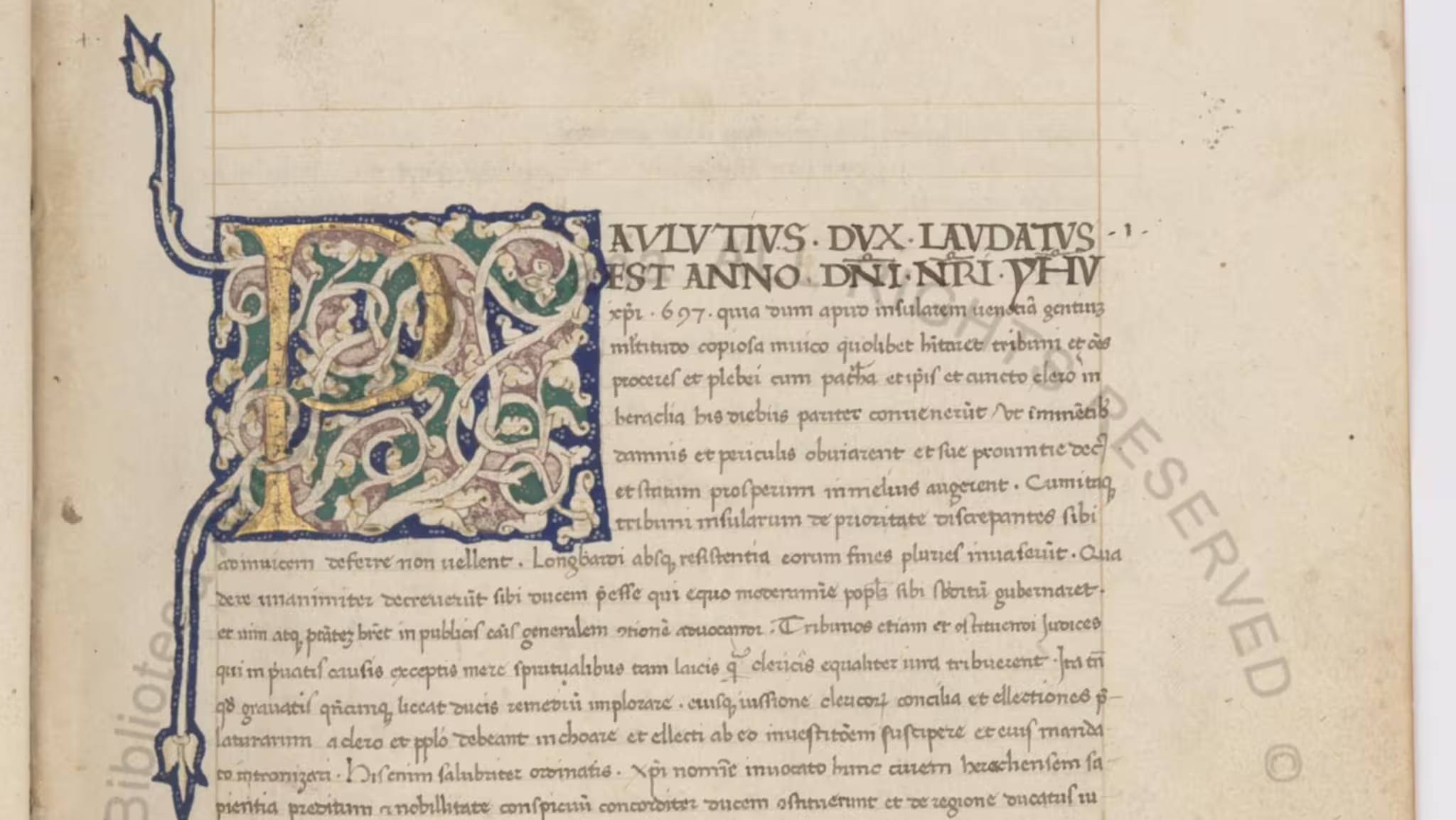
The authoritative source for the early political history of Venice was — from time of Andrea Dandolo until the 1800s — the Chronica per extensum descripta, written in the 1340s.
The Chronica Extensa was also the source for the tradition list of doges and the years of their reigns.
The relevant paragraphs for the doges between 742 and 804 are translated below, while the paragraphs for the first three doges are here.
The rulers are Deusdedit Hypatos (742-755), Galla (755–756), Domenico Monegario (756–764), Maurizio Galbaio (764–787) with his son Giovanni Galbaio (787–804), in turn with his son Maurizio II.
John the Deacon was an important source for Dandolo, both for this period and for the first three doges and five magistri militum, which preceded these.
Source: Chronica per extensum descripta (1340s), also called the Chronicon Venetum, by Andrea Dandolo, translated by René Seindal.
Available translations from the Chronica Extensa:
- The first doges — VII.1–8 (excerpts)
- Hildeprand in Ravenna — VII.3, paragraphs 2–5.
- Doges of the 700s — VII.9–13.
Excerpts from the Chronica per extensum descripta, book VII, chapters 9 to 13.
VII.9 (excerpts) — Deusdedit
Duke Deusdedit1 was appointed in the year of our Lord Jesus Christ seven hundred and forty-two.
Because the Venetians had proven through experience that the annual rulers2 were useless to them, they unanimously chose this leader, the son of Duke Ursus,3 who had been killed, at the gathering held in Metamauco,4 and established the duke’s seat in the same place.
Here, because he was noble and an imperial hypatos,5 that is, a consul, he served honourably.
… omissis …
Aistulf,6 who was the duke of Forum Iulii,7 at this time succeeded his brother Ratchis,8 who had become a monk, in the kingdom of the Lombards.
This king definitively confirmed the boundaries of the city of Heraclia,9 delineated at the time by duke Paulucius10 and Master of the Soldiers Marcellus;11 namely, from the greater Piave up to the dry Piave.12
… omissis …
Here, duke Deusdedit, in the thirteenth year of his rule, while attending to the fortification of the strongest castle on the other bank of the estuary of the Brenta river13 for its protection, was, by Galla,14 a most wicked man, deprived of his rule and sight.
Click to reveal the Latin text
Deusdedit dux decretus est anno Domini nostri Iesu Christi septingentesimo xlii.
Quia Veneti experimento probaverant annuales rectores sibi inutiles, eddicto in Methamauco congregati, hunc ducent filium Ursonis ducis occissi unanimiter elegerunt, et in eodem loco ducis sedem constituerunt.
Hic, quia nobilis erat, imperialisque ypati, idest consulis, honore fungebatur.
… omissis …
Aystulphus, qui dux Foroiullii erat, fratri Erathis facto monacho hoc tempore in regno Loogobardorum sucedit.
Hic rex terminos Heracliane civitatis, designatos tempore paulucianis ducis et Marceli magistri militum, integraliter confirmavit ; videlicet: de Piave maiore usque in Plavem sicam.
… omissis …
Hic Deusdedit dux, anno xiii sui ducatus, dum pro sui tutela hedificacioni castri fortissimi ex alia ripa Brentalis portus operam daret, auctore Galla viro sceleratissimo, ducatu et occulis privatus est.
VII.10 (excerpts) — Galla
Duke Galla seized the duchy, in the year of our Lord Jesus Christ 755. Here, having committed the crime, he came to Metamauco, and seized both the seat and title of the duke.
… omissis …
Against this Galla, while he had led for one year, two months, the Venetians, rising unanimously, deprived him of his eyes and dignity, and thus the punishment which he had unjustly inflicted on his predecessor, he now duly endured himself.
Click to reveal the Latin text
Galla dux ducatum arripuit, anno Domini nostri lesu Christi viic lv. Hic, perpetrato scelere Methamaucum venit, et ducis sedem et titulum arripuit.
… omissis …
Adversus hunc Gallam, dum ducasset anno uno, mensibus ii, Venetici unanimiter insurgentes eum occulis et dignitate privaverunt, et sic suplicium, quod iniuste predecessori intullit, nunc debite in se ipso suscepit.
VII.11 (excerpts) — Domenicus
Domenicus Monegarius15 was appointed duke in the year of our Lord Jesus Christ 756. He, originally from Metamauco, was made duke in Metamauco in person.
Indeed, as is the custom of the common people, who never persist in a determination, they, with a certain superstitious folly, devising various inventions, created for themselves two annual tribunes for this duke, who would serve under him.
… omissis …
The following year, the Venetians, having conspired, put out the eyes and deposed this duke, after he had ruled for eight years.
Click to reveal the Latin text
Dominicus Monegario dux assumptus est anno Domini nostri Iesu Christi viic lvi. Hic, origine Methamaucensis, in Methamauco presencialiter factus est dux.
Sane, uti mos vulgi est, qui nunquam in preposita voluntate persistens, se quadam supersticiosa stulticia, varias adinvenciones excogitans, in huius ducis creacione duos tribunos annuales, qui sub eo consisterent, sibi preposuerunt.
… omissis …
Sequenti anno, Veneti, conspiracione facta, hunc ducem, dum ducasset annis viii, occulis et sede exuerunt.
VII.12 (excerpts) — Mauricius
Mauricius16 was proclaimed duke in the year of our Lord Jesus Christ 764. He, born in Heraclea, noble by birth, and more noble for his illustrious deeds, was now made duke at Metamauco: who, exercising just rule, reconciled discordant citizens, and from the Italian disturbances imminent in his time,17 preserved the Venetian homeland unharmed.
… omissis …
These days, Mauricius, Duke of Venice and now appointed imperial consul, sympathizing with the people of Istria and grieving over the diminishment of the church of Grado, deplored the intolerable cruelty of the Lombards through his envoys: Magnus, priest and secretary, and the tribune Constantius, together with the patriarch, informed pope Stephen,18 but the pope, with his death approaching, could not provide the full remedy he wished.
… omissis …
Until now, all the islands where the citizens of Padua first settled had been under a single bishop, namely the bishop of Metamauco; but now, with a part removed, a cathedral seat has been established in the oldest island at the fortress of Olibola,19 with equally commendable clergy, and the neighbouring islands of Gemini, Rivoalto, Luprio, and Dorsoduro have been placed under its jurisdiction; these have been confirmed by the privilege of Pope Adrian.20
After this, a synod of the clergy and people of the Venetians was gathered, with the duke and the patriarch appointed Obeliebatus,21 a cleric, son of En’eaglius, tribune of Metamauco, bishop of the aforementioned see, and praised, invested and enthroned by the duke, who was consecrated by the patriarch, eleventh year of the duke, however, the title to him, according to the Greek pronunciation, was decreed bishop of Olivolo, in Latin however Olibolo; he also held the bishopric for 23 years.
… omissis …
In the same year,22 the Venetians, eager to please Doge Mauricius, who had conducted himself laudably in public affairs in his time, appointed his son Giovanni23 as a partner in dignity and later as his successor: and thus they began to have two dukes at the same time, leaving to the successors a disastrous outcome of affairs.
… omissis …
Mauricius, also Duke of Venice, full of days, in the twenty-third year of his duchy, happily ended his days.
Click to reveal the Latin text
Mauricius dux pronunciatus est anno Domini nostri Iesu Christi viic lxiiii. Hic, in Heraclia natus, genere nobilis, et inclitis gestis nobilior, apud Methamaucum dux nunc effectus est : qui iuste regimen exercens, disco[r]des cives reconciliavit, et ab ytalicis turbacionibus suo tempore imminentibus, Venetorum patriam illessam servavit.
… omissis …
Hiis diebus, Mauricius dux Venecie, et imperialis consul iam effectus, conpaciens Ystriensi populo, et dolens de mi’noracione gradensis ecclesie, intolerabìlcm Longobardorum seviciam per suos legatos: Magnum presbiterum et scrinearium et Constantinum tribunum, unna cum patriarcha Stephano, pape insinuai; sed papa, superveniente obitu, ut optabat piene providere non potuit.
… omissis …
Usque ad hec tempora insule omnes, in quibus primo Pathavini cives incolatum habuerant, sub uno tantum episcopo, scilicet methamaucense, extiterunt; nunc vero, parte subtracta, cleri et pepali pari conlaudacione in castro Olibolensi insula vetustissima sedes kathedralis instituta est, eique cohaderentes insule Geminis, Rivoalti, Luprii et Dorsoduri subposite sunt; que, privilegio Adriani pape, roborata fuerunt.
Post hec, Venetorum cleri et populi synodus adunata, asistentibus duce et patriarcha Obeliebatum clericum, filium En’eaglii tribuni Methamaucensis, sedis prephate episcopum laudavit, et laudatus, a duce investitus et inthronicatus, a patriarcha que consecratus est, xi ducis anno, titulus autem ei, iuxta grecam pronunciacionem, episcopus olivolensis decretus est, secundum latinam vero olibolensis; tenuit quoque episcopatum annis xxiii.
… omissis …
Eodem anno Veneti avidi Maur[i]cio duci satisfacere, qui in negociis publicis, suo tem pore, laudabiliter se habuerat, Iohanem eius natum dignitatis consortem, et postea sucessorem, conlaudaverunt: duosque duces eodem tempore Veneti habere ceperunt, perniciose rei exitum sucessoribus relinquentes.
Mauricius quoque dux Venecie, plenus dierum, xxiii sui ducatus anno, dies suos feliciter terminavit.
VII.13 (excerpts) — Giovanni
Duke Giovanni, held the duchy alone in the year of our Lord Jesus Christ 787. After the death of his father, he held the sceptre alone at Metamauco, but, unlike his father in word and deed, did not manage the affairs of the country well and undertook ruinous endeavours.
… omissis …
During these days, duke Giovanni, seizing the opportunity, sent his son Mauricius,24 with a naval force, to Grado to kill Patriarch Giovanni.25 However, Mauricius, in a fury, invaded the city; in this invasion, the patriarch was captured, severely wounded by the Venetians, and thrown from the highest tower of his palace where he died; his blood, as a testament to his death, still appears on the stones; and he was buried in the chapel of Saint Mark, behind the mausoleums of the holy martyrs.
… omissis …
… Giovanni also ruled with his father for nine years, and after his father’s death, he ruled alone for nine years, and with his son Mauricius for seven years; and thus, counting all the years, he held the dukedom for twenty-five years.
Click to reveal the Latin text
Iohanes dux solus ducatum tenuit anno Domini nostri Iesu Christi viic lxxxvii. Hic, post obitum genitoris, solus in Methamauco septrum tenuit, qui, verbo et opere patri disimilis, comoda patrie non bene tractavit, perniciosumque suscepit exictum.
… omissis …
Per hos dies Johanes dux, occasione sumpta, Mauricium filium suum, cum navali apparatu, Gradum missit, ut Iohanem patriarcham interficeret. Mauricius autem, cum furore, civitatem invasìt; in qua invasione, patriarcha captus, graviter a Venetis vulneratus est, et de turri altisima sui palacii ad yma deiectus expiravit; cuius sanguis, in testimonium mortis sue, in pe’tris presencialiter apparet; sepultusque fuit in Sancti Marci capela, post sanctorum martirum mausolea.
… omissis …
… Ducavit quoque Iohanes cum patre annis ix, et, post obitum patris, solus annis ix, cum Mauricio autem filio annis vii; et sic annis omnibus conputatis, annis xxv ducatum tenuit.
Notes
- Deusdedit Hypatos (†755) (also Deusdatus, Diodato, or Teodato Ipato) was the 4th doge of Venice, from 742 to 755, and son of Ursus Hypatos. He also served at the third magister militum in 739. ↩︎
- This is a reference to the magistri militum, who had governed Venice for the preceeding five years. ↩︎
- Ursus Hypatos (†737) (also Orso Ipato) was the 3rd doge of Venice, and probably the first to be chosen by the Venetians. He was killed in an internal struggle in 737. ↩︎
- Malamocco (or Metamauco) was capital of the Venetian proto-state for parts of the 700s, possibly located on the Lido di Venezia. ↩︎
- Hypatos (also: Latinised as hypatus or ypatus, or Italian ipato) was a Byzantine court title, meaning consul, derived from the late Roman honorary consulship. ↩︎
- Aistulf (†756) was Duke of Friuli from 744, and King of the Lombards from 749 until his death in 756. He attacked the Byzantine dominions repeatedly, including Ravenna and Rome. ↩︎
- Cividale del Friuli (orig: Forum Iulii) was the first Lombard capital in Italy, and the main city of the Lombard Duchy of Friuli. ↩︎
- Ratchis († after 757) was the Duke of Friuli (739–744) and King of the Lombards (744–749). ↩︎
- Eraclea (orig. Civitas Nova Heracliana, also Civitanova), founded in 640, was originally situated on a lagoon island. It was the first seat of the doges of Venice, before it moved to Metamauco. ↩︎
- Paulicius (also Paoluccio Anafesto or Paulicio) was the first doge of Venice, nominally from 697 to 717, but the years are uncertain, as is his real identity. See also: Paulicius — the first doge of Venice?. ↩︎
- Marcellus (†726), also Marcello Tegalliano, was, according to tradition, the 2nd doge of Venice from 717 to his death in 726, but very little is known about him. ↩︎
- The Pactum Lotharii from 840 was a treaty between Venice and the Holy Roman Empire, which regulated the border and activities around the border. ↩︎
- Brondolo was an ancient settlement in the lagoon, at the estuary of the Adige river. It is now a suburb of Chioggia. ↩︎
- Galla, later attributed the surname Gaulo, was the 5th doge of Venice. Having deposed and blinded Deusdedit, he was in turn deposed and blinded the following year. ↩︎
- Domenico Monegario was the 6th doge of Venice, from 756 until he was deposed and blinded in 764. ↩︎
- Maurizio Galbaio (†787), also Mauricius Galba, was the 7th doge of Venice from 764 to his death. He was succeeded by his son Giovanni. ↩︎
- The Carolingian conquest of northern Italy in 774 put an end to the Kingdom of the Lombards. ↩︎
- Pope Stephen III (720–772) was bishop of Rom from 768 until his death in January 772. ↩︎
- The Olivolo island was one of the most ancient settlements, which became Venice, and the seat of the Bishops of Venice since 774. ↩︎
- Pope Adrian I (700–795), also Hadrianus, was bishop of Rome from 772 until his death. ↩︎
- Obelaio (†798), or Obeliebatus, was the first bishop of Olivolo. ↩︎
- The year was 778. ↩︎
- Giovanni Galbaio (†804), was the 8th doge of Venice, from 778 as co-ruler of his father Maurizio, from 787 alone, until his death. ↩︎
- Maurizio II Galbaio was the son of doge Giovanni Galbaio, and his co-ruler for the last years. ↩︎
- Giovanni I (†802) was Patriarch of Grado from 766 until he was murdered in 802 by the son of doge Giovanni Galbaio. ↩︎
Bibliography
- Dandolo, Andrea and Ester Pastorello. Chronica per extensum descripta in Rerum Italicarum scriptores : raccolta degli storici italiani dal Cinquecento al Millecinquecento / ordinata da L. A. Muratori , 12.1. Bologna : N. Zanichelli, 1938-1958. [more] 🔗
- Muratori, Lodovico Antonio. Rerum Italicarum scriptores, 28 vols. Mediolani : ex Typographia Societatis Palatinae in Regia Curia, 1723-1751. [more]
Leave a Reply