The demise of the Exarchate at the hands of the Lombard king Aistulf in 750–752, indirectly led to the end of Lombard rule in northern Italy.
The papacy, which had been part of the Byzantine Exarchate of Ravenna, found itself without the protection of a secular power, and consequently allied with the Franks.
Within a couple of decades from the Lombard conquest of the Exarchate, the Kingdom of the Lombards was replaced with a Frankish Kingdom of Italy.
For the Venetians things went from bad to worse.
Aistulf and Pepin the Short
King Aistulf wanted to take all Byzantine lands in Italy. After the conquest of Ravenna and the Pentapolis in 751–752, he therefore turned is attention on Rome.
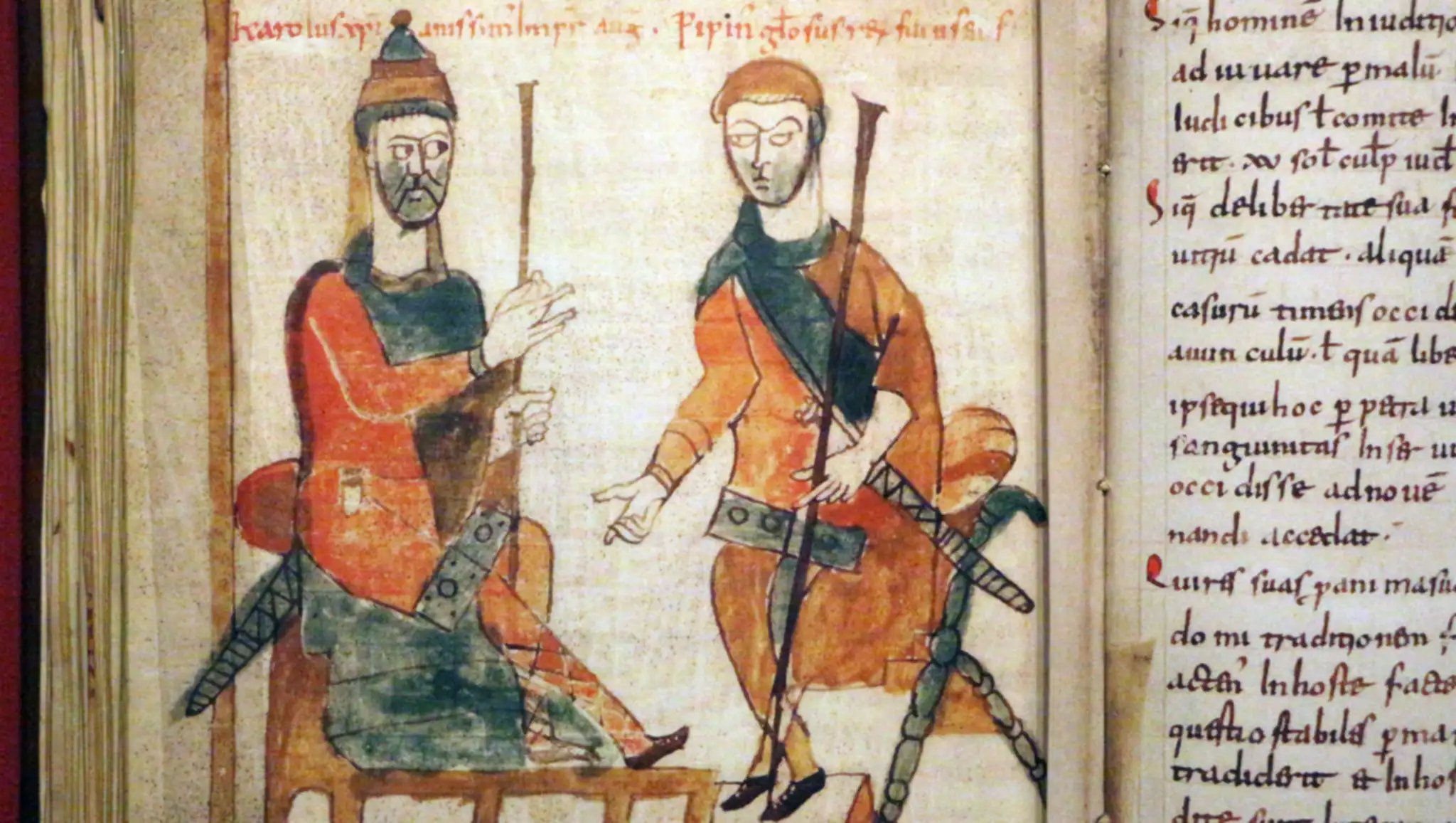
Consequently, no longer able to rely on Constantinople or the Exarchate, Pope Stephen II turned to Pepin the Short, king of the Franks, for support against the Lombards.
Pepin was only too pleased to help. He promptly invaded the Kingdom of the Lombards, defeated Aistulf twice, and forced him to hand over the conquered territories of the former Exarchate to the papacy, thus laying down the base for the later Papal State.
Pepin, however, did not depose Aistulf after the second defeat, but the Lombard king died shortly after, in 756.
Initially, Ratchis, his brother and former king, returned from his monastery to rule again, but within a few months, the Lombard dukes chose Desiderius as their king.
In Francia, Pepin died in 768 and was succeeded by his son Charles, later Charles the Great, Charlemagne.
Conflict in Istria
A single source — the Chronicon Salernitanum — stated that king Aistulf conquered Istria in 750, the year before he took Ravenna and the rest of the lands of the Exarchate.
Most other available sources recounted that king Desiderius embarked on a military campaign in Istria around 770, to take the province from the Byzantines.
If that is so, either Aistulf didn’t take Istria in 750, or he did, but failed to keep it as his attention turned towards Ravenna and the Pentapolis.
In either case, by the early 770s, the Lombards under Desiderius had successfully gained control over the peninsula of Istria.
The dioceses of Istria had traditionally been under the jurisdiction of the Patriarchate of Grado, in Venetia, but that was now questioned.
Issues of territorial control, taxation and interference in ecclesiastical matters led to a series of letters between Giovanni, patriarch of Grado, pope Stephen III in Rome and the patriarch of Aquileia, who had relocated to Cividale, the original Lombard capital of Friuli.
In the initial letter of complaint to the pontiff, the patriarch of Grado named duke Mauricius, and called him “consul” — the Byzantine title of hypatos — and “imperial duke” of “this province,” giving the impression that Venetia was still — at least in name — a loyal Byzantine province.
On account of all these matters set forth in the above chapters, we hastened to grant relief from all our unbearable tribulation and excessive oppression, with the consent of the holy Son of God, Mauricius, consul and imperial duke of this province of the Venetians.
Cessi (1940), n. 30 (excerpt), p. 49.
Pope Stephen, who had other problems with the Lombards, decided in favour of Grado, and sent a missive to the patriarch of Aquileia telling him off for interfering in matters of another ecclesiastical authority.
However, the pontiff died in 772, before he could take any further action.
The next pope was Adrian I.
In his biography in the Liber Pontificalis there’s a sentence, referring to events to around 772, which might indicate that the Venetians took active part in the Byzantine defence of Istria, against the Lombards. It mentioned in the passing, that a son of duke Mauricius was held captive by the Lombard king Desiderius, but offers no explanation as to why and how.
… in that Desiderius, king of the Lombards, was keeping the son of Mauricius, duke of the Venetians, captured, lest Mauricius himself, desiring to free his son from the king, should hand over Paul to him as ransom.
Duchesne (1886), vol. 1, p. 490–491.
Joining up these dots, many scholars have concluded that the Duchy of the Venetians participated directly in the fighting in defence of Byzantine Istria, but we have no sources stating so directly.
The end of the Lombards
Desiderius hadn’t given up on controlling the territories of the former Exarchate, and Lombard forces raided and attacked these — now papal — lands repeatedly.
Both Stephen III and Adrian I turned to the Franks for help.
Charlemagne already had some disagreements with Desiderius. Among other things, he had married a daughter of the Lombard king, but later repudiated her, and send her back to her father.
Charlemagne therefore happily listened to the grievances of the popes and in 773 he invaded the Kingdom of the Lombards. He besieged the capital Pavia, which he took the following year.
He also captured king Desiderius, appointed himself king of the Lombards, and later renamed it the Kingdom of Italy.
Consequently, from 774, there were only two important players left in the northern half of the Italian peninsula.
The Papacy of Rome was now essentially a state with a territory which included most of the former lands of the Exarchate in central Italy. The Papal State stretched across the peninsula, coast to coast, from Rome to Ravenna, until the Po estuary.
Everything north of the Papal State was the Frankish Kingdom of Italy, ruled by Charlemagne, and later by his son Pepin.
Everything, except the lagoons of Venetia Maritima, from Grado to Cavarzere. The Duchy of the Venetians — the dogado — was still Byzantine.
In practice, however, Constantinople was far away and could offer the Venetians little assistance against the combined efforts of a Frankish Kingdom of Italy, and a Frankish aligned papacy.
The Venetians and the Franks
From the very scarce sources available, the co-existence of the Venetians and the Franks don’t appear to have been easy.
In particular, we have a letter from pope Adrian I to Charlemagne, dating to 787 or shortly thereafter. This is around or just after the death of duke Mauricius and the sole rule of his son Giovanni.
Adrian I wrote to Charlemagne:
We have informed the most gracious royal excellence, for while your royal command was issued in celebration of victory, ordering the Venetians to be expelled from the regions of Ravenna and the Pentapolis for trading, we immediately sent emissaries to those regions, fulfilling your royal will.
Moreover, I also directed that the archbishop be ordered that in any of our territories under the holy church of Ravenna, where the Venetians should have rights, presences, and possessions, that they should expel them completely and thus hold the rights of their church in his own hands.
Gundlach et.al. (1892), p. 622–623.
In this letter, Adrian I confirmed to Charlemagne, that he had done as instructed by the king, and ordered the archbishop of Ravenna to expel all Venetians from the territories of the former Exarchate, to confiscate all their property, including what belonged to the Venetian church, and remove all established rights of residence, property and trade the Venetians might have there.
We don’t know if the expulsion of the Venetians from the former Exarchate was carried out as described in the letter. However, the mere fact that Charlemagne made such a request, and the pope tried to fulfil it, tells us that the situation was, at best, on the brink of war.
We have no other sources for these events, or for specific conflicts — armed or not — between the Venetians and the Franks.
Byzantine-Frankish tension
What is far more likely, is that such an expulsion of the Venetians from the former Byzantine lands was related to ongoing tensions and conflicts between Constantinople and the Franks.
Not all Lombards had submitted voluntarily to Charlemagne.
Adelchis was son of Desiderius, and had been co-ruler of the Kingdom of the Lombards since 759. During the siege of Pavia in 774, he had fled to Constantinople.
Other Lombard lords in exile gathered around Adelchis.
Around the time of the expulsion of the Venetians, Constantinople decided to actively promote the claim of Adelchis to the Lombard throne.
In late 778, a combined Byzantine-Lombard force landed in Byzantine territories in the south of Italy, hoping to gain the support of the Lombard duchies of Benevento and Spoleto.
However, the Lombard dukes of Benevento and Spoleto had sided with the Franks, and invading force was defeated, without getting anywhere near Frankish territories in northern Italy.
Nothing more is known about the fate of Adelchis.
Bibliography
- Cessi, Roberto. Documenti relativi alla storia di Venezia anteriori al Mille. Padova : Gregoriana, 1940-1942. [more] 🔗
- Duchesne, Louis. Le liber pontificalis / texte, introduction et commentaire, 2 voll. Paris : Thorin, 1886-1892. [more] 🔗
- Gundlach, Wilhelm and Ernst Dümmler (eds.). Epistolae Merowingici et Karolini aevi (I) in Monumenta Germaniae historica. Hannoverae : impensis Bibliopolii Hahniani, 1892. [more] 🔗
Leave a Reply