Obelerius and Beatus were two brothers from Metamauco, and among the leaders of the pro-Frankish faction in Venetian society in the late 700s and early 800s.
After the murder of patriarch Giovanni in 802, at the hands of the pro-Byzantine dukes Giovanni and Mauricius, Obelerius and other like-minded Venetians conspired with the new patriarch Fortunatus to overthrow the dukes and the pro-Byzantine faction in Venetian politics.
They succeeded in 804. Giovanni and Mauricius fled Venetia, and Obelerius was appointed duke of the Venetians. He soon made his brother Beatus co-ruler, and they ruled jointly until their later removal.
Their reign was dominated by internal strife in Venetia, and by the conflict between the Byzantine and the Carolingian empires over control of the upper Adriatic, including Venetia.
The city of Heraclia was destroyed during an internal conflict, and most of the leading families from there moved to Rivoalto, modern-day Venice.
Even though Obelerius and Beatus belonged to the pro-Frankish side in Venetian politics, when the patrician Nicetas appeared in the upper Adriatic with a Byzantine navy, they swore allegiance to Constantinople.
Obelerius received the title of spatharios, which ranked higher than the title of hypatos, which was normally awarded to dukes of the Venetians. Beatus travelled to Constantinople with the returning navy. He later came back, with the title of hypatos.
Following this Byzantine show of strength, Pepin, the Carolingian king of Italy and son of Charlemagne, attacked Venetia from the sea-side, but he was defeated by the Venetians. Pepin died the following year.
With the return of the Byzantines, the two dukes were removed, and the new duke Agnellus set up court in Rivoalto, making it the capital of Venetia.
This is one of the very rare occasions when John the Deacon admits to foreign influence on internal matters in Venetia.
Obelerius was exiled to Constantinople, but returned to Venetia almost two decades later. He still had followers in Metamauco, and started a rebellion, but was defeated and killed.
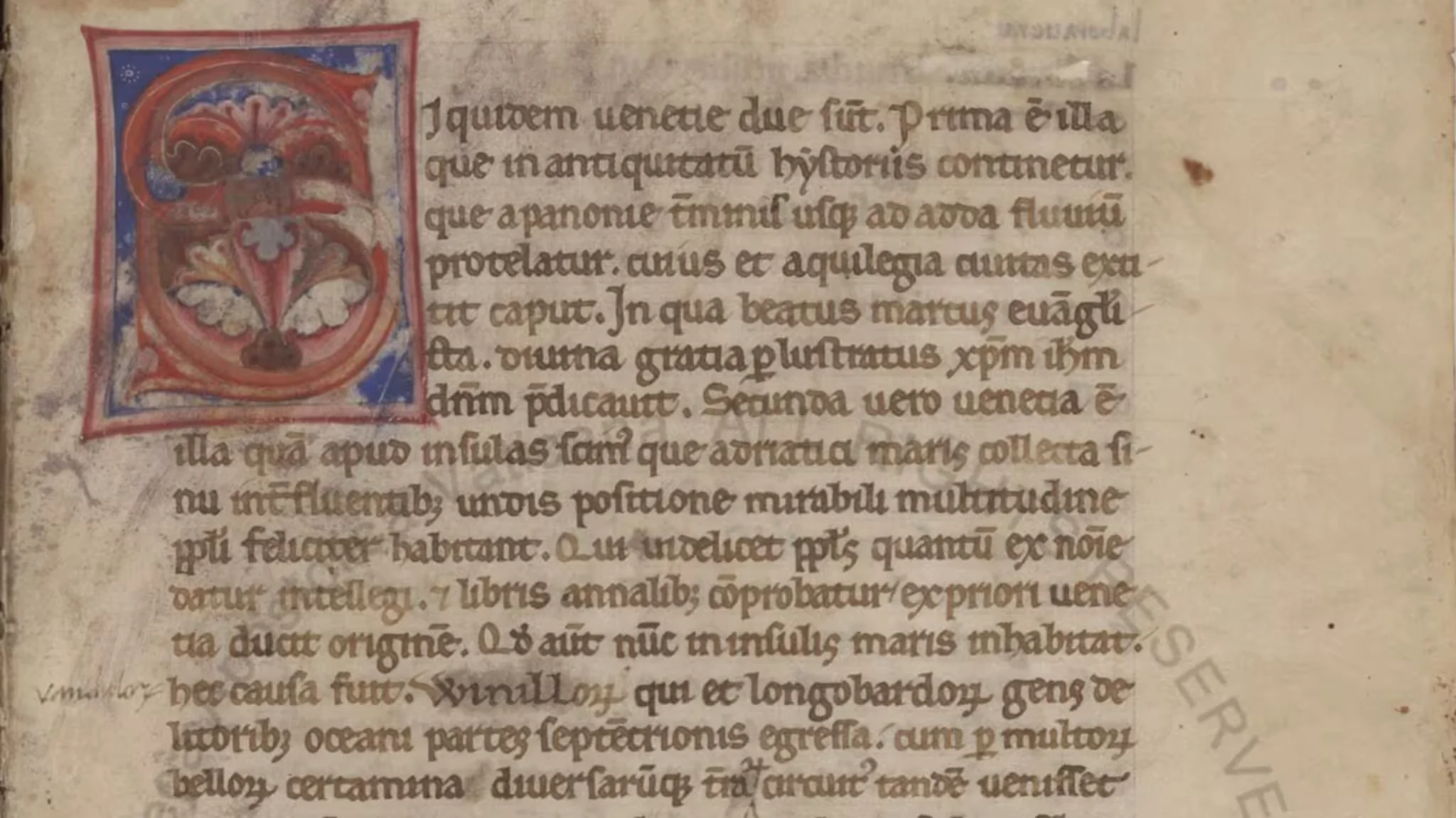
Source: Istoria Veneticorum (c.1008) by John the Deacon, translated by René Seindal, and controlled with the Italian translation in Iohannes : Diaconus Venetus et.al. (1999).
Available translations from the Istoria Veneticorum:
- The settlements of the lagoons — chapter I.7
- The first doges — chapters II.1–2, II.10–11 and II.14.
- Hildeprand in Ravenna — chapters II.12–13.
- Doges of the 700s — chapters II.17–19, 22 and 24.
- Obelerius and Beatus — chapters II.24–27, 29 and 41.
Chapter II.24
Indeed, Fortunatus the patriarch,1 bitterly grieving the murder of his predecessor and parent, arranged plots against the dukes Mauricius2 and Giovanni and, having left his seat and city, went to Italy.
Then a certain tribune, named Obelerius,3 from Metamauco,4 followed, and Felix the tribune, Dimitrius, Marianus, Fuscarus Gregorio, and some other elders of the Venetians, of whom only the patriarch went to France.
The others remained in a city not far from Venetia, called Treviso,5 and there, not staying for long, having been advised by those who were living in Venetia, they elected the tribune Obelerius as their duke.
When the dukes Giovanni and Mauricius, realized this, worn down by fear, they fled. One of them went to France, that is Mauricius, the other indeed went to Mantua, where they sojourned so long that neither of them returned to Venetia, but there they ended their last day.
Christoforus,6 also bishop of Olivolo,7 while he did not dare to await the arrival of Duke Obelerius, fled with the aforementioned dukes.
Then the same Obelerius boldly entered Venetia. Here, when he had been received by the people with devotion and honour, he made his brother, namely Beatus by name,8 his partner in dignity.
At this time also, the New City, which is called Heraclia,9 was destroyed by the Venetians. Then the aforementioned leaders sent a fleet to plunder the province of Dalmatia.
Click to reveal the Latin text
Prelibatus siquidem Fortunatus patriarcha acriter dolens interfectionem sui decessoris et parentis, insidias adversus Mauricium et Iohannem duces composuit et, relicta sede et urbe, ad Italiam perexit.
Quem etiam secutus est quidam tribunus, Obellierius nomine, Metamaucensis, Felix tribunus, Dimitrius, Marianus seu Fuscarus Gregorii et nonnulli alii Veneticorum maiores, ex quibus solus patriarcha in Franciam ivit.
Ceteri vero remanserunt in quadam civitate non procul a Venecia, nomine Tarvisio, ibique non diutius degentes, consilio illorum ammoniti qui in Venetia morabantur, Obellierium tribunum ducem elegerunt.
Quo Iohannes et Mauricius duces comperto, adtriti timoratione, fuga lapsi sunt. Alter illorum Franciam, id est Mauricius, alter vero Mantuam adivit, ubi adeo commorati sunt, ut neuter illorum Veneciam rediret, sed illic diem clauserunt extremum.
Christoforus etiam Olivolensis episcopus, dum Obelierii ducis adventum non auderet prestolari, cum predictis ducibus fuga lapsus est.
Tunc hisdem Obelierius audacter Veneciam intravit. Qui cum devote et honorifice a populo susceptus esset, suum fratrem, videlicet Beatum nomine, dignitate fecit sibi socium.
Hac etiam tempestate Civitas nova, que vocatur Eracliana, a Veneticis destructa est. Deinde predicti duces navalem exercitum ad Dalmaciarum provinciam depopulandam destinaverunt.
Chapter II.25
For the see of Olivolo, which left vacant lacking a proper pastor, had been assigned to John the deacon, elected by the people. After some time, however, Patriarch Fortunatus, together with Bishop Christopher, returned from France. Since they were not permitted to enter Venetia, they were accommodated and stayed for some time in the Church of Saint Cyprian, of the people of the bishopric of Altino,10 which is located in Mestre. But when Lord Fortunatus learned that the see of Bishop Christopher had been unjustly usurped by deacon John, he was thoroughly grieved, and began most diligently to consider how he might help to restore him to his proper see.
Indeed, the aforementioned deacon John, one day when he went carelessly, was captured by Patriarch Fortunatus and held prisoner for a long time. But when he considered what he ought to do with him, he slipped away during the night and promptly went to duke Obelerius.
When he recounted to him the things he had suffered from Fortunatus, he stirred the duke’s mind against the same patriarch into hatred stronger than it had been before.
Nevertheless, with the patriarch’s advice, Christopher finally regained his seat; Deacon John, however, returned to his own house.
Therefore, Patriarch Fortunatus, since he remained in exile from his own seat for some time, arranged to return to the city of Grado.
And because he greatly feared the arrival of the patrician Nicetas, who at that time was sent by the emperor with an army to the regions of Dalmatia and Venetia, he left his seat and his own city and returned again to France. Deacon John, however, who had been elected to the bishopric of Olivolo, was ordained patriarch.
Click to reveal the Latin text
Olyvolensis namambassadorque sedis, que proprio pastore vacua videbatur, Iohanni diacono electo a plebe fuerat adtributa. Post aliquod vero tempus Fortunatus patriarcha cum Christoforo episcopo de Francia repedavit. Quibus cum fas non esset Veneciam penetrare, in sancti Cipriani ecclesia, plebe scilicet Altinatis episcopii, quae scita est apud Mistrinam, ospitati et aliquamdiu commorati sunt. Verum postquam domnus Fortunatus Christofori episcopi sedem a Iohanne diacono iniuste usurpatam didicit, prorsus doluit, et tractare studiosissime cepit qualiter sibi faveret ut eum ad propriam sedem restituere posset.
Iohannes siquidem predictus diaconus quadam die cum incautus iret, a Fortunato patriarcha captus et diu detentus est. Sed ubi excogitaret quid de illo agere deberet, nocte fuga lapsus evasit et instanter Obellierium ducem adivit.
Cui cum ea que passus a Fortunato fuerat ordine recitaret, pocius ducis animum adversus eundem patriarcham in odium quam antea esset excitavit.
Tamen, consulente patriarcha, Christoforus sedem suam tandem recepit; Iohannes vero diaconus reversus est ad propriam domum.
Igitur Fortunatus patriarcha, cum per aliquanta temporum spacia exsul a propria sede maneret, Gradensem disposuit reciprocare urbem.
Et quia valde Nicetae patricii adventum prestolari formidabat, qui tunc missus ab imperatore cum exercitu in partes Dalmaciarum atque Veneciarum veniebat, relicta sede et propria urbe, iterum Franciam petiit. Iohannes vero diaconus, qui electus fuerat in episcopatu Olyvolensi, ordinatus est patriarcha.
Chapter II.26
Indeed, duke Obelerius received the title of spatharios11 through the patrician Nicetas. Beatus, his brother, however, went to Constantinople with the aforementioned Nicetas, bringing with him the hostages of the Venetians, Bishop Christopher, and the tribune Felix, whom the emperor condemned to exile.
The aforementioned Christopher, moreover, governed the church of Olivolo for twelve years; he was succeeded by Christopher the priest,12 who was the pastor of the church of Saint Moisè.
At the same time the city of Heraclia was again devastated by the Venetians and burned with fire.
Then duke Beatus, who went to Constantinople with the patrician Nicetas, having returned to Venetia, was honoured by the emperor with the rank of hypatus.13 Then the dukes Obelerius and Beatus wished to have Valentinus, their third brother, as a partner in the dignity of the duchy.
Click to reveal the Latin text
Obellierius siquidem dux per Nicetam patricium spatharii honorem suscepit. Beatus vero, frater eius, cum predicto Niceta Constantinopolim ivit secumque deferens Veneticorum obsides et Christoforum episcopum et Felicem tribunum, quos augustus exilio dampnavit.
Gubernavit autem predictus Christoforus Olivolensem ecclesiam annis duodecim; quem successit Christoforus presbyter, qui sancti Moysi ecclesiae estitit plebanus.
Eodem quoque tempore civitas Eracliana a Veneticis iterum devastata et igne combusta est.
Tunc Beatus dux, qui cum Niceta patricio Constantinopolim ivit, in Veneciam reversus, ab imperatore honore ypati condecoratus est. Deinde Obelierius et Beatus duces Valentinum, tercium illorum fratrem, in dignitate sui ducatus habere consortem voluerunt.
Chapter II.27
Meanwhile, the treaty that the Venetian people once had with the Italian king was broken at that time under King Pepin,14 who then sent a huge army of Lombards to capture the Venetian province.
After struggling greatly through the harbours that separate the islands of the coast, they finally reached a place called Albiola.15
They could make no further progress, and there the dukes with a large Venetian force, boldly attacked the king, and by divine intervention the Venetians were granted triumph over their enemies, so the aforementioned king withdrew humiliated.
Thus, in the year of the incarnation of our Redeemer […] King Pepin died, and the envoys from Constantinople who had been coming to him to negotiate, returned.
Click to reveal the Latin text
Interea foedus quod Veneticorum populus olym cum Italico rege habebat, illo tempore, Pipino agente rege, disruptum est et hisdem rex ingentem exercitum Longobardorum ad Veneticorum provinciam capiendam promovit.
Qui cum magna dificultate portus, qui dividunt insularum littora, pertransisset, tandem ad quendam locum, qui Albiola vocatur, pervenit.
Nulla racione in antea pertendere gressum valuit, ibique duces, stipati magna Veneticorum expedicione, eundem regem audacter aggressi sunt et divinitus datum est Veneticis de inimicis triumphum, sicque predictus rex confusus recessit.
Igitur anno incarnacionis Redemptoris nostri […] Pipinus rex deposuit hominem et Constantinopolitani missi, qui tunc ad eum legationis causa veniebant, mortuo ipso, reversi sunt.
Chapter II.29
At that time, an envoy from Constantinople, named Arfasio, visited Venetia and through the consent and support of the Venetians, obtained that both dukes lost their dignity and their homeland; one, that is Obelerius, sought Constantinople, while the other went to Zara. They governed the duchy of the Venetians for a period of five years.
Then, when it had been […] years since the incarnation of the Lord, the Venetians, by common decree, preferred the seat of the duchy to be on the island of Rivoalto, and elevated to this honour a certain man, named Agnellus,16 who constructed the palace which still stands today. Under his reign, they also established that two tribunes should be appointed each year.
Click to reveal the Latin text
Hac quidem tempestate nuntius Constantinopolitanus, nomine Ebersapius, Venetiam adivit et Veneticorum consilio et virtute hoc peregit, ut utrique duces et dignitatem et patriam amitterent; unus, id est Obelierius, Constantinopolim, alter vero Iateram petiit. Qui quinque annorum spacio Veneticorum ducatum gubernaverunt.
Deinde cum essent anni ab incarnatione Domini […] apud Rivoaltensem insulam Venetici communi decreto ducatus sedem habere maluerunt et ad hunc honorem quendam virum, Agnellum nomine, qui palatii hucusque manentis fuerat fabricator, sublimarunt. Sub dignitate etiam cuius duos tribunos per singulos annos fieri constituerunt.
Chapter II.41
Meanwhile, Obelerius, who had been condemned to exile at Constantinople, returned to Venice and took refuge in the city of Virgilia near Correggio.
When this was heard, duke Giovanni17 advanced the army to capture him. But after he had long besieged the aforementioned city, finally, with the army divided, the people of Metamauco fled to the aforementioned Obelerius for refuge.
Indeed, the army, which remained loyal to their commander, completely burned the island of Metamauco while capturing it.
Then Lord duke Giovanni once again prepared an army with which he himself came and captured the city of Virgilia and, having seized Obelerius, ordered him to be beheaded. His head was brought to the island of Metamauco and hung on the shore near Saint Martin’s18 on Holy Saturday.
Click to reveal the Latin text
Interea Obellierius, qui apud Constantinopolim exilio fuerat dampnatus, Veneciam reciprocavit et in Vigilia civitate apud Curiclum sese retrusit.
Quo audito, Iohannes dux ad eundem capiendum promovit exercitum. Sed cum diu predictam civitatem obsidione circumvallaret, tandem diviso exercitu, Metamaucenses ad predictum Obelierium confugium fecerunt.
Exercitus vero, qui suo seniori fidem servabant, Metamaucensem insulam expugnantes prorsus incenderunt.
Tunc domnus Iohannes dux iterum preparavit exercitum cum quo ipse veniens Vigiliam civitatem expugnavit et, capto Obelierio, decolare eum iussit. Cuius caput ad Metamaucensem insulam delatum in sabbati Sancti die iuxta sancti Martini marginem suspensum est.
Notes
- Fortunatus II was patriarch of Grado 802–820. Of the pro-Frankish faction in Venetian politics, he spent much of his reign in exile. ↩︎
- Giovanni Galbaio (†804), was the 8th doge of Venice, from 778 as co-ruler of his father Maurizio, from 787 alone, until his death. ↩︎
- Obelerio was doge of Venice from 804, after the fall of the Galbaio, until 811, following the war with the Franks in 809. ↩︎
- Malamocco (or Metamauco) was capital of the Venetian proto-state for parts of the 700s, possibly located on the Lido di Venezia. ↩︎
- Treviso (Latin: Tarvisium) was founded in Roman times, and it was an important city of Byzantine Venetia, then a Lombard duchy, and a Venetian regimento. ↩︎
- Cristoforo I Damiata, of Byzantine origin, born in Damietta in Egypt, was bishop of Olivolo 797–810 and 813–827. ↩︎
- The Olivolo island was one of the most ancient settlements, which became Venice, and the seat of the Bishops of Venice since 774. ↩︎
- Beatus, also Beato, later given the surname Antenoreo, was the brother of Obelerio, and co-ruler for most of his reign. ↩︎
- Eraclea (orig. Civitas Nova Heracliana, also Civitanova), founded in 640, was originally situated on a lagoon island. It was the first seat of the doges of Venice, before it moved to Metamauco. ↩︎
- Altino was an important city on the edge of the Venetian lagoon in Roman times, but was abandoned for Torcello in the 640s. ↩︎
- Spatharios (also spatharius) was originally a member of the imperial bodyguard in Constantinople, but in the 700s and 800s it was mostly an honorary title, ranking above hypatos. ↩︎
- Cristoforo II Tancredi was bishop of Olivolo from 810 to 813, both preceded by and succeeded by Cristoforo I Damiata. ↩︎
- Hypatos (also: Latinised as hypatus or ypatus, or Italian ipato) was a Byzantine court title, meaning consul, derived from the late Roman honorary consulship. ↩︎
- Pepin (c.773-810) was the second son of Charlemagne, and King of the Lombards, later King of Italy, from 781. ↩︎
- Alberoni is a town on the southern end of the Lido di Venezia. In medieval times, it was known as Albiola. ↩︎
- Agnello Partecipazio was the 11th doge of Venice, ruling from 811 to his death in 827. ↩︎
- Giovanni Partecipazio was the 12th doge of Venice, succeding his father Giustinian Partecipazio, ruling 829-836. ↩︎
- San Martinus de Strata was a monastery on the Venetian mainland, near modern-day Campalto. ↩︎
Bibliography
- Iohannes : Diaconus Venetus. Chronicon Venetum omnium quae circumferuntur vetustissimum et Johanni Sagornino vulgo tributum e mss. codice Apostoli Zeno V. Cl. nunc primum cum mss. codicibus Vaticanis collatum, notisque illustratum in lucem profert H. Fr. Zanetti Al. F. Venetiis, 1765. [more] 🔗
- Iohannes : Diaconus Venetus and Luigi Andrea Berto. Istoria Veneticorum. Bologna Zanichelli, 1999. [more] 🔗
- Monticolo, Giovanni. Cronache veneziane antichissime. Roma, Forzani e C. tipografi del Senato, 1890. [more] 🔗
Leave a Reply