The first doge of Venice was Paulicius, or Paoluccio Anafesta, who ruled Venice from 697 to his death in 717.
That, at least, is the official story, but how much do we actually know about a person who lived thirteen centuries ago, in an insignificant community on the margins of a north-eastern Italy, which was split and torn by constant enmities between the Byzantines and the Lombards.
The thing is, we don’t really know a lot about Paulicius. We don’t even know if he existed.
The official story
For much of the history of Venice — until the late 1800s, in fact — the official story was what doge Andrea Dandolo wrote in his Chronica per extensum descripta from the 1340s.
He dedicated one chapter of book IV of the chronicle to the reign of Paulicius, but of 27 paragraphs, only three are about the doge.
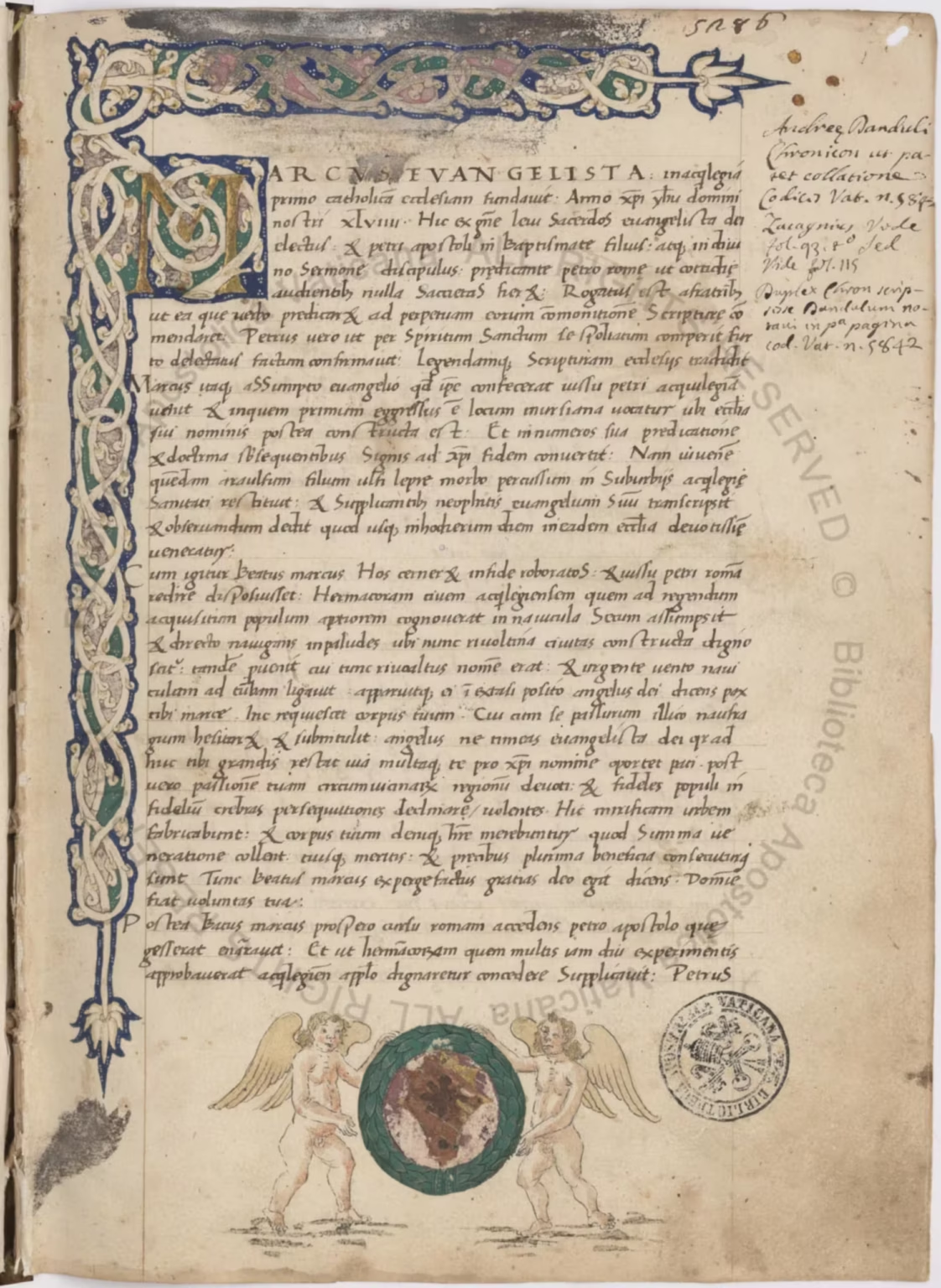
This is what Dandolo had to say about the election of the first doge:
The duke Paulucius was praised in the year of our Lord, 697. Because while on this Venetian island a large multitude of peoples lived on every alleyway, the tribunes and all the nobles and plebeians, together with the patriarch and bishops and the entire clergy, convened in Heraclea1 in these days, to confront the imminent dangers and perils and to augment the honour and prosperous condition of their province for the better.
Therefore, since the tribunes of islands, disputing about precedence, did not want to yield to one another, the Lombards invaded their territories several times without resistance, for which reason they unanimously decided to appoint a duke over themselves, who, with just moderation, would govern the people under his authority and have the power and authority in public matters to summon a general assembly, appoint tribunes and judges, who in private matters, except purely spiritual ones, would equally grant rights to both laypersons and clerics; provided however that the aggrieved may at any time seek the remedy of the duke, and by his judgment councils and elections of prelatures should be initiated by the clergy and the people, and those elected should receive investiture from him and be enthroned by his command.
With these matters wisely arranged, invoking the name of Christ, they unanimously appointed duke this citizen of Heraclea, devoted to wisdom and distinguished by nobility, and he swore an oath to administer the governance of the duchy justly and fairly, and he was placed on the throne with the ducal insignia.
Chronica per extensum descripta, VII.1, part 1.
Paulicius is only credited with one major act of government during his reign, but it was no small feat. He established peace with the Lombards, and settled the borders for centuries to come.
Duke Paulucius established a friendship with King Liutprand,2 and made agreements between the Venetians and the Lombards, through which he obtained many privileges for himself and his people, and he defined the boundaries of Heraclea, together with the Master of the Soldiers3 Marcellus, namely from the Greater Piave to the Dry Piave or Plavisela.
Chronica per extensum descripta, VII.1, part 24.
Finally, we have the demise of Paulicius:
And so the duke Paulucius, having happily held the duchy for twenty years, six months, and eight days, died and was buried in Heraclea.
Chronica per extensum descripta, VII.1, part 27.
That is all the most influential Venetian chronicle had to say about Paulicius, the first doge of Venice.
John the Deacon
Andrea Dandolo wrote about those events six centuries later. He was almost as far from the time of Paulicius as we are from the time of Andrea Dandolo, a medieval Venetian nobleman and scholar.
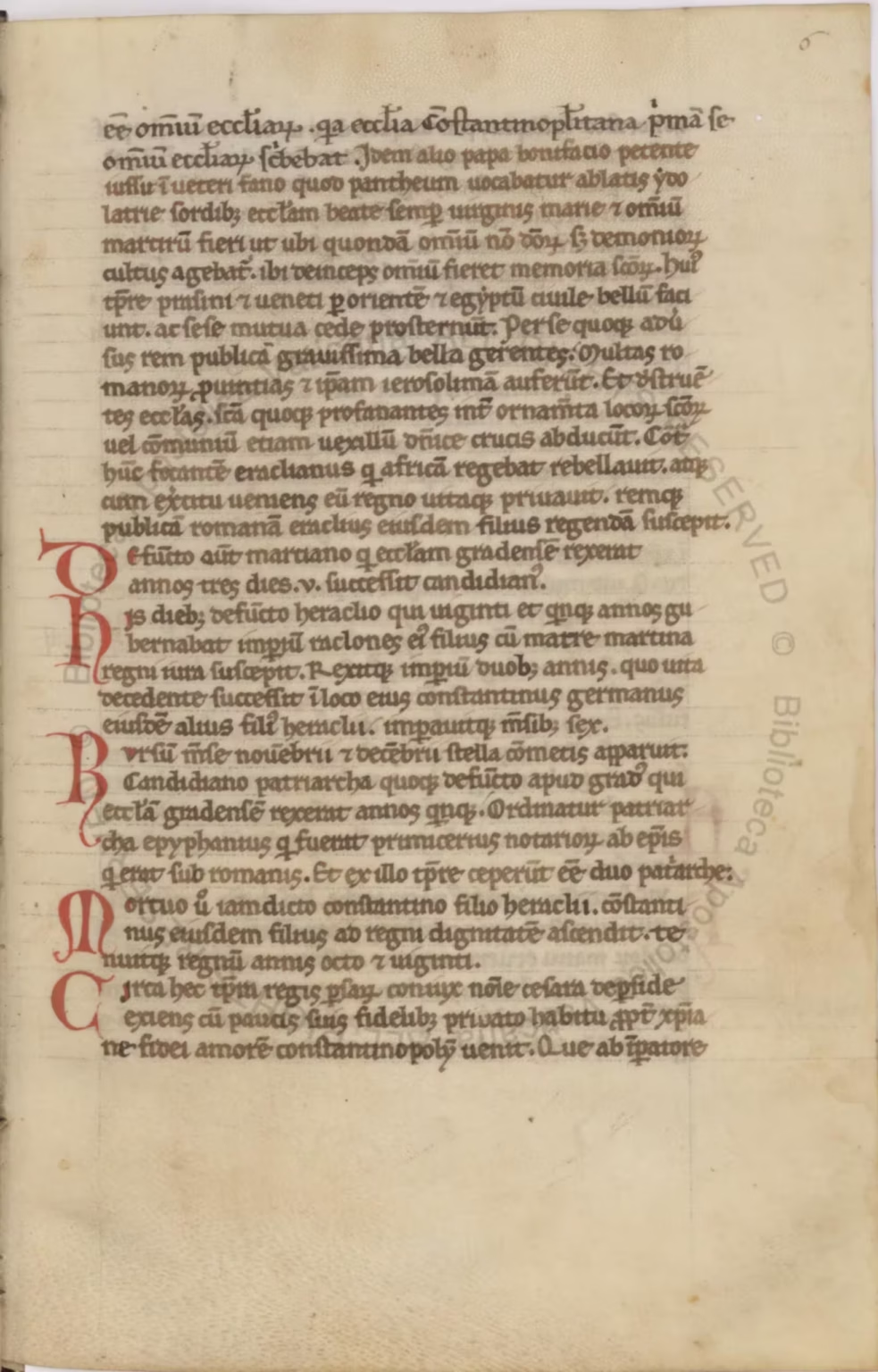
His main source was a bit closer, but only half-way.
John the Deacon wrote the first Venetian chronicle, the Istoria Veneticorum, around the year 1000s.
He had this to say about Paulicius:
During the times of Emperor Anastasius4 and King Liutprand of the Lombards, all the Venetians, together with the patriarch and bishops, met and decided that it would be more honourable from then on to remain under dukes rather than tribunes.
After long discussions about who should be given this dignity, they finally found a very able and renowned man, named Paulicius, to whom they swore loyalty and appointed him as duke in the city of Eracliana. He was very disciplined, and he controlled his men with equity.
With King Liutprand, he also secured a lasting peace, establishing agreements that still exist between the Venetians and Lombards.
He also set the boundaries of the New City, which until now were controlled by the Venetians, together with the same king, from Piave Major to Piavisella according to the designated locations.
Istoria Veneticorum, II.2.
And of his demise:
In the year of the Lord 727, with the death of Duke Paulicius at the New City, who had led for 20 years and 6 months, Marcellus succeeded him as duke.
Istoria Veneticorum, II.10.
That’s all the oldest Venetian chronicle had to say about the first doge of Venice.
It is clear that Andrea Dandolo had read the Istoria Veneticorum, but he changed a few things around the reign of Paulicius.
If we look up the reigns of emperor Anastasius and of king Liutprand, the appointment of Paulicius must have happened in the years from 713 to 715.
He then ruled for twenty years, but died in 727, after at most fifteen years.
Chronology wasn’t John the Deacon’s strongest side, and the numbers don’t add up, and it seems like Andrea Dandolo tried to adjust the numbers to make them make sense.
The Pactum Lotharii
Both Andrea Dandolo in the 1340s, and John the Deacon around the year 1000, used another source, which is the Pactum Lotharii from 840.
It was a treaty between Venice and the Holy Roman Empire, drawn up during the reign of Lothair I, which set down the rules for how the two polities interacted.
Several of the provisions of the treaty simply reconfirmed older agreements, made under past rulers.
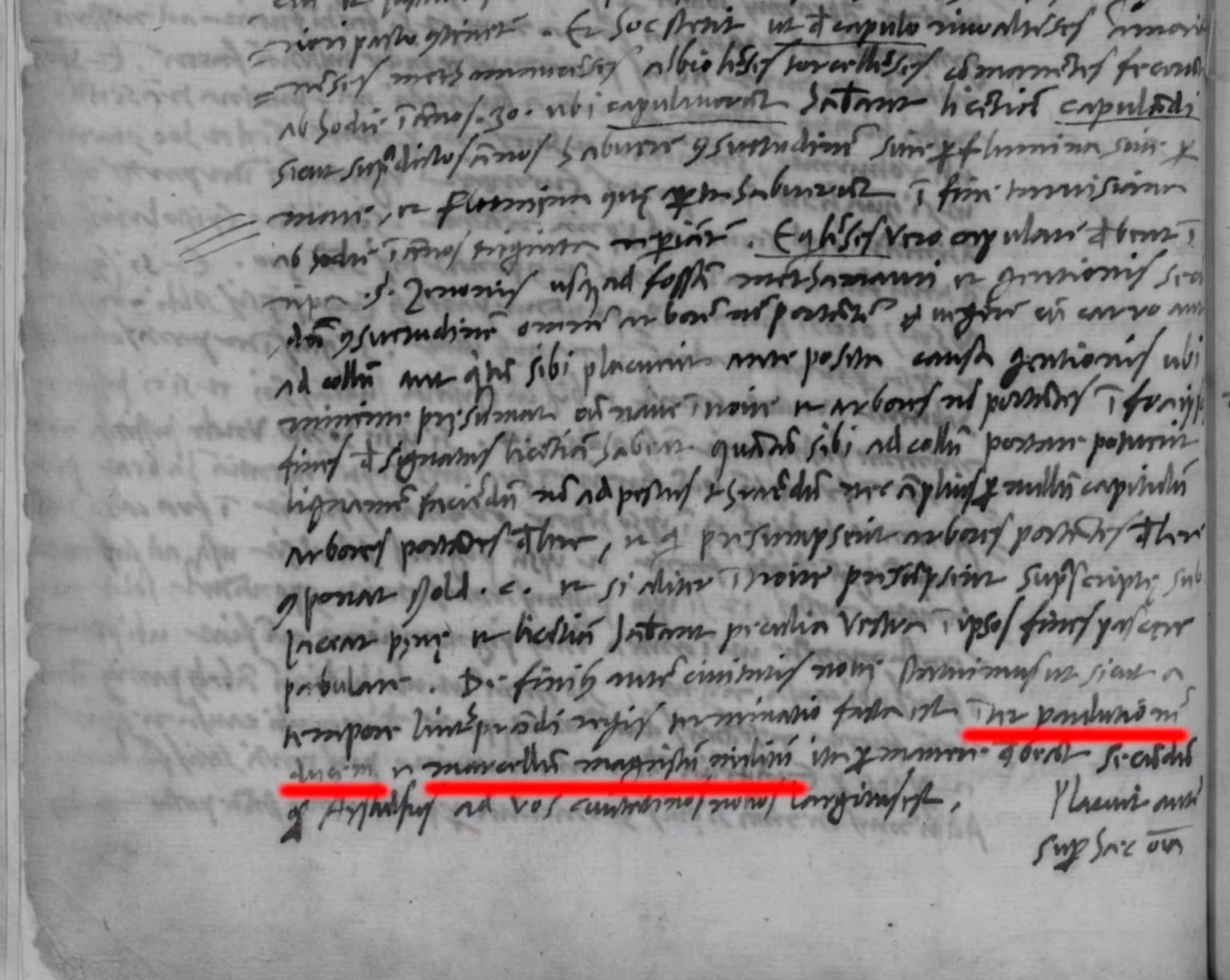
The relevant part for our discussion is chapter 26:
And about the boundaries of Cittanova we decree that they must remain as they are, like in the settlement made at the time of king Liutprand between the duke Paulicius and the magister militum Marcellus, according to the concession made to you inhabitants of Cittanova by Aistulf.5
Cessi (1940), p. 107.
Here we have our “duke Paulicius”, in a source which is only a century and a bit after his reign.
The agreement from the time of king Liutprand is called the terminatio Liutprandina, probably from around 712–713, and the later confirmation of it by king Aistulf is the largitio astolfina, which is from 751. Both documents are lost, and we only know them indirectly, as through the Pactum Lotharii.
The problem with this text, is that it refers to an agreement with two parties, who represent the opposing sides. Here the two sides are the Lombards on the mainland, and the Venetians in the lagoon, at Heraclia.
Both the Byzantines and the Lombards used the title dux (duke), but only the Byzantine side used the title magister militum — master of the soldiers.
Consequently, in this agreement, the Byzantine side was represented by the magister militum Marcellus, and the Lombard side by a duke named Paulicius.
Given the border in question, Paulicius was most likely the Lombard duke of Treviso.
A non-existent doge
We have no other sources for a doge Paulicius in the early 700s.
All this begs the question: why did John the Deacon interpret the text of the Pactum Lotharii in this way?
Firstly, he knew the Pactum Lotharii well because it was still in force at his time, as he himself noted. He also had access to it, since he was a trusted collaborator of doge Pietro II Orseolo, who used John the Deacon for important diplomatic missions to the Holy Roman Empire.
Secondly, John the Deacon had a political programme with the Istoria Veneticorum. He wanted to show that Venice was an ancient nation, descendants of refugees from Troy, and of the Romans, but that Venice and the Venetians had always been independent of both the Byzantines and the Lombards.
Consequently, he consistently wrote Byzantium out of his narrative, and represented the relationship with the Lombards as one between equals.
In front of a well-known and important treaty at his time — it was still in force and regulated with border of the dogado towards the mainland — he needed everything in that treaty to have been agreed by the Venetians, and not by somebody else (read: the Byzantines) on their behalf.
The Pactum Lotharii explicitly mentions the terminatio Liutprandina from 712 or 713, so he needed to extend the line of the doges of an independent Venice to that time.
He therefore took the two names from chapter 26 of the Pactum Lotharii, and made them the first two doges of an independent Venice: Paulicius and Marcellus.
While Marcellus was a Byzantine magister militum, he might very well have been in Heraclia at the time, but Paulicius was a Lombard duke.
The conclusion is, therefore, that there never was a doge Paulicius.
John the Deacon invented him to support his political narrative in the Istoria Veneticorum.
Fake news, from a thousand years ago.
Notes
- Eraclea (orig. Civitas Nova Heracliana, also Civitanova), founded in 640, was originally situated on a lagoon island. It was the first seat of the doges of Venice, before it moved to Metamauco. ↩︎
- Liutprand (c.680–744) was king of the Lombards from 712 to 744. During his reign, he fought wars with Byzantine over Ravenna, and donated lands at Sutri to the Pope, leading to the creation of the Papal State. ↩︎
- Magister militum (master of soldiers) was a Roman and Byzantine title for a provincial or local military commander, who often had civil duties too. ↩︎
- Anastasius II (†719) was Byzantine emperor from 713 to 715 when he was deposed. Later, he tried to stage a revolt, but failed and was executed. ↩︎
- Aistulf (†756) was Duke of Friuli from 744, and King of the Lombards from 749 until his death in 756. He attacked the Byzantine dominions repeatedly, including Ravenna and Rome. ↩︎
Bibliography
- Cessi, Roberto. Documenti relativi alla storia di Venezia anteriori al Mille. Padova : Gregoriana, 1940-1942. [more] 🔗
- Dandolo, Andrea and Ester Pastorello. Chronica per extensum descripta in Rerum Italicarum scriptores : raccolta degli storici italiani dal Cinquecento al Millecinquecento / ordinata da L. A. Muratori , 12.1. Bologna : N. Zanichelli, 1938-1958. [more] 🔗
- Iohannes : Diaconus Venetus. Chronicon Venetum omnium quae circumferuntur vetustissimum et Johanni Sagornino vulgo tributum e mss. codice Apostoli Zeno V. Cl. nunc primum cum mss. codicibus Vaticanis collatum, notisque illustratum in lucem profert H. Fr. Zanetti Al. F. Venetiis, 1765. [more] 🔗
- Iohannes : Diaconus Venetus and Luigi Andrea Berto. Istoria Veneticorum. Bologna Zanichelli, 1999. [more] 🔗
Leave a Reply