The first decade of the 800s — mostly during the reign of the dukes Obelerius and Beatus (804–811) — were decisive years in the history of Venice.
The events of those years set Venice on a course which would last centuries, even to the end of the republic in 1797.
The brothers Obelerius and Beatus were leaders of the pro-Frankish faction in Venetian politics, and rose to power in the duchy with the deposition of dukes Giovanni and Mauricius II in 804, following the murder of patriarch Giovanni of Grado in 802.
Ten years later, Venetia was as eastern as it could be, firmly entrenched in the Byzantine sphere of interest. Also, the destruction of Heraclia caused all the leading families of Heraclia and Equilo to move to Rivoalto. Furthermore, Metamauco ceased to be the capital of the duchy, which moved to Rivoalto — modern-day Venice.
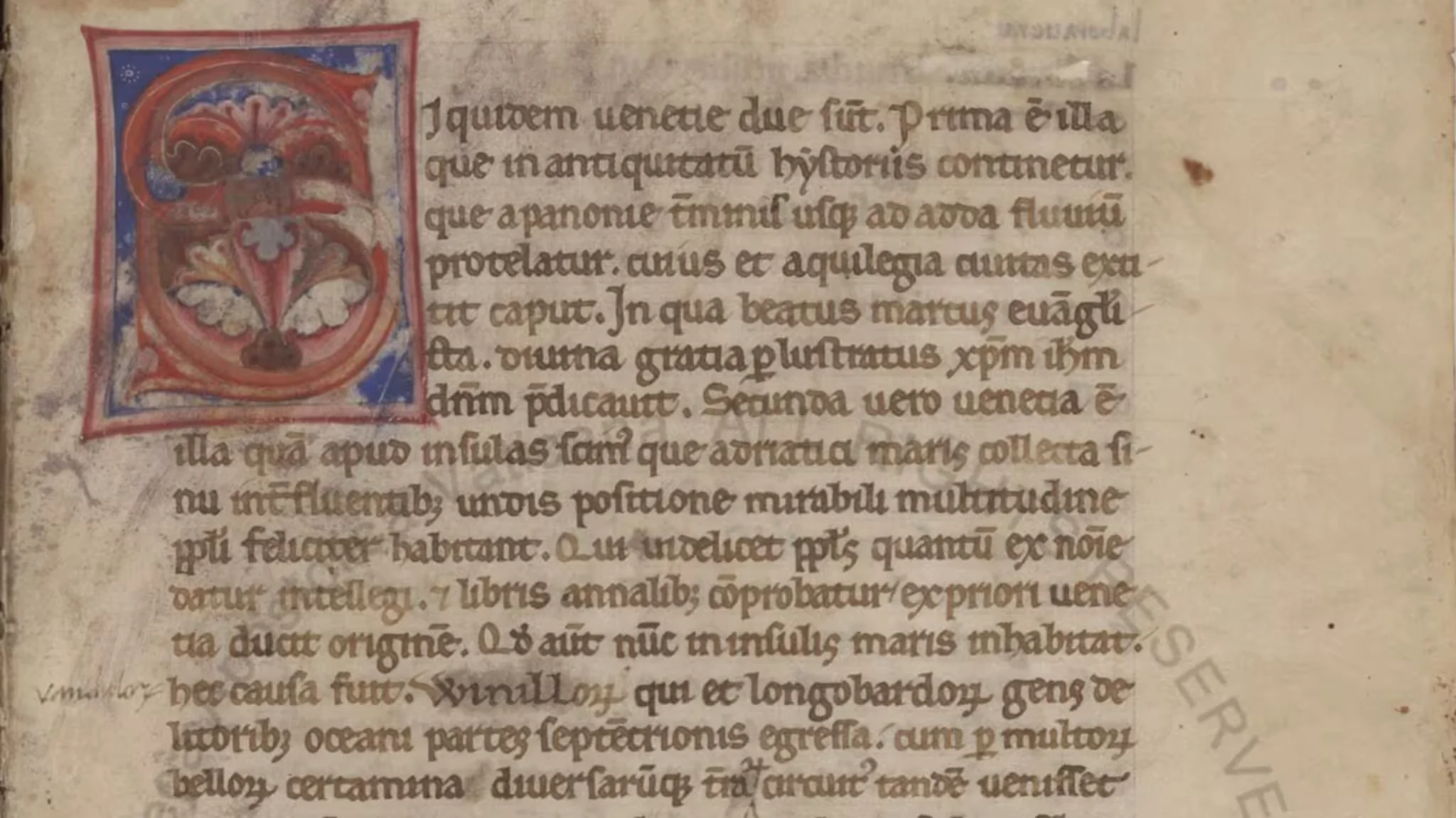
Andrea Dandolo primarily based his account on the Istoria Veneticorum by John the Deacon, on the Chronicon Altinate for some parts, and on various charters and documents from the ducal archives, not all of which have come down to us.
Dandolo weaved these sources together in a single narrative, designed to depict Venice in the best possible light, consistently depicting the Franks as the aggressors and treaty-breakers, and always emphasising Venetian independence of the Franks.
The Byzantine influence over these events were harder to ignore, but Dandolo still tried to minimise it in his narrative.
His account would be the dominant story for much of the years of the Venetian republic.
The narrative
Obelerius was elected duke in Treviso by the pro-Frankish faction, after the murder of the patriarch of Grado and the flight of his successor, Fortunatus.
Once established in Metamauco, his city of origin, he appointed his brother Beatus co-ruler.
Christopher, the bishop of Olivolo, who had been close to the defeated dukes, fled the duchy.
The patriarch Fortunatus went to Salz where he incited Charlemagne against the Venetians, and obtained protection of the properties of the Patriarchate of Grado in Frankish lands.
The list of territories, in which the emperor granted the patriarchate protection, did not include Venetia, which Andrea Dandolo took as a sign that Charlemagne did not have jurisdiction over the duchy.
The city of Heraclia was destroyed, both by the Venetians — i.e., the pro-Frankish faction in power — and by the Franks under Pepin, son of Charlemagne, incited by Fortunatus, thereby breaking a treaty.
Numerous wealthy families therefore moved from Heraclia and from Equilo to Rivoalto, and Dandolo provided two long lists of names.
The patriarch Fortunatus returned to Italy, in company with bishop Christopher, who appeared to have switched side. They were not, however, allowed to enter the duchy, and therefore remained in Altino on the mainland.
Fortunatus did somehow capture the deacon Giovanni, who had usurped the bishopric of Olivolo, but he later fled his captors, and turned the dukes against the patriarch.
After a while, an accord was reached, and Fortunatus returned to Grado, Christopher to Olivolo, and Giovanni went home.
Then, a Byzantine navy commanded by the patrician Nicetas arrived in the Golf of Venice. Fortunatus consequently fled to Francia again, and Giovanni the deacon became patriarch.
Nicetas granted Obelerius the title of spatharios, and took Beatus with him to Constantinople. Beatus later returned, having received the title of hypatos.
After the Byzantine navy had left, Pepin, on the orders of Charlemagne, attacked Venetia from the side of the sea. The residents of numerous settlements had to flee. After a hard fight, the Franks entered the lagoon at Albiola, near Metamauco.
The Venetians, however, didn’t surrender, so Pepin prepared for a siege, to starve the Venetians into submission. They reacted by pelting the Franks with bread using catapults, to show that they had plenty to eat.
The Venetians had established their headquarters at Rivoalto, abandoning Metamauco.
On the suggestion of an old woman, Pepin tried to construct a pontoon bridge across to Rivoalto, on shallow waters during low tide.
However, as the Frankish knights were crossing the bridge, the Venetians attacked it with the rising tide, destroyed it, causing many knights to drown, and were victorious.
Pepin sacked the parts of Venetia he held, and retreated.
He then acknowledged that Venetia should be Byzantine. Pepin later died in Milan, and Byzantine envoys sent to formalise a peace treaty, returned home empty-handed.
A Byzantine envoy to the Venetians supported the pro-Byzantine faction, which deposed Obelerius and Beatus. They were exiled to Constantinople and Zara in Dalmatia.
Dandolo noted that other sources (probably the Chronicon Altinate) recounted that Obelerius had a Frankish wife, and that he had tried to hand the duchy to Charlemagne, but failed to do so, which led to his downfall. Dandolo neither supported nor rejected this claim, but simply noted its existence.
As the ducal palace in Metamauco had been destroyed, the seat of the duchy moved to Rivoalto. Dandolo clearly saw this as a pivotal moment, as he explicitly ended book VII of his chronicle there.
Almost two decades later, Obelerius returned to Venetia from his exile in Constantinople, and gathered a group of supporters in an attempt at returning to power. The doge Giovanni Partecipazio defeated him, had him decapitated, and his head displayed in Metamauco and on the border with the Holy Roman Empire on the mainland.
Source: Chronica per extensum descripta (1340s), also called the Chronicon Venetum, by Andrea Dandolo, translated by René Seindal.
Available translations from the Chronica Extensa:
- The first doges — VII.1–8 (excerpts)
- Hildeprand in Ravenna — VII.3, paragraphs 2–5.
- Doges of the 700s — VII.9–13.
- Obelerius and Beatus — VII.14 (excerpts)
Excerpts from the Chronica per extensum descripta, book VII, chapter 14, parts 1–6, 11–19, 22–25, and book VIII, chapter 3, part 6.
VII.14.1
Duke Obelerius1 was enthroned in the year of our Lord Jesus Christ 804.
This tribune of Metamauco,2 elected duke in Treviso3 by exiled Venetians, entered Venetia after the dukes were chased away, and, received with honour by the people, was enthroned in Metamauco.
Click to reveal the Latin text
Obelierius dux inthronizatus est anno Domini nostri Iesu Christi VIIIc IIII.
Hic tribunus methamaucensis, in Tervisio a Venetis exulibus electus dux, fugatis ducibus, Veneciam intravit, et cum honore susceptus a populo, in Methamauco inthronizatus est.
VII.14.2
Here, from the praise of the people, he received his brother, named Beatus,4 as a partner in the dignity.
Click to reveal the Latin text
Hic ex colaudacione populi fratrem suum, Beatum nomine, consocium dignitatis suscepit.
VII.14.3
Christopher, bishop of Olivolo,5 who had been close to the expelled dukes, fearing his arrival, left Venice, and Giovanni the deacon, with public praise of the assembly, took over his see.
Click to reveal the Latin text
Christophorus quoque olivolensis episcopus, qui expulsorum ducum familiaris extiterat, adventum huius formidans, de Venecia exivit, in cuius sede lohanes diaconus, conlaudacione publice concionis, intrusus est.
VII.14.4
Therefore, Fortunatus, the patriarch, who had gone to Francia, recounting the plan of the Venetians, who seemed to totally adhere to the empire of Constantinople, and the killing of his predecessor,6 and he greatly stirred the spirit of Charlemagne against them; however, he decided to wait for a suitable time for revenge.
Click to reveal the Latin text
Fortunatus itaque patriarcha, qui in Franciam iverat, Venetorum propositum qui constantinopolitano imperio totaliter adherere videbantur et occissionem sui predecessoris Karolo enarans, ipsius animum contra eos plurimum excitavit; tempus tamen habile ad vindictam expectare disposuit.
VII.14.5
The patriarch, having become a member of the emperor’s household, obtained from him the privilege of immunity of his church of the following tenor.
“Charles the most serene, august, crowned by God, great and peaceful emperor, governing the empire of the Romans, and by the mercy of God king of the Franks and Lombards.
We believe that we act to the greatest advantage of our kingdom in matters of immunities, if we gladly grant the petitions of priests or servants of God, which have been presented to our ears, and bring them to effect, in the name of God; therefore, let it be known to all our faithful, present and future, how the venerable man Fortunatus, Patriarch of Grado, petitioned our serenity for the see of Saint Mark the Evangelist and Saint Hermagoras the bishop, that we should grant and confirm, by our indulgence, such a benefit concerning the aforementioned holy church, so that, under the name of immunity, neither he, nor the priests and others, nor the servants and tenants who dwell on their lands, in Istria, Romagna, or in Kingdom of the Lombards or anywhere else, should fail to live and remain in peace.
We did not wish to deny his petition, compelled by his service and merits, but for the increase in our reward, we have thus granted it in the name of God, and recognize it as confirmed in all respects, both to the bishoprics and also to the synods, or baptismal churches.
We therefore command that currently in towns, or villages, or estates, or any other possessions, wherever they may be, the aforementioned patriarch be rightly and reasonably recognized as invested, no public judge should presume to unjustly hear cases, or to exact fines, nor to make mansions or preparations, nor to demand any unjust redemptions.
but, while the aforesaid Patriarch Fortunatus shall have granted, under the name of immunity, that both he himself, and his successors, as well as the peasants and servants who dwell upon their lands, or the rest of his men, may, by our indulgence, live and reside in peace on their estates, so that they may better delight, for us, or for the stability of our kingdom, in continually imploring the mercy of the Lord;
And so that this authority may be firmly held, or better preserved over time, we have confirmed it below with our own hand and ordered it to be sealed with our seal.
The sign of Charles the most glorious emperor.
Hagdingus to Ercambald in turn.
Given on the First of August, at Salz,7 in our palace, in the third year, with Christ favourable, of our empire.”
Click to reveal the Latin text
Patriarcha igitur imperatori familiaris effectus, privilegium inmunitatis ecclesie sue infrascripti tenoris ab eo optinuit.
“Karolus serenisimus, augustus, a Deo coronatus, magnus et pacificus imperator, Romanorum gubernans imperium, et per misericordiam Dei rex Francorum et Longobardorum.
Maximum regni nostri in hoc agere credimus immunitatum, si peticionibus sacerdotum vel servorum Dei, que nostris auribus fuerint prolate, libenter annuamus, et eas, in Dei nomine, ad effectum perducamus; igitur notum sit omnibus fidelibus nostris presentibus et futuris, qualiter vir venerabilis Fortunatus, gradensis patriarcha, sedia sancti Marci Evangeliste et sancti Hermacore episcopi, serenitati nostre peciit, ut tale beneficium circa memoratam sanctam ecclesiam, ex nostra indulgencia, concedere et confirmare deberemus, quatenus, sub inmunitatis nomine, tam ipse, quamque sacerdotes et reliqui, nec non servi et coloni, qui in terris suis conmanent, in Ystria, Romandiola, seu in Longobardia vel ubique, quieto tramite vivere ac residere debeant.
Cuius peticionem eius servicio et meritis conpelentibus denegare noluimus, sed pro mercedis nostre augumento, in Dei nomine ita concessise, et in omnibus confirmase cognoscite tam episcopia, quamque et synodochia, vel ecclesias baptismales.
Precipientes ergo, iubemus, ut in vicis, vel villis, seu rebus, vel reliquis quibuslibet possesionibus, undecunque, presenti tempore, memoratus patriarcha iuste et rationabiliter vestitus esse dignoscitur, nullus iudex publicus iniuste ad causas audiendum, vel freda exigendum, nec mansiones aut paratas faciendum, nec ullas redimiciones iniustas requirendum, ingerere aut exactare presummat;
sed, dum predictus Fortunatus patriarcha advixerit, sub inmunitatis nomine, tam ipse, quam eiusque successores, ac colunni, et servi, qui supra terras suas conmanent, vel reliqui homines sui, valeant, ex nostra indulgencia, quieto tramite vivere ac residere, ita ut melius eis delectetur, pro nobis, vel pro stabi’litate regni nostri, iugiter Domini misericordiam exorare;
et ut hec auctoritas firmiter habeatur, vel per tempora melius conservetur, manu propria subtus firmavimus et de anulo nostro sigilari iussimus.
Signum Karoli gloriosisimi imperatoria.
Hagdingus ad vicem Ercambaldo.
Data idus augusti, Salcro, palacio nostro, anno IIIo, Christo propicio, imperli nostri.”
VII.14.6
From the series of this charter, it is most likely inferred that the province of Venice was separated from the jurisdiction of the Western Empire, since Charles, granting immunities to the church of Grado, and naming the other imperial provinces, makes no mention of Venice.
Click to reveal the Latin text
Ex serie namque huius privilegii verisimiliter elicitur, Veneciarum provinciam a jurisdicionis occidentalis imperii fore segregatam, cum Karolus immunitates gradensi ecclesie conferrens, ceteras imperli provincias nominando, de Venecia nullam facit mencionem.
… omissis …
VII.14.11
At the same time, the city of Heraclia,8 from which the expelled leaders had originated, was reduced to ruins by the Venetians, in their hatred and contempt;
Indeed, as most report, Pepin, King of Italy,9 by the persuasion of his father, who had been badly informed about the Venetians by Patriarch Fortunatus, defeated the Venetians in war, and destroyed this city, in which the greater part of the Venetian nobles lived, after annulling the treaty.
Click to reveal the Latin text
Per idem tempus, Heracliana civitas, de qua fugati duces originem duxerant, in eorum odium et contemptum, a Venetis in solitudinem redacta est;
vel, ut plurimi referunt, Pipinus rex Italie, iusione patris, qui a Fortunato patriarcha de Venetis male informatus fuerat, Venetos bello devincit, et hanc urbem, in qua nobilium Venetorum maxima pars degebat, abiecto federe destruxit.
VII.14.12
Therefore, Heraclia having been destroyed, the tribunes and leading citizens of the city arrived in Metamauco, Rivoalto, and Torcello, and the remaining adjoining islands, whose descendants, so that their antiquity may be revealed, are particularly listed:10 Particiaci, who are now called Badovarii; Candiani, who today are called according to many the Sanudo; Ursoyoli, here and called Orseolo; The Barbolani or Bulzani, or Gauli are the same; Silvi or Belegni who are the same; the Barcicesi; Viliarenes and Mastalici, who traced their origin from the same, are today called Basegli; Centranici; Benadi; Barbadians; Mauroceni; Grausoni or Gursoni; Gratici or Gradolici; Baraldi who are called Bonoaldi; Navalnarici; The Noeli who have been called Navigarosi; Caloprini; Brandinici or Bragadini; The Nigri, who are called Mauri; Metadori; Tornarici or Tanolici; Bachi or Benati who are called Bembo; Cogodici or Mortadellis; Alboni or Calbani; Bradani or Bredani; Cynopi or Cyrini; Transmundi who are called Stornati; Macigni or Marceli; Saraioni; Regini or Ruçini; Vicendi; Menguni; Basanici who are called Torseli; Pizani or Pianipini; Deusdedit or Deodones, who are also called Fauni; Magadisi who were called Darbores; Manabri; Masuni who are called Maralachins; Arbolini or Çopuli; Marcurius Sartor; Pepini; Calpini who are called Albini; Danii or Daney; The Scuvacalles who are now called Cavatortas; The Vidilici who are also called Barçicesi; Ludovici and Lupanici; Trodocus or Trivixano; Scurnata who were called Pantoni; Barbaromanus; Vilinicus; Tornaliti or Storladi; Busignaci or Brusta; The Fundareni, who are called Fundateni; Karabi; The Kalabresini who are are called Dacanales; Maurani or Madri; The Cepreseli who are called Daspinales.
Click to reveal the Latin text
Consumpta ergo Heraclia, tribuni et primates urbis in Methamauco, Rivoalto et Torcelo, et reliquie coadherentibus insulis, pervenerunt, quorum progenies, ut eorum antiquitas patefìat, singulariter subscripte sunt: Particiaci, qui nunc Badovarii appelati sunt; Candiani, qui hodie secundum plurimos Sanuti vocati sunt; Ursoyoli, qui et Ursioli dicti sunt ; Barbolani sive Bulzani, vel Gauli idem sunt; Silvi sive Belegni qui idem sunt; Barçicesi; Viliarenes et Mastalici, qui ab uno originem duxerunt, hodie Basegli nominati sunt; Centranici; Benadi; Barbadici; Mauroceni; Grausoni sive Gursoni; Gratici sive Gradolici; Baraldi qui Bonoaldi dicti sunt; Navalnarici; Noeli qui Navigarosi vocati sunt; Caloprini; Brandinici sive Bragadini; Nigri, qui dicti sunt Mauri; Metadori; Tornarici sive Tanolici; Bachi sive Benati qui dicti sunt Bembo; Cogodici sive Mortadellis; Alboni sive Calbani; Bradani sive Bredani; Cynopi sive Cyrini; Transmundi qui dicti sunt Stornati; Macigni sive Marceli; Saraioni; Regini sive Ruçini; Vicendi; Menguni; Basanici qui dicti sunt Torseli; Pizani sive Pianipini; Deusdedit sive Deodones, qui et Fauni dicti sunt; Magadisi qui Darbores vocati sunt; Manabri; Masuni qui Maralachins dicti sunt; Arbolini sive Çopuli; Marcurius sartor; Pipini; Calpini qui vocati sunt Albini; Danii sive Daney; Scuvacalles qui nunc dicti sunt Cavatortas; Vidilici qui etiam Barçicesi nuncupati sunt; Ludovici et Lupanici; Trodocus sive Trivixano; Scurnata qui Pantoni appelati sunt; Barbaromanus; Vilinicus; Tornaliti sive Storladi; Busignaci sive Brusta; Fundareni qui Fundateni dicti sunt: Karabi; Kalabresini qui Dacanales vocati sunt; Maurani sive Madri; Cepreseli qui dicti sunt Daspinales.
VII.14.13
Subsequently, the nobles and magnates of Equilo, leaving the dwellings of their parents, moved their residences to Rivoalto, and to the other abovementioned islands, whose surnames are listed: Faledri; Blancanici or Flabianici; Flabiani; Armuni or Armadi; Tribuni; Apoli; Trundominici: Caloprini; also Vitrignacii; Carosi; Iohanaceni or Ianaseni; Aulipati; Calvi or Calbonici; Cerbani; Daspinales; also Adoaldi, Barbati or Gatillesi; Viliarenes; Barzicesi or Mastalici, also Campoli; Alutuni, who are called Taureli; Sirani; Saponarii; Sarcini or Salertani; Calpini or Albini; also Sapini; Cyreni; Gausi or Bulzani; also Secredi; Calosi or Caysoli; Victores who are called Deamarci; Vausani; Valarici; Tornarici; Theodoxii and old Anastaxii; Manchanici who are called Moysolini; Marignoni; Rosxi or Rosii; Capuani who are called Zane; Marcuni; Lugnani; Salviani; Migluni; Larisagi; The Gauli who are called Andreadi; Ronciagi; The Vylliencii who are called Gemmo; Scaudarii; Cynopi; also Madi; Marrini; Narissi.
Click to reveal the Latin text
Subsequenter proceres et magnates equilenses, incolatus parentum suorum relinquentes, in Rivoalto, et aliis supranominatis insulis, domicilia sua transtulerunt, quorum cognomina subscripta sunt: Faledri; Blancanici sive Flabianici; Flabiani; Armuni sive Armadi; Tribuni; Apoli; Trundominici: Caloprini; iterum Vitrignacii; Carosi; Iohanaceni sive Ianaseni; Aulipati; Calvi sive Calbonici; Cerbani; Daspinales; iterum Adoaldi: Barbati sive Gatillesi; Viliarenes; Barzicesi seu Mastalici, iterum Campoli; Alutuni, qui dicti sunt Taureli; Sirani; Saponarii; Sarcini sive Salertani; Calpini sive Albini; iterum Sapini; Cyreni; Gausi sive Bulzani; iterum Secredi; Calosi sive Caysoli; Victores qui dicti sunt Deamarci; Vausani; Valarici; Tornarici; Theodoxii si ve Anastaxii; Manchanici qui dicti sunt Moysolini; Marignoni; Rosxi sive Rosii; Capuani qui Zane vocati sunt; Marcuni; Lugnani; Salviani; Migluni; Larisagi; Gauli qui Andreadi appelati sunt; Ronciagi; Vylliencii qui Gemmo dicti sunt; Scaudarii; Cynopi; iterum Madi; Marrini; Narissi.
VII.14.14
Fortunatus, the patriarch, having returned from Francia, not daring to enter Venice with Christopher, bishop of Olivolo, began to reside in the church of Saint Cyprian, with the people of the see of Torcello, and unexpectedly captured Giovanni, the intruder of the bishopric, as he was rashly proceeding;
He who afterwards, freed by flight, recounted to the leaders what he had suffered, strongly encouraged them against the patriarch.
Click to reveal the Latin text
Fortunatus igitur patriarcha, de Francia reversus, cum Christoforo olivolensi episcopo non audens Veneciam intrare, in sancti Cipriani ecclesia, plebe torcelensis sedis, degere cepit, et Iohanem episcopatus invasorem incaute pergentem captivavit;
qui postea, fuga liberatus, ducibus, que passus fuerat enarans, eos contra patriarcham vehemencius animavit.
VII.14.15
Finally, Fortunatus, with the fury of the Venetians mitigated, returned to his church, and, with his advice, Bishop Christopher was restored to his see, Giovanni the invader returning to his own house.
Click to reveal the Latin text
Fortunatus tandem, Venetorum mitigato furore, ad ecclesiam suam rediit, et, eo consulente, Christophorus episcopus1 in sede sua restitutus est, Iohane invasore in propria domo redeunte.
VII.14.16
After this, the patrician Nicetas, with an army, came to defend the places of Dalmatia, and obtained the military assistance requested from the Venetians, after which, Fortunatus the patriarch, not daring to remain when he was coming to Venice, rushed to France, and Giovanni the deacon, who had seized the bishopric, was placed in the patriarchal seat.
Here before the bodies of the holy martyrs, and the chapel of Saint Mark, he arranged marble choirs, and also decorated it with columns, and made a ciborium on the altar of the church of Saint Mary.
Click to reveal the Latin text
Post hec, Nicetha patricius, cum exercitu, ad tuenda loca Dalmacie venit, et sucursum bellicum a Venetis requisitum optinuit, quem postea Veneciam accedentem, Fortunatus patriarcha prestolare non audens, in Franciam properavit, et Iohanes diaconus, qui episcopatum invaserat, in patriarchali sede subrogatus est.
Hic ante sanctorum martirum corpora, et sancti Marci capelam, choros marmoreos composuit, et columpnis ecciam decoravit, et in altare ecclesie sancte Marie ciborium fecit.
VII.14.17
But when Nicetas approached Venice, he generously granted to Obelerius, the duke, the title of spatharios11, by imperial largesse.
Click to reveal the Latin text
Nicetha autem Veneciam accedens, Obellierio duci spatharii titulum, ex imperiali largicione, generose concessit.
VII.14.18
Also, duke Beatus, with the council of the Venetians, went to Constantinople with Nicetas the patrician, bringing with him Christopher of Olivolo the bishop and Felix the tribune, whom the Venetians had banished because they appeared loyal to the Frankish people.
Here he was received by the emperor with the honour he deserved, and decorated with the title of hypatos,12 he returned to Venice.
Click to reveal the Latin text
Beatus quoque dux, conscilio Venetorum, cum Nicetha patricio, Constantinopolim ivit, secum deferrens Christoforum Olivolensem episcopum et Felicem tribunum, quos Veneti relegaverant, quia Francorum genti adherere videbantur.
Hic ab imperatore, honore, quo decuit, receptus, ypati titulo decoratus, Veneciam rediit.
VII.14.19
Christopher II, bishop of Olivolo, of Greek nationality, served for 12 years.
He was a commoner of the Church of Saint Moses, and by deceiving the people with his hypocrisy he became a bishop;
Here, while he was celebrating the solemn Masses in the church of Saint Theodore, he was troubled by a demon, and judged unworthy of the bishopric, he was expelled.
Click to reveal the Latin text
Christophorus IIa eplscopus Olivolensis, nacione grecus, sedit annis XII.
Hic plebnnus ecclesie saocti Moysis fuit, suaque ypocrisi decipiens populum factus est episcopus;
qui dum in ecclesia sancti Theodori Misarum solempnia celebraret, a demonio vexatus est, indignusque episcopatu iudicatus, eiectus est.
… omissis …
VII.14.22
Obelerius and Beatus, the dukes, appointed Valentinus, their brother and partner of the duchy, and he was praised by the people.
Click to reveal the Latin text
Obelierio et Beato ducibus anuentibus, Valentinus eorum germanus consors ducatus a populo laudatus est.
VII.14.23
In the eighth year of Charles, Pepin, king of Italy, urged by the orders of his father, breaking the treaty, came from the sea with an army to the province of Venice to subdue it;
Here, when he had passed through the ports between the islands meeting very difficult resistance, with the people of Brondolo,13 Chioggia,14 and Pellestrina15 having been put to flight, he finally reached a place, which is called Albiola,16 situated on the side of the port of Metamauco;
He was able to obtain nothing in advance, nevertheless thinking that the Venetians would surrender shortly by hunger.
But the Venetians, hearing this, pelted the army with bread and hardtack thrown in large quantities by machines, to completely dispel the fear of famine.
However, with the Franks regaining strength, the Venetians, having left the city of Metamauco, came to Rivoalto; which, while King Pepin was subtly investigating how he could subdue them, having made use of the counsel of a cunning old woman, he had a bridge built from planks, small vessels, and woven willows over the shallow waters, thinking to enter Rivoalto without hindrance.
Therefore, at that hour, the knights, with confidence, ascend the bridge;
Then the Venetians, not unaware of this plan, with many prepared ships went out secretly to meet them, attacking them in the rising waters;
Those, who had attacked the bridge, obtained the desired victory from the breaking of the ropes, with all the iron sunk.
But the king, alarmed, seeing that he could no longer accomplish his intention, devastated the neighbouring places as much as he could, and by burning everything reached up to the church of Saint Michael;
And, as some write, he judged that the province of Venice should be left to Emperor Nicephorus of Constantinople,17 according to the treaty; and not long after King Pepin died in Milan;
The envoys of the Emperor of Constantinople, who had come to him on a diplomatic mission, returned to their own without achieving their purpose.
Click to reveal the Latin text
Anno VIIIa Karoli, Pipinus, rex Ytalie, iusione genitoris alectus, rupto federe, cum exercitu ad Venecie provinciam subiugandam per litora venit;
qui cum portus dividentes litorum insulas, cum resistencia dificilima, pertransisset, fugatis Brondulensibus, Clugiensibus et Pestrinensibus, ad locum quemdam, qui Albiola vocatur, in ripa Methamaucensis portus situatum, tandem pervenit;
nulla racione pertendere in antea gressum valuit, putans tamen Venetos brevi tempore famis inedia posse arcere.
Veneti vero, hoc audientes, panum ac paximatum multitudine machinis proiecta, exercitum verberant, ut famis opinionem omnino excludant.
Francorum tamen recalescentibus viribus, Veneti, Methamaucensi urbe relicta, in Rivoalto venerunt; quos, cum qualiter submictere posset Pipinus rex subtiliter indagaret, cuiusdam vetule astute functus conscilio, pontem ex lignaminibus, vasculis et viminibus connexis, super aridas aquas construi fecit, putans absque obstaculo Rivoaltum introire.
Statuta itaque hora, equites, cum fiducia, pontem adscendunt;
tunc Veneti, huius conscilii non ignari, cum multis preparatis navigiis clandestine obviam exierunt, in augmento aquarum insultantes eos;
de quibus, ex disolucione lignaminum, submersis ferre omnibus, qui pontem adscenderant, victoriam optatam habuerunt.
Rex autem consternatus, videns amodo inten· tum suum compiere non posse, adiacentia, que potuit, loca vastavit, et usque ad ecclesiam sancti Michaelis omnia conburendo pervenit;
et, ut quidam scribunt, provinciam Venecie Nikiphoro constantinopolitano imperatori, iuxta fedus, relinquendam censuit; et non multum postea Pipinus rex Mediolani defunctus est;
nuncii vero imperatoris Constantinopolitani, qui, legacionis causa, ad eum venerant, absque profectu, ad propria redierunt.
VII.14.24
Subsequently, the Venetians, with Arsaphios, the imperial emissary, assisting, acted so that both dukes would lose their dignity and homeland: one, that is Obelerius, travelled to Constantinople, the other, named Beatus, went to Zara;18
Valentinus, the third brother, being of youthful age, remained in his own place.
Therefore, under Obelerius as duke, others wrote that, while he had a certain Gallic noblewoman as a wife, having been enticed by promises, he went to the king, offering to hand over the dominion of Venice to him, but he did not accomplish it as was promised, and judged unworthy of the duchy, he remained exiled from his homeland by the Venetians.
They ruled the duchy for five years.
Click to reveal the Latin text
Subsequenter Veneti, asistente Ebersapio imperiali apocrisario, hoc egerunt, ut utrique duces dignitatem et patriam amitterent: unus idest Obelierius Constantinopolim, alter vero, Beatus nomine, Iadram petiit;
Valentinus terciusque frater, iuvenilem habens etatem, in propria remansit.
De Obelierio itaque duce alii scripserunt, quod dum galicam quendam nobilem haberet uxorem, promissionibus allectus, ad regem perexit, offerens venetum dominium sibi contradere, nec perfecit ut premissum est; iudicatusque indignus ducatu et patria a Venetis exulatus permansit.
Tenuerunt quoque ducatum annis V.
VII.14.25
Since the ducal throne of the city of Metamauco having been removed, it is now recognized to exist in the city of Rivoalto, which is therefore at the end of this book, and we will begin another about the new location of the seat.
Click to reveal the Latin text
Quia ducalis thronus de Methamaucensi urbe sublatus, in Rivoltina ci vitate amodo extare dignoscitur, ideo huic libro fine imposito, de nova situacione sedis, alium inchoabimus.
VIII.3.6
At this time,19 Obelerius, who had been deprived of the duchy and his homeland, returned to Venetia, and entered the city of Vigilia at Curiclum,20 which city duke Giovanni21 besieged with an assembled army and attacked.
Then the people of Metamauco, from whom Obelierius had drawn his origin, leaving the army, went to Obelerius within the city walls.
The duke accordingly, making a diversion, conquered Metamauco and consumed it by fire, and, having renewed his army, captured the city of Vigilia and Obelerius, and ordered him beheaded; his head was displayed in Metamauco, and afterwards suspended on the day of Holy Saturday near Saint Martin on the border.22
Click to reveal the Latin text
Hoc tempore Obelierius, qui ducatu et patria fuerat privatus, Veneciam rediit, et in Vigilia civitate apud Curiclum se intrusit, quem Iohanes dux, congregato exercitu, obsedit, et urbem impugnat.
Tunc Methamaucenses, de quibus Obelierius originem traxerat, relicto exercitu, intra urbis menia ad Obellierium adiverunt.
Dux propterea, divertens, Methamaucum expugnavit, et igne consumpsit, et, renovato exercitu, Vigiliam civitatem et Obellierium cepit, et eum decollari iussit; cuius capud Methamaucum delactum, postea in Sabati Sancti die, iuxta sancti Martini marginem, suspensus est.
Notes
- Obelerio was doge of Venice from 804, after the fall of the Galbaio, until 811, following the war with the Franks in 809. ↩︎
- Malamocco (or Metamauco) was capital of the Venetian proto-state for parts of the 700s, possibly located on the Lido di Venezia. ↩︎
- Treviso (Latin: Tarvisium) was founded in Roman times, and it was an important city of Byzantine Venetia, then a Lombard duchy, and a Venetian regimento. ↩︎
- Beatus, also Beato, later given the surname Antenoreo, was the brother of Obelerio, and co-ruler for most of his reign. ↩︎
- Cristoforo I Damiata, of Byzantine origin, born in Damietta in Egypt, was bishop of Olivolo 797–810 and 813–827. ↩︎
- See The murder of a patriarch. ↩︎
- The Königspfalz Salz, the Royal Palatinate of Salz, was a Carolingian royal residence and administrative centre in Bavaria. See Königspfalz Salz – Lebensraum für Könige. ↩︎
- Eraclea (orig. Civitas Nova Heracliana, also Civitanova), founded in 640, was originally situated on a lagoon island. It was the first seat of the doges of Venice, before it moved to Metamauco. ↩︎
- Pepin (c.773-810) was the second son of Charlemagne, and King of the Lombards, later King of Italy, from 781. ↩︎
- These lists of family names served as proof of how ancient the Venetian noble families were. The lists are taken from the Chronicon Altinate, but they were still relevant in the 1300s and later. ↩︎
- Spatharios (also spatharius) was originally a member of the imperial bodyguard in Constantinople, but in the 700s and 800s it was mostly an honorary title, ranking above hypatos. ↩︎
- Hypatos (also: Latinised as hypatus or ypatus, or Italian ipato) was a Byzantine court title, meaning consul, derived from the late Roman honorary consulship. ↩︎
- Brondolo was an ancient settlement in the lagoon, at the estuary of the Adige river. It is now a suburb of Chioggia. ↩︎
- Chioggia (also Clodia and Clugia) is the main city in the southern lagoon, from Roman times, and a bishopric. ↩︎
- Pellestrina is an ancient settlement on the Lido di Pellestrina, between Venice and Chioggia. ↩︎
- Alberoni is a town on the southern end of the Lido di Venezia. In medieval times, it was known as Albiola. ↩︎
- Nicepheros I (750–811) was Byzantine emperor from 802 to his death in 811. ↩︎
- Zara, (also Zadar and Diadora) is an important harbour city on the Dalmatian coast. ↩︎
- Around 829. ↩︎
- The city of Vigilia near Curiclum is mentioned in the Istoria Veneticorum and derived works, but the location of both places are unknown. The presence of a Canale Virgilio in the Venetian lagoon has led to the assumption that the place existed near present-day Pellestrina. ↩︎
- Giovanni Partecipazio was the 12th doge of Venice, succeding his father Giustinian Partecipazio, ruling 829-836. ↩︎
- San Martinus de Strata (Ital.: San Martino in Strata) was a monastery on the Venetian mainland, on the ancient border of the Duchy of the Venetians, near the modern village of Campalto, between Mestre and Altino. ↩︎
Bibliography
- Dandolo, Andrea and Ester Pastorello. Chronica per extensum descripta in Rerum Italicarum scriptores : raccolta degli storici italiani dal Cinquecento al Millecinquecento / ordinata da L. A. Muratori , 12.1. Bologna : N. Zanichelli, 1938-1958. [more] 🔗
- Muratori, Lodovico Antonio. Rerum Italicarum scriptores, 28 vols. Mediolani : ex Typographia Societatis Palatinae in Regia Curia, 1723-1751. [more]
Leave a Reply