Internal strife was commonplace within Venetian society, and had led to repeated depositions, mutilations and killings throughout the 700s.
After his appointment in 764, duke Mauricius appeared to have put a lid on most such outbreaks of violence, which our sources ascribe to the respect and esteem he enjoyed within the Venetian elite.
The underlying tensions, however, had not gone away.
Unfortunately, Giovanni, son and co-ruler of Mauricius, clearly didn’t have the same standing as his father within the duchy, and when he took over in 787, discord soon became conflict and violence again.
Internal strife
We can only discern the main divisions within the Venetian elite, with very little detail.
Our sources for these events within Venetia are few and sparse. While they allow us to perceive a major fracture in Venetian society between opposing factions, we definitely don’t have the whole picture.
Most likely, the details and dynamics of the relationships and political intrigues within the Venetian elite were far more complex that we’re able to reconstruct.
The main division followed the lines of the Byzantine-Frankish conflict, which around 787 had led to the expulsion of the Venetians from the lands of the former Exarchate.
The fracture within the Venetian elite was probably a reflection — on a local scale — of the tension between the two empires, which surrounded Venetia after the Frankish conquest of the Kingdom of the Lombards in 774.
Consequently, one faction in Venetia wanted closer relations to the Franks on the mainland, and might even have accepted some kind of subordination or vassalage of the duchy to the Kingdom of Italy under Charlemagne and his son Pepin.
The other side was pro-Byzantine or pro-independence, which in any case meant that they would not accept a dependency or subordination to the Franks.
The dukes Mauricius and his son Giovanni were firmly on the Byzantine or independence side, while the patriarch of Grado from 766, another Giovanni, was as strongly on the pro-Frankish side.
The leaders of the two most important institutions within Venetia were on diametrically opposing sides of this fundamental dispute over the destiny of the Duchy of the Venetians.
The dukes, whose family originated in Heraclea, were of Venetian stock, while the patriarch — according to the Chronicon Altinate — came from Trieste, considered part of Istria, which was under Frankish rule.
The Istrian dioceses had slowly, since the Lombard conquest in early 770s and the Frankish takeover in 774, been orienting themselves towards the Franks.
Such a change of allegiance was more economical than political or theological.
The dioceses, churches and monasteries relied on income from agricultural estates, which were predominantly in Frankish territory. If they opposed the Franks openly, those estates could be taken from them with a wave of the hand of the king, just as it had happened to the Venetians in 787 in the former Exarchate, as Charlemagne had requested of the pope.
The attack on Grado
The conflict between duke and patriarch turned bloody in 802, when duke Giovanni sent a navy to Grado to force the patriarch into submission.
We don’t know the specific reason for this attack, but it was most likely because the patriarch had been getting to close to the Franks. From the perspective of the pro-Byzantine faction, he was openly fraternising with the enemy.
The navy was commanded by Mauricius, the son of Giovanni and grandson of duke Mauricius, whom the duke had made co-ruler.
In a surprise attack on Grado, the Venetians quickly entered the city and captured the elderly patriarch.
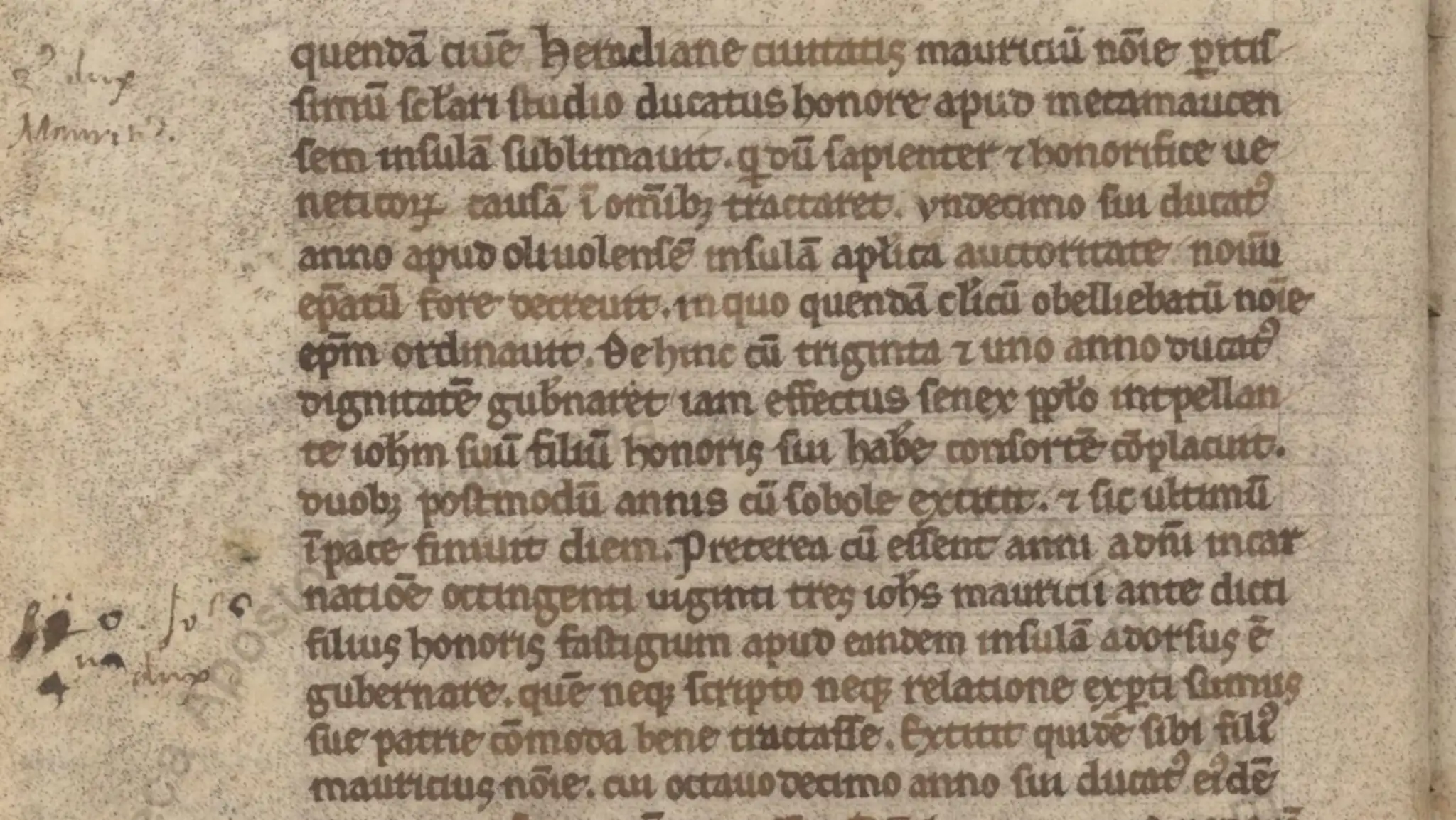
John the Deacon, in his Istoria Veneticorum, wrote:
In the twenty-third year of the rule of the aforementioned Giovanni, seizing an opportunity, he sent his son Mauricius with a naval force to the city of Grado to kill Lord Giovanni, the most holy patriarch.
When he arrived there, eager to obey his father’s orders, he cruelly killed the same most holy man. His death caused the greatest sorrow to his fellow citizens, since he had been slain unjustly.
Istoria Veneticorum, II.22 (excerpt).
Andrea Dandolo, writing centuries later in the Chronica Extensa, added more details, which at least in part, came from the Chronicon Altinate:
During these days, duke Giovanni, seizing the opportunity, sent his son Mauricius, with a naval force, to Grado to kill Patriarch Giovanni. However, Mauricius, in a fury, invaded the city; in this invasion, the patriarch was captured, severely wounded by the Venetians, and thrown from the highest tower of his palace where he died; his blood, as a testament to his death, still appears on the stones; and he was buried in the chapel of Saint Mark, behind the mausoleums of the holy martyrs.
Chronica per extensum descripta, VII.13 (excerpt).
None of the chroniclers bothered to specify what the mentioned opportunity was, but it sounds like the dukes were simply waiting for a pretext — any pretext — to rid themselves of a troublesome patriarch.
The counter-attack
The factional conflict wasn’t resolved by killing the patriarch.
The remaining leadership of the church in Grado chose the next patriarch, and they doubled down on the political line of the slain patriarch.
The successor, Fortunatus, was therefore not only of the same political orientation, but also from the same diocese in Istria, and a blood relative of the dead patriarch, giving him a personal grievance atop the political differences with the dukes.
In the face of what had just happened, he immediately fled Grado for Treviso on the Frankish mainland, where a group of like-minded Venetians gathered around him.
From there, Fortunatus later travelled to Francia to seek the support of Charlemagne, while the others descended on Venetia.
According to our sources, the two dukes Giovanni and Mauricius, stricken by fear, fled Venetia, and the pro-Frankish side took control of the duchy.
When Giovanni and Mauricius, the dukes, realized this, worn down by fear, they fled. One of them went to France, that is Mauricius, the other indeed went to Mantua, where they sojourned so long that neither of them returned to Venice, but there they ended their last day.
Then the same Obelerius boldly entered Venice. Here, when he had been received by the people with devotion and honour, he made his brother, namely Beatus by name, his partner in the dignity.
Istoria Veneticorum, II.24 (excerpt).
Interestingly, the same sources stated that both Giovanni and Mauricius fled to the Frankish controlled mainland, rather than towards Byzantine controlled territories across the Adriatic.
A more likely interpretation than the one offered by John the Deacon, is that they two dukes Giovanni and Mauricius were captured, and sent into a safe exile with the supporters of the new rulers.
The role of the church
What is clear from this account that the church organisation — that is, the Patriarchate of Grado — was an important power base in Venetian politics.
It is also evident, that the church organisation at the time was outside the control of the ruling factions within the duchy.
Patriarch Giovanni governed the church for most of the combined reigns of Mauricius and Giovanni, from 766 to 802, while representing a political line opposite that of the dukes.
Furthermore, at this time, the patriarchs were elected by the clergy, not by the political leadership of the duchy.
Even in a situation where the dukes had physically taken control of the city of Grado, and had killed the patriarch, the next patriarch was not somebody acceptable to the dukes. Rather, the leaders of the patriarchate doubled down, and chose a new patriarch who not only represented the same political line as his predecessor, opposite of the dukes, but also a relative of the slain patriarch, and therefore with a personal axe to grind.
Within Venetia, the two main power structures — the duchy and the patriarchate — ended under the control of two opposing sides in what was probably the main political fight of the period.
It definitely didn’t help that half the nominal territory of the patriarchate was in Istria, which was de facto Frankish territory, and that both patriarchs, Giovanni and Fortunatus, came from there.
Heraclia and Metamauco
The factional divide within Venetia was not simply between the leaderships of the duchy and of the church.
A large part of the Venetian elite sided with the patriarchs, and when the dukes Giovanni and Mauricius were exiled, the pro-Frankish faction took over the duchy, led by the brothers Obelerius and Beatus.
The internal conflict within the duchy is often depicted as competition and animosity between the two settlements of Heraclia and Metamauco.
John the Deacon usually mentioned where each of the early dukes came from.
Ursus and Deusdedit were from Heraclia, even if Deusdedit moved — or was forced to move — the seat of government to Metamauco. Domenicus Monegarius was from Metamauco, while Mauricius and Giovanni came from Heraclia. Obelerius and Beatus were from Metamauco.
When Obelerius and Beatus ascended to power, they exacted a brutal revenge on Heraclia.
John the Deacon noted:
At this time also, the New City, which is called Heraclia, was destroyed by the Venetians.
Istoria Veneticorum, II.24 (excerpt).
The Venetians destroyed a Venetian city, which only makes sense in the context of the internal conflict between the pro-Byzantine elite from Heraclia, and the more Frankish leaning elite of Metamauco.
Besides the Istoria Veneticorum, the Chronicon Altinate is full of fanciful stories about infighting within the Venetian elite, many of which pitted people from Metamauco, supposedly originating from Padua, against people of Heraclia, who came from the Byzantine Opitergium.
Once such story is of the supposed death of Paulicius, during a ferocious naval attack of people from Metamauco and Equilo on Heraclia. This story also illustrates some of the problems with the Cronicon Altinate, as the story has a very unclear chronology, and blatantly contradicts most other sources for the period.
The Chronicon Altinate is often too incoherent to be a reliable source.
While many of these stories are justly discarded by modern scholars, it had an enormous influence on the later Venetian chroniclers, from Martin da Canal and Andrea Dandolo.
Bibliography
- Cessi, Roberto. Origo civitatum Italie seu Venetiarum : (Chronicon Altinate et Chronicon Gradense) in Fonti per la storia d'Italia / pubblicate dall'Istituto storico italiano ; 73. Roma : Tipografia del Senato, 1933. [more]
- Dandolo, Andrea and Ester Pastorello. Chronica per extensum descripta in Rerum Italicarum scriptores : raccolta degli storici italiani dal Cinquecento al Millecinquecento / ordinata da L. A. Muratori , 12.1. Bologna : N. Zanichelli, 1938-1958. [more] 🔗
- Iohannes : Diaconus Venetus. Chronicon Venetum omnium quae circumferuntur vetustissimum et Johanni Sagornino vulgo tributum e mss. codice Apostoli Zeno V. Cl. nunc primum cum mss. codicibus Vaticanis collatum, notisque illustratum in lucem profert H. Fr. Zanetti Al. F. Venetiis, 1765. [more] 🔗
- Iohannes : Diaconus Venetus and Luigi Andrea Berto. Istoria Veneticorum. Bologna Zanichelli, 1999. [more] 🔗
- Monticolo, Giovanni. Cronache veneziane antichissime. Roma, Forzani e C. tipografi del Senato, 1890. [more] 🔗
- Rossi, Antonio, Giovanni Galvani, Martino : da Canale and Emmanuele Antonio Cicogna. La Cronaca veneta detta Altinate di autore anonimo, in latino, preceduta da un commentario del prof. Antonio Rossi e La cronaca dei Veneziani del maestro Martino da Canale, nell'antico francese, colla corrispondente versione italiana del conte Giovanni Galvani e con annotazioni di Emmanuele Cicogna … [et al.]. Firenze : Gio. Pietro Vieusseux, 1845. [more] 🔗
Leave a Reply