After the first three doges of Venice, there was a kind of interregnum, which lasted five or six years.
In this period, between 737 and 742 in the traditional reckoning, rather than having a duke or doge chosen for life — or until he was deposed having his eyes gouged out — the Duchy of the Venetians was governed by officials called magistri militum — masters of the soldiers — which was a Byzantine military rank.
Our only source for this is the Istoria Veneticorum by John the Deacon, written two and a half centuries after the facts. All later Venetian sources essentially copy from John the Deacon, and no external sources corroborate this story.
In fact, of the five names, only one appears elsewhere in our sources.
The five magistri militum were (with the names as given by John the Deacon):
- Leo (737–738)
- Felix Cornicola (738–739)
- Deusdedit (739–740)
- Iubianus (740–741)
- Giovanni Fabriacus (741–742)
The third, Deusdedit, was the son of the third doge of Venice, Ursus Hypatos.
The Chronicon Altinate deviated slightly from the other sources, by having Deusdedit serve two one-year terms as magister militum.
Theories
The explanation offered by our few sources — essentially John the Deacon and derivatives — is that, following the assassination of duke Ursus, the Venetians decided that they didn’t want to have dukes any more, and therefore chose another style of government with one-year terms.
We’re not told why the Venetians took that decision, but it is presented as an entirely internal decision by the people of an independent duchy, made without any external influences whatsoever.
The problem is that the Venetians weren’t as independent in the mid-700s as they were at the time of John the Deacon, in the late 900s. It is therefore unlikely that such a decision could be made without considering what happened around the duchy.
The Duchy of the Venetians was still formally a part of the Byzantine Exarchate of Ravenna, and the Kingdom of the Lombards was a very real presence in most of northern Italy, including on all the mainland of Venetia.
Consequently, no modern scholars accept that this decision happened in a vacuum.
There are two dominant — and opposing — interpretations of these events, and given the scarcity of sources, there is no way to decide which is the more likely.
A Byzantine backlash
The first interpretation is that of a Byzantine backlash following the unauthorised rise to power of Ursus during the anti-iconoclast rebellion around 727.
In this reading, the Venetians had chosen Ursus as their duke during the rebellion, as the Liber Pontificalis for Gregory II recounted.
Soon after, the patrician and eunuch Eutychius replaced the slain Paulus as exarch, and set about restoring order to the Exarchate.
However, before he could do something to bring the Venetians, with their illegitimate duke, back in line, Ravenna was attacked and taken by Hildeprand and Peredeo. Eutychius was forced to flee to Venetia, where, with the backing of the pope, he asked the Venetians for help.
The Venetians, led by duke Ursus, successfully expelled the Lombards from Ravenna, and placed Eutychius back on his throne.
Being thus indebted, Eutychius couldn’t force a replacement of Ursus in the Duchy of the Venetians, and instead awarded him the title of hypatos.
After Ursus was assassinated by the Venetians — in 737 on the traditional timeline — Eutychius used the opportunity to restore Byzantine order to the duchy. He swiftly appointed a trusted Byzantine commander to head the province, but only for a one-year term, to keep Venetia on a leash, so to say.
In an attempt to placate the unruly locals, the son of duke Ursus was later allowed back to the duchy, and then given the post of magister militum for one or two terms, but afterwards Eutychius reverted to appointing outsiders.
In the fifth or sixth year of this order, something snapped, and the Venetians rebelled. They blinded the fifth magister militum, and chose Deusdedit as their doge, in opposition to the Exarchate, as with his father.
On the traditional timeline, this happened in 742, when the Exarchate was in trouble again. King Liutprand was raiding and pillaging much of the Exarchate, and Eutychius and archbishop John VI had to turn to pope Zachary for help.
An anti-Byzantine rebellion
The other interpretation of the interlude of the magistri militum is that of a local Venetian reaction to Byzantine control and influence over the duchy.
In this reading of events, Ursus became duke on the wave of anti-Byzantine sentiments which rose during the reaction to the iconoclast edicts.
Ursus, however, switched side — or was perceived by parts of Venetian society to have switched side — when Eutychius arrived in Venetia, asking for help against the Lombards. He went with what forces Venetia could muster, succeeded, and was rewarded afterwards by Eutychius.
Consequently, the anti-Byzantine faction within Venetian society rose against Ursus, and he was killed, and his son Deusdedit exiled.
Unable to agree on a successor, the victorious faction compromised by choosing a leader for just one year at a time, and by using another title than that of duke.
Within a few years, Deusdedit was allowed to return from exile, and then to serve as magister militum for one or two years. This reversal could be due to a shift in the internal power balance between the factions, or it could be an attempt at compromise between the competing factions.
In any case, the faction of Deusdedit grew in strength, and two years later, they had the fifth magister militum deposed and blinded, and replaced by Deusdedit as the fourth duke of the Venetians, succeeding his father.
Both John the Deacon and Andrea Dandolo emphasised in their narratives, how the Venetians, before the first doge, had been governed by the tribunes of the individual lagoon settlements, who served one-year terms.
This interpretation of the period of the magistri militum could be seen as a return to such a style of government, but it doesn’t explain why the Venetians chose a very Byzantine title. Dandolo wrote that the Greek title was more prestigious, while John the Deacon ignored the question altogether, just as he, in general, ignored any Byzantine influence on Venetia.
Sources
Below are translations of the main primary sources we have for the five magistri militum.
John the Deacon
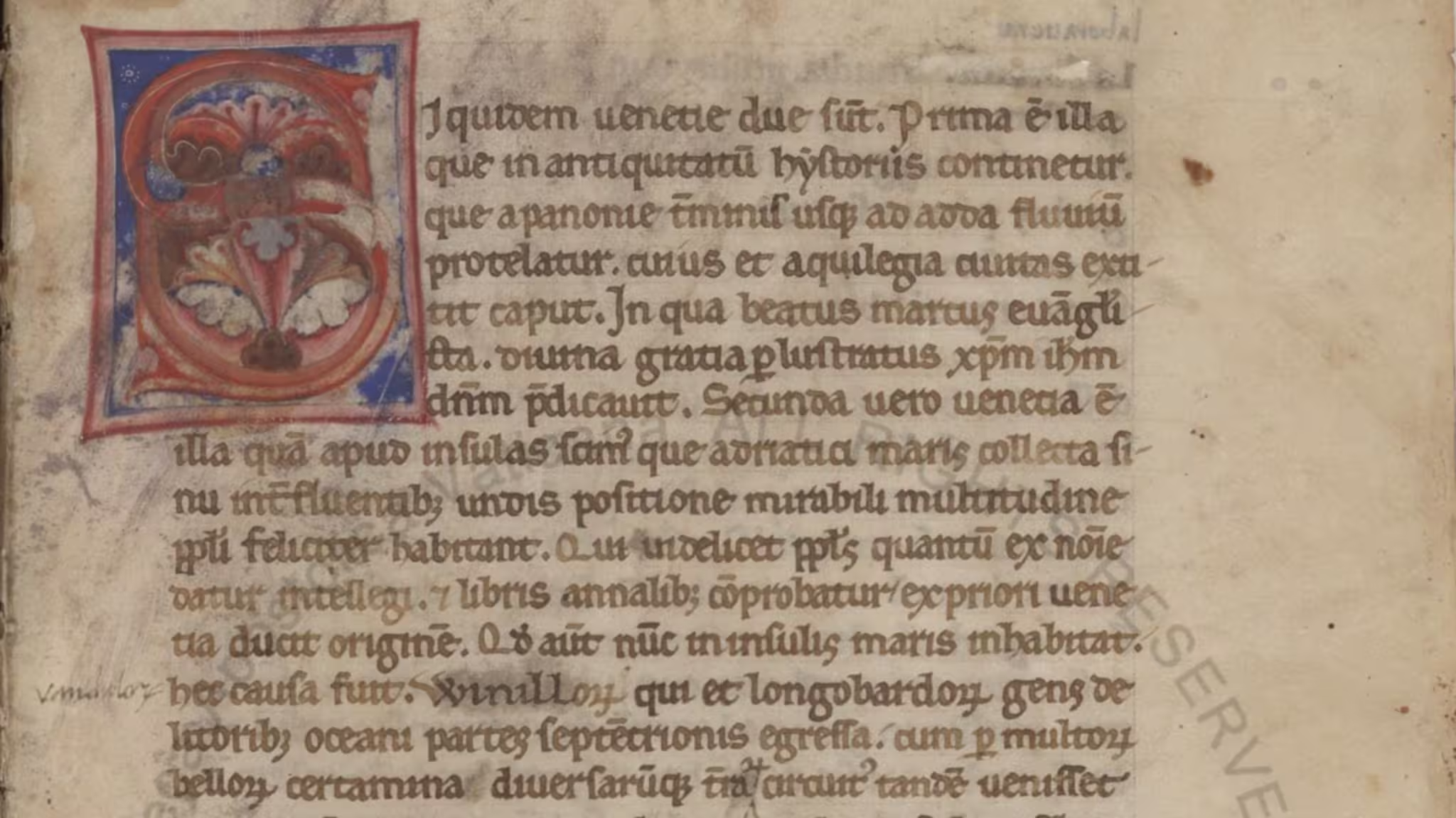
The oldest extant source is the Istoria Veneticorum by John the Deacon, written around the year 1000. He wrote, starting with the short account of the assassination of duke Ursus Hypatos:
Whereupon later the Venetians, killing him with bitter jealousy, wished that for a period of five years they should remain subject only to the military commanders.
The first, whose name was said to be Leo, whose power over them was for one year.
Then the second of them was called Felix, with the surname Cornicula, who similarly had ruled them for the space of one year.
Then a third master of the soldiers was called Deusdedit, the son of the aforementioned Ursus, the slain duke, who also held that power for the space of one year.
Afterwards the fourth among them was Iubianus by name, hypatus; he had likewise been the holder of the same honour for one year.
… omissis …
After the deaths of the aforementioned four masters of the soldiers, the fifth of the same prefecture was appointed, who was called Giovanni Fabriacus; in a similar way to the others, he held the command for the space of one year, and his eyes were also gouged out by the Venetians.
Istoria Veneticorum, II.11 (excerpts) and II.14.
Chronicon Altinate
The anonymous Chronicon Altinate, of uncertain date, only has a few lines, which are probably derived from the Istoria Venticorum.
After the death of Duke Ursus, there were no dukes in Venice for 6 years, but the Master of Soldiers judged matters, that is, Lord Leo, Master of Soldiers served for 1 year; Felix, Master of Soldiers served for 1 year; Deusdedit, Master of Soldiers served for 2 years; Julian, Hypatus, Master of Soldiers served for 1 year; Johannes Fabriacus, Master of Soldiers served for 1 year.
Chronicon Altinate, liber I
The only variation in the Altinate is that Deusdedit was given two one-year terms.
There are several editions of the Chronicon Altinate, and the above corresponds to editio I and editio II in Cessi (1933), p. 29 (editio III on p.115–116). The differences for these parts of the chronicle are insignificant.
Andrea Dandolo
Doge Andrea Dandolo, writing his Chronica per extensum descripta in the 1340s, had little more to add.
These are the relevant chapters of book VII.
Dominicus Leo began to preside as master of the soldiers in the year of our Lord Jesus Christ, 737.
Because the Venetians, upon the death of their leader, were discordant in the promotion of a new duke, they decided to have for themselves a ruler for one year, whom they called master of the soldiers; this dignity, according to the usage of the Greeks, was greater than the tribunate and held authority over them and the entire populace.
… omissis …
Now he presided over the government of Venice for one year.
… omissis …
Felix Cornicula began to govern as master of the soldiers in the year of our Lord Jesus Christ, 738. This humble and peaceful man restored discordant Venetians to harmony, and he caused Deusdedit, the son of the slain duke, whom the killers had exiled, to return to his homeland.
… omissis …
Felix ruled Venice for one year.
… omissis …
Deusdedit, master of the soldiers, began to rule in the year of our Lord Jesus Christ, 739. Here, the son of the slain leader, recalled from exile, was honoured with the military command by the Venetians, to somewhat exact satisfaction for his injustices.
Certainly, Deusdedit held the throne for one year; and in some records, it is found that he held the throne for two years; namely, that after completing the first year, he was again approved for the second.
… omissis …
Iubianus Hypatus took office as master of the soldiers in the year of our Lord Jesus Christ, 740. He, hypatus by imperial generosity, that is, having already become an imperial consul, a noble and virtuous man, deserved to obtain this honour.
… omissis …
For one year, Iubianus also presided over this throne.
… omissis …
Johannes Fabricius served as master of the soldiers in the year of our Lord Jesus Christ 741.
… omissis …
Here Johannes, not yet having completed the year honourably, was deposed by the Venetians, and deprived of his sight.
Chronica per extensum descripta, liber VII, chapters 4–8 (excerpts)
Bibliography
- Cessi, Roberto. Origo civitatum Italie seu Venetiarum : (Chronicon Altinate et Chronicon Gradense) in Fonti per la storia d'Italia / pubblicate dall'Istituto storico italiano ; 73. Roma : Tipografia del Senato, 1933. [more]
- Dandolo, Andrea and Ester Pastorello. Chronica per extensum descripta in Rerum Italicarum scriptores : raccolta degli storici italiani dal Cinquecento al Millecinquecento / ordinata da L. A. Muratori , 12.1. Bologna : N. Zanichelli, 1938-1958. [more] 🔗
- Iohannes : Diaconus Venetus. Chronicon Venetum omnium quae circumferuntur vetustissimum et Johanni Sagornino vulgo tributum e mss. codice Apostoli Zeno V. Cl. nunc primum cum mss. codicibus Vaticanis collatum, notisque illustratum in lucem profert H. Fr. Zanetti Al. F. Venetiis, 1765. [more] 🔗
- Iohannes : Diaconus Venetus and Luigi Andrea Berto. Istoria Veneticorum. Bologna Zanichelli, 1999. [more] 🔗
- Monticolo, Giovanni. Cronache veneziane antichissime. Roma, Forzani e C. tipografi del Senato, 1890. [more] 🔗
- Rossi, Antonio, Giovanni Galvani, Martino : da Canale and Emmanuele Antonio Cicogna. La Cronaca veneta detta Altinate di autore anonimo, in latino, preceduta da un commentario del prof. Antonio Rossi e La cronaca dei Veneziani del maestro Martino da Canale, nell'antico francese, colla corrispondente versione italiana del conte Giovanni Galvani e con annotazioni di Emmanuele Cicogna … [et al.]. Firenze : Gio. Pietro Vieusseux, 1845. [more] 🔗
Leave a Reply