The Pactum Lotharii was a treaty between the Duchy of the Venetians and the Holy Roman Empire, or parts thereof, from 840.
With the Pactum Lotharii, for the first time, the Venetians entered into an agreement with another country on their own, without the Byzantines at the table.
The treaty has therefore been seen as a pivotal milestone in the history of Venice, as making international treaties is usually part of the definition of a sovereign country. Some scholars, however, interpret it more as a local agreement between Venice and the surrounding parts of the Kingdom of Italy, under the Holy Roman Empire.
The Holy Roman emperor — and king of Italy — at the time was Lothair I, and the doge of the Venetians was Pietro Tradonico.
In the Venetian sources
For the Venetians, it was an important document because it defined their borders with the empire on the mainland, and later their claim to self-government from ancient times.
John the Deacon, who wrote the first Venetian chronicle around the year 1000, used this document to identify the two first doges of Venice — Paulicius and Marcellus — by misreading the text, most likely on purpose.
The importance of the document also earned it an entire paragraph in the Chronica per extensum descripta by Andrea Dandolo:
In the first year of his [Lothair] reign, a pact was concluded between the Venetians and their neighbours, who were subjects of the Empire, regarding the restitution of rights and the payment of customs, which he confirmed at the request of the duke for five years, and he distinguished the territories of the Duchy from the those of the Italian Kingdom, and approved the boundary made between Duke Paulicius and Master of the Soldiers Marcellus concerning the borders of the New City under King Liutprand and confirmed by Astulf.
Chronica Extensa, VIII.4.11, in Dandolo et.al. (1938), p. 151.
Earlier charters
The Pactum Lotharii has references in chapters 26 and 28 to two other agreements or charters.
It refers to an agreement “between duke Paulicius and master of the soldiers Marcellus”, from the time of king Liutprand, defining the border separating the Lombard territories on the mainland, and the Venetian territories around the New City of Heraclia.
This agreement is called the Terminatio Liutprandina, and is dated at the start of his reign, around 712–713. John the Deacon used this part to name the the first doges, Paulicius and Marcellus.
Half a century later, king Aistulf confirmed the Terminatio Liutprandina in a charter, which is called the Largitio Astolfina. It is not possible to date it any closer than to the periods of the reign of Aistulf as either duke or king of the Lombards, between 745 and 756. It was likely issued around the time of the Lombard conquest of the Exarchate, in 750–752.
Nothing is known about the contents of these agreements or charters, beyond what can be deduced from the Pactum Lotharii.
Manuscripts
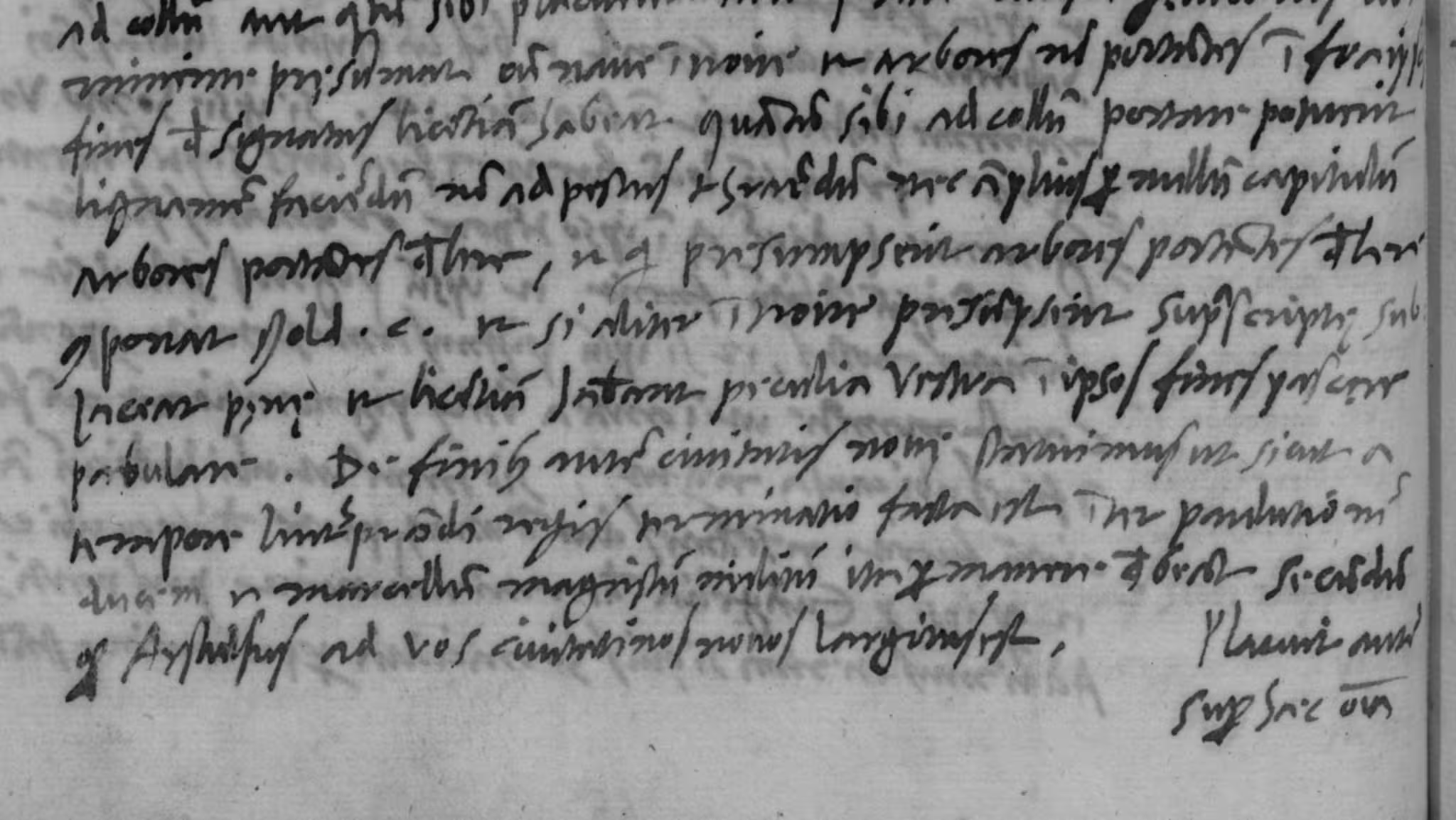
The only extant versions of the text of the pact are from two Venetian manuscripts, still kept in the Archivio di Stato di Venezia, which is the heir to the archives of the Republic of Venice.
One manuscript is a copy of the Liber Blancus (a compendium of treaties) from the time of Andrea Dandolo, and the other is the Codex Trevisaneus, from around 1500, copied from the Codex Egnatii, two centuries older and now lost.
An edition of the Pactum Lotharii was published in Cessi (1940), p. 101–108. The complete Latin text, with extensive commentary, is also available on the Fontes Istrie Medievalis website.
Pactum Lotharii (excerpts)
The excerpts translated and published here are the parts cited in other articles on this site.
The preamble lists many of the settlements in the lagoons at the time.
The chapters 26 and 28 were used by John the Deacon to name — or invent — the first two doges of Venice, Paulicius and Marcellus.
Preamble
In the name of our Lord Jesus Christ, God eternal.
In the year of the incarnation of the Lord eight hundred and forty.
Lothair, by divine providence emperor, in the twenty-sixth year of his reign, on the eighth day before the Kalends of March,1 at the palace of the city of Pavia.2
This agreement — suggested and requested by Pietro,3 most glorious duke of the Venetians — was established and ordered to be delineated between the Venetians and their neighbours, so that on both sides oaths may be given to observe these provisions and thereafter through the observance of these provisions firm peace may be maintained among them.
Those, to whom the terms of this agreement pertain, are very close to the Venetians: the peoples of Istria, Forum Iulii, Ceneda, Treviso, Vicenza, Monselice, Gavello, Comacchio, Ravenna, Cesena, Rimini, Pesaro, Fano, Senigallia, Ancona, Numana, Fermo, Pineto, in whose territories, either at present or in the future, the elders and the juniors, appointed by the emperor himself, are established, and it is agreed with Pietro, duke of the Venetians, and with the Venetian people themselves, that is, with the inhabitants of Rivoalto, the castle of Olivolo, Murano, Metamauco, Albiola, Chioggia, Brondolo, Fossone, Loreo, Torcello, Ammiana, Burano, the New City,4 Fine, Equilio, Caorle, Grado, Cavarzere,5 and with all the inhabitants of those places, both bishops and priests as well as the dignitaries and the rest of the people, and in general, all things pertaining to the Duchy of Venice, that this agreement should be observed for a period of five years, so that no malice or injury arises between the parties; and if, [which God forbid], any harm is committed between the parties, they mutually promise to amend it according to the terms of this pact and to preserve justice.
Click to reveal the Latin text
In nomine domini nostri Iesu Christi Dei eterni.
Anno incarnationis Domini octigentesimo quadragesimo.
Lotarius divina ordinante providentia imperator augustus, anno imperii eius vigesimo sexto, octavo kalendas marcii, Papie civitatis palatio.
Hoc pactum – suggerente ac supplicante Petro gloriosissimo duce Veneticorum – inter Veneticos et vicinos eorum constituit ac describere iussit, ut ex utraque parte de observandis his constitutionibus sacramenta dentur et postea per observationem harum constitutionum pax firma inter illos perseveret.
Vicini vero Veneticorum sunt, ad quos huius pacti ratio pertinet: Histrienses, Foroiulienses, Cenetenses, Tarvisanenses, Vincentinenses, Montesilicenses, Gavalenses, Comaclenses, Ravennenses, Cesentenses, Ariminenses, Pisaurenses, Fanenses, Senegalenses, Anconenses, Humanenses, Firmenses et Pinenses, quibus locis vel presenti tempore constituti sunt vel in futuro constituti fuerint, maiores atque minores, quos constituit ipse imperator, ut cum Petro duce Veneticorum et cum ipso populo Veneticorum, id est cum habitatoribus Rivoalti, castri Olivoli, Amorianis, Madamauci, Albiole, Clugie, Brunduli, Fossiones, Laureti, Torcelli, Amianarum, Buriani, Civitatis Nove, Fines, Equili, Caprularum, Gradus, Caput Argelis et cum omnibus his locis habitantibus, tam episcopis ac sacerdotibus quam et primatibus seu reliquo populo et cuncta generalitate ad Ducatum Venetie pertinentibus, hoc pactum observare deberent per annos constitutos numero quinque, ut nulla malitia nec lesio inter partes proveniat; et si, [quod absit], aliquod malum inter partes commissum fuerit, secundum pacti huius seriem emendare et iustitiam conservare ad invicem repromittunt.
Chapter 26
Regarding the borders of the New City, we decide that, just as during the time of King Liutprand6 a boundary was set between Duke Paulicius7 and Marcellus,8 Master of the Soldiers,9 it should remain the same, according to what Aistulf10 granted you citizens of the New City.11
Click to reveal the Latin text
[26] De finibus autem Civitatis Nove statuimus, ut, sicut a tempore Liuthprandi regis terminatio facta est inter Paulutionem ducem et Marcellum magistrum militum, ita permanere debeat, secundum quod Aistulfus ad vos Civitatinos Novos largitus est.
Chapter 28
The herds from your territories can pasture with security up to the boundary set by Duke Paulicius with the citizens of the New City, as it is written in the agreement, from the Greater Piave12 to the Dry Piave, which is the boundary of your property.
Click to reveal the Latin text
Peculiarumque vestrarum partium greges pascere debeat cum securitate usque in terminum quem posuit Paulutius dux cum Civitatinis Novis, sicut in pacto legitur, de Plave maiore usque in Plavem siccam, quod est terminus vel proprietas vestra.
Notes
- In the Roman calendar, the kalends indicated the first day of a month. In this case, it is February 21st. ↩︎
- Pavia was the capital of the Kingdom of the Lombards in the 600s and 700s, and the Frankish Kingdom of Italy in the 800s. ↩︎
- Pietro Tradonico (c. 800–864), also Petrus Tradonicus, was the 13th doge of Venice, from 836 until his death. Pietro Tradonico was the signatory to the important Pactum Lotharii (840). ↩︎
- Eraclea (orig. Civitas Nova Heracliana, also Civitanova), founded in 640, was originally situated on a lagoon island. It was the first seat of the doges of Venice, before it moved to Metamauco. ↩︎
- For details about these settlements, please see Lagoon settlements in the early Middle Ages. They are also marked on the interactive map below. ↩︎
- Liutprand (c.680–744) was king of the Lombards from 712 to 744. During his reign, he fought wars with Byzantine over Ravenna, and donated lands at Sutri to the Pope, leading to the creation of the Papal State. ↩︎
- Paulicius (also Paoluccio Anafesto or Paulicio) was the first doge of Venice, nominally from 697 to 717, but the years are uncertain, as is his real identity. See also: Paulicius — the first doge of Venice?. ↩︎
- Marcellus (†726), also Marcello Tegalliano, was, according to tradition, the 2nd doge of Venice from 717 to his death in 726, but very little is known about him. ↩︎
- Magister militum (master of soldiers) was a Roman and Byzantine title for a provincial or local military commander, who often had civil duties too. ↩︎
- Aistulf (†756) was Duke of Friuli from 744, and King of the Lombards from 749 until his death in 756. He attacked the Byzantine dominions repeatedly, including Ravenna and Rome. ↩︎
- Eraclea (orig. Civitas Nova Heracliana, also Civitanova), founded in 640, was originally situated on a lagoon island. It was the first seat of the doges of Venice, before it moved to Metamauco. ↩︎
- The city of Heraclia was located on an island in the estuary of the river Piave. The river had earlier changed its course, and the “Dry Piave” referred to the old riverbed. ↩︎
Bibliography
- Cessi, Roberto. Documenti relativi alla storia di Venezia anteriori al Mille. Padova : Gregoriana, 1940-1942. [more] 🔗
- Dandolo, Andrea and Ester Pastorello. Chronica per extensum descripta in Rerum Italicarum scriptores : raccolta degli storici italiani dal Cinquecento al Millecinquecento / ordinata da L. A. Muratori , 12.1. Bologna : N. Zanichelli, 1938-1958. [more] 🔗
- Gasparri, Stefano. The First Dukes and the Origins of Venice in Gelichi and Gasparri (eds). Venice and its neighbors from the 8th to 11th century. Leiden ; Boston : Brill, 2018. 🔗
- Gelichi, Sauro and Stefano Gasparri (eds). Venice and its neighbors from the 8th to 11th century : through renovation and continuity. Leiden ; Boston : Brill, 2018. 🔗

Leave a Reply