The presence of the Exarchate of Ravenna was a fixture in the world of the Venetians in the 600s and into the 700s.
Venetia was a Byzantine duchy under the Exarchate of Ravenna, which was how the Eastern Roman Empire had organised its territories in Italy.
What happened in and with the Exarchate of Ravenna often had a direct influence on the province of Venetia, just as what happens in politics in Rome today can have a direct influence on the Veneto region and those who live there.
The territory
The Exarchate of Ravenna had been established in 584 as an emergency response to the Lombard invasion.
After the initial wave of invasion and conquest, the Exarchate of Ravenna and the Kingdom of the Lombards established a kind of co-existence, albeit an uneasy and often conflictual co-existence.
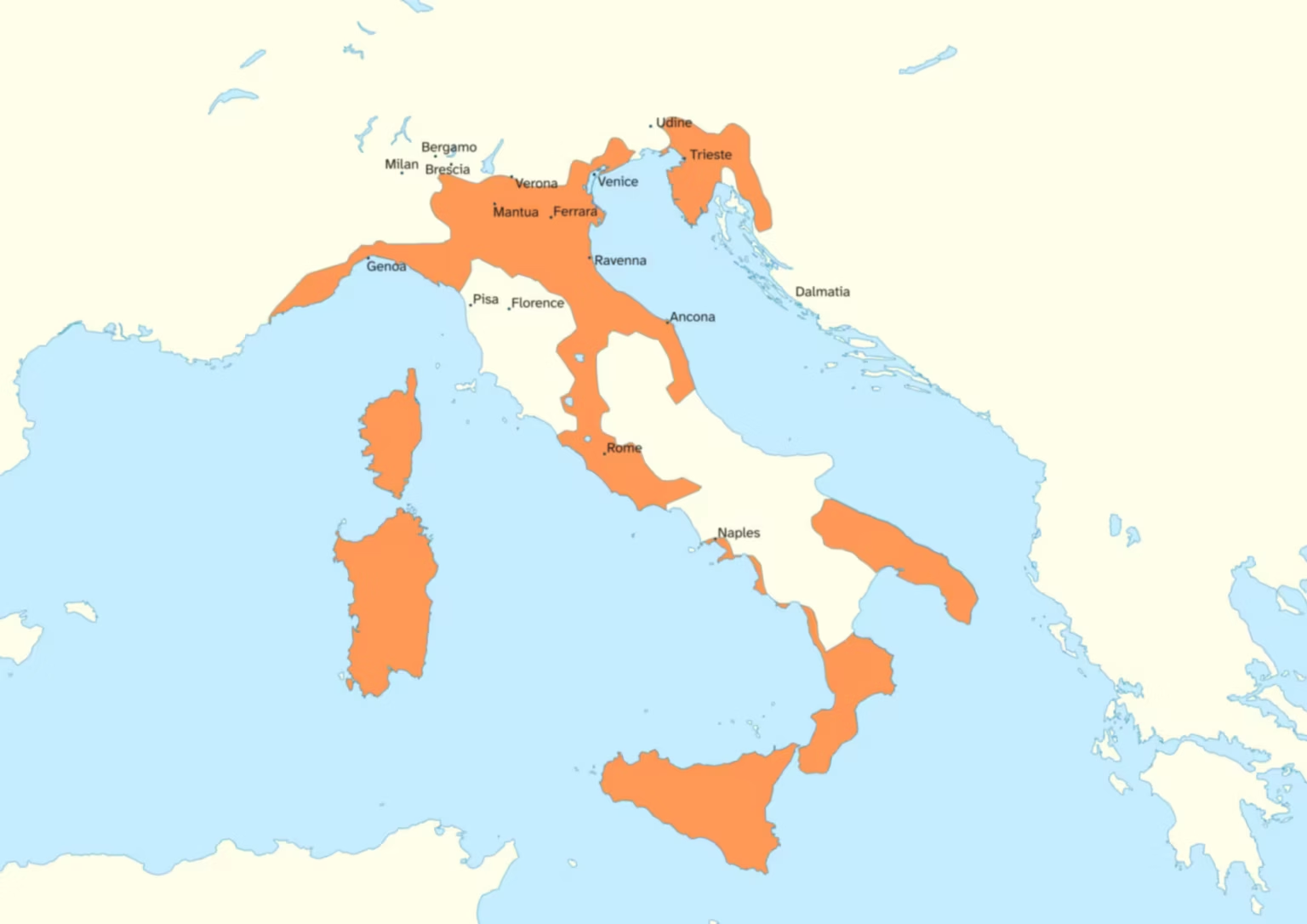
By the mid-600s, the Byzantine parts of Italy were reduced to the islands and the south, the areas around Naples and Rome, most of the Adriatic coast, with the Pentapolis south of Ravenna, Ravenna itself and its surroundings up to the estuary of the river Po, and Venetia Maritima north of the estuary.
The Lombards had established themselves in most of the north, and in the centre and south in-land, mostly away from the coastal areas.
For much of the period, the Exarchate managed to maintain a land corridor across the Apennines, connecting Ravenna and Rome.
Consequently, the Lombard duchies of Spoleto and Benevento — in the centre and south of the Italian peninsula — were detached from the rest of the Kingdom of the Lombards. The dukes of Spoleto and Benevento would often take advantage of this peculiarity to act more independently than the other Lombard duchies could get away with.
Ravenna — the capital of the Exarchate
Ravenna was the political centre of the Exarchate. It had been a capital city since the mid-400s, from the late Western Roman Empire, through Odoacer and the Kingdom of the Ostrogoths, to the Exarchate of Ravenna.
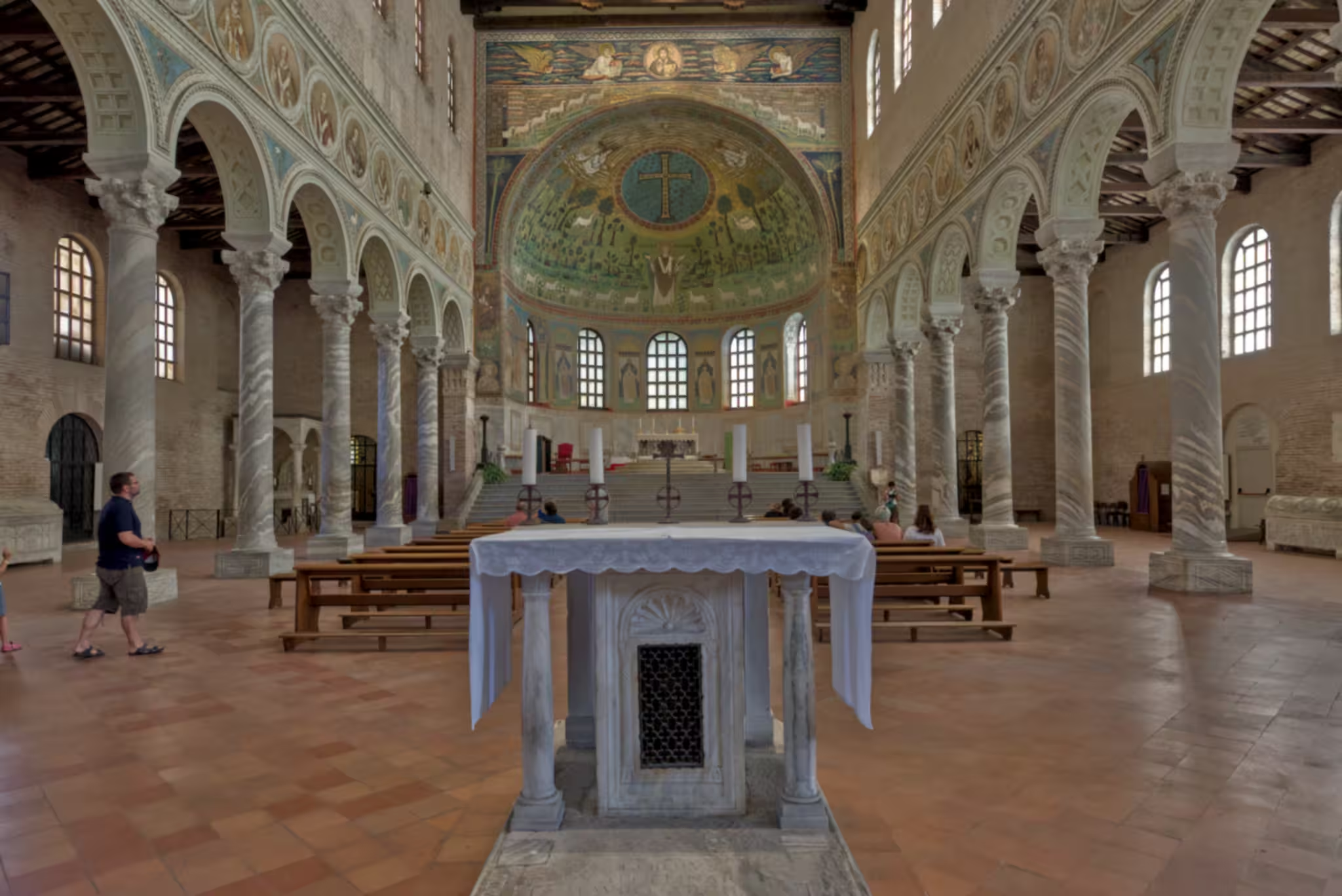
It was — and still is — full of magnificent churches and monuments, while the ancient palaces of government are mostly gone.
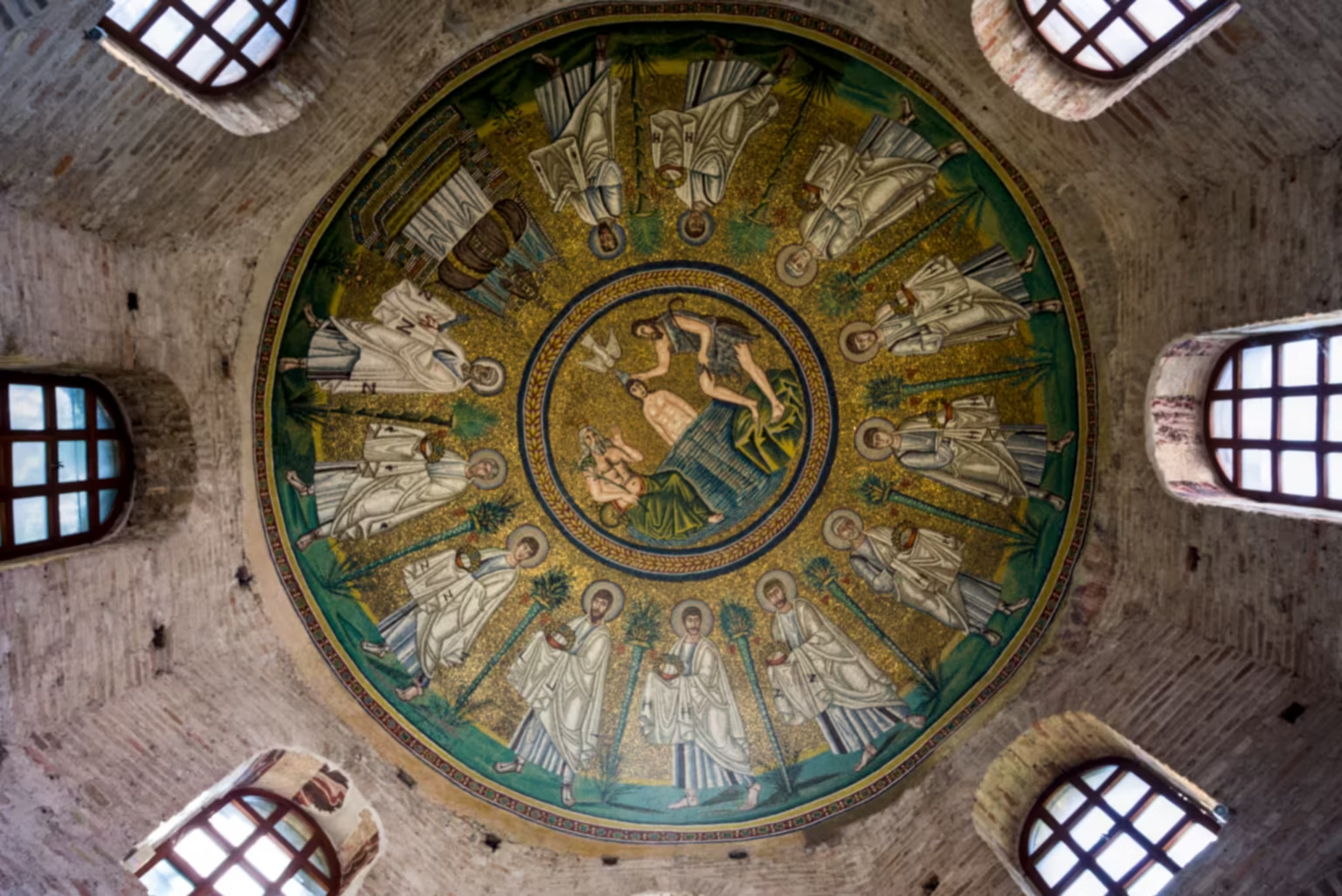
The importance of Ravenna was in part due to its geographical position. It was located on an island in a lagoon, not unlike later Venice, with effective natural lines of defence. On a lido nearby, the city of Classe was a major naval base since Roman times. The name Classe literally means navy.
In addition to being easily defensible, Ravenna had good maritime connections to the Eastern Empire, and was near the main Roman consular roads inland, in particular the Via Emilia towards Lombardy and Piedmont, but also north to Venetia and Histria.
From a Byzantine perspective, as an Italian capital, Ravenna was preferable to Rome.
Rome — the seat of the Papacy
Rome was, of course, special, despite being on the ‘wrong’ side of the peninsular, from a Byzantine point of view.
The Papacy was based in Rome, and the pope was the spiritual leader of Christianity in the Latin west. Together with the patriarchs of Alexandria, Antioch and Constantinople, the pope was one of the undisputed leaders of Christianity.
Locally, however, the pope found himself in a precarious situation.
Formally a part of the Exarchate, but geographically almost detached, if not for that land corridor across the Apennines, and for a narrow stretch of coastline towards Naples.
The territory of the Byzantine Duchy of Rome bordered on the Lombard duchies of Benevento to the south, Spoleto to the east, and Tuscia (Tuscany) to the north, which were some of the largest Lombard duchies, and some of the most independent.
The popes were forced to come to terms with the neighbouring Lombard dukes, regardless of what the rulers in Constantinople and Ravenna thought of the matter.
It therefore happened that the interests and needs of the bishops of Rome, who formally had no political or military power, diverted from the priorities of the empire.
Byzantine control of the papacy
In the second half of the 600s, that tension regularly became grew into open conflict, and the relationship between the empire on one side, and the papacy and the people of the Exarchate on the other, deteriorated.
The empire saw the pope in Rome as subordinate to the emperor in Constantinople and to the Patriarch of Constantinople.
If a pontiff did not accept that subordination, the empire reacted with coercion, violence and repression.
For example, Pope Martin I, who refused to tow the Byzantine line in a religious dispute, was arrested in Rome, hauled to Constantinople, deposed and replaced as pope, and finally exiled to Crimea, where he died.
As the relationship became more conflictual, the empire became more heavy-handed with the papacy
Justinian II
Justinian II was the last emperor of the Heraclian dynasty. He ruled initially from 685 to 695, was deposed and exiled, but came back, and ruled again 705 to 711.
In 692, he called a church council, called the Quinisext council or the Council in Trullo, which took place in a large domed hall (the troúlos) in the imperial palace in Constantinople.
The Roman church wasn’t invited and therefore wasn’t represented.
Afterward the canons of the council were sent to Rome for the signature of pope Sergius I, but he rejected some of the canons and refused to sign, as several of the decisions went against the established traditions of the Roman church.
Justinian responded by sending an armed mission, led by the head of the imperial bodyguard, Zacharias the protospatharios, to coerce the pope to sign, or, if he refused, to take him to Constantinople, by force if necessary.
However, the people of Rome rose in defence of the pontiff, and the army of Ravenna joined in. According to the Liber Pontificalis, Zacharias ended up hiding in the pontiff’s bed chamber, under his bed.
Needless to say, pope Sergius didn’t sign, and he didn’t go to Constantinople.
Meanwhile, back in Constantinople, Justinian II had made himself so hated, that he was deposed in 695. He was captured in the imperial palace, dragged down to the hippodrome, where his nose and his ears were cut off. He was then sent into exile in Cherson in Crimea.
Around 701, emperor Tiberius III appointed Theophylactus as exarch of Ravenna, likely from a previous position of strategos in Sicily.
When Theophylactus arrived in Rome, the people rioted again, for reasons our sources don’t reveal. The troops of Ravenna also joined in, against the exarch, who had to seek the protection of pope John VI. Once the pontiff had calmed the people down, the exarch could proceed to Ravenna to take up his command.
Despite the mutilations and political setbacks, Justinian II returned to the imperial throne in 705, and picked up where he had left. A wave of reprisals came down on Constantinople, where everybody, who in any way had assisted the preceding emperors, were arrested, tortured and often murdered, including the patriarch of Constantinople and numerous clerics.
To resolve the outstanding issue of Roman consent to the canons of the Quinisext council, Justinian invited pope Constantine to Constantinople, and the pope accepted.
Justinian also sent a new exarch to Italy, a John Rizocopus, of whom we know very little.
Their roads crossed in Naples, where John Rizocopus landed just as pope Constantine was about to embark on the sea journey to Constantinople.
After the impromptu meeting, each went their way, but once in Rome, John Rizocopus had the people, whom the pope had left in charge, summarily executed.
He then proceeded to Ravenna. Within a very short time, the people of Ravenna rioted, and he was killed.
Without mincing words, the Liber Pontificalis stated that:
Going to Ravenna, and for his most heinous deeds, by the judgment of God, he died there a most ignominious death.
Duchesne (1886), vol. 1, p. 390.
Emperor Justinian was furious, and sent another strategos from Sicily, Theodore, to Ravenna. Here, he had many nobles tortured and murdered, others hauled in chains to Constantinople for a similar fate, including the archbishop Felix, who was blinded and exiled to Crimea.
In late 711, enough was enough, and Justinian was deposed and killed in Constantinople. His severed head was then sent to Italy, first to Ravenna and then to Rome.
In Ravenna, there were scenes of jubilation as the head of the dead emperor was paraded around the city.
The Liber pontificalis ecclesiae Ravennatis — the Book of the bishops of Ravenna — for archbishop Felix recounts the following story of the sister of a scholar named Giovannicio, whom Justinian had ordered tortured to death a few years earlier:
The sister of the late Giovannicio, having heard what had happened, weeping, invoked the Lord of heaven that she might see Justinian’s severed head, as the rumour had spread, and then immediately die. While that head was being carried on a spear through all the squares, it happened that the aforementioned woman was informed that the head was being brought from there. Immediately she went up to the upper floor of the house and, observing from the window, prayed to the bearer to stop; after watching for a long time, she poured out tears from her chest, thanking God because she had seen what she desired. As she was about to lean out the window, she fell backward and died, crushed.
Holder-Egger (1878), §142, p. 371
A strained relationship
The relationship between the empire and the people of the Exarchate wasn’t exactly harmonious.
These stories of repressions, brutality and riots during the reigns of Justinian II are not unique.
The Liber Pontificalis for Gregory II has two successive exarchs trying repeatedly to assassinate the pope, and the Liber pontificalis ecclesiae Ravennatis for St Felix goes into great details of the repressions there.
An almost constant feature of these stories is that the local population — both in Rome, in Ravenna and in other Byzantine duchies — usually sided with the pope if there was contention between papacy and empire.
Even though the pontiff didn’t have much secular power in this period — that came later with the establishment of the Papal State — he was still the one, who people turned to, for leadership and protection.
That imperial troops in Ravenna did the same, was probably because most of them were recruited locally.
The distance was increasing between the rulers in Constantinople, and the ruled in Byzantine Italy, and the latter turned to the pope for support and leadership.
Bibliography
- Duchesne, Louis. Le liber pontificalis / texte, introduction et commentaire, 2 voll. Paris : Thorin, 1886-1892. [more] 🔗
- Holder-Egger, O. (ed). Agnelli qui et Andreas liber pontificalis ecclesiae Ravennatis in Waitz, Scriptores, p. 265–391. Hannover, 1878. [more]
- Waitz, Georg (ed.). Scriptores rerum Langobardicarum et Italicarum saec. 6.-9 in Monumenta Germaniae historica. Hannoverae : impensis Bibliopolii Hahniani, 1878. [more] 🔗
Leave a Reply