Ursus Hypatos — or Orso Ipato in Italian — was the third doge on the traditional list of doges of Venice, but probably the first to be chosen by the Venetians. The nominally first, Paulicius, most likely never existed, and the second, Marcellus, was probably a Byzantine appointee.
We know very little about duke Ursus.
Our main primary sources are the Istoria Veneticorum by John the Deacon, and the Chronica per extensum descripta by Andrea Dandolo.
In the traditional chronology — as established by Andrea Dandolo in the 1340s — Ursus ruled the duchy from 726 to 737.
Consequently, Ursus was chosen as doge of the Venetians during or immediately after the rebellion of Byzantine Italy against the iconoclast edicts of emperor Leo III from around 726, as attested — in general terms, without any mention of Ursus — by the Liber Pontificalis for pope Gregory II.
Likewise, still according to Andrea Dandolo, the Lombard attack and conquest of Ravenna, the capital of the Exarchate, happened during the reign of Ursus, either in 732 or 735. The Byzantine exarch Eutychius fled to Venetia, and with the help of the Venetians he returned to Ravenna.
John the Deacon, writing three centuries before Dandolo, has a different — and a very problematic — chronology of events. He placed the attack on Ravenna after the death of Ursus, most likely confounding it with later Lombard raids on the Exarchate in the early 740s, which appears prominently in the Liber Pontificalis for pope Zachary.
Dandolo reproduced a papal letter, in which pope Gregory III — or possibly Gregory II — entreated duke Ursus to help Eutychius against the Lombards. This letter is the only non-Venetian source we have for the reign of Ursus, but it is also exclusively known from the Chronica Extensa.
There were supposedly two letters, one to the duke, and one to the patriarch.
John the Deacon only quoted the second letter, from the pope to the patriarch of Grado, which has a very similar text. As a cleric, working in the ducal palace, John the Deacon had access to all the available documents of his time, from the archives of both the duchy and the patriarchate. It is therefore highly unlikely that he would have known only one of two such letters. This places some question marks on the veracity of the letter to duke Ursus, quoted by Dandolo.
Ursus was attributed the Byzantine title of hypatos — corresponding to honorary consul — by John the Deacon, in a passage referring to his son, Deusdedit. It was a title, which in the 700s was often given to foreign or provincial dignitaries.
Most sources agree that Ursus was killed in an internal conflict, but none of the main sources provide any details.
The Chronicon Altinate contains several descriptions of conflicts and violence between the elites in Heraclia, the native city of Ursus, and the nearby Equilio, allied with Metamauco. The main story of this type, however, is about duke Paulicius, not about Ursus, who is hardly mentioned in the Altinate.
In the commentary to book III of the Altinate in Rossi et.al. (1845), it is argued that the scribe copying the text had confused Paulicius with Ursus. The many later dramatic accounts of the death of Ursus no doubt stem from this not very well-founded thesis.
In short, we have two primary sources for the reign — and for the existence — of duke Ursus Hypatos. John the Deacon wrote 250 years after the facts, and had invented the previous two doges, and the papal letter to duke Ursus only surfaced in the Chronica Extensa, written six centuries after the reign of Ursus.
It is not a very convincing record, but on the positive side, neither do we have anything, which contradicts the narrative.
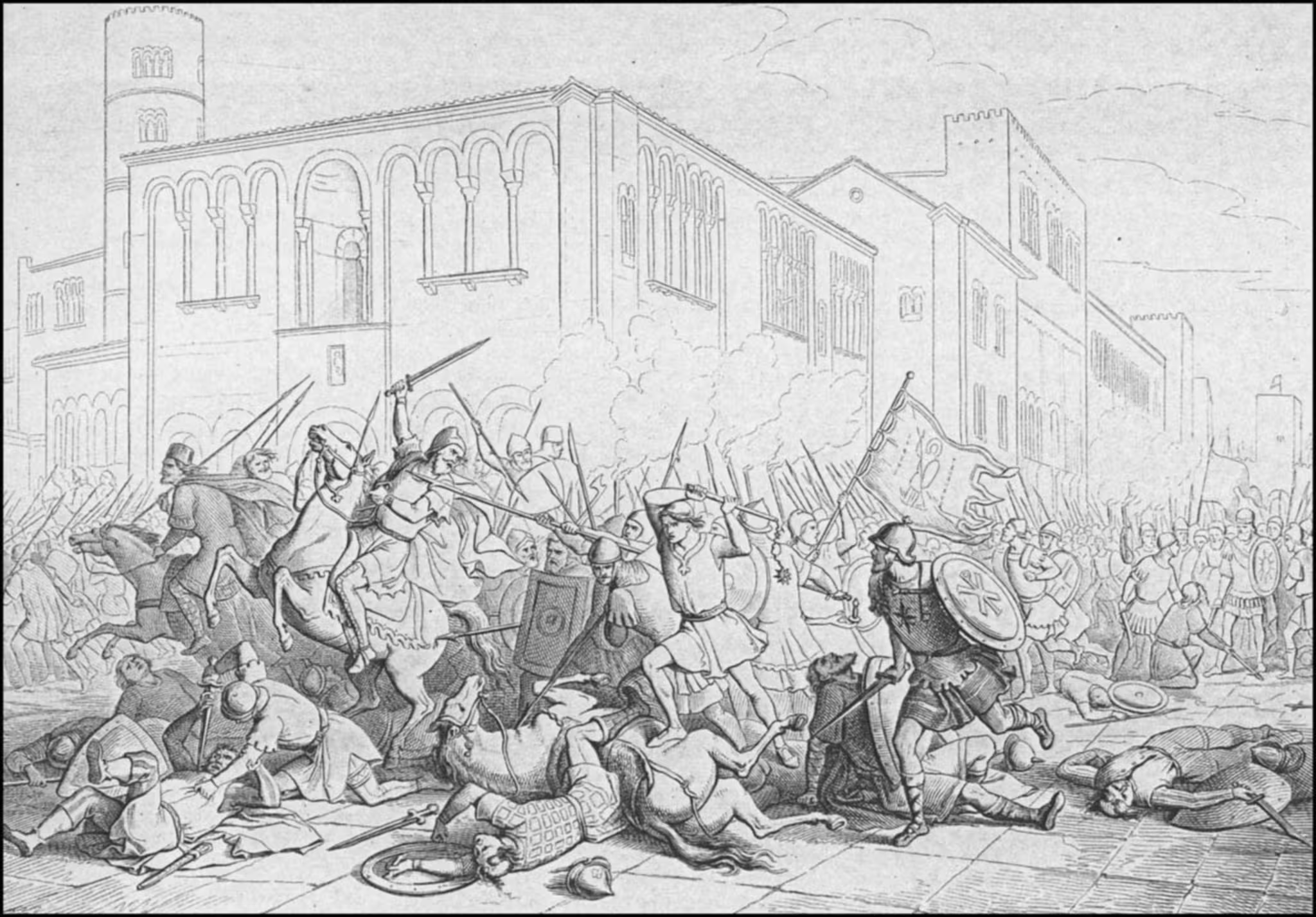
No contemporary — or even near contemporary — images of Ursus exists. The earliest are from the 1500s, and therefore entirely fictitious.
The drawing at the top of this page is a romanticised illustration of the Venetian attack on Ravenna, supposedly led by duke Ursus, by Giuseppe Gatteri (1829-1884).
Sources
Below are translations of the main primary sources we have for the life of duke Ursus Hypatos.
John the Deacon
The oldest extant source is the Istoria Veneticorum by John the Deacon, written around the year 1000. He wrote:
At the same time, the mentioned duke Marcellus died, who had governed the duchy at the New City of Venice for eighteen years and twenty days, succeeded by duke Ursus, who had also ruled the aforementioned duchy in the same city for eleven years and five months. Whereupon later the Venetians, killing him with bitter jealousy, wished that for a period of five years they should remain subject only to the military commanders.
Istoria Veneticorum, II.11.
The source for the title hypatos is this:
At the same time, the Venetians, abhorring the esteemed dignity of the prefects, again, as before, chose a duke for themselves, namely Deusdedit, the son of Ursus the hypatos, on the island of Metamauco;
Istoria Veneticorum, II.17.
Chronicon Altinate
The anonymous Chronicon Altinate, of uncertain date, only has one line:
Duke Ursus ruled for 11 years and 5 months.
The source for this is likely John the Deacon.
Most other early medieval sources, which relied on the Altinate — such as Les estoires de Venise by Martino da Canal — are equally terse.
Andrea Dandolo
Doge Andrea Dandolo, writing his Chronica per extensum descripta in the 1340s, had more to say, as he placed the events around the Lombard attack on Ravenna, and the subsequent Venetian intervention, during the reign of Ursus.
These are the relevant chapters of book VII.
Duke Ursus was confirmed in the year of our Lord Jesus Christ, 726. Here, the Heraclean nobleman, having been appointed duke in Heraclea, greatly enhanced the glory of the nation through illustrious deeds, yet he faced a perilous end, as the subsequent accounts will show.
At that time, Liutprand besieged Ravenna, attacked and destroyed Classe, and after a long siege, Hildeprand, the king’s nephew, and Peredeo, the duke of Vicenza, took possession of Ravenna; however, the exarch, escaping the fury of the Lombards, took refuge safely in Venice. And therefore, Pope Gregory, agreeing with him, wrote two letters of the following tenor for the patriarch and the duke.
“Bishop Gregory, servant of the servants of God, to the beloved son Ursus, Duke of Venice, etcetera.
Because, through sin, the city of Ravenna, which was the foremost of all, was captured by the unspeakable people of the Lombards, and our distinguished son, the lord exarch, as we have learned, is staying in Venice, your nobility ought to adhere to him, and with him, in our stead, contend together, so that the city of Ravenna may be restored to its former state in the holy service of the republic and imperial service of our lords and sons, Leo and Constantine, the great emperors, so that, with zeal and love for our holy faith, we may remain steadfast in the state of service to the republic and the empire, with the Lord assisting us.
May God keep you safe, my dear son.”
But the Duke, with the Venetians, inflamed with zeal for the faith, hastening to Ravenna with a naval army, attacked the city, and captured Hildeprand, the king’s nephew, and killed Peredeo, the duke of Vicenza, fighting valiantly: and, once the city had been obtained, restored the exarch to his seat. Indeed, the honesty and loyalty of the Venetians are commendable, attested by the testimony of Paul, historian of the deeds of the Lombards.
Chronica per extensum descripta, VII.3.1–4.
And finally:
This Duke Ursus, after having held the duchy for eleven years and five months, was treacherously killed amid civil wars that had arisen among the Venetians.
Chronica per extensum descripta, VII.3.13.
Bibliography
- Cessi, Roberto. Origo civitatum Italie seu Venetiarum : (Chronicon Altinate et Chronicon Gradense) in Fonti per la storia d'Italia / pubblicate dall'Istituto storico italiano ; 73. Roma : Tipografia del Senato, 1933. [more]
- Dandolo, Andrea and Ester Pastorello. Chronica per extensum descripta in Rerum Italicarum scriptores : raccolta degli storici italiani dal Cinquecento al Millecinquecento / ordinata da L. A. Muratori , 12.1. Bologna : N. Zanichelli, 1938-1958. [more] 🔗
- Iohannes : Diaconus Venetus. Chronicon Venetum omnium quae circumferuntur vetustissimum et Johanni Sagornino vulgo tributum e mss. codice Apostoli Zeno V. Cl. nunc primum cum mss. codicibus Vaticanis collatum, notisque illustratum in lucem profert H. Fr. Zanetti Al. F. Venetiis, 1765. [more] 🔗
- Iohannes : Diaconus Venetus and Luigi Andrea Berto. Istoria Veneticorum. Bologna Zanichelli, 1999. [more] 🔗
- Monticolo, Giovanni. Cronache veneziane antichissime. Roma, Forzani e C. tipografi del Senato, 1890. [more] 🔗
- Rossi, Antonio, Giovanni Galvani, Martino : da Canale and Emmanuele Antonio Cicogna. La Cronaca veneta detta Altinate di autore anonimo, in latino, preceduta da un commentario del prof. Antonio Rossi e La cronaca dei Veneziani del maestro Martino da Canale, nell'antico francese, colla corrispondente versione italiana del conte Giovanni Galvani e con annotazioni di Emmanuele Cicogna … [et al.]. Firenze : Gio. Pietro Vieusseux, 1845. [more] 🔗

Leave a Reply