The invasion of the Lombards in 568 was only the start of their conquest of much of Italy. It was, however, not a centrally planned process, and it would take almost a century before Byzantine Venetia was under Lombard rule, and then some smaller bits still eluded them.
The Lombard migration appears to have mostly followed the main consular roads between the Roman cities, at a distance from the more swampy coastal areas adjacent to the lagoons.
Consequently, the cities first occupied by the invaders were along those roads, while other towns, either closer to the lagoons or easy to pass by, were left alone.
The route of the Lombards went from Forum Iulii — now Cividale del Friuli — to Aquileia — the seat of the patriarch of Roman and Byzantine Venetia et Histria — and onwards to Treviso, Ceneda — which is now Vittorio Veneto — and then inland towards Vicenza and Verona.
The following year, the Lombards proceeded into the Roman province of Liguria — much of which is now called Lombardy after the same Lombards, who later made it the centre of their kingdom.
The remains of Venetia
Following the route from Friuli to Lombardy, the bulk of the Lombard migration bypassed important parts of Venetia et Histria.
The peninsula of Istria — now in Croatia — remained Byzantine.
Likewise, the entire coastal part of Venetia was left alone, all the way down to the Po river.
The city of Opitergium — modern-day Oderzo — was not attacked. It is now a small town of 20,000 inhabitants, but at the time it was the centre of Byzantine administration in Venetia and an important bishopric.
Over a century earlier, in 452, the Huns under their ruler Attila had invaded Italy. The city of Aquileia was then the capital of Venetia et Histria, and it resisted the Huns valiantly, but was taken. Consequently, Attila had the city sacked and burned to the ground.
Aquileia remained the centre of the Christian Church in the old province, with the seat of the patriarch, but civil administration was split. After the Romans re-established control of the province, Histria was governed from Forum Iulii and Venetia from Opitergium.
Therefore, at the time of the Lombard invasion, the Byzantine Dux Venetiarum — the governor — resided in Opitergium.
Moving westwards towards Liguria, the Lombards left much of southern Venetia alone.
The ancient Roman city of Patavium — modern-day Padua — was left behind as the Lombards moved on, and so was Monselice further south, and Mantua on a strategic crossing of the Po river.
These cities formed an initial Byzantine defensive line in the area.
The continued conquest
For the next several decades, the Lombard conquest of northern and central Italy continued, but they didn’t move on that defensive line in Venetia.
During the 570s, they moved from the north-east to the north-west — current Lombardy and Piedmont — and then down the Po valley, having crossed the river upstream.
Part of the Lombards moved into Tuscany, while others moved down the Via Emilia — the ancient Roman road on the southern side of the Po valley. Here they took Parma, Modena, Bologna, Imola and many other important cities.
The Byzantines, seeing the Lombards close in on both Rome and Ravenna, but unable to stop them, called on the Franks to help.
During the 580s, Frankish kings invaded Italy twice, but without much success.
Alboin, the Lombard king, who had led the initial invasion, was assassinated by his own, instigated by his wife, in 572, and his successor died a few years later, after which came a ten-year period without a king.
The continued Lombard conquest was therefore often the local Lombard dukes trying to expand their territories, without a grand plan.
The invaders
When they arrived in Italy, the Lombards weren’t just an army on the march.
They were an entire people, with men, women, children, slaves, animals and all their belongings loaded on carts and carried by beasts of burden.
We don’t know exactly how many they were, but something in the range from 150 to 200,000.
Paul the Deacon mentioned the Saxons, as a non-dominant subgroup of the invaders, being 50,000.
The Lombards must have been many more than that, and then there were others in the train too, such as Gepids, Ostrogoth stragglers and whatnot.
It was both a military invasion and a migration of an entire people, searching for fertile lands to occupy.
When they crossed the border in 568, the train must have been tens of kilometres long. Luckily for them, the Romans had built good roads.
A wounded country
Byzantium was an empire, a superpower of its time, and yet they couldn’t stop the Lombards.
The main reason was that the Italian peninsula was worn down by decades of war and plague.
Our main source for these events, Paul the Deacon, was very explicit.
The Romans had then no courage to resist because the pestilence which occurred at the time of Narses had destroyed very many in Liguria and Venetia, and after the year of plenty of which we spoke, a great famine attacked and devastated all Italy.
Historia Langobardorum, II.26.
He also left a vivid description of the effects of the plague.
After the lapse of a year indeed there began to appear in the groins of men and in other rather delicate places, a swelling of the glands, after the manner of a nut or a date, presently followed by an unbearable fever, so that upon the third day the man died. But if any one should pass over the third day he had a hope of living.
Historia Langobardorum, II.4
His description sounds exactly like bubonic plague, and recent research into the DNA of victims of these epidemics has confirmed that the Justinian plague was yersinia pestis.
The effects of the pestilence were much like in the Middle Ages.
For as common report had it that those who fled would avoid the plague, the dwellings were left deserted by their inhabitants, and the dogs only kept house. The flocks remained alone in the pastures with no shepherd at hand. You might see villas or fortified places lately filled with crowds of men, and on the next day, all had departed and everything was in utter silence.
Sons fled, leaving the corpses of their parents unburied; parents forgetful of their duty abandoned their children in raging fever. If by chance long-standing affection constrained any one to bury his near relative, he remained himself unburied, and while he was performing the funeral rites he perished; while he offered obsequies to the dead, his own corpse remained without obsequies.
You might see the world brought back to its ancient silence : no voice in the field ; no whistling of shepherds ; no lying in wait of wild beasts among the cattle; no harm to domestic fowls.
The crops, outliving the time of the harvest, awaited the reaper untouched; the vineyard with its fallen leaves and its shining grapes remained undisturbed while winter came on ; a trumpet as of warriors resounded through the hours of the night and day ; something like the murmur of an army was heard by many ; there were no footsteps of passers by, no murderer was seen, yet the corpses of the dead were more than the eyes could discern ; pastoral places had been turned into a sepulchre for men, and human habitations had become places of refuge for wild beasts.
Historia Langobardorum, II.4
All this in Byzantine Italy, under the rule of Narses in the 560s, but it never touched the Lombards or their allies.
And these evils happened to the Romans only and within Italy alone, up to the boundaries of the nations of the Alamanni and the Bavarians.
ibid.
For the Byzantine patrician Narses and his successors, they had far fewer men to call to arms, and far fewer resources to feed them and keep them mobilised.
The Exarchate of Ravenna
The work of Narses in the 550s and 560s to create a Byzantine prefecture of Italy was mostly for nothing, due to the Lombards and their swift conquest of half the peninsula.
The Byzantine organisation of Italy got the rather unusual form of the Exarchate of Ravenna, which was officially created in 584.
The Exarchate was largely a military organisation, intended to defend the territories. The Exarch was a kind of vice-emperor for Byzantine Italy, and had wide-ranging powers, both to wage war and make peace.
The turbulent times meant that so few documents from the Exarchate has survived, that we can’t even reconstruct a complete and reliable list of the exarchs.
In the few surviving documents, almost all men were considered soldiers. Men were designated as miles, soldiers, organised into numeri and bandi (regiments).
By the 590s, the main Byzantine possessions were in the south, where the Lombards didn’t arrive, so Puglia (the heel of Italy), Calabria (the toe), the islands of Sicily, Sardinia and Corsica were firmly under Byzantine control.
On the western side of the peninsula, the areas around Naples and Rome remained Byzantine, while on the eastern side, the capital of Ravenna was flanked by the Pentapolis (the five cities) on the south, and the coastal parts of Venetia north of the Po estuary.
The titles Dux — whence the Venetian title of Doge originated — and Magister Militum appear to have been used almost interchangeably, for a leader with a military command over a designated territory. Besides the Dux of Venetia, there were Byzantine dukes in the Pentapolis, in Rome and in Naples.
The defensive line
From 590 or 591, the king Agilulf of the Lombards saw off the Frankish threats, made peace with the Pope in Rome, fought off the Avars and Slavs from the east, and also established a ceasefire with the Exarchate.
However, the ceasefire was broken in 599, when troops from the Exarchate captured his daughter, along with her husband, in Parma.
Since Parma was formally taken by the Lombards in the early 570s, it is a sign of how fluid the borders were between the various dominions.
Agilulf reacted by attacking the remaining Byzantine strongholds in Venetia, which fell one after another.
In 601, Padua was taken and thoroughly sacked. Paul the Deacon described it this way.
Up to this time the city of Patavium had rebelled against the Langobards, the soldiers resisting very bravely. But at last when fire was thrown into it, it was all consumed by the devouring flames and was razed to the ground by command of king Agilulf. The soldiers, however, who were in it were allowed to return to Ravenna.
Historia Langobardorum, IV.23
The quotes from the Historia Langobardorum are from the translation by William Dudley Foulke, but he got one word wrong here.
Paul the Deacon used the verb rebellavit, which can mean that the city rebelled, but it can also mean that it “waged war again”, literally to ‘re-war’.
Foulke translated it in the first meaning, while Paul the Deacon no doubt intended the other.
Padua could not rebel against the Lombards, as the invaders hadn’t conquered the city yet. Furthermore, the soldiers defending it weren’t Lombards, but Romans, as Paul made clear. They couldn’t return to Ravenna if they were Lombards.
The year after the conquest of Padua, in 602, Monselice fell to the Lombards, and the following year, in 603, Mantua likewise.
Following these setbacks, and with a change of emperor in Constantinople, and a change of exarch in Ravenna, in 605 a peace deal was struck.
All this coincided with the start of the Byzantine–Sassanian Wars, which lasted almost three decades and brought both empires to the brink of collapse. Consequently, Constantinople had few resources to throw at the Lombards, and settled for a co-existence of some kind.
Venetia Maritima
The loss of the important cities of Padua, Monselice and Mantua left Byzantine Venetia even further reduced, with Opitergium, Concordia and Altinus as the only major cities still under the control of the Exarchate.
Venetia was reduced to just the coastal parts, the Venetia Maritima.
The fall of Concordia, in 616, left Opitergium isolated.
The next major blows came during the reign of king Rothari, who ruled the Lombards from 636 to 652.
Sometimes between 639 and 641, Rothari took and sacked the former Byzantine administrative centre of Opitergium, but apparently he didn’t keep it.
Altinus, on the edge of the Venetian lagoon, was likewise taken and sacked at the same time.
What exactly happened in Opitergium around 640 is not clear from the sources. The confusion arises because Paul the Deacon wrote that king Grimuald, who ruled the Lombards from 662 to 671, took and destroyed the city again in 667.
Either the Byzantines retook the city sometimes after 641, but no sources report such an event, or the attack on the city by Rothari was more a raid than a conquest.
What is certain, is that after 667, with the definitive Byzantine loss of Opitergium, there were no longer any mainland cities held by the Exarchate.
The birth of Venice
By the late 600s, the only remaining Byzantine territories were the lagoons from Grado to Cavarzere, an area of approximately 130 by 15km, of mostly mud and marsh.
These marshes and lagoons — called the dogado — were the only bit of Roman and Byzantine Venetia which escaped the Lombards. Later, the Franks would fail to take it, and an ever weaker Eastern Empire fail to hold on to it, leading to a semi-independent little state, which then grew into the Republic of Venice.
Early Venetian sources recount how the Venetians from the mainland, pushed by the Lombard conquest, migrated into the settlements in the lagoons, and created a new, maritime Venetia.
Illustration
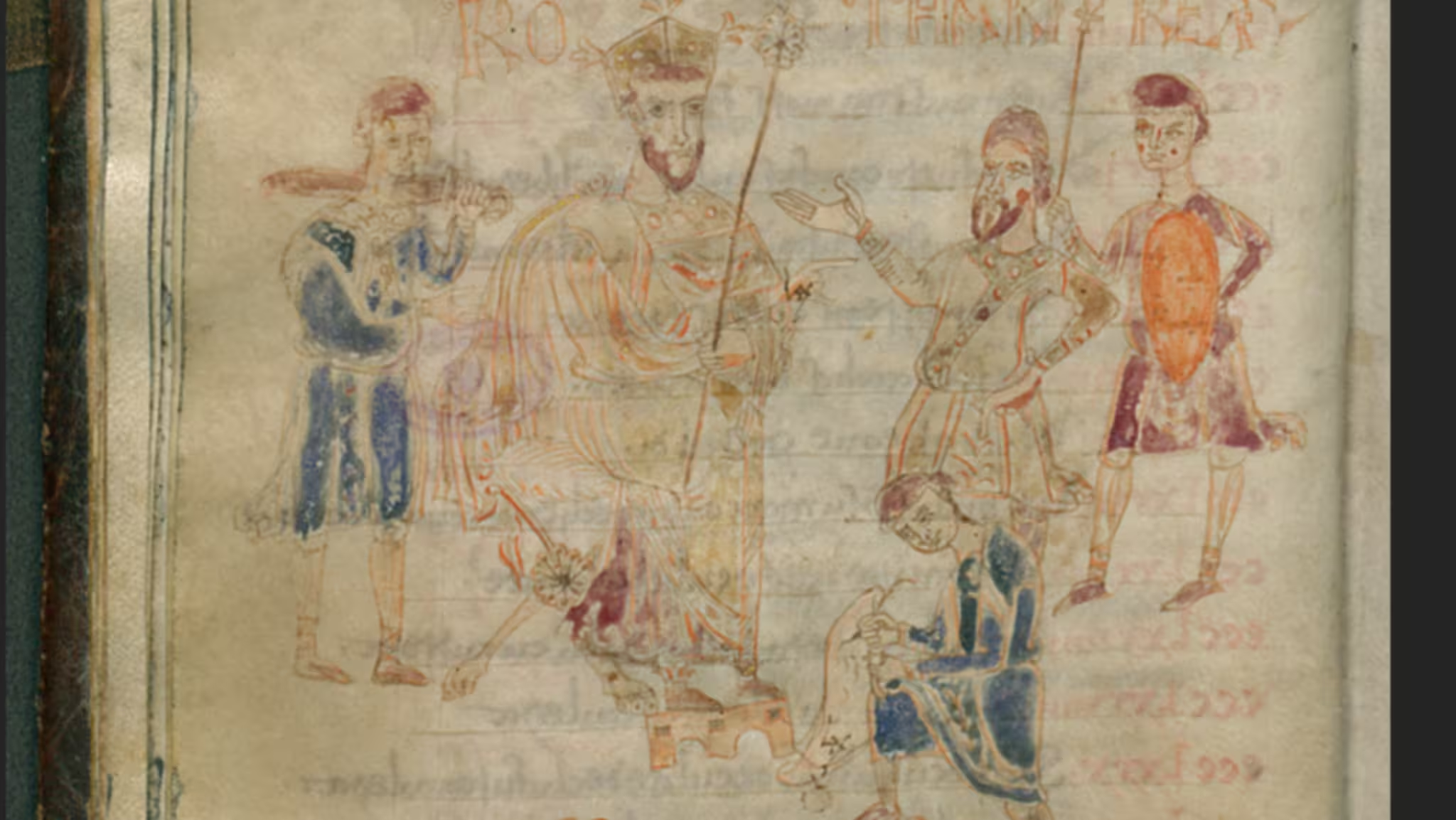
The illustration at the top of the page is a depiction of king Rothari of the Lombards, from a Codex legum Langobardorum — a Codex of the laws of the Lombards — from 1005. The manuscript is held in the Abbazia della Santissima Trinità, Cava dei Tirreni, Campania, Cod. 4, foglio 15v (Rothari rex).
Bibliography
- Cessi, Roberto. Origo civitatum Italie seu Venetiarum : (Chronicon Altinate et Chronicon Gradense) in Fonti per la storia d'Italia / pubblicate dall'Istituto storico italiano ; 73. Roma : Tipografia del Senato, 1933. [more]
- Fedalto, Giorgio. Le origini della città di Venezia tra antiche fonti e recente storiografia in Antichità Altoadriatiche XXXVI (1990). Aquileia e l'Arco Adriatico. EUT Edizioni Università di Trieste, Trieste, 1990. [more] 🔗
- Gasparri, Stefano and Sauro Gelichi. Le isole del rifugio : Venezia prima di Venezia. Bari, Laterza, 2024. [more]
- Iohannes : Diaconus Venetus and Luigi Andrea Berto. Istoria Veneticorum. Bologna Zanichelli, 1999. [more] 🔗
- Monticolo, Giovanni. Cronache veneziane antichissime. Roma, Forzani e C. tipografi del Senato, 1890. [more] 🔗
- Paulus : Diaconus and William Dudley Foulke (translator). History of the Langobards. New York Longmans, Green & Co., 1907. [more] 🔗
- Paulus : Diaconus, Antonio Zanella (translator) and Bruno Luiselli. Storia dei longobardi. Milano BUR, 2000 (6th ed.). [more]
- Rossi, Antonio, Giovanni Galvani, Martino : da Canale and Emmanuele Antonio Cicogna. La Cronaca veneta detta Altinate di autore anonimo, in latino, preceduta da un commentario del prof. Antonio Rossi e La cronaca dei Veneziani del maestro Martino da Canale, nell'antico francese, colla corrispondente versione italiana del conte Giovanni Galvani e con annotazioni di Emmanuele Cicogna … [et al.]. Firenze : Gio. Pietro Vieusseux, 1845. [more] 🔗
Leave a Reply