

The black plague — or bubonic plague — is caused by a bacterium, yersinia pestis. It is one of the most virulent diseases in the world.
Yersinia pestis has caused three pandemics in known history. The first was the Justinian plague in the 500s, named after the Byzantine emperor at the time. We don’t have exact numbers, but most likely tens of millions died in and around the Byzantine Empire, and the Italian peninsula was particularly hard hit. The Lombard chronicler Paul the Deacon has left a vivid description of the impact of the plague in early Medieval Italy.
The second pandemic of the plague started in 1348 in Europe, and would over half a century kill half the population of the continent. The plague remained endemic in Europe until the late 1700s, with recurring outbreaks here and there.
Venice saw repeated outbreaks throughout the second half of the 1300s, and all the 1400s, but only one major epidemic in the 1500s, one in the 1600s, and none in the 1700s. This is quite a testament to the efficacy of the Venetian Lazzaretti and the preventive measure the Republic of Venice developed.
The last outbreak in Venice was in 1793 on the island of Poveglia – or Lazzaretto Nuovissimo.
Finally, the third and last plague pandemic struck in south-east Asia in the 1890s, and spread through much of South Asia and eastern Africa. Here, too, the victims were tens of millions.
The disease
The usual way of contracting yersinia pestis is through the blood, most commonly by insect bites. Fleas and mosquitoes were therefore the main carries of the contagion.
The infection has an incubation period of between a few days and a week.
Initially, the bacterium settles in the lymph nodes, in the armpits and in the groin. They swell, and can become the size of chicken eggs. These swollen lymph nodes were often called buboes or tumours.
This phase has given the disease the name Bubonic plague.
If the infected person’s immune system can overcome the infection, it happens at this point. The swelling subsides, the fever falls, and after a while the infection passes, leaving no other marks than the psychological scars.
In the unfortunate case, the infection spreads from the lymph nodes into the blood stream, leading to sepsis. With the infection present all over the body, if the disease doesn’t kill the victim, their own immune system will, as it goes into overdrive and eliminates cells at random.
During the last, fatal phase of the infection, necrosis often sets in. As the body struggles to contain the infection, it sacrifices the extremities, which suffer widespread cell death. Fingers, toes, and sometimes the nose and the lips, go black as necrosis sets in. Death usually follows shortly after.
This last phase has earned yersinia pestis the name Black plague.
The two names are therefore the same disease, but refer to two separate phases of the infection.
The entire process, from the swollen lymph nodes until death, can take a few days, or a week, depending on the strain of the bacterium.
Pneumonic plague
It is also possible to contract the plague through the lungs. Infected droplets, from coughs or sneezes of an already infected person, can enter the lungs of another individual.
Pneumonic plague is very fast, and normally always fatal.
Fatality and survival
Getting an infection of yersinia pestis wasn’t an automatic death sentence.
On average, in the absence of any efficient treatment, between forty and fifty percent of the infected die.

In comparison, untreated COVID-19 has a case fatality rate of one to two percent.
Being a bacterium, yersinia pestis can be treated with antibiotics, as long as it happens in an early stage.
The human body is incapable of developing lasting immunity to yersinia pestis, and it is therefore possible to get it several times. There is, however, some short-term protection, which might be how epidemics like the ones in Venice in 1575–77 and in 1630–31 ran out of steam. Once the bacterium had touched almost everybody, if could no longer find new receptive victims.
Rats and other rodents
We tend to associate the plague with rats.
However, the real vectors of transmission are fleas and mosquitoes. By biting several individuals in turn, whether human or animal, they can move minute quantities of blood between them, and with that also the bacterium.
The role of rats and other rodents in the spread of the disease was another.
While humans often die of the plague, many species of rodents don’t. They can live with the bacterium in their bloodstream without getting sick.
It would take a bite of a rat to contract the disease directly from an infected, but otherwise healthy, animal, and such bites are not very common.
The populations of rats, however, served as a reservoir for the bacterium, where it could linger between outbreaks. When the bacterium had burned though most of the population, and it failed to find new human victims, it could survive in the blood of the rats, and come back again much later.
The decline of the plague
During the first half of the 1700s, the numbers of cases diminished slowly but consistently, not only in Venice, but throughout Europe. The last major outbreak was in 1720, in Marseilles and Provence in France.
The reasons for the decline of the plague in Europe is not entirely clear.
There are several possible explanations, which are not mutually exclusive, so there might very well be more than one valid reason.
The main means of spreading of the plague was through fleas and mosquitoes, which carried the infection from one individual to another, animal or human.
One way the bacterium persisted between outbreaks, was that it found refuge in populations of rodents, in particular rats. Many rodents can live with yersinia pestis in their bloodstream, without getting sick.
The rats in the cities and in the ships didn’t spread the disease directly, but they served as a reservoir where the plague bacterium could linger.
The black Mediterranean rat was very common, and could live with the bacterium.
In the 1700s, shipping in the Atlantic brought the grey Norwegian rat into the Mediterranean. It is an aggressive beast, which doesn’t tolerate rats from other species in its habitat. It will straight out attack and kill black rats, if they live in the same space.
The grey rat therefore slowly replaced the black rat in much of the Mediterranean, starting in the western half.
There is, however, an important difference between the two species of rats. In contrast to the black rat, the grey rat dies of the plague.
This could have been a factor in the decline of the plague in the 1700s.
While the population of black rats formed a stable reservoir for yersinia pestis, the grey rat population didn’t. An infected black rat could do a month-long journey from one end of the Mediterranean to the other, carrying the bacterium in its blood. An infected grey rat would be dead in a week, and no longer serve as a vehicle for the contagion.
Another factor could be the stringent isolation of the sick and quarantining of the suspect, which, following Venice’s lead, became the norm in Europe in the 1600s and 1700s.
Isolation and quarantining limited the spread of the disease, making it harder for the bacterium to find new victims to infect and kill.
Finally, genetic factors might have had a role.
Some people appear more likely than others to get the infection, and the repeated epidemics would have given an evolutionary advantage to those who were genetically less susceptible. At some point, they would make up the larger part of the population, and the plague would have a harder time spreading.
This might also explain why the plague is no longer present in Europe, while it still exists in other parts of the world. The Europeans of today are the descendants of those who made it through three centuries of plague epidemics, effectively cleansing the gene pool of those more likely to develop the disease.
Genetic factors could also have played a role on the side of the bacterium. Yersinia pestis would undergo mutations too, and less virulent strains might have come to dominate in the 1700s.
None of these possibilities are mutually exclusive. They might all have played a role in the decline of the plague in Europe in the 1700s.
But, whatever the reasons, the numbers were falling and the cases ever rarer. By the end of the 1700s, cases were very uncommon.
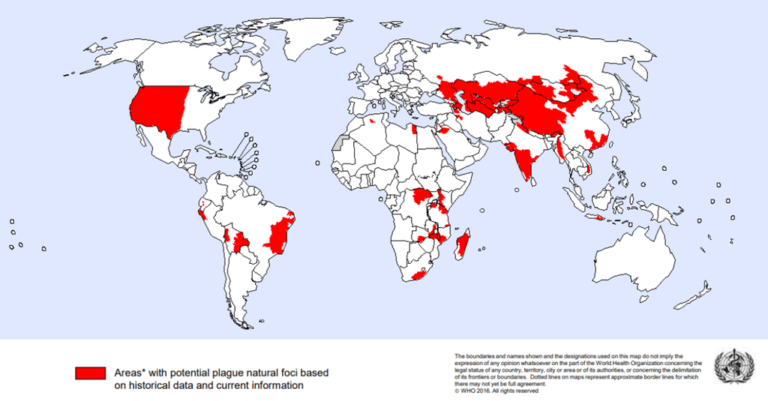
Uncommon in Europe, that is. The plague is still a problem in other parts of the world, such as in Madagascar, in Mongolia and in the USA.
Related articles
- The Venetian Lazzaretti
- Lazzaretto Vecchio
- Lazzaretto Nuovo – the first quarantine station
- Poveglia – more than ghost stories
- Quarantine – forty days of isolation
- The word Lazzaretto
- Festa del Redentore
Venetian Stories
- Episode 17 — Venice and the plague – part 1
- Episode 18 — Venice and the plague – part 2
- Episode 19 — Venice and the plague – part 3
- Episode 20 — Venice and the plague – part 4
- Episode 21 — The Plague Doctor
- 404 Doctor Not Found
- The Plague Stone of Poveglia
- Lazzaretto Vecchio – six centuries
- Remembering the plague
Related sources
- The Justinian plague — Historia Langobardorum
- The start of the plague in 1575 — Cornelio Morello (1584)
- Francesco Sansovino — Venetia Descritta (1581)
- The plague in Verona, 1630 — Francesco Pona
- Capitoli Da osservarsi nelli Lazaretti — 1674
- Provveditori e Sopraprovveditori alla Sanità — ASV Indice
- Provveditori sopra la Sanità — Lessico Veneto
- Sanità — Dizionario
E-book
- Latest news from Venice, 1576 — an eyewitness account of the plague in 1575–1577 (e-book, PDF, online).
Related images


- Protomedico — Chief Physician — Grevembroch 2-160
- Medico Industrioso — Industrious Doctor — Grevembroch 2–161
- Custodia gelosa — Zealous custodian — Grevembroch 4–43
Bibliography
- Benedetti, Rocco, Donatella Calabi, Elena Svalduz, Luca Molà and Simone Rauch. Venezia 1576, la peste : una drammatica cronaca del Cinquecento. Venezia Progetto Rialto, 2021. [more] 🔗
- Comune di Venezia: Assessorato alla cultura e belle arti. Venezia e la peste: 1348-1797. Marsilio, 1979. [more] 🔗
- Fazzini, Gerolamo (ed.). Venezia : isola del Lazzaretto Nuovo in Guide archeologiche della Laguna di Venezia. Archeoclub Venezia, 2004. [more]
- Fazzini, Gerolamo (ed.). I Lazzaretti Veneziani : il sistema sanitario della Serenissima contro le epidemie. Marcianum Press, Venezia, 2024. [more]
- Green, Monica H. Plague (Yersinia Pestis) in Encyclopedia of the History of Science, May 2024. 2024. 🔗
- Magistrato alla Sanità. Capitoli Da osservarsi nelli Lazaretti Stabiliti, e decretati Dagl’Illustrissimi, & Eccellentissimi Signori Sopraproveditori, Aggionti, e Proveditori alla Sanità. Venezia, 1674. [more] 🔗
- Pona, Francesco. Il gran contagio di Verona nel milleseicento, e trenta. Descritto da Francesco Pona. In Verona per Bartolomio Merlo. Stampator camerale, 1631. [more] 🔗
- Preto, Paolo. Peste e societa a Venezia nel 1576. Vicenza N. Pozza, 1984. [more] 🔗
- Vanzan Marchini, Nelli-Elena. Guardarsi da chi non si guarda : la Repubblica di Venezia e il controllo delle pandemie. Sommacampagna : Cierre, 2022. [more]
Leave a Reply