
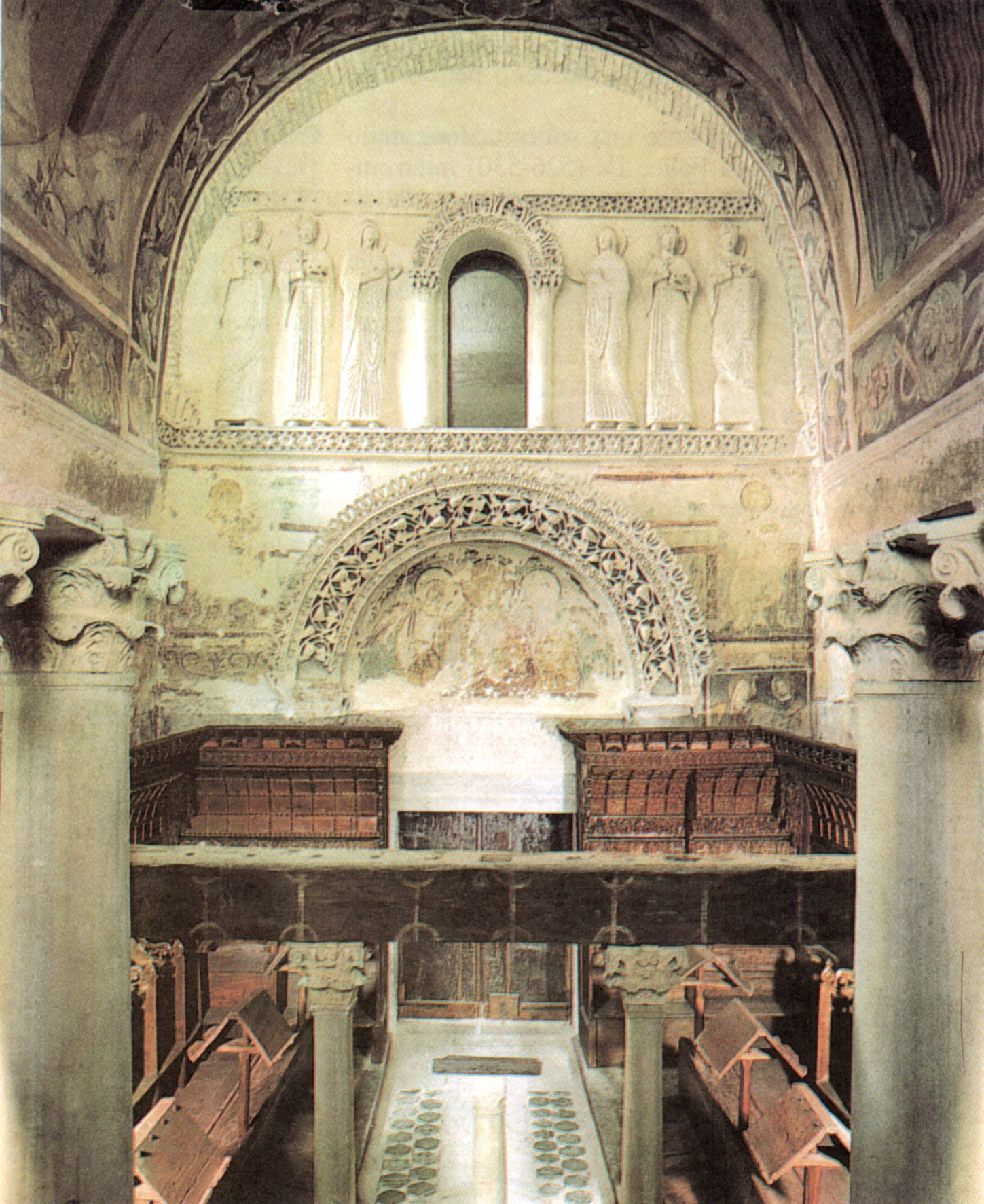
These are some of the main events of the Lombard conquest of Venetia and other parts of Italy.
- 568 — Invasion of Byzantine Venetia by the Lombards under Alboin, who conquered Forum Iulii without any resistance, and established the Duchy of Friuli. The conquest of Ceneda, Treviso, Vicenza and Verona followed, all of which also became Lombard duchies. The only major cities not taken in the initial invasion were Padua, Monselice and Mantua, and probably also Altino and Oderzo — HL II.9–14; IV I.5.
- 569 — The Lombards proceeded into the province of Liguria, and took Bergamo, Brescia, and Milan. The duchies of Torino and Asti were established as a bulwark against the Franks. The siege of Pavia started.
- 570–572 — The cities of Parma, Modena, Bologna, Imola, Lucca, Chiusi, Camerino and Benevento fell to the Lombards.
- 572 — Pavia fell after three years of siege. Later, king Alboin was assassinated in Verona.
- 579 — Faroaldo, duke of Spoleto, occupied Classe outside Ravenna.
- 580 — Perugia fell to the Lombards.
- 580s — The monastery of Montecassino was destroyed.
- 584–585 — A Frankish invasion, which was repulsed.
- 588 — A second Frankish invasion, which failed — HL III.32.
- 601 — Padua in Venetia was sacked and destroyed of under king Agilulf — HL IV.23.
- 602 — Monselice was occupied — HL IV.25.
- 603 — Mantua fell — HL IV.28.
- 604 — After a Lombard attack towards Ravenna, a peace deal was struck with the Byzantine exarch Smaragdus — HL IV.32.
- 605 — The Lombards took Bagnoregio (Viterbo) and Orvieto. The peace treaty with Byzantines was renewed — HL IV.32.
- 606/610/611 — The death of the bishop of Grado, after which the Lombards appointed their own bishop in Aquileia, leading to a permanent schism.
- 616/617 — Death of Gisulf II, Duke of Friuli, whose sons were killed by deceit by the Byzantine exarch Gregory — HL IV.38
- 639/641 — Lombard king Rothari captured and destroyed Oderzo, which had already been abandoned by the Byzantine Dux of the Venetians, and by the bishop. Both moved to the lagoon settlement of Eraclea — HL IV.45; IV I.5
- 639/640 — Altino was taken, and the bishop fled to Torcello in the lagoon — IV I.38
- 642 — Rothari waged war on Ravenna against the exarch Isaac — HL IV.45
- c. 667 — Grimoald destroyed Oderzo (the second time) and divided the territory between the Lombard duchies of Friuli, Treviso and Ceneda — HL V.28
- c.732 — Hildeprand, nephew of Lombard king Liutprand, took Ravenna, and the Venetians helped the exarch retake it, taking Hildeprand prisoner in the fight.
- 735/736 — Hildeprand (who must have been released) was named co-ruler with Liutprand.
- 743 — Liutprand attacked Ravenna, but was stopped by the intercession of the Pope.
- 744 — Liutprand died and was succeeded by Hildeprand, who was quickly deposed and replaced by Ratchis.
- 751 — Aistulf, who had succeeded Ratchis as king of the Lombards, took Ravenna, Ferrara, Comacchio and Istria. The last Byzantine exarch was killed. This marked the end of the Byzantine Exarchate of Ravenna.
- 752 — Aistulf took all the Pentapolis and adjoined it to the Duchy of Spoleto, leaving Venetia Maritima as the only Byzantine territory in the northern half of the Italian peninsula.
- 758/759 — Lombard king Desiderius returned Ferrara and Faenza to the Pope. Evidently, Byzantium is no longer an actor in Italy after the loss of Ravenna.
- 774 — Charlemagne, king of the Franks, conquered Pavia and made himself King of the Lombards. This marked the end of an independent Lombard kingdom.
Notes
Bibliography
- Cessi, Roberto. Origo civitatum Italie seu Venetiarum : (Chronicon Altinate et Chronicon Gradense) in Fonti per la storia d'Italia / pubblicate dall'Istituto storico italiano ; 73. Roma : Tipografia del Senato, 1933. [more]
- Cessi, Roberto. Documenti relativi alla storia di Venezia anteriori al Mille. Padova : Gregoriana, 1940-1942. [more] 🔗
- Iohannes : Diaconus Venetus and Luigi Andrea Berto. Istoria Veneticorum. Bologna Zanichelli, 1999. [more] 🔗
- Paulus : Diaconus and William Dudley Foulke (translator). History of the Langobards. New York Longmans, Green & Co., 1907. [more] 🔗
- Paulus : Diaconus, Antonio Zanella (translator) and Bruno Luiselli. Storia dei longobardi. Milano BUR, 2000 (6th ed.). [more]
- Rossi, Antonio, Giovanni Galvani, Martino : da Canale and Emmanuele Antonio Cicogna. La Cronaca veneta detta Altinate di autore anonimo, in latino, preceduta da un commentario del prof. Antonio Rossi e La cronaca dei Veneziani del maestro Martino da Canale, nell'antico francese, colla corrispondente versione italiana del conte Giovanni Galvani e con annotazioni di Emmanuele Cicogna … [et al.]. Firenze : Gio. Pietro Vieusseux, 1845. [more] 🔗
Leave a Reply