Following the Lombard invasion in 568-569, and the subsequent conquest of Byzantine Venetia, mostly in the first half of the 600s, a part of the Venetian population of the mainland cities fled or left for the settlements in the nearby lagoons.
The lagoons were, by the late 600s, the only part of ancient Venetia, which remained under Byzantine rule.
Barbarians and refugees
It is easy to discuss warfare and conquest in high-level and abstract terms, but the cities and territories where the wars happened, were inhabited by real living persons, most of whom were just trying to get on with their lives the best they could.
Even before the arrival of the Lombards, that wasn’t good. Decades of wars between the Byzantines and the Goths — with several waves of bubonic plague for good order — had left many of the survivors struggling.
Life was hard, and with the invasion, it got harder.
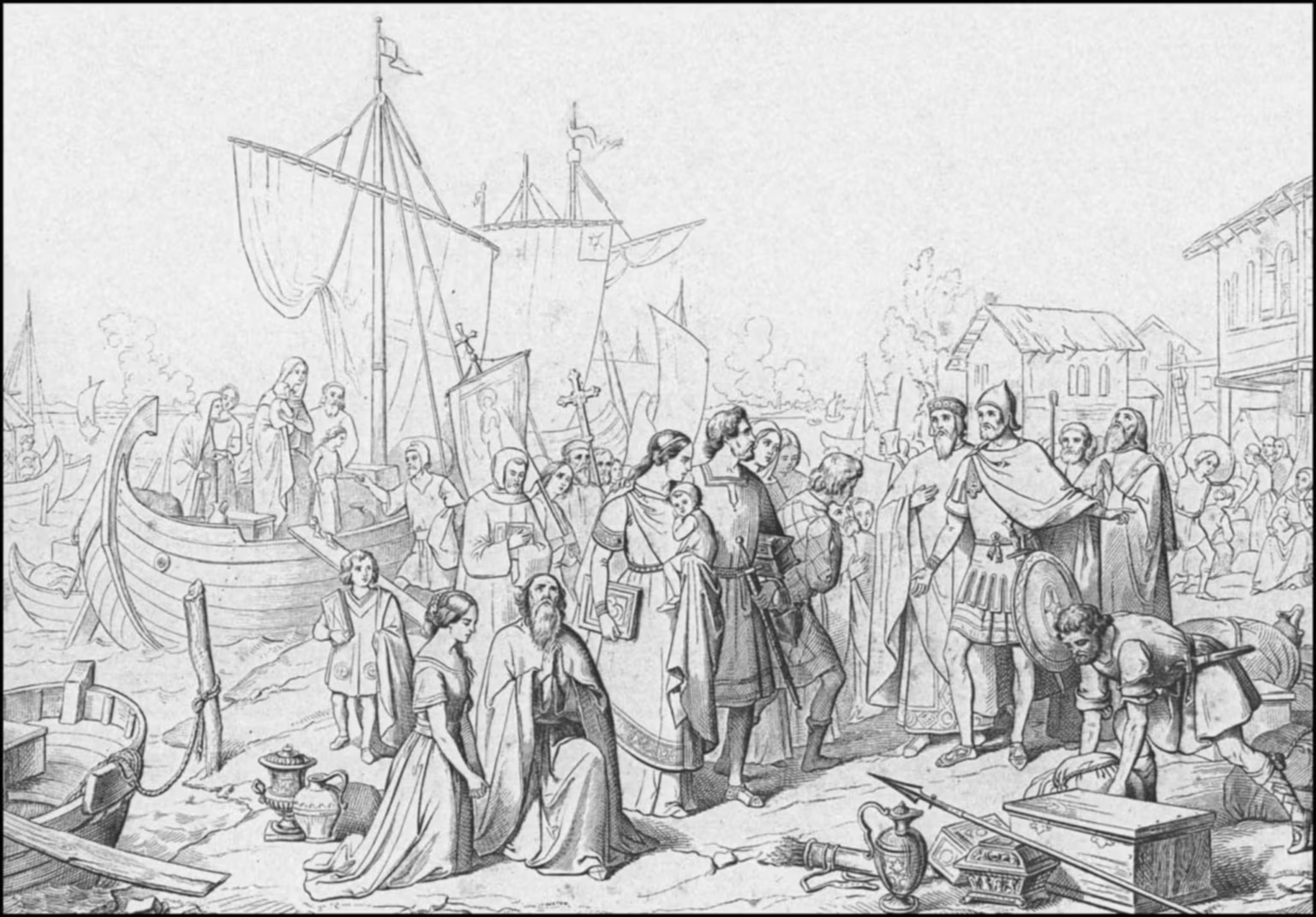
The common story goes that the Venetians fled the mainland cities in front of the marauding barbarians, which quickly leads to images of miserable and destitute refugees fleeing their destroyed and burned down homes with what little they could carry, to head for the safer marshes and start a new life entirely from scratch.
This might very well have happened in some cases, but the Lombards didn’t move to Italy to destroy it.
They, too, wanted the best life they could get, and they migrated to Italy to benefit from the riches of the peninsula, which they wouldn’t do if they destroyed those same riches.
What the Lombards wanted, was to take over a rich and functioning Roman society, as they had seen it when they served in Narses’ army in the 550s, and keep it rich and functioning for their own profit.
They also knew that the epidemics had left Italy short on people, so there would be houses, farms, estates, and opportunities for those who moved in to fill the void. The account of the effects of the plague by Paul the Deacon is of a desolate and destroyed countryside.
If the Lombards largely failed in that project, it wasn’t because they destroyed the riches of the land, but because those riches were already largely gone due to prolonged periods of war and plague, before the Lombards arrived.
The ideal situation for the Lombard invaders was what happened in Treviso in 568.
During the first thrust into Venetia, as the Lombard train crossed the river Piave, the bishop of nearby Treviso came out to meet the Lombard king Alboin. In return for the submission of the city, he re-confirmed all the privileges and rights of the church of Treviso.
Treviso surrendered, and wasn’t destroyed. The head of the church submitted, and the church wasn’t despoiled of everything.
Even in the later phases of the Lombard-Byzantine conflict, few cities were destroyed on purpose.
Paul the Deacon reported that Padua was later burned down, but that was a last means to take the city, not for wanton destruction. Furthermore, he didn’t report of any retaliation against the defenders. On the contrary, the Roman soldiers were allowed to leave, which makes it very unlikely that the inhabitants of the city got a harsher deal.
Archaeological evidence has confirmed a widespread fire in the period, but also that life and trade continued afterwards. During this siege, Padua lost most of the monuments and buildings from the Roman era, as opposed to Verona, where many still stand today.
Opitergium — modern Oderzo — was sacked and destroyed twice, and abandoned by its inhabitants. The reason for this was probably, that it was the administrative capital of Byzantine Venetia, so it was a symbolic act of eradicating Roman rule in the area, so show that the empire was gone for good. Apparently, many had already left the city before its first destruction around 640.
Smaller towns, like Concordia and Altinus, were abandoned, even if we haven’t any reports of destruction or pillaging.
Other factors than the Lombards, such as environmental changes, might have played a role.
The plains between the foothills of the Alps and the Adriatic Sea are naturally marshes, wetlands and meadows. The area only became predominantly agricultural with major drainage works in Roman times, with a capillary network of ditches and canals to remove excess water from the countryside.
Much of the 500s, — and especially the latter half dominated by war, plague and population loss — had seen a decline in the maintenance of the countryside, and therefore a partial return to the natural conditions of the landscape.
Who fled, and why?
The question remains of who fled the Lombards — who clearly weren’t the murderous, ferocious barbarians they’re often depicted as — and why they fled.
Most of the lower classes — which our sources hardly ever mention — had little choice but to remain where they were. Their very existence and survival was bound to the land they farmed or depended on.
The incentive to flee the invaders was much stronger in the higher echelons of society.
Already during the initial invasion, some bishops fled their cities for safer Byzantine territories.
The bishop of Milan fled to Genoa, as the Lombards approached, and in Venetia, the archbishop or patriarch of Aquileia moved to Grado, taking with him the substantial treasure of the See of Aquileia, and declaring the city of Grado to be the New Aquileia.
It is unlikely that there’s a single reason why some bishops fled.
Fear of looting and pillaging might have been a factor. The patriarch of Aquileia hauled all their treasure, relics and valuables, to Grado to keep it safe.
The Lombards were mostly Arian, and some might not have converted to Christianity yet, while the Byzantine world was Orthodox. That difference might have induced some Orthodox church leaders to fear for the worst, and react accordingly.
Also, the bishops were part of the power structure of Byzantine society. They were members of the ruling elite in the late Roman world, and as the Byzantine power structure gave way to the Lombards, it wasn’t a good omen for the people who had governed the old system.
In fact, both the patriarch of Aquileia and the bishop of Milan ran for Byzantine controlled territories.
The leniency, which Alboin publicly showed the bishop of Treviso, might have been to avoid more bishops running for Byzantine lands, as the patriarch of Aquileia had done shortly before.
Treviso was a bit further down the route of the Lombards from Aquileia.
In the following decades, as more and more of the remaining cities of Byzantine Venetia fell to the Lombards, more people moved to the safer — and Byzantine controlled — lagoons.
The first Venetian chronicler, John the Deacon, recounted how numerous bishoprics moved the see from the mainland to the lagoons.
He mentioned Grado — New Aquileia — first.
Then the bishop of Concordia moved to Caorle, and obtained the permission of the Pope to formally move the diocese. Pope Adeodatus I reigned from 615 to 618, so the move happened around the time of the Lombard conquest of Concordia in 616.
Then we have Civitas Nova Heracliana — Eraclea — where the bishop of Opitergium moved. Pope Severinus, who only reigned for 66 days in 640, sanctioned the move, so it must have happened in 640 or shortly before.
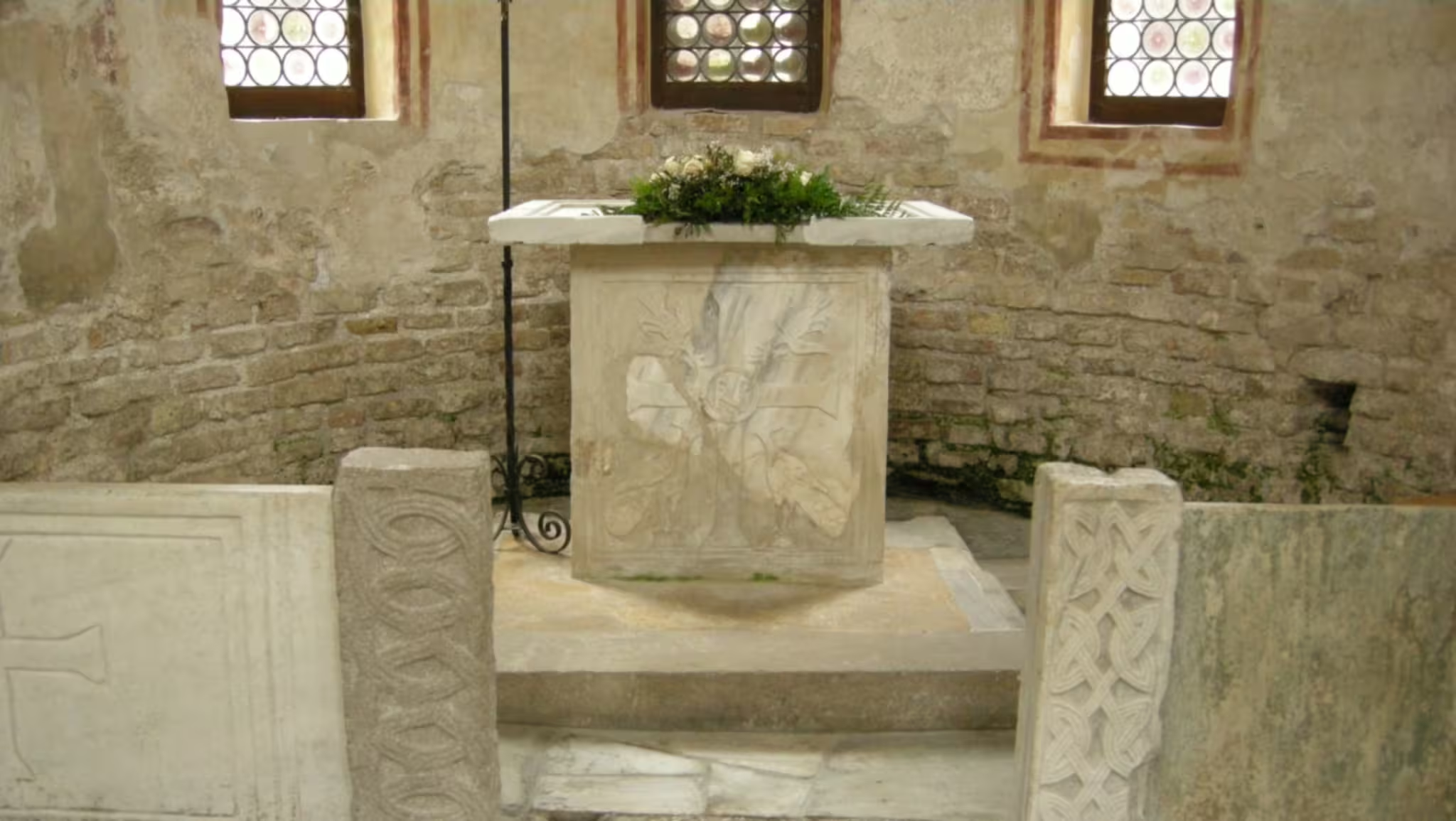
Under the same Pope Severinus, the bishop of Altinus, fearing the “fury of the Lombards”, moved to Torcello. The church of Torcello is slightly earlier, and dates from the 630. It is the oldest extant building in the Venetian lagoon. The church of Sant’Eufemia in Grado, however, is older.
John the Deacon didn’t mention refugees from Padua, and noted that Rivoalto — which was the medieval name for Venice the city — was settled later. In fact, the settlements in what is now Venice didn’t get their own bishop until 774.
Couplets of cities
In this account of bishops fleeing the Lombards, we have several couplets of cities, one on the mainland, one in the lagoons of the time.
Such pairs of cities were nothing odd.
Ancient Athens, situated on an inland hilltop, had its harbour at Piraeus on the coast, but they were two distinct settlements in a symbiotic relationship.
Likewise, ancient Rome, a day’s journey up the river, had its harbour at Ostia in the estuary of the Tiber, just around the first bend of the river.
In Venetia, the important cities near the coast were generally located where the main Roman roads crossed the main rivers. They were therefore often ten to forty kilometres inland from the lagoons or from the sea, and they were all paired with a harbour city close to the estuary of the local river.
This is how we get the pairings of Aquileia-Grado, Concordia-Caorle, Opitergium-Heraclia, Altinus-Torcello, and much later, an imaginary Padua-Rivoalto.
Consequently, the cities in the lagoons where the bishops — and supposedly with them many others — went, were not new cities. They had been there for ages. They were probably there at the time of Cassiodorus, and even earlier because they were the settlements which provided the mother-city up the river with access to the sea.
In the best documented case, that of Aquileia and Grado, we know that Grado was fortified during the invasion of the Huns in the 450s, so Aquileia had a well-defended sibling in the lagoon a century before the Lombards arrived. Not only that, but Grado had probably already existed as a viable settlement for some time, when the Patriarch of Aquileia had the surrounding walls built.
We are therefore not talking about huddles of destitute refugees limping down the road from the smoking ruins of the burned down cities with all their meagre remaining belongings in a bundle over their shoulders. That is a myth, developed later as part of the Venetian national narrative about the origins of the Serenissima.
The Byzantine Venetians simply moved, in good order, along well-trodden — or more likely, well-rowed — routes between two settlements which had always co-existed in a symbiotic relationship. The settlements were siblings, and as the larger town was lost to the Lombards, those who needed to, and could, moved to the smaller settlement, in the lagoon, which was still part of the Byzantine world.
The pair of cities were already there, as separate parts of a single economic and social unit.
The mainland city had an agricultural hinterland, and engaged in trade along the Roman roads and up and down the local river. The lagoon settlement, near the river estuary, connected that economic reality with the sea and long-distance trade around the empire.
As the mainland cities were destroyed or occupied by the Lombards, the bond between the two was broken, leading to change, but eventually, both recalibrated and continued along different paths, as they ended up in different polities.
An important take-away here is, that the Byzantine-Venetian social, political and religious order didn’t break down during this movement. Authority did not collapse, even if it was shaken and reduced.
Yet, this is where the paths taken by the mainland cities and by the lagoon settlements divide, not to rejoin until the 1400s, under Venetian dominance.
The mainland, divided into duchies and city states, became part of the Kingdom of the Lombards, which then morphed into the Carolingian Kingdom of Italy, and finally became part of the Holy Roman Empire, centred in Germany.
The lagoon settlements, from Grado to Cavarzere, remained part of the Byzantine world, centred in Constantinople, and became the Dogado — the Duchy of the Venetians — and later, the Serenissima — the Most Serene Republic of Venice.
The birth of Venice
Therefore, if we want to point to a time and place where Venice was born, this period in the first half of the 600s is probably it.
That was the fork in the road.
The displacement of the Byzantine elite of Venetia from the mainland cities to the coastal lagoon settlements, was the push that started the process which ultimately led to the Republic of Venice and the city we know today.
Bibliography
- Cessi, Roberto. Origo civitatum Italie seu Venetiarum : (Chronicon Altinate et Chronicon Gradense) in Fonti per la storia d'Italia / pubblicate dall'Istituto storico italiano ; 73. Roma : Tipografia del Senato, 1933. [more]
- Fedalto, Giorgio. Le origini della città di Venezia tra antiche fonti e recente storiografia in Antichità Altoadriatiche XXXVI (1990). Aquileia e l'Arco Adriatico. EUT Edizioni Università di Trieste, Trieste, 1990. [more] 🔗
- Gasparri, Stefano and Sauro Gelichi. Le isole del rifugio : Venezia prima di Venezia. Bari Laterza, 2024. [more]
- Iohannes : Diaconus Venetus. Chronicon Venetum omnium quae circumferuntur vetustissimum et Johanni Sagornino vulgo tributum e mss. codice Apostoli Zeno V. Cl. nunc primum cum mss. codicibus Vaticanis collatum, notisque illustratum in lucem profert H. Fr. Zanetti Al. F. Venetiis, 1765. [more] 🔗
- Iohannes : Diaconus Venetus and Luigi Andrea Berto. Istoria Veneticorum. Bologna Zanichelli, 1999. [more] 🔗
- Monticolo, Giovanni. Cronache veneziane antichissime. Roma, Forzani e C. tipografi del Senato, 1890. [more] 🔗
- Paulus : Diaconus and William Dudley Foulke (translator). History of the Langobards. New York Longmans, Green & Co., 1907. [more] 🔗
- Paulus : Diaconus, Antonio Zanella (translator) and Bruno Luiselli. Storia dei longobardi. Milano BUR, 2000 (6th ed.). [more]
- Rossi, Antonio, Giovanni Galvani, Martino : da Canale and Emmanuele Antonio Cicogna. La Cronaca veneta detta Altinate di autore anonimo, in latino, preceduta da un commentario del prof. Antonio Rossi e La cronaca dei Veneziani del maestro Martino da Canale, nell'antico francese, colla corrispondente versione italiana del conte Giovanni Galvani e con annotazioni di Emmanuele Cicogna … [et al.]. Firenze : Gio. Pietro Vieusseux, 1845. [more] 🔗
Leave a Reply