
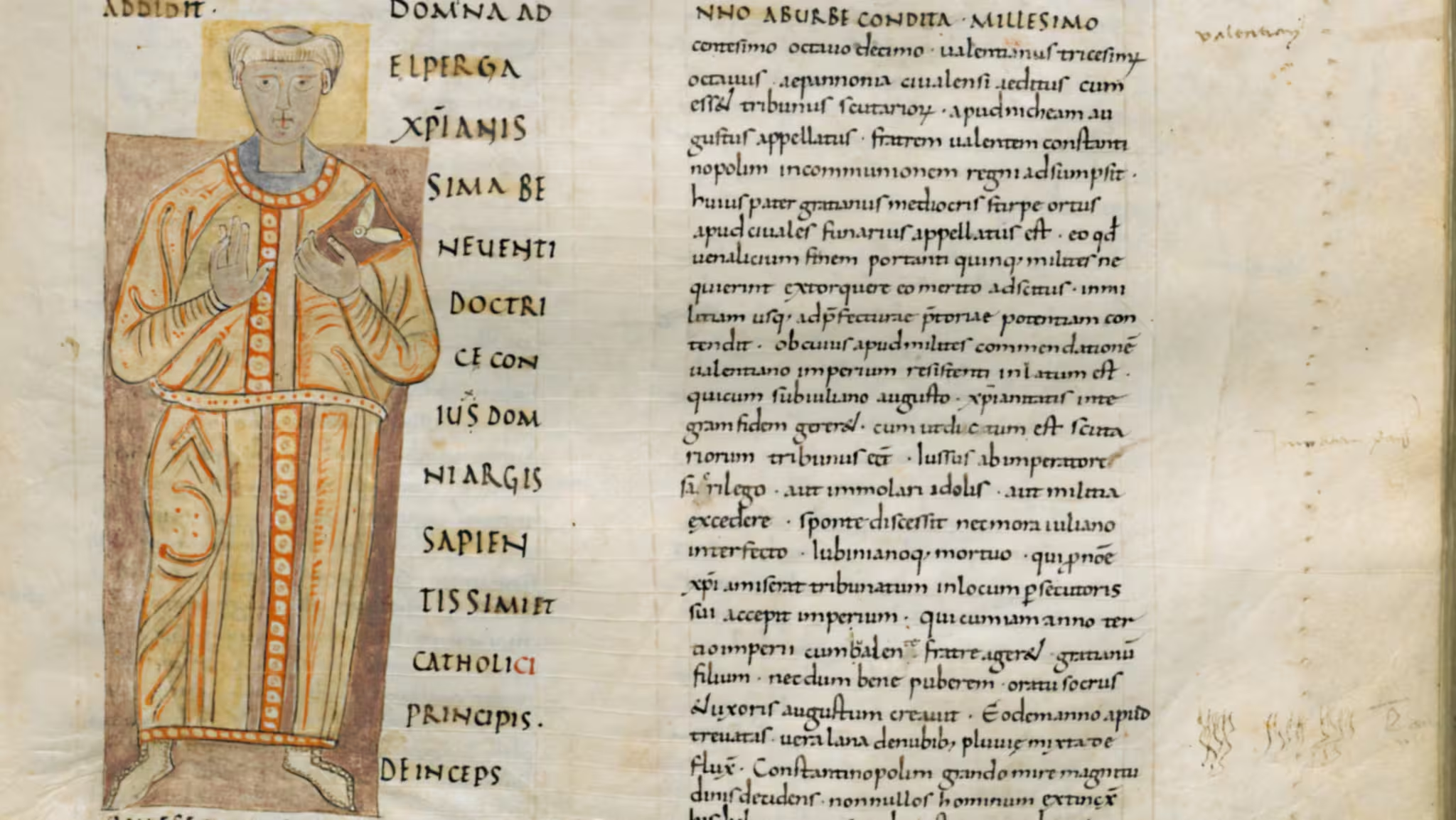
The primary sources for the early history of Venice are — in the nature of things — manuscripts written in Latin, and sometimes in Greek.
They are not easy to approach.
Many are published, and some translated, which is a help for those of us who are not trained medievalists, and, luckily, more and more manuscripts are now digitised, for those who want to see the real thing.
This is a quick overview of the main sources to early Venetian history, with links and references to where they can be found, printed or online, in the original and translated.
This is not meant to be an exhaustive and complete list. Often, only the most recent edition is mentioned, or the easiest available, if choice is scarce.
It is more of a working document for my own studies, but hopefully useful to others too.
Sources from antiquity
— Pliny the Elder
The Naturalis Historia by Pliny the Elder — c. 70s — is a monumental description of the ancient world, and it touches briefly on the Regio X Venetia et Histia and the people who lived there.
- Pliny the Elder on Venetia
- Latin and English: Pliny the Elder (1942).
— Cassiodorus
The Variae Epistolae by Flavius Marcus Aurelius Cassiodorus Senator — c. 537 — is a collection of letters by the praetorian prefect to the Ostrogoth kings of Italy, a few of which are relevant to Venetian history.
- Venetian Stories podcast: Episode 27 — Cassiodorus
- English (condensed translation): Hodgkin (1886).
- English and Latin: Bjornlie (2013). This translation appears in the transcript of the podcast episode.
- English and Latin:
Fontes Istrie medievalis: Cassiodorus, praefectus praetorio.
Lombard sources
— Paul the Deacon
The Historia Langobardorum by Paul the Deacon (Latin Paulus Diaconus, Italian Paolo Diacono) — from 780s or 790s — is a history of the Lombard people from the origins to around 744.
- The Historia Langobardorum by Paul the Deacon
- Latin: Corpus Corporum, based on Waitz (1878).
- English: Paulus : Diaconus et.al. (1907), and others.
- Italian: Paulus : Diaconus et.al. (2000), and many others.
Byzantine sources
— Constantine Porphyrogenitus
The De administrando imperio by the Byzantine emperor Constantine Porphyrogenitus — c. 950 — is a comprehensive manual to running the Byzantine Empire, which briefly touches on the area of Venice.
- The relevant parts for Venice
- English and Greek: Constantine Porphyrogenitus et.al. (1968).
Venetian sources
— Translatio Marci …
The Translatio Marci Evangelistae Venetias by an unknown author — late 900s — describes the translation (movement) of the relics of St Mark from Alexandria in Egypt to Venice in 828.
It is also referred to as Translatio Sancti Marci.
- Original text: Translatio Marci Evangelistae Venetias.
- My translation: Translatio Marci Evangelistae Venetias (English)
- Latin: Mirabile and Corpus Corporum, both based on Colombi (2010).
- Critical edition: Colombi (2010).
— Cronica de singulis patriarchis nove Aquileie
The Cronica de singulis patriarchis Nove Aquileie by an unknown author — late 900s — recounts the story of how the patriarchate moved from Aquileia to Grado, and the subsequent schism.
- Latin: Monticolo (1890), p. 3–16.
— Chronicon Gradense
The Chronicon Gradense by an unknown author — late 900s — is partially derived from the Cronica de singulis patriarchis nove Aquileie, and covers the same topics.
- Latin: Monticolo (1890), p. 17–56.
- Latin: Waitz (1878).
— John the Deacon
The Istoria veneticorum by John the Deacon (Latin: Ioannes Diaconus, Ioannes Venetus; Italian Giovanni Diacono, Giovanni da Venezia) — c.1008 — is the first history of Venice.
It is also called Chronicon Venetum et Gradense and, in older texts, the Chronicon Sagornini due to a mis-attribution. The original doesn’t have a title, and it has been given many names over the centuries, often names which conflict with other sources.
- Critical edition: Monticolo (1890), p. 57–174.
- Critical edition and Italian translation: Iohannes : Diaconus Venetus et.al. (1999).
- Latin text (online, searchable): Corpus Corporum based on Iohannes : Diaconus Venetus et.al. (1999).
- No English, French or other international translation.
— Chronicon Altinate
The Chronicon Altinate, with no identifiable author, is a varied collection of documents from the 1200s, but several of the included texts are older.
It is also called Origo civitatum Italie seu Venetiarum and Cronicon Altinate et Cronicon Gradense.
- Latin text and Italian commentary: Rossi et.al. (1845).
- Critical edition: Cessi (1933).
— Martino da Canal
The Les estoires de Venise by Martino da Canal — written around 1267–1275 — is an account of the history of Venice from the origins to 1275, with particular focus on the reign of doge Ranier Zen (1253–1268).
Little is known of Martino da Canal, but he was Venetian and resided in Venice at the time of writing, but wrote in early French.
- French and Italian: Rossi et.al. (1845), starting from page 229.
- French: Repertorio Informatizzato Antica Letteratura Franco-Italiana.
- Manuscript: Riccardiana, 1919
— Andrea Dandolo
The Chronica per extensum descripta by Andrea Dandolo, doge of Venice 1343-1354, was an influential early chronicle of the history of Venice, from the mythical foundations to the early 1300s.
Dandolo was, besides a Venetian aristocrat and politician, also a scholar, and a friend of Petrarch, who wrote “… the most marvellous city of Venice, and its illustrious duke, to be named also for the sake of honour, Andreas, a man famous no less for his devotion to the good arts than for the insignia of such a great magistracy.”
It is also called the Chronicon Venetum, Andreae Danduli ducis venetiarum Chronica per extensum descripta or just Chronica extensa.
- Latin text: Dandolo et.al. (1938); reprinted from Ludovico Muratori, Rerum: Italicarum Scriptores, vol. XII.
— Cronica di Venexia detta di Enrico Dandolo
The Cronica di Venexia detta di Enrico Dandolo is the first Venetian chronicle written in the vernacular, clearly to reach a wider audience than the hitherto Latin only texts.
The text is written in the 1360s, as it arrives at the doge Lorenzo Celsi (1361-1365), with whom the author is evidently familiar.
While the chronicle is traditionally ascribed to an Enrico Dandolo, the author is unknown. The attribution only appears in later copies of the chronicle. There can be no doubt, however, that the author was one of the Venetian elite of the time.
- Critical edition (in Venetian): Pesce et.al. (2010).
— Charters and documents
Various charters, donations and other documents are also among the important sources from the early period of Venetian history.
Collections of the most important such documents are published, usually in the original with some commentary in Italian.
- Cessi, Roberto. Documenti relativi alla storia di Venezia anteriori al Mille. Padova : Gregoriana, 1940-1942.
- SAAME — Centro Interuniversitario per la Storia e l’Archeologia dell’Alto Medioevo.
Fontes Istrie medievalis— primary sources with a focus on Istria.
Church sources
— Liber Pontificalis
The Liber Pontificalis — the Book of the Popes — contains short biographies of the early popes of Rome. Compilation of the Liber Pontificalis started in the mid-500s.
- Latin (online): Fontistoriche (until Hadrian I (772–795).
- Latin (online): WikiSource (until Felix IV, 526–530).
- English: Loomis (1916) (until Pelagius II, 579–590).
— Agnellus Ravennatis
The Liber pontificalis ecclesiae Ravennatis — the Book of the Bishops of Ravenna — by Agnellus Ravennatis (c.795–after 846), likewise contains short biographies of the bishops of Ravenna, until the time of writing.
- Latin: Waitz (1878), p. 265–391.
- Latin and Italian (online): PatER – Catalogo del Patrimonio culturale dell’Emilia-Romagna.
Bibliography
- Agnellus of Ravenna and Deborah Mauskopf Deliyannis. The Book of Pontiffs of the Church of Ravenna. Washington : Catholic University of America Press, 2004. 🔗
- Bjornlie, M. Shane. Variae: The Complete Translation. University of California Press, 2019. [more] 🔗
- Cessi, Roberto. Origo civitatum Italie seu Venetiarum : (Chronicon Altinate et Chronicon Gradense) in Fonti per la storia d'Italia / pubblicate dall'Istituto storico italiano ; 73. Roma : Tipografia del Senato, 1933. [more]
- Cessi, Roberto. Documenti relativi alla storia di Venezia anteriori al Mille. Padova : Gregoriana, 1940-1942. [more] 🔗
- Colombi, Emanuela (ed. comm.). Translatio Marci Evangelistae Venetias [BHL 5283-5284] in Hagiographica, 17, p. 73-129. 2010. [more] 🔗
- Constantine Porphyrogenitus and Romilly J. H. Jenkins (translator). De Administrando Imperio, 2nd ed. Washington, DC, 1968. [more] 🔗
- Dandolo, Andrea and Ester Pastorello. Chronica per extensum descripta in Rerum Italicarum scriptores : raccolta degli storici italiani dal Cinquecento al Millecinquecento / ordinata da L. A. Muratori , 12.1. Bologna : N. Zanichelli, 1938-1958. [more] 🔗
- Fedalto, Giorgio. Le origini della città di Venezia tra antiche fonti e recente storiografia in Antichità Altoadriatiche XXXVI (1990). Aquileia e l'Arco Adriatico. EUT Edizioni Università di Trieste, Trieste, 1990. [more] 🔗
- Hodgkin, Thomas. The letters of Cassiodorus : being a condensed translation of the Variae Epistolae of Magnus Aurelius Cassiodorus senator. London, 1886. [more] 🔗
- Holder-Egger, O. (ed). Agnelli qui et Andreas liber pontificalis ecclesiae Ravennatis in Waitz, Scriptores, p. 265–391. Hannover, 1878. [more]
- Iohannes : Diaconus Venetus and Luigi Andrea Berto. Istoria Veneticorum. Bologna Zanichelli, 1999. [more] 🔗
- Loomis, Louise Ropes. The book of the popes (Liber pontificalis). New York, Columbia University Press, 1916. [more] 🔗
- Monticolo, Giovanni. Cronache veneziane antichissime. Roma, Forzani e C. tipografi del Senato, 1890. [more] 🔗
- Paulus : Diaconus and William Dudley Foulke (translator). History of the Langobards. New York Longmans, Green & Co., 1907. [more] 🔗
- Paulus : Diaconus, Antonio Zanella (translator) and Bruno Luiselli. Storia dei longobardi. Milano BUR, 2000 (6th ed.). [more]
- Pesce, Roberto and Angela Caracciolo Aricò. Cronica di Venexia detta di Enrico Dandolo : origini-1362. Venezia Centro di studi medievali e rinascimentali "E. A. Cicogna", 2010. 🔗
- Pliny the Elder. Natural History in Loeb Classical Library, vol. 352. Harvard University Press, 1942. [more] 🔗
- Rossi, Antonio, Giovanni Galvani, Martino : da Canale and Emmanuele Antonio Cicogna. La Cronaca veneta detta Altinate di autore anonimo, in latino, preceduta da un commentario del prof. Antonio Rossi e La cronaca dei Veneziani del maestro Martino da Canale, nell'antico francese, colla corrispondente versione italiana del conte Giovanni Galvani e con annotazioni di Emmanuele Cicogna … [et al.]. Firenze : Gio. Pietro Vieusseux, 1845. [more] 🔗
- Waitz, Georg. Scriptores rerum Langobardicarum et Italicarum saec. 6.-9 in Monumenta Germaniae historica. Hannoverae : impensis Bibliopolii Hahniani, 1878. [more] 🔗
The 🔗 symbols above are linked to the best source available, either a downloadable book, an authoritative bibliographic record, or a publisher website.
Leave a Reply