The name Venice comes from the Roman district of Venetia, and that name, in turn, from the first known inhabitants of the area, the tribe of the Veneti or Venetici.
The Veneti people were as indigenous as was possible in Europe.
Archaeological evidence indicates that they lived in parts of the north-east of the Italian peninsula already in the Bronze Age.
Republican Roman period
The Romans arrived in the area in the third century BCE.
The relationship between the Veneti and the Romans appears to have been amicable, and the Veneti soon allied themselves with Rome against the Celts of Cisalpine Gaul.
Later, the Veneti participated with auxiliary troops on the side of Rome in the Second Punic war, and in the war against Hannibal.
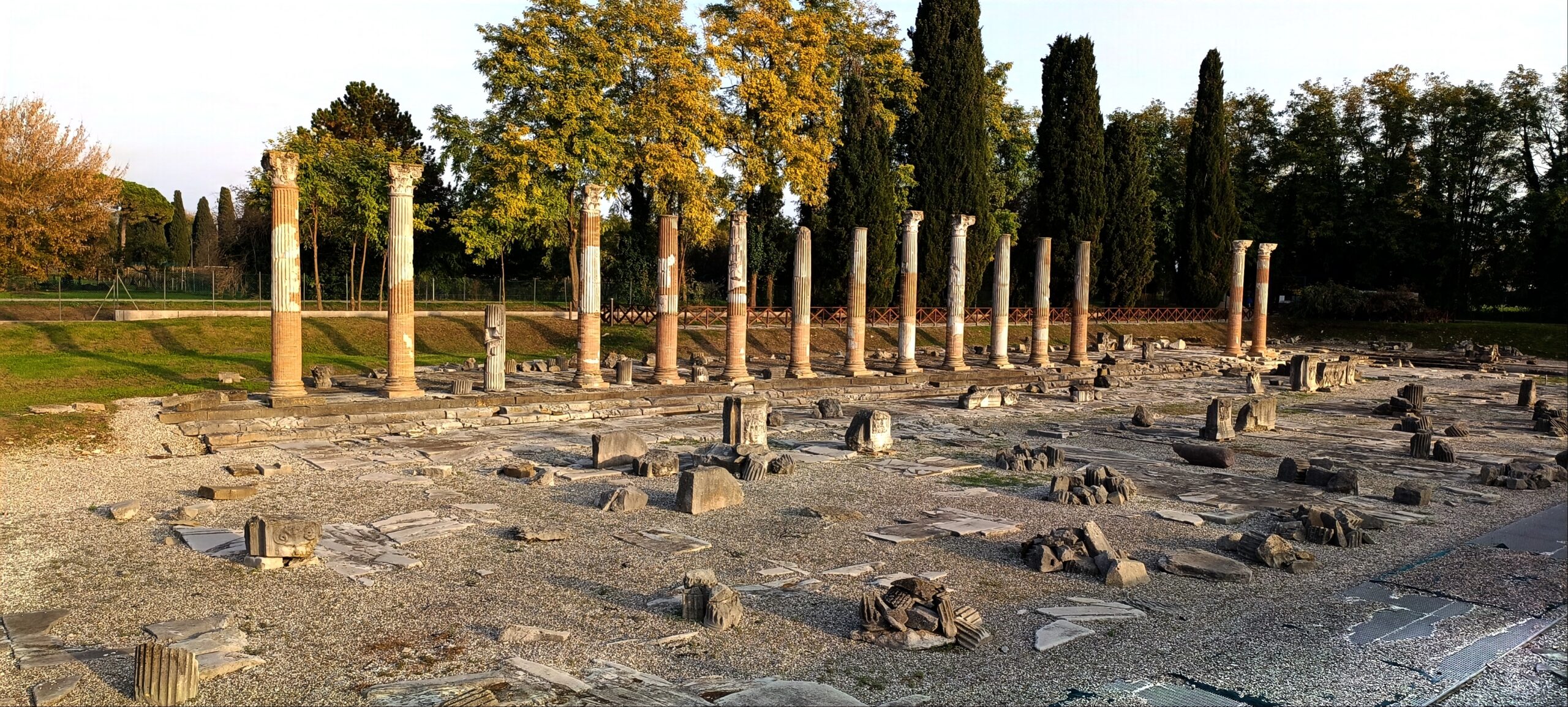
The Romans founded Aquileia as a colony in 181 BCE, and built the Via Postumia in 148 BCE, and the Via Annia in 131 BCE.
At this time, the Veneti were probably thoroughly Romanised, and speaking Latin.
The Veneti took the side of Rome in the Social War (91–87 BCE). Their allegiance earned them Latin rights within the Roman Empire, and in 49 BCE they acquired Roman citizenship.
In 42 BCE, Cisalpine Gaul, which then included the lands of the Veneti, became a Roman province.
Organising the empire
After his victories in the civil wars, Augustus reorganised the administration of the empire, and in mainland Italy, he created eleven regions. The land of the Veneti was included in the tenth, the Regio X, which later got the informal addition of Venetia et Histria to the name.
One of the promises Augustus had made his soldiers during the civil wars, was that they would each get a farm after the final victory. Not honouring such a promise was dangerous, and numerous soldiers were settled in the Regio X. In many areas, the Roman subdivision of the farmland can still be seen clearly in the landscape.
Pliny the Younger, writing in the first century CE, included a description of the region:
Next comes the tenth region of Italy, on the coast of the Adriatic Sea. In it are Venetia, the river Silo that rises in the mountains of Treviso, the town of Altino, the river Liquenzo rising in the mountains of Oderzo, and the port of the same name, the colony of Concordia, the river and port of llieti, the Greater and Lesser Tagliamento, the Stella, into which flows the Revonchi, the Alsa, the Natisone, with the Torre that flows past the colony of Aquileia situated 15 miles from the sea.
Pliny the Younger, Natural History, book III, chapter 18
and
In the interior of the tenth region are the colonies of Cremona and Brescia in the territory of the Cenomani, and Este in that of the Veneti, and the towns of Asolo, Padua, Oderzo, Belluno, Vicenza and Mantua, the only remaining Tuscan town across the Po.
Pliny the Younger, Natural History, book III, chapter 19
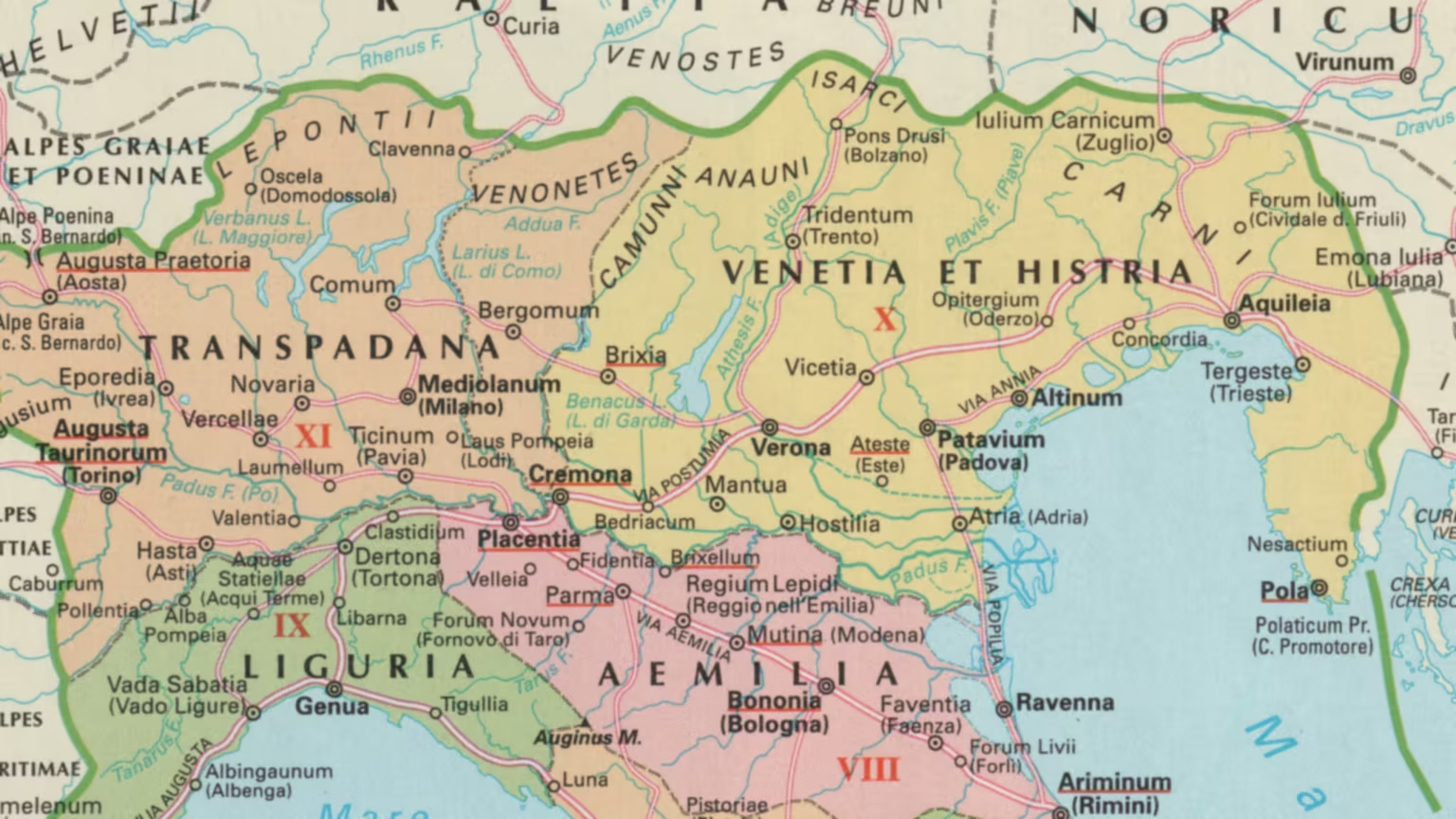
It was delineated by the Alps on the northern and eastern sides, the river Adda on the west, and the Po river on the south.
The capital of the Regio X was in Aquileia, which was the political, administrative and religious centre, and also where the first Christian church was founded, according to legend by St Mark and St Peter, but more realistically in the early 300s.
Diocletian’s reforms
The next change was in 292, when Diocletian reformed the administration of Italy, which now became a province like any other in the empire. Rome had by then lost its role as the centre of government and administration, which was an itinerant imperial court in the western part of the empire, or in Constantinople in the east.
Italy was the eighth province, and the old Regio X became VIII provincia Venetia et Histria — Venetia and Histria in the eighth province. Here the name Venetia is, for the first time, explicit and official.
For such parts of a larger province, the Diocletian reforms introduced the role of a dux. The dux was a local military commander, who also had some civil responsibilities, ruling over a territory called a ducatus.
The dux of Venetia and Histria resided in Aquileia, just as the head of the Regio X had before.
The words dux and ducatus are the origins of the English words duke and duchy, and the Venetian doge and dogado.
Later invasions
The Italian peninsula was subject to a series of invasions in the 400s and 500s. Almost all these invaders arrived in Italy from the north-east, through Venetia et Histria.
For Venetia et Histria, the most devastating war was the invasion of Attila the Hun in 452. The capital of Aquileia resisted the invaders, and when it fell, it was thoroughly sacked and destroyed.
The city never recovered from the devastation, and afterwards Venetia et Histria was de facto administrated as two entities. Venetia was governed from Opitergium (modern-day Oderzo), and Histria from Forum Iulii (current Cividale del Friuli).
The only figure of authority which remained in Aquileia, was the head of the church, the patriarch. During the war, the patriarch of Aquileia had fled to Grado, situated in a more defensible lagoon area, but returned to Aquileia after the Huns had left.
The capital of the Western Empire moved to Ravenna, which was more defensible, situated in an area with lagoons, not unlike later Venice.
Then, the last Western Roman emperor was deposed in 476, and soon after the Ostrogoths, instigated by Constantinople, invaded Italy and established their own kingdom. While formally still a part of the empire, the Ostrogoths nevertheless acted more independently than what the Eastern Empire desired.
Cassiodorus, who has left us some letters regarding early Venetia, was pretorian prefect (first minister) to several Ostrogoth kings, in the first decades of the 500s.
In 535, the Byzantines, dissatisfied with the situation, invaded Italy to restore it to the empire. This resulted in the protracted Gothic Wars, which in two phases lasted until 554.
A major epidemic of bubonic plague struck Italy starting in the 540s, and in 568 the Lombards invaded Italy, or were they invited?
The history of the Venice, as we know it, started with the Lombard invasion, or rather, with the Lombard conquest of Venetia in the first half of the 600s.
Bibliography
- Bjornlie, M. Shane. Variae: The Complete Translation. University of California Press, 2019. [more] 🔗
- Gasparri, Stefano and Sauro Gelichi. Le isole del rifugio : Venezia prima di Venezia. Bari, Laterza, 2024. [more]
- Madden, Thomas F. Venice : a new history. New York, Penguin Books, 2012.
- Pliny the Elder. Natural History in Loeb Classical Library, vol. 352. Harvard University Press, 1942. [more] 🔗
- Romano, Dennis. Venice : the remarkable history of the lagoon city. Oxford University Press, 2024.
- Zorzi, Alvise. La Repubblica del leone : storia di Venezia. Milano : Tascabili Bompiani, 2001.
Leave a Reply