The Lombard invasion of Byzantine Italy was a pivotal event in Venetian history.
The invasion, and the conquests that followed, led to an increased importance of the lagoon settlements, to a slow demise of Byzantine control in north-east Italy, to the establishment of a semi-independent church in the lagoons, and ultimately to Venetian statehood.
The Lombard invasion, and the subsequent migration of parts of the mainland residents into the lagoons, became a central part of the later Venetian national narrative — the stories they told to explain where they came from and who they were.
The Lombards
The Lombards — or the Longobardi or Langobardi, literally the long-bearded people — were a tribe of Germanic origin.
Both Cassius Dio and Tacitus mentioned them, and placed them around the lower Elbe, in what is now northern Germany. However, in the late 400s they were in modern-day Austria, and in the early 500s in the Roman Empire in the Balkans.
Ruled by Alduin, in the 540sm they were allowed to settle as foederati — allied with the empire — in Pannonia, which was in-between Austria, Hungary and Slovenia on a modern map.
In Pannonia, the Lombards were surrounded by Heruli, Gepids and Avars, with whom they had changing alliances and conflicts, while their lands bordered on the Italian provinces to the west.
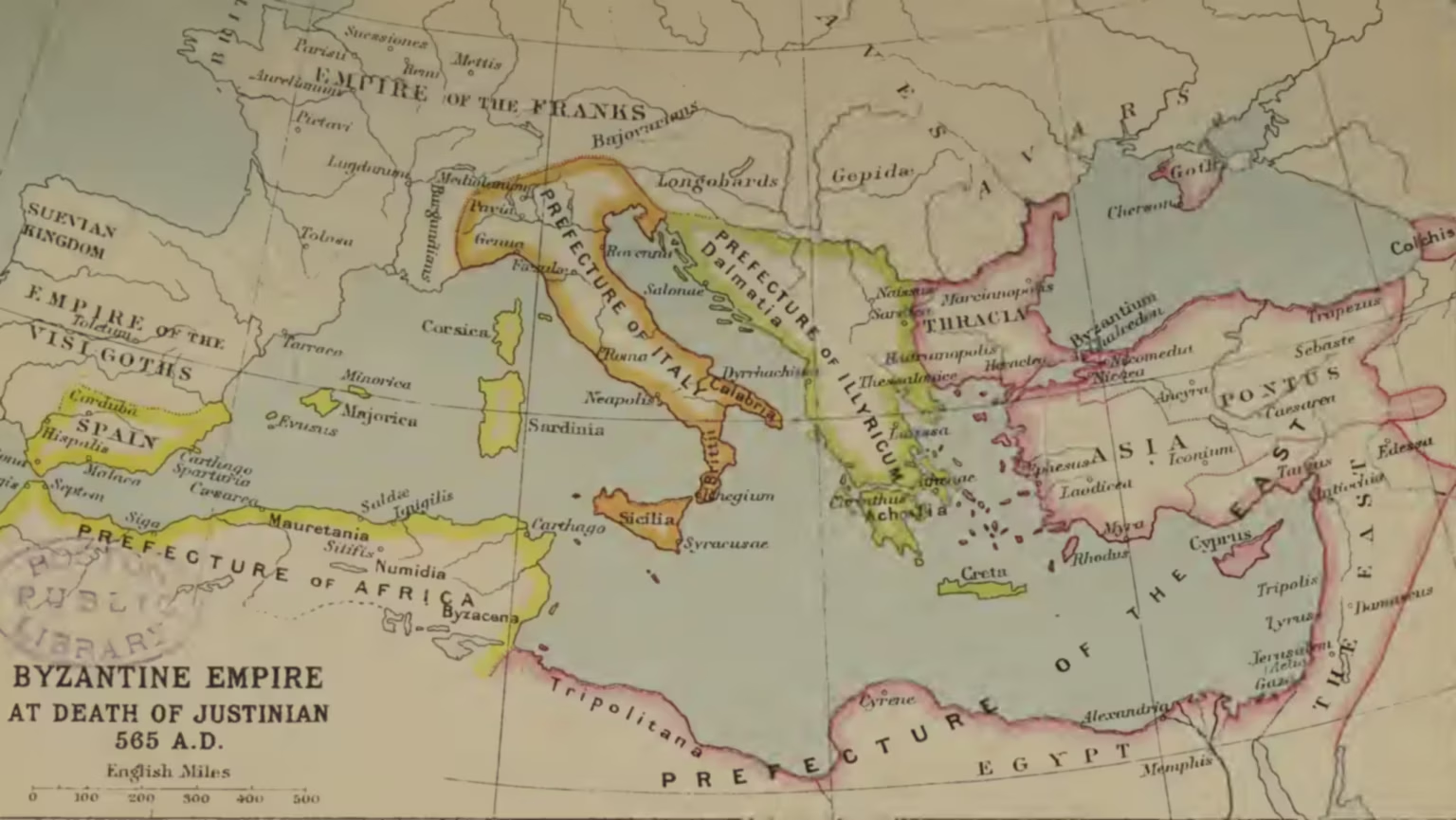
As foederati, the Lombards sent a contingent of troops to Italy in the early 550s, for the war between the Ostrogoths and the Roman Empire — the second phase of the Gothic Wars.
The Gothic Wars
The situation in Italy was complicated, to say the least.
The last western Roman emperor was deposed in 476 by Odoacer, who in turn was replaced in 493 by Theodoric, king of the Ostrogoth.
The Ostrogoth established a kingdom in Italy, and initially the Eastern Roman Empire let it pass. However, in 535, they invaded, led by Belisarius, in what became known as the Gothic Wars.
The first phase of the Gothic wars ended with Byzantine victory in 540, when Belisarius took Ravenna and captured king Witiges of the Ostrogoths
It was only the first phase, though. The Ostrogoths soon regrouped around a new able king, Totila, who took most of the peninsula back again.
The Byzantine responded by sending an army over from the Balkans, under the leadership of Narses.
Narses was a high-ranking court eunuch — this was a thing at the time — with the title of patrician. He was also around 70 years old at the time.
He was a skilled commander, but he might have been chosen because his age and condition meant that even if successful in Italy, he couldn’t pose much of a threat to the power balance in Constantinople.
The Byzantine troops arrived in 551, passing through Pannonia, where the Lombards had settled a few years earlier.
There can be little doubt that Narses knew, or at least met, Alduin, king of the Lombards.
Within a few years, Narses had defeated the last Ostrogoth kings, and nominally taken the Italian peninsula back for the empire.
Some Frankish kings, however, saw an opportunity, and invaded from the west, but they too were defeated by Narses.
In 554, Narses was in Rome, seeing to the restoration of the former imperial capital, while Byzantine forces were mopping up pockets of resistance.
The Pragmatic Sanctions — an imperial decree re-establishing imperial legal and administrative control over the peninsula — arrived from Constantinople, as a sign that Italy was being incorporated into the empire again.
Narses is sometimes referred to as the first Exarch of Byzantine Italy, even if the Exarchate of Ravenna was only formally established in 584, after the death of Narses.
The army of Narses in Italy was largely made up of foederati, and there were several thousands of Lombards fighting for the empire in Italy in the 550s.
Italy in the 560s
With the end of the Gothic Wars, peace finally came to Italy, but the peninsular was in a sorry state.
Besides the wars, Italy was also ravaged by plague. The so-called Justinian plague — which recently has been confirmed to be yersinia pestis or bubonic plague — had arrived in 541, and came back in recurring waves.
Paul the Deacon, our main source for the Lombard invasion of Italy, describes the plague this way:
For as common report had it that those who fled would avoid the plague, the dwellings were left deserted by their inhabitants, and the dogs only kept house. The flocks remained alone in the pastures with no shepherd at hand. You might see villas or fortified places lately filled with crowds of men, and on the next day, all had departed and everything was in utter silence.
Sons fled, leaving the corpses of their parents unburied; parents forgetful of their duty abandoned their children in raging fever. If by chance long-standing affection constrained any one to bury his near relative, he remained himself unburied, and while he was performing the funeral rites he perished; while he offered obsequies to the dead, his own corpse remained without obsequies.
Historia Langobardorum, II.4
Paul makes it clear the plague did not afflict the Lombards or nearby peoples:
And these evils happened to the Romans only and within Italy alone, up to the boundaries of the nations of the Alamanni and the Bavarians.
This description refers to 566 or 567, shortly before the Lombard invasion.
The migrants
While the invasion of Italy in 568 is associated with the Lombards, they were not the only tribe. There were others too.
For several centuries, various tribes had moved across Europa and Northern Africa, searching for land to settle on.
The Lombards had themselves moved into Pannonia just a few decades earlier. A few decades are living memory, so they knew exactly how to migrate. Most of them had already done at least one major migration in their lifetime.
Italy is large, and Alboin must have known that the Lombards were too few, so he sent for the Saxons to join them. There’s a bit of uncertainty as to where they were settled at the time, but probably somewhere in southern Germany.
Paul the Deacon says the Saxons were twenty thousand men, with women and children, so most likely around fifty thousands, but as always, mediaeval numbers must always be taken with a few grains of salt.
Another people who joined the migration into Italy, albeit not exactly voluntarily, were the Gepids. They, too, had been settled by the empire in the northern Balkans, but in a war with the Lombards under Alboin, just a few years earlier, they had suffered a devastating defeat.
In the war against the Gepids, the Lombards had been allied with the Avars (which Paul the Deacon called Huns), who lived on the opposite side of the Gepids.
The lands of the Gepids were taken over by the Avars. Many of the surviving Gepids were reduced into slavery by the Lombards and the Avars, or followed along the victorious Lombards because they had nothing left to stay for.
Alboin took for his wife a princess of the Gepids, after having killed her father in battle. He would pay dearly for that decision later.
The people invading Italy were therefore a rather mixed group, made up of several tribes. There were at least Lombards, Saxons and some Gepids in the group.
If, for a second, we accept the numbers of Paul the Deacon, and assume the Lombards were the largest group, as they retained leadership uncontested, we’re talking of well over a hundred thousand persons: men, women and children.
Departure
Once everything and everybody was ready, the Lombards handed over their homes and lands to the Avars.
They had struck a deal that the Avars, who had already occupied the lands of the Gepids, would also take Pannonia, on the condition that, if the endeavour should fail and the Lombards return, they would return in possession of their former homes and lands.
The group left Pannonia on the day after Easter.
They came out of it [Pannonia] in the month of April in the first indiction on the day after holy Easter, whose festival that year, according to the method of calculation, fell upon the calends (the first) of April, when five hundred and sixty-eight years had already elapsed from the incarnation of our Lord.
Historia Langobardorum, II.7
Alboin led his people to the border of the Byzantine province of Venetia et Histria. There, they scaled a mountain and looked across the land that they were going to take.
Paul the Deacon described this process of leaving Pannonia and entering Italy in great detail, and he did that for a reason.
He was a proud Lombard, who wrote shortly after the fall of the Lombard Kingdom, which was created with these events.
He was, therefore, recounting parts of the Lombard national narrative, the creation myth of his people and country, at a time when that creation was in grave peril.
The Duchy of Friuli
The Lombards and their companions entered Italy without any opposition.
The first city they encountered was Forum Iulii — modern-day Cividale del Friuli.
These are the words of Paul the Deacon:
When Alboin without any hindrance had thence entered the territories of Venetia, which is the first province of Italy — that is, the limits of the city or rather of the fortress of Forum Julii (Cividale) — he began to consider to whom he should especially commit the first of the provinces that he had taken.
Historia Langobardorum, II.9
This was an important question because just as the Lombards had to pass Forum Iulii, so would any other invader. They had to secure that city to protect their back.
Alboin understood this perfectly well, as Paul the Deacon explained:
For indeed all Italy (which extends toward the south, or rather toward the southeast), is encompassed by the waves of the Tyrrhenian and Adriatic seas, yet from the west and north it is so shut in by the range of Alps that there is no entrance to it except through narrow passes and over the lofty summits of the mountains. Yet from the eastern side by which it is joined to Pannonia it has an approach which lies open more broadly and is quite level.
Historia Langobardorum, II.9
It is not a coincidence that the vast majority of all invasions into Italy arrived from the north-east.
Before the Lombards, the Visigoths, the Huns and the Ostrogoths had used that road in the 400s, Narses with his army in the mid-500s and now the Lombards.
Alboin entrusted his nephew Gisulf with guarding the rear, and he was given as many people and horses and the authority needed to become the first Duke of Friuli.
The Duchy of Friuli would remain an important part of the future Kingdom of the Lombards, but over time many more duchies would be established.
The name Friuli, which is now used for the Italian region, is but a contraction of the Roman name Forum Iulii.
Venetia
According to Paul the Deacon, Narses died at this time, but his successor Longinus was probably already in Italy.
The train of people, horses and carts continued along the road, as before, unopposed.
From the Byzantine world, there was no reaction.
When the Lombards arrived at the river Piave, which is about 100km from Forum Iulii, they finally met somebody.
Felix, the bishop of Treviso, had come to meet Alboin, who — as Paul the Deacon recounts — generously granted him all the lands and properties which the church of Treviso already possessed.
Granting the bishop of Treviso everything he already had might not seem much, but it was important.
Alboin could have taken everything. He could have killed the bishop right there.
At this time, the Lombards were still Arians, not orthodox Christians, and there might have been parts of the group, which still held the ancient Germanic beliefs.
Such a sign of respect of the established church was important, and might have made the further progress of the Lombards easier.
On the other side, it must have taken quite a bit of courage for the bishop to head out of the fortified city and confront the invaders unarmed. He could easily have become a saint that day, but he didn’t.
Treviso later became a Lombard duchy.
Continuing, still unopposed, Alboin took possession of many of the major fortified cities of Byzantine Venetia, including Verona and Vicenza, but not Padua, Monselice and Mantua.
Paul the Deacon doesn’t offer any explanation as to why Alboin didn’t take Padua, Monselice and Mantua, so we’re left at guessing.
The most likely reason is that he tried to move as fast as possible while the Byzantines were unprepared, occupying the cities which surrendered quickly, while leaving the others for later.
Alboin probably expected some kind of Byzantine counter-attack, and the more fortified cities he held, the better he could defend his conquest, even if there were some pockets behind the lines.
He also had plenty of people and horses, while Italy was tired and weary from decades of war and plague. He could therefore dominate the countryside to a larger extent than the Byzantines were capable of.
In late 569, Alboin moved on, towards Liguria, which then included large parts of what we now call Lombardy.
It almost goes without saying, that the name Lombardy only came into use after the Lombards established their capital in Pavia, south of Milan. It means the land of the Lombards.
The city of Pavia was where the Lombards first met determined resistance. According to Paul the Deacon, the siege of the city lasted for over three years.
Alboin, enraged by the opposition, had sworn to put everybody in the city to the sword.
However, as he passed the city gate after their surrender, his horse fell to the ground and couldn’t get up again. Seeing this as a bad omen, he rescinded his vow to kill everybody, and the horse got back up.
During the years of the siege of Pavia, Lombard troops took Tuscany, but didn’t try to move on Rome or Ravenna.
Paul the Deacon explains the lack of resistance with plague and famine:
The Romans had then no courage to resist because the pestilence which occurred at the time of Narses had destroyed very many in Liguria and Venetia, and after the year of plenty of which we spoke, a great famine attacked and devastated all Italy.
Historia Langobardorum, II.26
In these early years of Lombard rule in Northern Italy, the capital was in Verona, and it was here that Alboin, in 572, met an unfortunate end at the hand of his wife.
Further conquest
The Lombard expansion in Italy continued for almost two centuries, until the definitive fall of Ravenna in 751, and the end of the Byzantine Exarchate of Ravenna.
However, not every town in Venetia was taken and held by the Lombards during the initial invasion. Parts of Venetia remained under Byzantine rule for over a century, until the territory was reduced to just the lagoon areas along the coast, the so-called Venetia Marittima.
There were already people living in the lagoons before 568, as the letter of 537 from Cassiodorus to the maritime tribunes documents.
It was, however, the invasion of the Lombards in 568 and 569, which triggered the larger movement of people from the mainland into the lagoons, and with them, the Byzantine institutions of government and the church organisation.
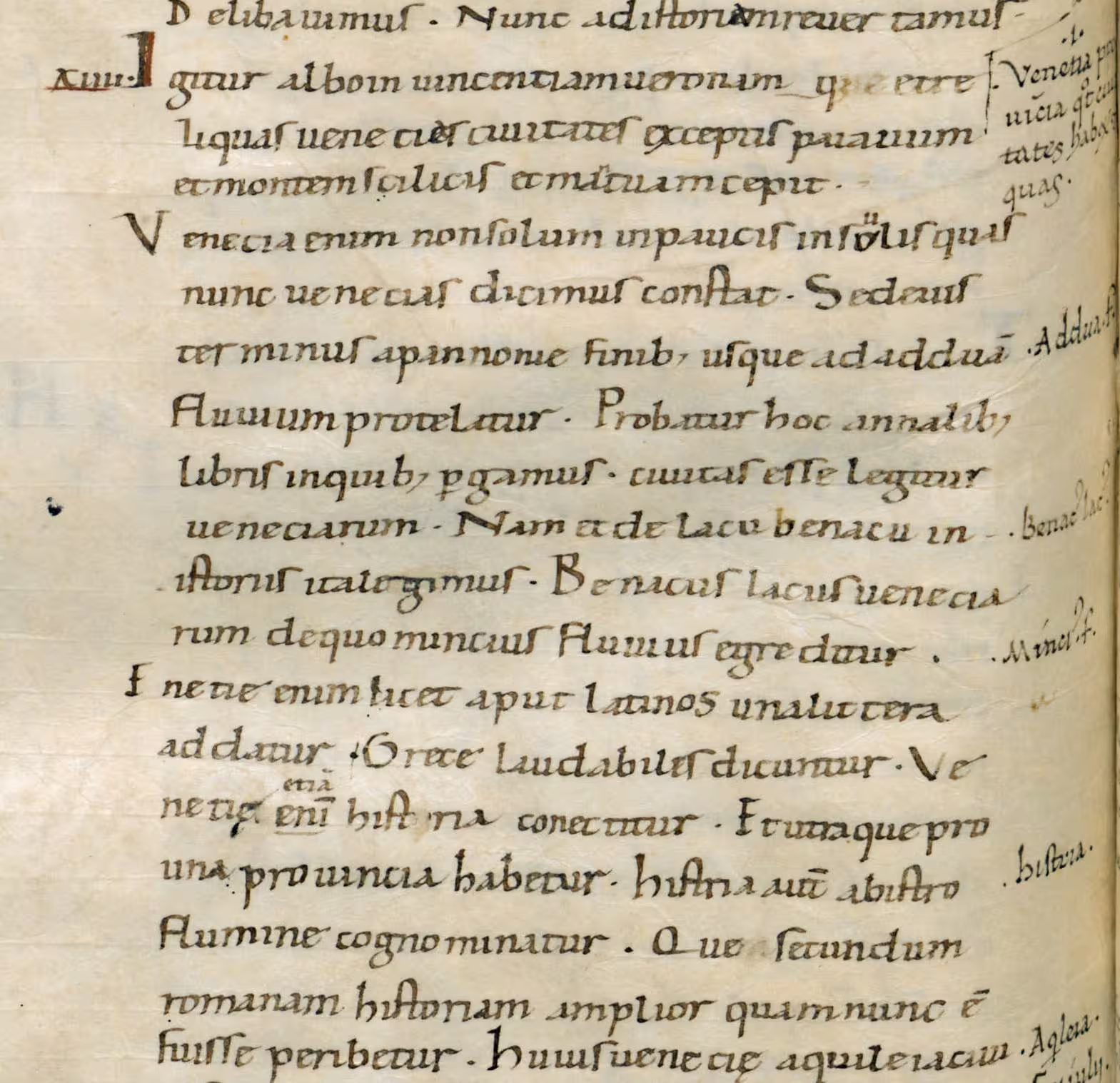
Paul the Deacon goes into some detail of the different meanings at the time of the name Venetia, and later Venetian chroniclers and historians often talked about the first and the second Venetians.
Bibliography
- Gasparri, Stefano and Sauro Gelichi. Le isole del rifugio : Venezia prima di Venezia. Bari, Laterza, 2024. [more]
- Hodgkin, Thomas. Italy and her invaders, 553–600, Volume V, 2nd ed. Oxford, at the Clarendon Press, 1916.
- Paulus : Diaconus and William Dudley Foulke (translator). History of the Langobards. New York Longmans, Green & Co., 1907. [more] 🔗
- Paulus : Diaconus, Antonio Zanella (translator) and Bruno Luiselli. Storia dei longobardi. Milano BUR, 2000 (6th ed.). [more]
Leave a Reply