
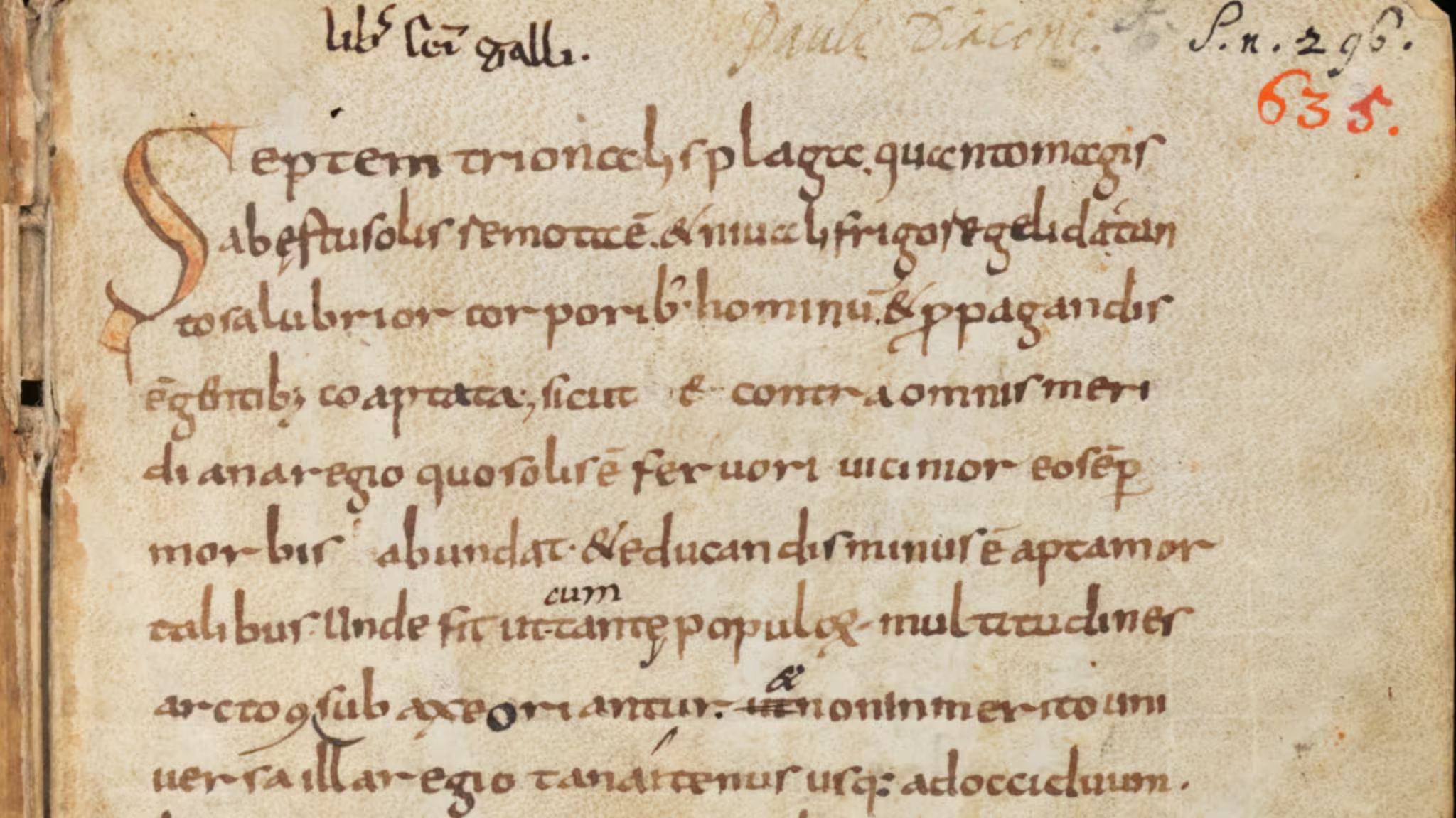
The Chronicon Altinate — the Chronicle of Altino — is not, despite the name, a chronicle, but rather a collection of various texts, which treats a wide variety of topics.
We don’t know the author — or authors — of the Chronicon Altinate.
It is usually called the Chronicon Altinate or the Origo civitatum Italie seu Venetiarum — The origin of the cities of Italy or of the Venetians — but also Chronicon Venetum — the Venetian Chronicle — which causes confusion with the Istoria Veneticorum by John the Deacon, which also goes under similar names.
The earliest manuscript with the Chronicon Altinate is from the 1300s, but most scholars agree that at least parts of some of the included documents are several centuries older, from the 1000s or 1100s.
Contents
There are eight books in the collection, very different in nature.
The first is a list of all the doges of Venice, which must have been extended as the text has been copied, as it finishes in the 1300s.
The second book lists the patriarchs of Grado, the bishops of Torcello, Olivolo and Altino on the mainland. It also recounts how the citizens of Altino decided to move into the lagoon, where they founded Torcello in the early 600s.
The third is a mix of accounts of three noble families, and descriptions of the various settlements in the dogado, their extensions and borders, and their particular conflicts, traditions and customs.
The fourth book is a very short chronicle of the patriarchs of Grado, but not the same as the Chronicon Gradese from the period of John the Deacon. They do share some material, though.
Then comes an account of the lives of eight doges, from the early 1100s to the early 1200s, in the fifth and sixth books. The texts are a bit messy. They are sometimes interrupted, bits are missing, or they lack continuity.
The last two books are different again. The seventh is an account of the events at the end of the Gothic Wars, in the 550s, with the story of general Narses, who, having lost the favour of the emperor and empress, enticed the Lombards to invade Italy, leading the Venetians to abandon the mainland for the lagoons. It is not a very likely story, but it exists in many versions, and is also recounted in the Translatio Marci Evangelistae Venetias.
The last book is about the period of Charlemagne’s rule over the Kingdom of the Lombards, and later his son, Pepin, and the war against the Venetians. The text is full of myths and anachronisms, as when Charlemagne asked to go to Rivoalto to worship the relics of St Mark, except Charlemagne died in 814, and the relics of St Mark arrived in Venice in 828.
As should be clear, the Chronicon Altinate is a very mixed bag, both regarding the content and the periods covered.
The Venetian narrative
The late date of the earliest manuscript, and the way the texts have been mangled during copying make it a very difficult source, but important, nonetheless, as it contains much which doesn’t exist elsewhere.
A common theme in the texts, which constitute the Chronicon Altinate, is that they underline the independence of Venice from the other powers, from the very beginning.
The Chronicon Altinate therefore played a large role in the propagation of the ancient legends and stories around the origins of the Venetians and of Venice. These legends and stories would be told and retold in Venice for centuries, and consequently, they became a central part of the Venetian national narrative, and formative of a Venetian identity.
Bibliography
- Cessi, Roberto. _Origo civitatum Italie seu Venetiarum : (Chronicon Altinate et Chronicon Gradense) in Fonti per la storia d'Italia / pubblicate dall'Istituto storico italiano ; 73. Roma : Tipografia del Senato, 1933. [more]
- Rossi, Antonio, Giovanni Galvani, Martino : da Canale and Emmanuele Antonio Cicogna. La Cronaca veneta detta Altinate di autore anonimo, in latino, preceduta da un commentario del prof. Antonio Rossi e La cronaca dei Veneziani del maestro Martino da Canale, nell'antico francese, colla corrispondente versione italiana del conte Giovanni Galvani e con annotazioni di Emmanuele Cicogna … [et al.]. Firenze : Gio. Pietro Vieusseux, 1845. [more] 🔗
Leave a Reply