
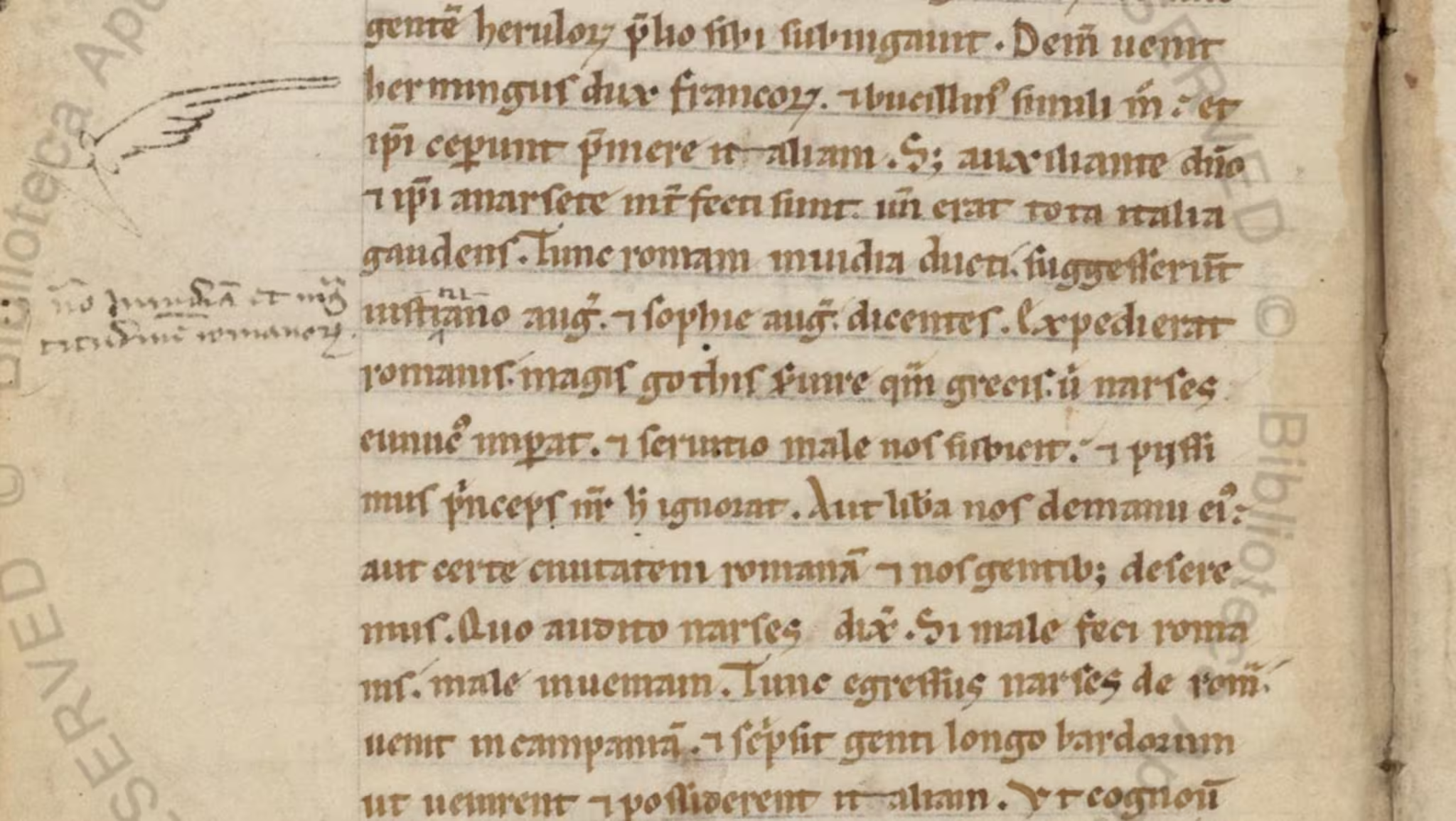
The Lombards, led by their king Alboin, invaded Byzantine Italy in 568, in a movement which was well-prepared in advance.
The move was not a response to an emergency or an attack by another group. It was a planned and organised migration towards new lands.
They even had a plan B in case of failure.
They handed over their houses and lands to another people, the Avars, with the agreement that if they returned, they would get them back.
The Lombards in Pannonia
The Lombards were, before the invasion of Italy, allied with the Roman Empire.
They were foederati — non-Romans, living within the empire or on the border, by agreement with the empire, and supplying troops to the empire on request.
The Lombards had settled in Pannonia as foederati, just a few decades earlier.
During the second phase of the Gothic Wars, in the early 550s, they had supplied troops to the imperial army in Italy, which fought the Ostrogoths successfully to reclaim Italy for the empire.
Less than two decades later, they packed up all their belongings, and — men, women, children, animals, belongings — moved to Italy, in what was apparently a direct attack on the Roman Empire.
The Historia Langobardorum
Our main source for the Lombard invasion of Italy is a Lombard scholar from the 700s, Paul the Deacon.
He was close to the last King of the Lombards, had an important position at court, and was tutor to one of the princesses.
In the 780s, after the Franks under Charlemagne had conquered the Kingdom of the Lombards, Paul the Deacon wrote a story of his people, the Historia Langobardorum.
There, he recounted in great detail the events that led up to the invasion, and how the Lombards gradually took control over much of Italy, in direct opposition to the Byzantine Empire.
In the Historia Langobardorum, Paul the Deacon claimed the Lombards were invited to come to Italy and take it over.
Not only that, but he also wrote that the invitation came from the same Byzantine general, who had reconquered the peninsular for the empire.
National narratives
The story might not be very likely, but it became very popular and a staple of most later Venetian chronicles.
Paul the Deacon told the story because it became part of the founding myths of the Kingdom of the Lombards. It became part of their national narrative.
Likewise, the events set in motion what ultimately led to Venetian statehood, and consequently, the story also became part of the Venetian narrative of why and how Venice came about, and it is therefore interesting.
A treasonous general
The story is as follows, based on Paul the Deacon’s version, with a few excursions to other sources.
The Ostrogoths had created an independent kingdom in Italy in 493, under Theodoric.
In 535, Justinian the Great sent his general Belisarius to Italy to take it back for the empire. He largely succeeded, and returned victorious to Constantinople in 540, with the defeated and captured Ostrogoth king.
The Ostrogoth, however, rallied around another king, and the war flared up again in the late 540s.
Justinian appointed Narses, a Byzantine court eunuch, a bureaucrat, but with military experience, to lead the army in Italy for the continued war with the Ostrogoths.
The army was mostly made up of foederati, and there was a Lombard contingent.
Narses arrived in 551, and he was largely successful. By 554, Italy was reasonably calm and under Byzantine control. Narses settled in Rome, to oversee the restoration of the city and of the wider country, as the official ruler of Italy under the empire.
Decades of war, and recurring waves of bubonic plague, had left Italy and its economy in a sorry state.
Justinian died in 565 and was succeeded by his nephew Justin II, whose wife Sophia became empress.
While Justinian had let Narses rule Italy as he pleased, Justin and Sophia (according to Paul the Deacon) resented his power and wealth.
They claimed to have received a petition from the citizens of Rome, who accused Narses of being a harsh and unjust ruler.
The petition was, according to the Historia Langobardorum by Paul the Deacon:
It would be advantageous for the Romans to serve the Goths rather than the Greeks wherever the eunuch Narses rules and oppresses us with bondage, and of these things our most devout emperor is ignorant: Either free us from his hand or surely we will betray the city of Rome and ourselves to the heathens.
Historia Langobardorum, II.5
The Ostrogoths were Arians — not orthodox Christians like the Romans and Byzantines — which is why they’re called heathens here.
When confronted with this complaint, Narses simply replied:
If I have wronged the Romans, I will suffer.
Historia Langobardorum, II.5
This — still according to Paul the Deacon — angered the emperor so much that he sent the prefect Longinus to Italy to replace Narses.
When Narses heard of this, he was alarmed, and the more so because the empress Sophia sent him a rather nasty message.
Her letter said on his return to Constantinople, he would be assigned to the groups of women making yarn and weaving in the palace, in the sense that as a eunuch, he was more woman than man.
This was a message to a highly accomplished general, who was in his 70s or 80s.
Another source reports that she sent him a golden spindle and the message that in the future he would rule over wool-workers and not over nations.
In any case, that in turn got Narses angry, and he replied that he would weave her such as web as she would never see the end of it.
Paul the Deacon described his reaction this way:
Therefore, greatly racked by hate and fear, he withdrew to Naples, a city of Campania, and soon sent messengers to the nation of the Langobards, urging them to abandon the barren fields of Pannonia and come and take possession of Italy, teeming with every sort of riches. At the same time he sent many kinds of fruits and samples of other things with which Italy is well supplied, whereby to attract their minds to come.
Historia Langobardorum, II.5
So, according to this story, Narses invited the Lombards to Italy because he fell out of favour with the emperor, and in particular, with the empress.
Tracing the story
This is not something Paul the Deacon made up, as the story can be traced back to shortly after the Lombard invasion.
The Frankish so-called Chronicle of Fredegar, which ends in 642 or 658, recounts the story, but without the detail of sending gifts from Italy to the Lombards.
Likewise, Isidore of Seville, whose chronicle ends in 615, has the simpler story without the gifts.
The origin of these accounts is probably the Liber Pontificalis — the Book of the Popes — for John III (who ruled 561-574), a text which most likely dates to the 580s.
Then the Romans, inspired by malice, sent an accusation to Justinian and Sophia, saying: “It were better for the Romans to serve the Goths than the Greeks, for Narses, the eunuch, governs us and reduces us to slavery; and our most devout prince is ignorant of it. Either free us from his hand or we and the city of Rome will serve the Gentiles.”
When Narses heard this he said: “If I have done evil to the Romans may evil fall on me!”
Then Narses departed from Rome and went to Campania and wrote to the tribe of the Lombards that they might come and possess Italy.
But when Pope John learned that the Romans had sent an accusation against Narses to the emperor he went hastily to Naples. And Pope John began to entreat Narses to return to Rome.
Then Narses said: “Tell me, most holy Father, what evil have I done to the Romans? I shall go back to the feet of him that sent me and all Italy shall know how I have toiled for her with all my strength.”
Pope John answered and said: “I myself shall go to him sooner than you shall leave this land.”
And Narses returned to Rome with the most holy pope John.
Loomis (1916), p. 164–165, reproduced here.
So we get very close — a few decades after the alleged events — but other almost contemporaneous chroniclers don’t report on the treason.
Both Marius Aventicensis, who died in 596, and Gregory of Tours, who died in 594, wrote about the Lombard invasion of Italy, but made no mention of an invitation from Narses.
Add to that, that the whole story of the treason of Narses is contradicted by the very same sources that reported it.
Paul the Deacon later wrote, corresponding to a year between 571 and 573:
Narses indeed returned from Campania to Rome and there not long afterwards, departed from this life, and his body, placed in a leaden casket, was carried with all his riches to Constantinople.
Historia Langobardorum, II.11
The Liber Pontificalis has this, after the meeting between Narses and pope John III:
But Narses entered Rome and after a long time he died. And his body was laid in a leaden coffin and was carried with all his riches to Constantinople.
Loomis (1916), p. 165.
This would hardly have taken place, if Narses had betrayed the empire and the emperor.
Furthermore, we know from Byzantine sources that the emperor took active part in the funeral of Narses in Constantinople, and that Narses was buried with all honours in a monastery he himself had founded there.
Would that have happened to a traitor, who had abandoned all of Italy to another people?
Narses had enemies
What this story does tell us, is that Narses had enemies in Italy, which can hardly be a surprise, given how successful, rich and powerful he had become.
The likely reason for such a complaint from the Romans to the emperor, was that Italy was in a miserable state, after decades of war and bubonic plague, yet imperial taxation didn’t relent because war and reconstruction are also expensive.
We have no way of knowing if Narses enriched himself unduly during his reign — legends of hidden treasure circulated after his death — but if his wealth ended up in Constantinople, the emperor was unlikely to be dissatisfied.
Whatever the details, Narses doesn’t appear to have been in disgrace with the imperial court at the time of this death.
The Lombard angle
Then there’s the perspective of the later Lombards.
Paul the Deacon — a later Lombard scholar and patriot — recounted the tale — and embellished it — because it was very handy from a Lombard point of view.
If the Lombards had moved to Italy due to an invitation from the official Roman ruler of Italy, they had done the right and honourable thing in responding to the invitation.
In this narrative, they would be the loyal foederati, who did as their imperial overlords asked of them. Under the previous king, Alduin, they had been asked to settle in Pannonia, and they had done so. Under his son Alboin, they were asked to move to Italy, and they did so.
Such a story put the Lombards in a much better light than an unprovoked opportunistic attack on a peaceful neighbour and subsequent land-grab.
In any case, the Lombards hardly needed gifts of fruit and produce to be convinced that Italy was rich and fertile. Many of them had been in Italy fifteen years earlier, serving in the army of Narses against the Ostrogoth, in the early 550s.
They already knew Italy and its riches. They also knew that those riches were there for the taking, in a country wounded and depopulated by protracted wars and repeated plagues.
The Venetian narrative
The story of Narses’ betrayal of the empire and the emperor was retold by almost all successive Venetian chroniclers.
Among others, it appears prominently in the Istoria Veneticorum by John the Deacon, and the in the Translatio Marci Evangelistae Venetias, both essential sources to early Venetian history.
The Lombard invasion of Italy was a crucial push towards what much later became the Republic of Venice, and just like the Lombards saw the invasion as part of their origin myth, it came to mean the same for the Venetians.
For the Venetians, is wasn’t a great national endeavour like it was for Paul the Deacon, but it was that external push, which set the Venetian narrative in motion.
Bibliography
- Loomis, Louise Ropes. The book of the popes (Liber pontificalis). New York, Columbia University Press, 1916. [more] 🔗
- Paulus : Diaconus and William Dudley Foulke (translator). History of the Langobards. New York Longmans, Green & Co., 1907. [more] 🔗
- Paulus : Diaconus, Antonio Zanella (translator) and Bruno Luiselli. Storia dei longobardi. Milano BUR, 2000 (6th ed.). [more]
Leave a Reply