
The chronicle of John the Deacon — often called the Istoria Veneticorum — is the first work of Venetian historiography, from around 1008.
As the first Venetian chronicle, it has been hugely influential on just about every later chronicle or history book on the early centuries of Venice. It will be difficult to find a history book on Venice, from any period, which doesn’t quote or reference John the Deacon a few times.
The earliest manuscripts state neither a title nor an author.
It has been given many names, the most common being the Chronicon Venetum et Gradense — the Chronicle of Venetia and Grado — and the Istoria Veneticorum — the History of the Venetians. The latter is the ‘better’ name, as there are several other chronicles which are called Venetum, Gradense, or variations thereof, creating much confusion.
The first published edition of the chronicle — from 1765 — named it the Chronicon Venetum di Giovanni Sagornino, after a blacksmith who appears in several associated documents. It is therefore the Istoria Veneticorum is often referenced in earlier literature simply as il Sagornino.
John the Deacon
The current consensus is that the Istoria Veneticorum was written by a deacon named Iohannes, who was close to Pietro Orseolo II, doge of the Venetians from 991 to 1008.
This attribution is based on some passages in the text, where Iohannes Diaconus was sent as ambassador to emperor Otto III of the Holy Roman Empire, and organised a secret visit of the emperor to Venice. The chronicle recounts many facts about those meetings, which only somebody present could know, and which are not known from any other contemporary sources.
While referred to as John the Deacon in English, in Italian it is common to see Giovanni Diacono and Giovanni da Venezia, both from variations of the Latin Iohannes Diaconus Venetus.
We do know a bit more about John the Deacon, than what can be deduced from the chronicle itself. This is because he appears in some charters from the time.
John was probably born in the early 940s, as he appears first in an official role in 967, during the reign of Pietro Candiano IV, when he must have been at least in his twenties.
He later shows up repeatedly during the reign of Pietro Orseolo II. They must have been quite close, maybe even relatives, and John was on several occasions sent as ambassador to the Holy Roman Emperor when the emperor was in Italy.
Just like Paul the Deacon, he was a trusted collaborator to the head of state, and as such centrally placed and with access to plenty of documents, and in John’s case, active participation in high level international diplomacy.
Also, like his Lombard predecessor, he is fairly reliable for the period close to his own time, but much less for the earlier periods.
The last reference we have to John the Deacon, is a document from 1018, when he was in Rome, probably as an ambassador to the Holy Roman Emperor, who was there at the time. He must have been at least seventy then, but we do not know where or when he died.
The Istoria Veneticorum
The Istoria Veneticorum is an account of the history of the Venetian people, chronologically, largely focused on political and military events. It ends in 1008 with the death of Pietro II Orseolo.
Given his vicinity to the people in power, he must have had access to all the documents in the archives, and he certainly knew the treaty of 841 with emperor Lothar of the Holy Roman Empire.
The chronicle definitely drew on Paul the Deacon, with whom there are many similarities, and there’s an overlap with the Translatio Sancti Marci, without it being entirely clear who copied from whom.
It is divided into four books.
Book I is about the beginning of Venice. Large parts are copied, often from of the Historia Langobardorum, including the Gothic wars, general Narses and his alleged invitation of the Lombards, followed by the Lombard invasion and the migration of the Venetians into the dogado — the lagoon settlements from Grado to Cavarzere. Other parts are from the Venerable Bede, or the Translatio Marci Evangelistae Venetias.
In book II, the Venetian narrative starts with the first doge, Paoluccio, in the early 700s, and — interspersed with much information about what happened elsewhere in Italy, Europe and in Constantinople — continues until around 860.
The assassination of doge Giovanni Tradonico in 863, and the election of Orso Partecipazio I, opens book III, which continues in the same style as book II until the death of Pietro Candiano II, and the election of Pietro Badoer in 939.
Book IV covers the period of the life of John the Deacon, up to the death of Pietro Orseolo II in 1008. This is also where John the Deacon himself appears in the narrative, and where the information is more reliable, with due precautions.
National narrative
The Istoria Veneticorum is not a simple list of events, chosen without any particular tendencies or biases.
The chronicle of John the Deacon is an expression of a well-defined political programme, consistently emphasising events and interpretations which underlined the political, cultural and ecclesiastical independence of Venice the polity.
Much space is dedicated to the relationship with the Holy Roman Empire, with Constantinople and with the Pope on Rome, but always in ways which depict Venice as an independent peer.
The story of the Lombard invasion is used to explain why the Venetians moved to the lagoons, but Byzantium is mostly absent, and there is no mention of Venetian society ever being a part of the Eastern Empire.
None of the doges are ever described as being subservient to the Roman emperor. When they interact with the empire, and are given titles and gifts, they still appear as rulers of a friendly, but independent nation.
Likewise, all the events around the move of the Patriarch of Aquileia to Grado are recounted meticulously, while leaving out Byzantium, as they serve to make Venice independent in matters of the church too. By having its own patriarch, Venice was not subject to neither the Lombards, the Franks, the Holy Roman Empire, the Pope in Rome, or the Patriarch of Constantinople.
The Istoria Veneticorum was a statement of a Venetian society, which already around the turn of the millennium was becoming more assertive and sure of itself, and John the Deacon wrote a history supporting this.
As Venice grew richer and more powerful over the following centuries, the narrative of the Istoria Veneticorum continued to resonate, and the Venetians largely constructed their national narrative on the foundations laid down by John the Deacon.
Manuscripts
There are eight surviving manuscripts with the Istoria Veneticorum, of which only three are relevant, as the remaining five are later copies of one of the first three.
The original manuscript by John the Deacon is lost.
The oldest extant manuscript (Vat.Urb.lat. 440, 9r–39r) is in the Vatican Libraries, but came originally from the library of the Duchy of Urbino. It is from the first half of the 1000s, so quite close to the source.
Unfortunately, the manuscript from Urbino is incomplete, as the entire first book, and the first 18 chapters of book II are missing. This appears to be due to the loss of some pages of the manuscript, but it has led to much debate over whether book I, which is largely copied from Paul the Deacon and Bede, was a later addition, to reinforce the narrative of independence.
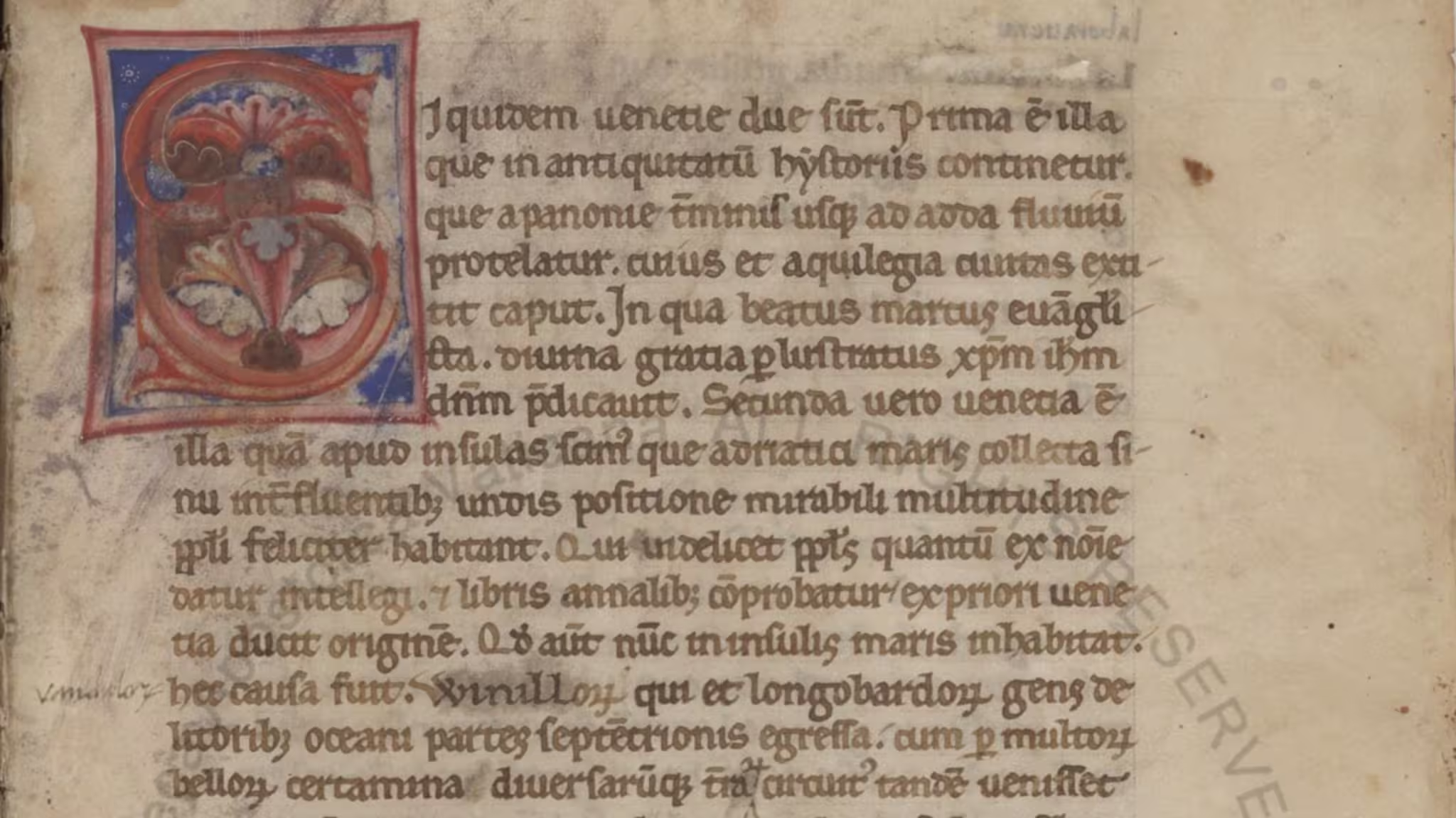
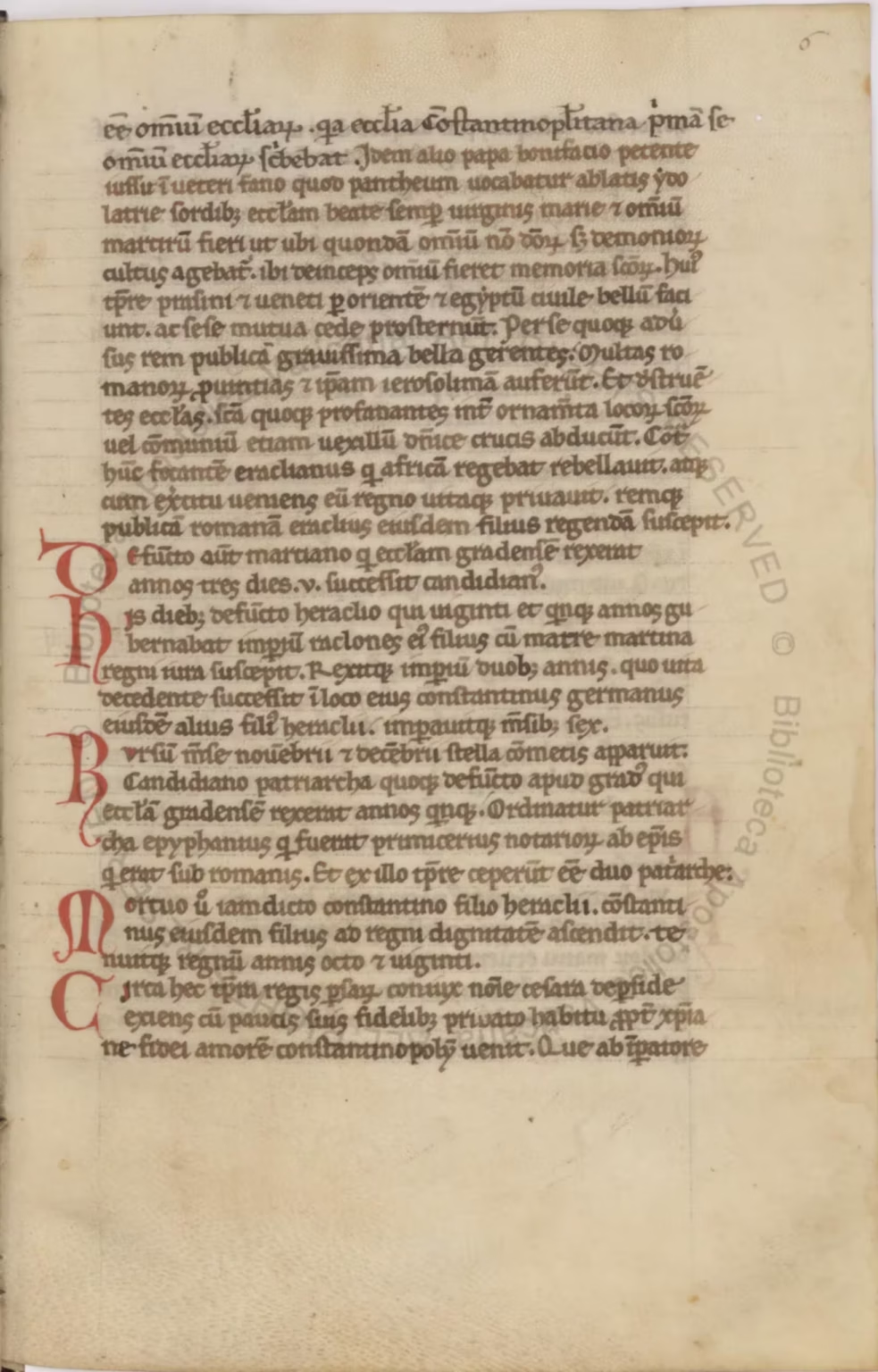
The next manuscript, also in the Vatican (Vat.lat. 5269, 1r–39v), is from the 1200s. It is the oldest copy with a complete text, but it is still two centuries later than Vat.Urb.lat. 440.
The image at the top of this page is the incipit of Istoria Veneticorum from Vat.lat. 5269, foglio 1r.
Finally, the manuscript Marciano Latino X, 141, in the Marciana Library in Venice, is derived from Vat.lat. 5269. It was the one used by most Venetian scholars during the time of the republic.
All other surviving manuscripts are copies of one of these three.
Editions
The first edition of the Istoria Veneticorum is from 1765, published in Venice by Girolamo Francesco Zanetti (Iohannes : Diaconus Venetus (1765)).
The first critical edition is by Giovanni Monticolo, published in 1890, with a commentary in Italian (Monticolo (1890)).
Finally, from 1999, there’s a critical edition with Italian translation and commentary, by Luigi Andrea Berto (Iohannes : Diaconus Venetus et.al. (1999)).
Latin texts are available online, the best being Corpus Corporum based on Iohannes : Diaconus Venetus et.al. (1999).
Related articles
- Early Venice
- Main sources for early Venice
- The Lombard Invasion
- Did Narses invite the Lombards?
- Invasions of Italy in Late Antiquity
- The Historia Langobardorum by Paul the Deacon
- The Chronicon Altinate
- Doges of Venice
- Kings of the Lombards
- Chronology of the Lombard invasion
Venetian Stories
- Episode 27 — Cassiodorus
- Episode 28 — The early sources
- Episode 29 — The Lombard Invasion
- Episode 30 — Venetia Maritima
Related sources
- Pliny the Elder on Venetia
- Liber Pontificalis — John III
- De Administrando Imperio by Constantine VII Porphyrogenitus (c. 950)
- Translatio Marci Evangelistae Venetias (English)
- Translatio Marci Evangelistae Venetias (Latin)
Related images
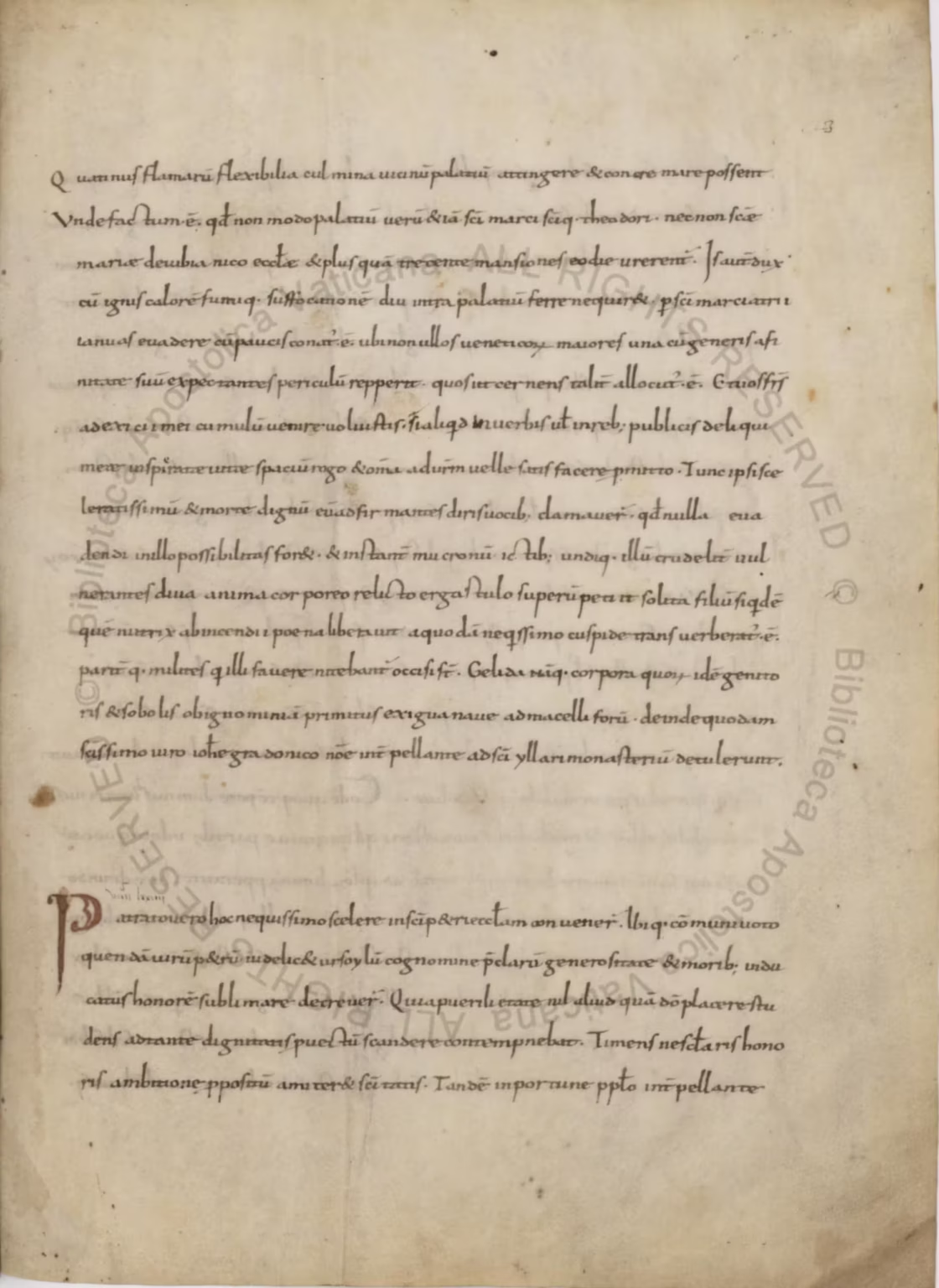
- Urb.lat.440, foglio 23r, Istoria Veneticorum, IV.14
- Vat.lat.5269, foglio 6r, Istoria Veneticorum, II.21–26
Bibliography
- Colombi, Emanuela. Alcune riflessioni sull’Istoria Veneticorum del diacono Giovanni e il prologo della Translatio Marci evangelistae (bhl 5283-5284) in Studi Veneziane N. S. LXIV (2011). Pisa Roma, Fabrizio Serra Editore, 2012. [more]
- Iohannes : Diaconus Venetus. Chronicon Venetum omnium quae circumferuntur vetustissimum et Johanni Sagornino vulgo tributum e mss. codice Apostoli Zeno V. Cl. nunc primum cum mss. codicibus Vaticanis collatum, notisque illustratum in lucem profert H. Fr. Zanetti Al. F. Venetiis, 1765. 🔗
- Iohannes : Diaconus Venetus and Luigi Andrea Berto. Istoria Veneticorum. Bologna Zanichelli, 1999. [more] 🔗
- Monticolo, Giovanni. Cronache veneziane antichissime. Roma, Forzani e C. tipografi del Senato, 1890. [more] 🔗
Leave a Reply