The Translatio Marci Evangelistae Venetias — or Translatio Sancti Marci — by an unknown author, is the earliest description of the translation (movement) of the relics of St Mark from Alexandria in Egypt to Venice in 827–828, by two Venetian merchants.
It also recounts common stories about the origin of Venice, and describes elements of the religious and political order of early Venice, up to the 830s.
More than a dozen medieval manuscripts reproduce the text. It probably dates to the late 900s, but different scholars have suggested a wide range of dates, from the mid-800s to the late 1000s.
This is a translation from the original Latin to English.
Caveat lector!
Unable to find any published translation, online or elsewhere, I have made this translation myself. I am not, however, a Latinist or Medievalist. The translation is based on my high-school Latin, my knowledge of Italian, and of the general historical context, aided by online dictionaries and translators.
Any errors in the translation of the text are exclusively mine. If you have a better translation, or corrections to this, please let me know.
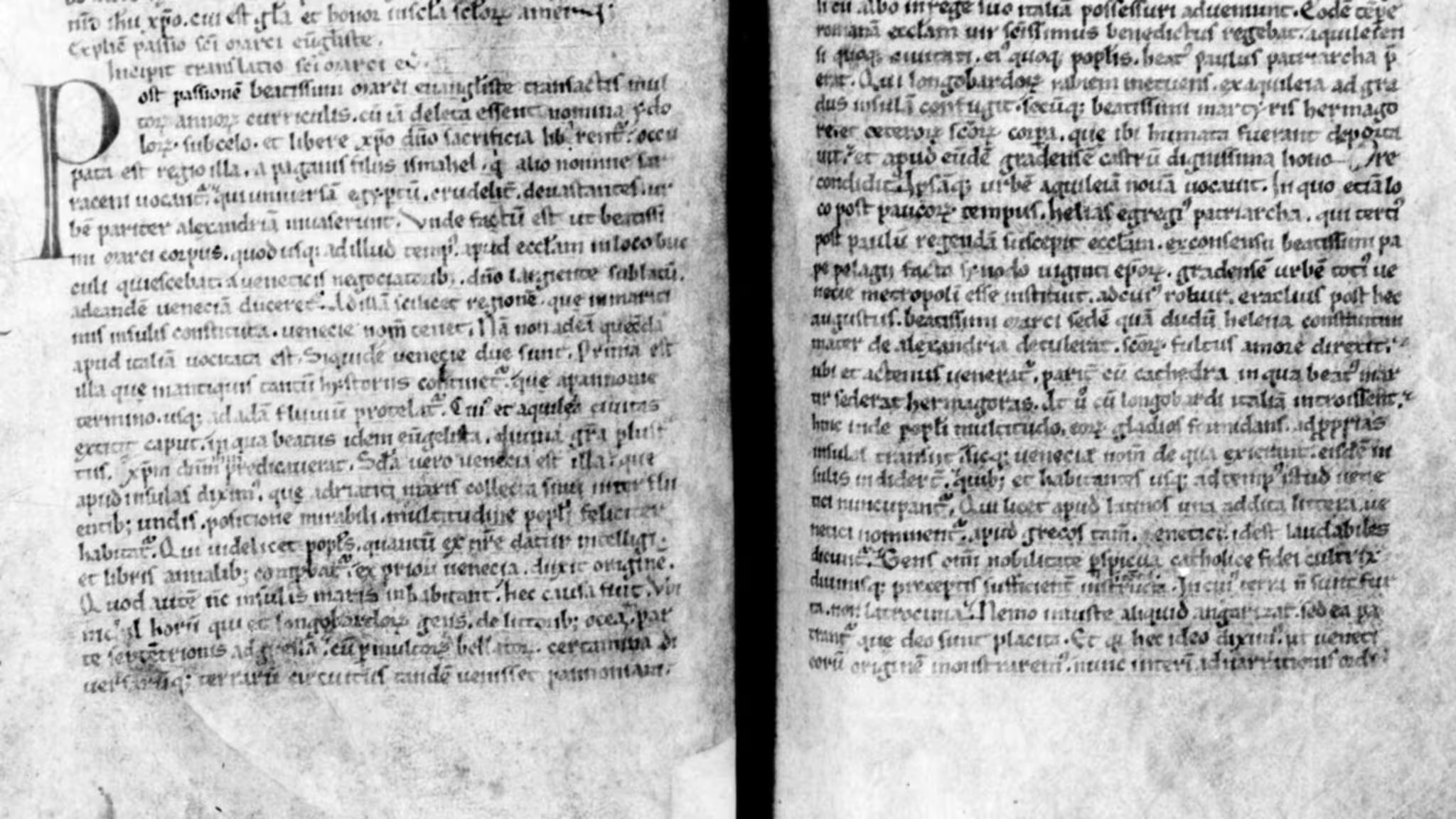
The illustration above of the start of the Translatio Marci Evangelistae Venetias is from Bibliothèque Nationale de France, lat. 12606, ff. 20v-21r — a Life of Saints from the 1100s.
The original Latin text is reproduced here.
The Translation of Mark the Evangelist to Venice
I
- After the passion of the most blessed evangelist Mark, and after the course of many years had passed, when the names of the idols under heaven had already been destroyed and offerings were freely made to Christ the Lord, that region was seized by the pagan sons of Ishmael, who are called Saracens by another name, who, cruelly devastating all of Egypt, invaded the city of Alexandria as well.
- Thus it came about that the body of the most blessed Mark, which until that time had rested at the church in the place called Buculus, was, by the Lord’s grace, taken by Venetian merchants and brought to the same Venetia.
- To that region, of course, which is located on the maritime islands and bears the name of Venetia. For not to that which was once called that near Italy.
II
- Indeed, there are two Venetiae. The first is that which is contained in the histories of antiquity, which extends from the boundary of Pannonia to the river Adda.
- Of which Aquileia also became the capital city, in which the same blessed evangelist, having been traversed by divine grace, had preached Christ Jesus the Lord.
- The second, however, is Venetia, that which we mentioned among the islands, which, gathered in the bay of the Adriatic Sea, positioned amidst flowing waves in a marvellous manner, is happily inhabited by a multitude of people.
- Here, namely, the people, as can be understood from the name and is confirmed by the annalistic books, derive their origin from former Venetia. However, the reason why they now live on the islands of the sea was this.
III
- The Winnili, who are also Longobards, a people who had set out from the shores of the ocean in the northern part, after passing through the struggles of many wars and circuits of diverse lands, finally came to Pannonia, and, not daring to advance further, established a settlement for themselves there as a permanent habitation.
- When it had lived for forty-two years, at the time when the most glorious Augustus Justinian1 was governing the Roman Empire at Constantinople, who sent Narses the patrician,2 a eunuch, to the city of Rome, so that, with God’s help, he might crush the army of Totila,3 king of the Goths, who was devastating Italy.
- Here, when he had first come with the Lombards, he established all kinds of peace, and then proceeding to war against the entire Gothic people, and their king Totila, he destroyed him to the point of annihilation and gained control of all the borders of Italy.
IV
- Here Narses was at first indeed a secretary, then on account of his virtue he deserved the honour of the patriciate.
- He was, moreover, a pious man, a Catholic in religion, generous to the poor, fairly zealous in restoring basilicas, so devoted to vigils and prayers that he achieved victory more through supplications to God than through weapons of war.
- But when he had acquired from the spoils of the nations he had defeated vast riches in gold, silver, and various other things, he incurred the greatest envy from the Romans, for whom he had done much against their enemies.
V
- Here against him, Justin the emperor,4 who had succeeded Justinian in the kingdom, and his wife Sophia,5 suggested in these words, saying that «it would be better for the Romans to serve the Goths rather than the Greeks, where Narses the eunuch rules and oppresses us with servitude, and our most pious prince is unaware of this. Therefore now, either free us from his hand, or certainly, we will hand over both the Roman city and ourselves to the nations».
- And when Narses heard this, he briefly replied with these words: «If I have wronged the Romans, I will meet with misfortune.» Then the emperor became so upset against Narses that he immediately sent the prefect Longinus to Italy to take the place of Narses.
- But Narses, having learned these things, was very much afraid, and he was so greatly terrified by the same august Sophia that he did not dare to return beyond Constantinople. Among other things, she had instructed, on account of the fact that he was a eunuch, that he should have the girls in the courtyard divide skeins of wool with him.
- To these words, Narses is said to have given this reply: that he would weave for him such a cloth as he himself could not lay down while alive. Therefore, driven by hatred and fear, he withdrew to the city of Naples in Campania and soon sent envoys to the people of the Lombards, ordering them to leave the impoverished land of Pannonia and come to Italy, filled with riches, to take possession of it; and at the same time he sent many kinds of fruits and other items with which Italy is fertile so that he might entice their spirits to come.6 The Lombards gladly received the good news and what they themselves preferred, and lifted their spirits with thoughts of future benefits, and having set out, they arrived, to possess Italy, with their king Alboin.7
VI
- At the same time, the Roman Church was governed by the most holy Pope Benedict,8 and the blessed patriarch Paul9 presided over the city of Aquileia and its people.
- Fearing the rage of the Lombards, he fled from Aquileia to the island of Grado and carried with him the bodies of the most blessed martyr Hermagorus10 and the other saints, which had been buried there, and he laid them in the same fortress of Grado with the greatest honour, and he called the city itself New Aquileia.
- In which place, after a short time, Elijah,11 the distinguished patriarch, who after Paul took charge of governing the church as the third, by the consent of the most blessed Pope Pelagius,12 having held a synod of twenty bishops, established that the same city of Grado should be the metropolis of all Venetia.
- To whose strength Heraclius,13 after these events, directed the seat of the most blessed Mark, which long ago Helena, mother of Constantine, had brought from Alexandria, supported by the love of the saints, where he is still venerated together with the chair in which the blessed martyr Hermagoras had sat.
VII
- But indeed, when the Lombards had entered Italy, a multitude of people here and there, fearing their swords, crossed over to the nearby islands. And thus they gave the name Venetia, from which they had come, to those same islands, whose inhabitants are even to this time called Venetians.
- Here, although among the Latins one additional letter is allowed, they are called Venetici, among the Greeks, however, they are called praiseworthy Enetici.14 A people remarkable for all nobility, cultivators of the Catholic faith, and sufficiently attentive to divine precepts, in whose land there are no thefts, no robberies, no one wrongfully oppresses anyone, but they practice what is pleasing to God.
- But we said this for the purpose of showing the origin of the Veneti; now, however, let us return to the order of the narrative.
VIII
- Therefore, when the Saracens had invaded all of Egypt and Alexandria, Leo, having then obtained the Roman Empire, ordered throughout the various parts of his empire that no one at all should proceed to the land of Egypt for business purposes.
- Whose order, namely, while being spread everywhere and brought also to the Venetians, Giustinian,15 who at that time was the duke of the Venetians, confirming the decrees of his emperor, fully commanded them to do the same.
- But when, as was customary among the Venetians, they often explored places of trade, some of them, with their ships loaded, wanted to cross the sea and were sailing through the depths of the ocean, it happened by divine will that, with a favourable wind blowing, what they did not dare to do of their own accord because of the commands of their leaders, they were led to Alexandria as if unwillingly.
IX
- In those days, however, a prince of the wicked people of the Saracens, while he wished to build a palace for himself near the city, which is called Babylon from the name of the ancient city, commanded contrary to God that wherever in the land of Egypt marble columns or slabs were found, whether in churches or in common buildings, they be brought to him for the splendour of the structure he was preparing. Hence, it happened that, the decree of impiety having been given, even stones were taken from the churches of Alexandria.
- And while the Venetians were engaged in business at the same city and remained there for some time, they made it their custom to visit the body of Saint Mark daily with prayers, and through gifts or offerings to seek him as an intercessor for their own sins. For the place itself was nearby.
- Among the Venetians, the ships which had arrived guided by God were ten, in which were all equally noble men, among whom were the most distinguished Bonus, tribune of Metamauco,16 and Rusticus of Torcello.17
- While they were observing that there was a certain familiarity for themselves during the usual daily prayers with the guards of the Church of Blessed Mark, one day seeing them sad, at first indeed they began to share their feelings and sympathize with them over the order of the Saracen ruler, who had commanded that the marble tablets or columns be removed. For the guards were also sad for this reason, because they feared that the servants of that impious ruler would do to the Church of Blessed Mark what they were doing to other places.
X
- Then indeed, in the same words of compassion, inspired by the Lord, Bonus and Rusticus said: “Why are you so sorrowful, servants of Christ? Why is your spirit more afflicted than usual? Behold, we see that the persecution of the impious rulers is even hostile to the most sacred places. This generates a grief of great sorrow not only for you but for all who believe in Christ. But what can we do against these things? Since the Lord himself foretold to his faithful that countless persecutions would come. Therefore, if you can keep it a secret or if you would welcome our counsel, we would certainly encourage you to do that, by which you would both be safe from this perfidious people and live in the highest honours.”
- There were indeed two guards with whom they were speaking, one of whom was a monk named Stauratius, while the other, Theodore, held the office of priesthood. Moreover, there were other guards of the same church, but these stood out more than the others.
- And because both were of Greek origin, Theodore the presbyter, following the teaching of the blessed Apostle Paul, had a wife and children, whom the aforementioned tribune Bonus had also made his companion, for this very reason: so that the words he urged might more easily find entrance into his ears.
- Therefore both Stauratius, of course, and Theodorus responded and said: «It will be a secret in our hearts, just say what you want. And if we deem it most agreeable, we will certainly do it.» They said: «Take up the body of blessed Mark and, ascending secretly on the ship, come with us to our land.»
- And they, taking it harshly at first, said: «What is it that you are saying? Do you perhaps seek to bring death upon us over the distress we are in? For who among us even dares to think of doing this great thing and handing over that most revered body, which is honoured throughout the land of Egypt, to foreign men?
- And perhaps it remains unknown to you how the blessed Mark preached the gospel, which he had written at the command of Peter and also by his own order, in this province, and how he made the citizens of Alexandria, who served idols, the adopted children of Christ Jesus our Lord through the font of baptism?
- Therefore, and rightly so, as indeed the most holy father is revered by all, and how could it happen that anyone would dare to deprive the city of Alexandria, which is so famous throughout the world because of him, of its patron? But if we were to act boldly against our own soul, this could by no means escape the notice of the people, and then, being seized, we would be killed by the penalties of many kinds and would be a disgrace to all flesh.»
XI
- Bonus and Rusticus said: «If we are to discuss his preaching, we know that he first led the city of Aquileia in Italy to the faith, which is located in that province which from ancient times has been called Venetia, from which we originate.
- Therefore we are the firstborn sons of him, who were first born of him through the gospel. Hence, it can also be believed that he rejoices, even after death, to visit his children whom he had left to acquire elsewhere, and perhaps, as we hope, for this reason, the Lord has led us here as if invited so that he may restore to us the same most holy father of ours. For certainly we wished to go to another region.»
- Stauratius and Theodorus said: «It is enough for you that you have his seat. But you are asking for a difficult matter. For who knows if what are you saying pleases the Lord? Or who will be able to say that blessed Mark will allow his body to be touched? Therefore, cease now to say such things, which you know cannot in any way happen. And yet, if it could happen, what would be done about us?
- If we were to stay here in person, we would be killed by the common people with various punishments. But if, on the other hand, we were to ascend into the ship with you, we would surely be led as captives to a land that we do not know. Therefore, it is far better for us to remain here and endure persecution than to be subjected again to new difficulties. For the Lord also says: ‘Blessed are those who suffer persecution for righteousness’ sake,’ and again: ‘He who perseveres to the end will be saved’.
- Bonus and Rusticus said: «What you say is true. But, yet in another place, the Lord also says: ‘When they persecute you in one city, flee to another.’ Which admonition many of the saints followed, and even as we have heard, this most blessed Mark fulfilled when, in the midst of fervent persecution, he left Alexandria and retired to the Pentapolis.18 Wherefore, since we believe that this pleases the Almighty God and the blessed evangelist himself, let no human fear terrify you, since where God is a helper, human rashness can do nothing.»
- Stauratius and Theodorus said: «This rashness, although it is distressing for us because of the stones of the church that are being removed, can still be endured because these pagans will not inflict any harm on our members.»
XII
- Having heard these things and similar ones spoken secretly by them for several days, Stauratius and Theodorus, finally with divine grace inspiring them, conceived in their minds what they had heard with their words.
- And when they had separated from each other, behold, it was reported to Stauratio and Theodore that the servants of that pagan ruler, whom we mentioned, had cruelly flogged one of the keepers of a certain church. For indeed, there had been in the same church a marble slab of too great value, and the keeper, fearing that it might be taken by the Saracens, went and broke it in the place where it stood. When the ruler’s servants learned this, they seized the keeper and condemned him to flogging.
- Therefore, Stauratius and Theodorus, hearing this and terrified with fear, sent for and called Bonus the tribune and Rusticus and said: «We have discussed among ourselves the matter you requested, and although we do not know whether it will please the Lord, nevertheless it has entered our hearts that we should carry out that most holy body and go out with you. Now, therefore, we want to know what will happen to us when, coming to your province, we have brought such a great treasure.»
- Bonus and Rusticus said: «With God’s help, once we have reached there, life being our companion, we will lead you to our lord Justinian, the distinguished leader, a man illustrious and a lover of the saints. When this is announced to him, he will immediately, rejoicing in his mind, receive the venerable body and, building a church, will dedicate you with honour, and you will be in his eyes, beyond what can be believed, beloved and foremost in the order of priests, just as you were here in the order of ministers.»
The guards said, «How can we trust you?» Bon and Rusticus said, «The Lord be a witness.»
XIII
- Then they set the day on which they would receive the most holy body. And when the appointed day came, the forementioned guardians went and secretly opened the tomb, which was made of marble, having, as it were, grooves along the sides in the manner of a little box, through which a slab on top had been inserted. The blessed body lay surrounded on all sides by a silk cloak and was placed supine, having seals placed from head to foot in the places where the edges of the cloak met on top.
- And since they did not know what to do, they finally came up with a main plan. Therefore, turning the body, they cut the cloak from its back, so that the marks that had been there remained intact. And bringing the body of Blessed Claudia, which had been buried nearby, they placed it in the location of Blessed Mark, similarly lying supine and surrounding it with the cloak, they also imprinted the marks on the chest so that, if by chance someone were to say that the body of Blessed Mark had been stolen, the cloak and the marks that remained there would show that it was not true.
- Therefore, so much fragrance of odour emanated from the lifted body that not only the church or its surroundings, but even the whole city of Alexandria was filled. The moved Christian citizens, of course, as well as the pagans, said: «What is this?». Others said: «We do not know». Yet others said: «Let us see – they say – lest perhaps the blessed Mark’s body be stolen by those Venetian sailors».
- Therefore, those who had gathered from the city arrived at the same church and, opening the sarcophagus, saw the body of Blessed Claudia wrapped in a cloak and uninjured. When they saw this, believing that the body of Blessed Mark lay there, once the commotion had subsided, they returned to their homes.
- The Venetians, of whom we have often already made mention, when they were lying in ambush there, carried the body and, placing it in a basket, covered it with vegetable leaves, namely those of cabbage and others, and on top they placed pork meat.
XIV
- And as they were walking to the ship, the Saracens whom they met came up to see what they were carrying. But when they saw the pork, which they themselves abhor, they shouted, saying: «Halkanzir, halkanzir!», that is, «Pig, pig!», and, spitting, they moved away.
- But indeed, they, having crossed, came to the rock which was near the sea, and lowering a basket with ropes, they sent it down into the boat and brought it to the ship. When they had entered, they, taking out the blessed body from the basket, hid it in the sails of the ship: for they feared that if the ship were searched, it would be found by the Alexandrians.
- And when the day of their departure had come, the monk Stauratius secretly went up with them. But the presbyter Theodorus, fearing the crowd that was standing on the shore, remained there, having already placed his belongings on the ship.
- There was also a certain monk there, named Dominic, of Comacchio, who, sustained by divine love, had at the same time been in Jerusalem and was returning after completing his prayer, and who himself also ascended with them. Therefore, when they departed from Alexandria, the Venetians carried the holy body on the sails in which they had hidden it and placed it most worthily under the ship’s sun-deck, lighting lamps and continually offering incense. Indeed, the monk Dominic, together with Stauratius, was continually engaged in long-lasting services.
- Among these signs, the Lord worked through him while he was being brought. For on a certain day, while all those Venetian ships were sailing together and the others did not know the reason, the sailors of Saint Mark said to some who were on another ship: «Do you not know what has happened?» They said: «What?» They said to them: «Truly, we are carrying the body of Saint Mark.» But they said: «And how could that be?» And when they explained the sequence of events, one of them, mocking, said: «Perhaps the body of some Egyptian has been given to you, and you say that we are carrying Saint Mark?»
- And when he had said this, that ship in which the blessed body lay immediately turned with such speed as no man could turn, rose up against the one in which that man was, and broke a part of its side, nor did it withdraw from it until all acknowledged that the blessed Mark lay there.
XV
- Then, when one night a storm arose and those ships were being driven at great speed and the sailors did not know where they were heading because of the darkness of the night, Blessed Mark appeared in a dream to Dominic the monk, saying: «Rise and tell these men to take down the sails quickly so that they do not suffer shipwreck because the land is not far away».
- When the monk had said this upon rising, immediately, with the sails lowered, as the dawn was already approaching twilight, behold, a certain island appeared, named Strofades, which the most blessed Mark had foretold would be near. Then all together, giving their trust, began to venerate his most reverend body with greater diligence, being made believers and rejoicing together that they had been worthy to first have the evangelist.
- Yet it was hidden among them, and they had decided that no one from any region at all should know of this matter: for they feared that the blessed body might be forcibly taken away by someone.
- But because the Lord willed that the light of His lamp should shine so much before many men, among those dwelling near the sea who entirely did not know the cause, He deigned to reveal that the shining limbs of His martyr rested within the ship.
- Here, coming from various places, while the ship approached the ports or shores of the regions, they were asking, saying: «It has been revealed to us by the Lord that you have the body of the blessed evangelist Mark, therefore, in divine love, we pray that you allow us to pray to him.» Then, when they entered, having offered prayers to the Lord and laid down gifts, they returned with fear, giving glory to God and saying to the Venetians: «O how blessed you are, who have deserved to have such a saint!».
- But when, as most fools are accustomed to doubting such matters for a long time, some of the sailors, not claiming it to be Blessed Mark but to be able to carry the body of anyone else, the almighty God, wishing to rebuke his hardness and make him immediately gullible, promptly condemned him with a fitting sentence.
- For that man, seized by a demon, was tormented for so long until, brought to the holy body, foaming and grinding his teeth, he confessed that the blessed Mark lay there and offered a gift for his sins. Immediately, freed from the demon, he both gave glory to God and declared that he would no longer doubt anything about the sacred body.
XVI
- Indeed because there are many things said about the virtues performed by him through the Lord, let us explain how he came to Venetia. Therefore, when the sailors had arrived at Istria, they turned aside to a certain city called Umag; for they were afraid to return to their own because Justinian, their leader, was extremely angry with them, on account of the fact that, rejecting the emperor’s command and his own, they had presumed to go to Alexandria.
- However, when they sent to him a mission, they said: «We confess our sin and are ashamed because we have been found as if rebellious, but the Lord is witness that we did this more unwillingly than willingly. Yet behold, we have the body of Blessed Mark the Evangelist. If our Lord, granting us grace, promises not to bring harm either to bodies or to possessions, we bring it to him. But if not, we will turn aside to another region.»
- To this, Duke Justinian, greatly pleased, said: «If what they claim is true, let them return in peace because if they bring such a treasure, I will not only do them no harm, but I will also call my sons to them». Therefore, the sailors having received the word, they returned to Venetia.
- And when they had arrived at the port of Olivolo, Orso,19 the bishop of that place, having come out with the crosses and all the orders of ministers, clothed in priestly tunics, met the most reverent body and, receiving it, led it to the duke’s palace, where, while they were ascending the stair of the hall, the pallium with which the body was covered moved with such swiftness, as soon as there was calm, that hardly even a breeze of wind could stir it. But for the ministers who were carrying it, it at once became of the heaviest and immovable weight, and again suddenly so light that they said they felt nothing at all.
- Therefore I accept it in body; the duke placed it in the room of the cenacle which is near his palace up to the present time, showed it with singers and ministers arranged there to offer praises to God, among whom that guardian Stauratius was the first. But also the presbyter Theodorus came the following year with his companions, and furthermore that monk Dominic returned to his own affairs.
- But indeed, Duke Giustinian, when he wished to build a church over the blessed body, was prevented by death. His brother Giovanni,20 a man beloved by God, taking up the duchy, fulfilled it in his place. For he built a basilica of most elegant form next to the palace, to resemble the tomb of the Lord which he had seen in Jerusalem, which he also ordered to be painted with many and varied colours, where he placed the most venerable body with the most fitting honour.
- In which the prayers of himself flourish, and many benefits are granted to Christians, and most of all, many are freed from demons.
- Whose glorious translation is celebrated on the day before the Kalends of February,21 and the dedication of his basilica is observed on the second day of the month of January, with our Lord Jesus Christ reigning, to whom be honour and glory forever and ever. Amen.
Notes
- The Byzantine emperor Justinian I (482–565) initiated the reconquest of Italy to the empire, which made Venetia a Byzantine province under the Exarchate of Ravenna. ↩︎
- Narses (c. 478–573) was a Byzantine general, who led the imperial forces in parts of the Gothic Wars in Italy in the 500s. ↩︎
- Totila was King of the Ostrogoths during later part the Gothic wars, when he reconquered must of what the empire had taken under Belisarius. He died in battle in 552 against Narses. ↩︎
- Justin II was Eastern Roman Emperor 565–578, during whose reign the Lombards invaded Italy. ↩︎
- Sophia (c. 530–c. 601) was wife of emperor Justin II, and regent during his period of incapacity. ↩︎
- The story that Narses invited the Lombards to invade Italy because he fell out of favour with Justin II and Sophia, is often told, but the narrative is contradicted by other sources. ↩︎
- Alboin (530s–572) was king of the Lombards from about 560 until 572, and led the first Lombard invasion of Italy in 568. ↩︎
- Benedict I was the 62nd Pope in Rome, from 575 to 579. ↩︎
- Paulinus I was Patriarch of Aquileia 557–569, and moved the seat of the patriarchate to Grado following the Lombard invasion in 568. ↩︎
- Hermagoras of Aquileia was the first archbishop of Aquileia, according to legend chosen by St Mark, and invested by St Peter in Rome. ↩︎
- Elias was Patriarch of Aquileia 571–586. ↩︎
- Pelagius II was the 63rd Pope of Rome, from 579 to 590. ↩︎
- Heraclius (c.575–641) was Eastern Roman emperor from 610 to 641. The lagoon city of Eraclea was named after him. ↩︎
- The Greek word Αινετοι, which means laudable or the praiseworthy, was in Antiquity thought to be the origin of the name of the Veneti people and Venetia itself, which is why the words laudable or praiseworthy are often associated with Venice. ↩︎
- Giustinian Partecipazio was the 11th doge of Venice, ruling 827-829. ↩︎
- Malamocco (or Metamauco) was capital of the Venetian proto-state for parts of the 700s, possibly located on the Lido di Venezia. ↩︎
- Torcello was one of the first settlements in the lagoon, inhabited by people from the Roman town of Altino on the mainland, already in the late 500s or early 600s. In the early Middle Ages, Torcella was larger then Venice. ↩︎
- The Duchy of the Pentapolis was a Byzantine province, under the Exarchate of Ravenna, located south of Ravenna. The five cities were Rimini, Pesaro, Fano, Senigaglia and Ancona. ↩︎
- Orso Partecipazio was the 5th Bishop of Olivolo, and son of doge Giovanni Partecipazio. ↩︎
- Giovanni Partecipazio was the 12th doge of Venice, succeding his father Giustinian Partecipazio, ruling 829-836. ↩︎
- In the Roman calendar, kalendae means the first day of a month, so February 1st. ↩︎
Bibliography
- Colombi, Emanuela (ed. comm.). Translatio Marci Evangelistae Venetias [BHL 5283-5284] in Hagiographica, 17, p. 73-129. 2010. [more] 🔗
- Colombi, Emanuela. Alcune riflessioni sull’Istoria Veneticorum del diacono Giovanni e il prologo della Translatio Marci evangelistae (bhl 5283-5284) in Studi Veneziane N. S. LXIV (2011). Pisa Roma, Fabrizio Serra Editore, 2012. [more]
- McCleary, Nelson. Note storiche ed archeologiche sul testo della « Translatio sancti Marci » in Memorie storiche forogiuliesi, 27-29. 1931-1933. 🔗
Leave a Reply