
The offices of Rason Vecchie e Nuovo were from 1368 auditors of many other offices of the republic, and accountants of the central offices of state.
The word rason can best be translated as Accountancy or Accountant’s Office. It is a cognate of the Italian ragioneria, which means bookkeeping.
It was one of the most important offices of the Republic of Venice.
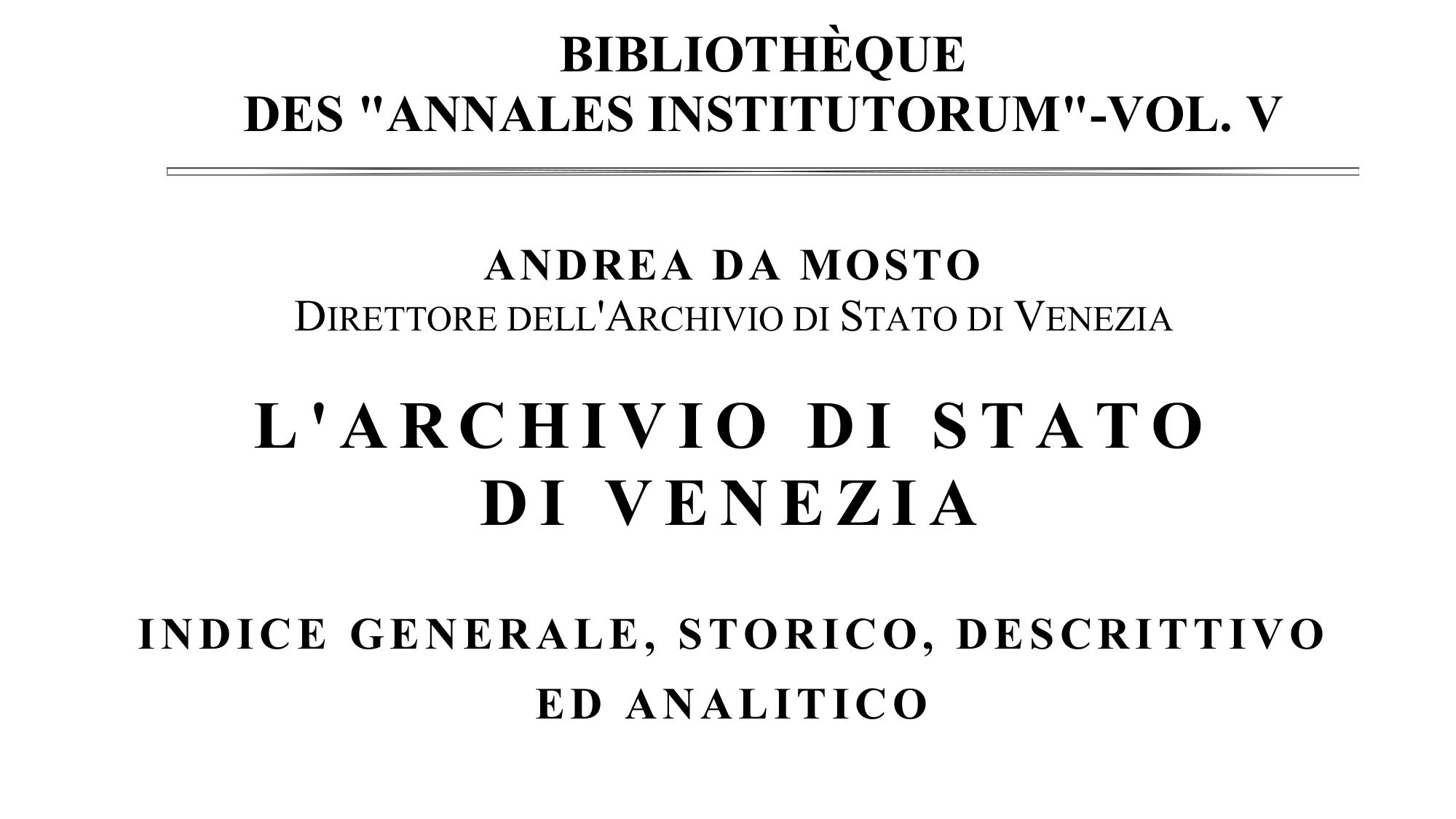
The L’Archivio di Stato di Venezia: indice generale, storico, descrittivo ed analitico by Andrea Da Mosto was published in 1937. Besides being a general index of the holdings of Venetian documents in the state archive, it contains short historical descriptions of most Venetian offices and magistracies.
Andrea Da Mosto (1868-1960) was director of the Archivio di Stato di Venezia (1936-1937).
Officials of the Old and New Accountancy
The Officials of the Old Accountancy and the Officials of the New Accountancy were two magistracies closely connected with each other and, undoubtedly, among the most important in the Republic.
The first to be established were — as the name itself suggests — the Officials of the Old Accountancy. Like many Venetian magistracies, it was, in 1368, created on an extraordinary basis by the Senate,1 with the purpose of reviewing the accounts of the governors of Treviso, Mestre, Noale, Castelfranco, Asolo, and other territories. It became permanent in 1375 through another decree of the same Senate. In that same year, its jurisdiction was extended to all Venetian governors, the following year to Ambassadors, and in 1381 it was also entrusted with the oversight of certain duties and the leases of public fisheries.
In 1385, the Great Council2 granted it the right to collect from all the state’s debtors; years later it also gained the power to audit the accounts of the Officials of the Levant, and of the Rectors of Istria and the Dogado, and finally in 1394 the essential task of noting those Magistrates who failed or neglected to attend the offices to which they were assigned. These notes were called appuntature.
But even for this magistracy, the large number of cases forced an increase in members and a split of the body into two others, the Old Accountancy and the New Accountancy. In 1395, in fact, the number of Officials was increased from four to six; each of the two new bodies was composed of three members.
In the same establishing decree, the functions that had gradually been assigned to the old magistracy were reaffirmed. But the evolution of the body was not yet complete; in 1401 it was entrusted with the auditing of the accounts of the Rectors of Candia, and in 1409 with that of the Rectors of all Dalmatia; and in the following years, it oversaw the financial administration of the Rectors of Albania and the Morea, of the Consuls and Vice-Consuls of Syria and Aleppo, and also that of the contracts and journeys to Flanders and Cyprus.
It is most interesting to note that in 1413, both the Old Accountancy and the New Accountancy were granted criminal jurisdiction over the embezzlement of public funds committed by State officials; and, finally, in 1433, they were authorised to give gifts and cover hospitality expenses for foreign dignitaries. Already by 1410, they had gained entry into the Council of the Pregadi with the right to vote.
Translator’s notes
- The Pregadi was the Senate of the Republic of Venice, and one of the most important institutions of the republic. ↩︎
- The Maggior Consiglio was the sovereign body of the Republic of Venice, where all noblemen aged twenty-five or more participated. ↩︎
Original text
Officiali alle Rason Vecchie e Rason Nuove
Gli Officiali alle Rason vecchie, e gli Officiali alle Rason nuove furono due magistrature intimamente collegate, fra loro e, senza dubbio, tra le più importanti della Repubblica.
Primi a sorgere furono — come lo dice lo stesso nome — gli Officiali alle Rason vecchie. Come molte magistrature veneziane la troviamo, nel 1368, istituita in via straordinaria dal Senato, con lo scopo di rivedere i conti dei Rettori del Trevisano, Mestre, Noale, Castelfranco, Asolo ed altre terre. Divenne stabile, nel 1375, con altro decreto dello stesso Senato. In questo stesso anno la sua competenza fu estesa a tutti i Rettori veneziani, nell’anno successivo agli Ambasciatori e, nel 1381, fu ad esso anche affidata la vigilanza su alcuni dazi e le locazioni delle pesche pubbliche.
Nel 1385, il Maggior Consiglio gli diè diritto di esazione da tutti i debitori dello Stato; anni dopo ottenne pure la revisione dei conti degli Ufficiali del Levante, e dei Rettori dell’Istria e del Dogado, e infine nel 1394 l’importantissima mansione di notare quei Magistrati che mancassero o trascurassero di intervenire agli offici a cui erano preposti. Le quali note venivano chiamate appuntature.
Ma anche per questa magistratura il numero grande di affari costrinse, ad un aumento dei membri e ad uno sdoppiamento dell’organo in due altri, delle Rason vecchie e delle Rason nove. Nel 1395 infatti si portò il numero degli Officiali da quattro a sei; ed ognuno dei due nuovi organismi fu composto di tre membri.
Nello stesso decreto di istituzione vengono riaffermate le funzioni che si erano, man mano, attribuite alla vecchia magistratura. Ma l’evoluzione dell’organo non era ancora compiuta; nel 1401 furono ad esse affidate la revisione dei conti dei Rettori di Candia e, nel 1409, quella dei Rettori di tutta la Dalmazia; e negli anni successivi la vigilanza sull’amministrazione finanziaria dei Rettori dell’Albania e della Morea dei Consoli e Vice Consoli di Siria e di Aleppo, e inoltre quella sui cottimi e i viaggi di Fiandra e Cipro.
E’ assai interessante notare, che nel 1413, sia alle Rason vecchie che alle Rason nuove, fu attribuita giurisdizione criminale sulle sottrazioni di pubblico denaro, commesse dagli Ufficiali dello Stato; e, infine, nel 1433, ebbero facoltà di far donativi e le spese di ospitalità a potentati stranieri. Già dal 1410 avevano avuto ingresso nel Consiglio dei Pregadi con diritto di voto.
Related articles
- State institutions of the Republic of Venice
- Chronology of major Venetian state institutions
- The Maggior Consiglio
- Giovedi Grasso
Leave a Reply